

What if the fragility of your organization isn't a failure of your business continuity plan, but a reflection of the unconscious psychological scripts running beneath the surface? As of early 2026, nearly 75% of business executives report that geopolitical upheaval is actively destabilizing their operations; yet, many find that traditional crisis management fails to address the root cause of systemic collapse. You've likely noticed that even the most robust plans can't save a culture where chronic burnout has become the baseline. Developing organizational resilience requires more than just updating your ISO 22316 documentation. It demands a shift from reactive survival to a state of conscious, systemic evolution.
We understand the exhaustion that comes when change initiatives repeatedly stall and high-stakes pressure triggers regressive behaviors across leadership teams. This article explores how to move beyond surface-level fixes by applying the art and science of Transactional Analysis to your business structure. You'll discover a framework for maintaining Adult ego states during disruption, ensuring that your organization doesn't just bounce back, but grows into a more complete version of itself. We'll examine how building a resilience by design culture creates the long-term agility necessary to thrive in an era of constant transformation.
Key Takeaways
- Reframe your perspective on resilience as a systemic capacity for continuous evolution rather than a mechanical process of recovery.
- Identify how "Parent" and "Child" ego states within your hierarchy can inadvertently foster rigid cultures or collective fragility.
- Learn to recognize the psychological habit of "discounting" to ensure your team stops ignoring critical issues before they escalate into crises.
- Establish a practical foundation for developing organizational resilience by cultivating the leadership capacity to remain in an "Adult" state under pressure.
- Understand why profound cultural transformation requires the sustained depth of team coaching and supervision over the temporary energy of one-off workshops.
Beyond Bouncing Back: Redefining Organizational Resilience in 2026
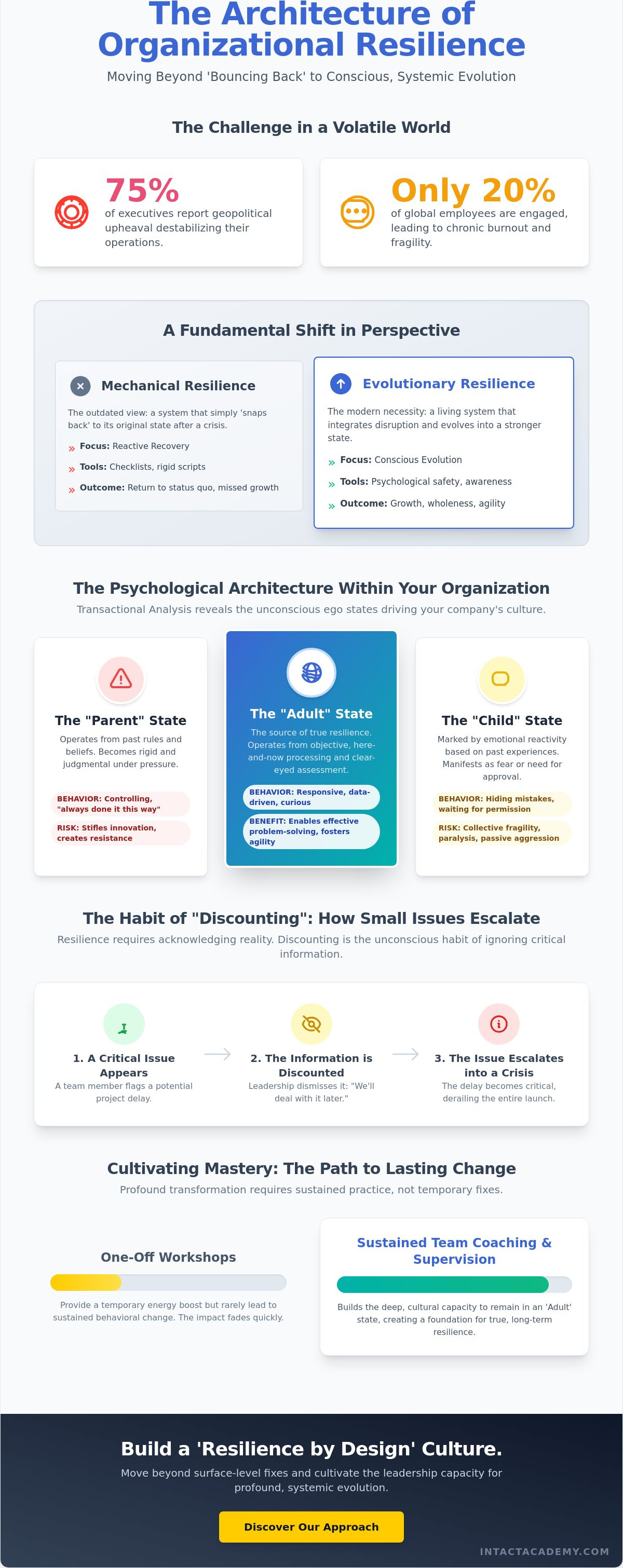
We often think of resilience as a spring that snaps back to its original shape after being stretched. In a mechanical world, this definition suffices. But organizations are living systems, not machines. For a human system, "snapping back" is often a missed opportunity for growth. True resilience is the capacity to integrate disruption and emerge as something more evolved. This is the heart of developing organizational resilience; it is a movement toward wholeness rather than a desperate return to the status quo.
Traditional risk management focuses on checklists, redundancies, and documented routines. While these are necessary for operational continuity, they are insufficient because they ignore the human element. When we look at What is Organizational Resilience?, we see it isn't just about business continuity plans. It's about how the collective psyche handles pressure. Mechanical resilience relies on rigid scripts. Organic resilience relies on the health of the system's relationships and its ability to remain present during a crisis.
The Shift from Reactive to Evolutionary Resilience
The 2026 landscape is defined by what we might call a state of permanent volatility. With global employee engagement at a low of 20% and geopolitical upheavals affecting nearly 75% of executives, survival is no longer a high enough bar. We must move toward evolutionary resilience. This process requires a foundation of psychological safety. Without it, individuals retreat into defensive postures that stifle innovation. Resilience isn't a policy document tucked away in a digital folder. It's a lived experience, felt in the way a team speaks to one another during a high-stakes meeting.
Transactional Analysis: The Missing Piece of the Resilience Puzzle
To understand these lived experiences, we need a sophisticated map of human behavior. Understanding what is transactional analysis offers exactly that. Transactional Analysis (TA) is a social psychology that examines the "transactions" between people to understand internal ego states. In an organizational context, it allows us to see the unseen. It reveals why a team might suddenly stop communicating or why a leader might become overly controlling under stress. By mapping these behaviors, we can move the entire system toward a more robust, Adult-centered response. This methodology is the foundation for developing organizational resilience in a way that is both profound and permanent.
The Psychological Architecture: Ego States and Organizational Scripts
Organizations function through a collective psyche. To master the art of developing organizational resilience, we must look at the three primary ego states: Parent, Adult, and Child. In a hierarchy, these aren't just individual traits; they become cultural anchors. When a system operates from a "Parent" state, it becomes rigid and judgmental, relying on "how we've always done things" even when those ways no longer work. Conversely, a "Child" state culture is marked by emotional reactivity, fear of authority, or a desperate need for approval. These states often operate unconsciously, pulling the organization away from the present reality.
The "Adult" ego state is where true resilience lives. It is the only state capable of objective, here-and-now processing. While Parent and Child states are rooted in the past, the Adult state allows for the clear-eyed assessment of current reality. According to 4 Best Practices From Our Research, building this objective capacity is essential for surviving modern turbulence. In this state, leaders don't react to a crisis; they respond to it. They see challenges as data points rather than personal threats or moral failures.
Identifying Fragile Ego State Patterns
During a crisis, look for the "Adaptive Child" in your teams. This manifests as employees waiting for permission to act or hiding mistakes for fear of reprimand. This is often a defensive response to "Critical Parent" leadership, where executives use blame to manage market volatility. To break this cycle, leaders can establish a "Contract for Change." This professional agreement shifts the transaction back to an Adult-Adult level, where shared accountability replaces fear. If you are seeking to deepen these skills, our coaching academies provide the structured methodology needed for this profound human transformation.
Rewriting the Organizational Script
Every organization follows a script, an unconscious life plan created in the early days of its founding. Some follow a "failure script," where success is followed by self-sabotage. Others operate under a "perfectionist script" that leads to chronic burnout. By leading organizational change through a psychological lens, we can facilitate a "re-decision." This isn't just a strategy shift; it's a systemic choice to move toward an "autonomy script." In this new narrative, the organization recognizes its power to evolve beyond historical limitations, making developing organizational resilience a natural outcome of systemic health.
Systemic Fragility vs. Robustness: Analyzing Cultural Scripts
Fragility in an organization is rarely the result of a single catastrophic event. Instead, it is the cumulative effect of avoidance. When a culture is built on the suppression of reality, it becomes brittle, cracking under the weight of high-stakes pressure. Robustness, conversely, is the systemic capacity to hold the truth. It is the ability of a team to look at uncomfortable data without retreating into defensive ego states. This distinction is central to developing organizational resilience; we are not just building better plans, we are building a higher tolerance for reality.
A team's "Resilience Quotient" can be measured by the quality of its transactional patterns. In robust systems, transactions are predominantly Adult-to-Adult, characterized by an open exchange of information and shared responsibility. In fragile systems, energy is diverted into maintaining facades. When we analyze these patterns, we see that resilience is not a static trait but a dynamic state of health. It is the difference between an organization that hides its scars and one that uses them to map a more sophisticated path forward.
The Cost of Discounting Reality
In Transactional Analysis, "discounting" is the internal mechanism where we ignore aspects of ourselves, others, or the situation. Organizations do this at four distinct levels. First is the existence of the problem; for example, the 24% of organizations that never test their business continuity plans are often discounting the very existence of risk. Second is the significance, where a threat is acknowledged but its impact is minimized. Third is changeability, the belief that "this is just how the industry is." Finally, there is the discount of personal ability, where teams believe they lack the agency to act. Developing organizational resilience requires leaders to identify these discounts. If 50% of leaders report having no formal strategy for critical events as of late 2025, they aren't just failing at planning; they're stuck in a systemic discount of significance.
Breaking the Cycle of Workplace Games
Workplace "Games" are repetitive, unconscious patterns of interaction that end in a predictable "payoff" of negative emotion. These games are the primary drain on systemic energy. Common examples include "Yes, But," where a team member asks for help only to reject every suggestion, or "Look How Hard I Tried," which justifies failure through exhaustive, yet ineffective, effort. These games prevent genuine problem-solving. They keep the organization stuck in a "Child" or "Parent" loop, making it impossible to access the Adult state needed for evolution. To stop the cycle, we must move toward authentic connection. This requires the courage to step out of the script and engage in transactions that are direct, honest, and grounded in the present moment.
5 Strategic Pillars for Developing Organizational Resilience
Moving from a fragile culture to one of profound robustness requires an architectural shift. It isn't enough to simply survive a crisis; the system must be designed to evolve through it. We propose five strategic pillars that form the backbone of this transformation. These pillars integrate the psychological depth of Transactional Analysis with the practical demands of modern governance. By focusing on these areas, developing organizational resilience becomes an intentional act of systemic health rather than a reactive scramble for safety.
- Systemic Awareness: Viewing the organization as a living, breathing entity. This aligns with the upcoming February 2027 ISO 22316 standards that prioritize "resilience by design" over static documentation.
- Adult-State Leadership: The capacity for leaders to remain grounded and objective. This is essential when geopolitical upheaval or cyber threats escalate, requiring a response rooted in the present.
- Clear Contracting: Replacing unspoken expectations with explicit agreements. This reduces the systemic anxiety that often leads to "Child" state reactivity.
- Script Agility: The capacity to identify and shed cultural scripts that served the organization in the past but now act as barriers to its becoming.
- Systemic Supervision: Implementing a reflective practice that ensures the organization's leaders maintain a clear, unbiased perspective on the system's health.
Implementing Adult-State Leadership
Leadership in a resilient system requires the capacity to observe one's internal reactions before taking outward action. When a team faces a disruption, the leader's primary job is to model the Adult ego state. This involves a deliberate practice of grounding. It starts with identifying the physical markers of stress and choosing to return to a state of calm inquiry. This level of emotional intelligence has a direct systemic impact. It creates a container where others feel safe enough to remain in their own Adult states. For those ready to master this work, our executive coaching certification provides the deep psychological training necessary to facilitate this shift across entire leadership teams.
The Power of Systemic Contracting
Hidden agendas are the silent killers of organizational speed. When expectations aren't made explicit, teams default to "Parent" or "Child" transactions, leading to the psychological games that drain collective energy. Systemic contracting moves the culture toward transparency. By establishing a "Resilience Contract," teams can pre-agree on how they'll communicate during high-stakes pressure. This contract acts as a psychological anchor. It ensures that even in the midst of a critical event, the focus remains on objective problem-solving and mutual support. This transparency doesn't just reduce anxiety; it accelerates the organization's ability to pivot with precision and return to a state of completeness.
If you're looking to build a culture that remains whole under pressure, consider joining our TA EMCC Senior Team Coach Academy to gain the tools for profound systemic change.
Cultivating Mastery: The Role of Team Coaching and Supervision
True resilience is never a destination reached through a one-off workshop or a series of PowerPoint slides. It is a lived capacity, a systemic muscle that must be cultivated through consistent, reflective practice. While strategic education provides the map, it is the ongoing work of coaching and supervision that allows an organization to actually walk the terrain. Developing organizational resilience is a process of becoming, where the system learns to remain present and flexible in the face of the unknown. It requires a commitment to psychological depth that surface-level training simply cannot reach.
The role of the Senior Team Coach is to facilitate this transformation by acting as a mirror to the organization's unconscious processes. They don't just provide solutions; they create the conditions where the system can find its own path to wholeness. This work is steady and methodical, mirroring the process of deep learning itself. It moves the organization away from the frantic energy of crisis management toward a grounded state of evolutionary readiness.
From Coach to Systemic Architect
The transition from an individual coach to a systemic architect is a fundamental shift in sight. It requires looking past the individual to the "whole system" and the invisible threads that bind it. By applying Transactional Analysis, a Senior Team Coach can map the transactional patterns that either drain or energize a team. They identify where "Child" state reactivity is stalling progress and facilitate the move toward "Adult" autonomy. In this work, the coach's primary tool is their own presence. This "Self-as-Instrument" approach means the coach must embody the very resilience they seek to foster, providing a stable container for the system's often-turbulent evolution. They become the anchor in the storm, allowing the team to explore new ways of being without losing their footing.
The Necessity of Systemic Supervision
Even the most experienced coaches need a reflective space to maintain their objectivity and psychological health. This is the role of systemic supervision. Supervisors are the guardians of the organization's resilience, ensuring that the "eyes" of the system remain clear and unbiased. Through models like the 7-Eyed Model of Supervision, they help coaches navigate the complex interplay between the client, the team, and the wider organizational context. This level of professional development for coaches is what distinguishes a surface-level consultant from a master of systemic transformation.
At Intact Academy, we believe that this level of mastery is the only way to facilitate genuine, long-term change. Our TA EMCC Senior Practitioner, Team Coach, and Supervisor academies are designed for those who have the courage to go deep. They provide a space where psychological theory meets professional pragmatism, allowing you to return to a state of completeness and genuineness in your own practice. This is the ultimate path to developing organizational resilience; it begins with the depth, integrity, and systemic awareness of those who lead the way.
The Path Toward Systemic Wholeness
True resilience is found in the courage to look inward before acting outward. We've explored how the psychological architecture of ego states and the invisible scripts of corporate culture dictate an organization's capacity for growth. By shifting from reactive "Child" or "Parent" loops into a grounded "Adult" state, the process of developing organizational resilience becomes a natural extension of systemic health. It's a journey from mechanical routines to organic evolution; one that honors the complexity of the human experience while maintaining professional pragmatism.
This level of transformation requires more than insight; it demands mastery. Our academies are accredited by both the EMCC and ICF, providing a global standard for those committed to profound professional change. Led by international expert Sari van Poelje and joined by participants from over 14 countries, we offer a stable container for this deep developmental work. Master the art of systemic resilience at the TA EMCC Senior Practitioner Academy and begin the work of returning your organization to a state of completeness. The capacity to evolve is already within your system; it simply awaits the clarity of a systemic perspective.
Frequently Asked Questions
What is the first step in developing organizational resilience?
The first step is cultivating systemic awareness to identify where the organization is currently discounting reality. This involves a clear-eyed assessment of whether the team is ignoring the existence, significance, or changeability of external threats. By mapping these blind spots, leaders move from a reactive posture to a conscious one. This diagnostic phase ensures that any subsequent strategy is built on a foundation of truth rather than a collective facade.
How does Transactional Analysis help in a corporate crisis?
Transactional Analysis provides a precise map for human behavior by identifying the ego states driving team interactions. During a crisis, individuals often regress into Child or Parent states, leading to panic or rigid control. TA allows leaders to recognize these patterns in real-time and consciously pivot back to an Adult state. This shift ensures that decision-making remains objective and grounded, preventing the emotional contagion that often accelerates systemic collapse.
Can organizational resilience be measured?
Yes, resilience can be measured through a combination of demonstrated performance and internal transactional health. The February 2027 ISO 22316 revision will introduce a measurement-based framework focused on resilience by design. Beyond compliance, organizations track their Resilience Quotient by analyzing Adult-to-Adult transactions versus psychological games. These metrics offer a tangible indicator for developing organizational resilience. It's a shift from paperwork to proven performance.
What is the difference between a resilient culture and a rigid one?
A resilient culture is reality-based and capable of continuous evolution, while a rigid culture is bound by historical scripts and defensive routines. Rigid organizations rely on how things have always been done, which leads to fragility when market conditions shift. In contrast, resilient systems prioritize psychological safety and systemic agility. They don't just follow rules; they maintain the capacity to rewrite their internal scripts as new data emerges from the environment.
How do organizational scripts affect long-term growth?
Organizational scripts act as unconscious life plans that either propel a company toward success or lead it into repetitive cycles of failure. If a script is rooted in perfectionism or avoidance, it will eventually stifle innovation and cause chronic burnout. Long-term growth requires the systemic courage to identify these outdated narratives and facilitate a re-decision. This process allows the organization to move toward an autonomy script where evolution is a natural state of being.
Why do most resilience training programs fail to deliver results?
Most programs fail because they treat resilience as a skill to be taught rather than a systemic capacity to be cultivated. One-off workshops focus on surface-level coping mechanisms without addressing underlying psychological scripts or ego states. Without the ongoing support of team coaching and systemic supervision, the organization quickly reverts to old patterns once the initial energy fades. It's about changing the system's architecture, not just the individuals within it.
What is the role of a systemic team coach in building resilience?
A systemic team coach acts as a catalyst for transformation by mapping team dynamics and intervening at the root cause of dysfunction. Unlike individual coaching, this role focuses on the whole system and the transactions between its members. By using Transactional Analysis, the coach helps the team move toward developing organizational resilience from the inside out. They provide the stable container necessary for the system to explore new, more robust ways of functioning.
How can leaders stay in the "Adult" ego state during high-pressure situations?
Leaders can maintain an Adult ego state by practicing self-observation and identifying their physical markers of stress. When pressure hits, the first step is to pause and check if the current reaction is rooted in the past or the present. Establishing clear Resilience Contracts with the team also helps by setting explicit expectations for communication. This groundedness allows the leader to respond to a crisis with clarity rather than reacting with fear.


