

What if the gravitas you seek isn't a performance you master, but a psychological state you inhabit? Many professionals find that developing executive presence for leaders often feels like a series of exhausting rehearsals rather than a genuine evolution. You might feel overlooked in high-stakes meetings despite your deep expertise, or perhaps you struggle with the persistent anxiety that you're merely "playing a role" to fit a corporate mold. This misalignment between who you are and how you lead doesn't just hinder your influence; it creates a path toward profound burnout.
In 2026, as human-centered leadership becomes the primary differentiator in an AI-augmented world, the demand for authenticity has never been higher. This article explores how to move beyond behavioral hacks and into the psychological foundations of leadership. We'll examine the process of returning to a state of completeness, where your internal values and external impact are perfectly synchronized. You'll learn to cultivate a natural confidence that remains stable under pressure, giving you the power to influence stakeholders with ease and integrity.
Key Takeaways
- Move beyond the "fake it till you make it" paradox to build a leadership foundation rooted in psychological depth rather than behavioral hacks.
- Discover how developing executive presence for leaders requires a shift into the Adult ego state to maintain clarity and influence during high-stakes meetings.
- Identify the hidden Life Scripts, such as the "Don't be important" pattern, that may be silently limiting your ability to project authority.
- Learn to recognize and exit the Drama Triangle to navigate complex systemic games without sacrificing your emotional energy or professional integrity.
- Understand why presence is a continuous developmental practice that thrives through systemic supervision and a commitment to personal wholeness.
The Presence Paradox: Why Behavioral Hacks Fail Modern Leaders
Many senior leaders operate under a quiet, exhausting tension. They've mastered the scripts, polished their slides, and learned where to place their hands during a keynote. Yet, they often feel like they are merely "performing" leadership rather than embodying it. This is the Presence Paradox. The more you try to "act" the part, the more your genuine authority recedes. Developing executive presence for leaders in a post-AI era requires moving beyond these surface-level performances. It demands a return to a state of completeness where your external impact is a natural extension of your internal stability.
When you rely on "fake it till you make it" strategies, you build a leadership foundation on sand. This approach might work for situational confidence, but it fails to produce core psychological gravitas. There is a profound difference between being technically proficient and being relationally impactful. When you focus on developing executive presence for leaders through a lens of psychological depth, you bridge the gap between technical mastery and relational impact. You can have the best data in the room and still lose the audience because they don't feel a connection to the person behind the expertise.
The Limitations of Traditional Executive Coaching
Traditional coaching often relies on models that prioritize external optics. While these elements have their place in historical theories of leadership, they frequently fail the modern executive. Focusing solely on body language or vocal projection creates a "robotic" style that stakeholders can sense is inauthentic. Why does this happen? Because generic communication training rarely addresses the internal anxiety that drives the need to perform. When your external gestures don't match your internal psychological state, the resulting dissonance creates a fragile foundation. You might project confidence in a routine meeting, but that confidence often evaporates under the heat of a systemic crisis.
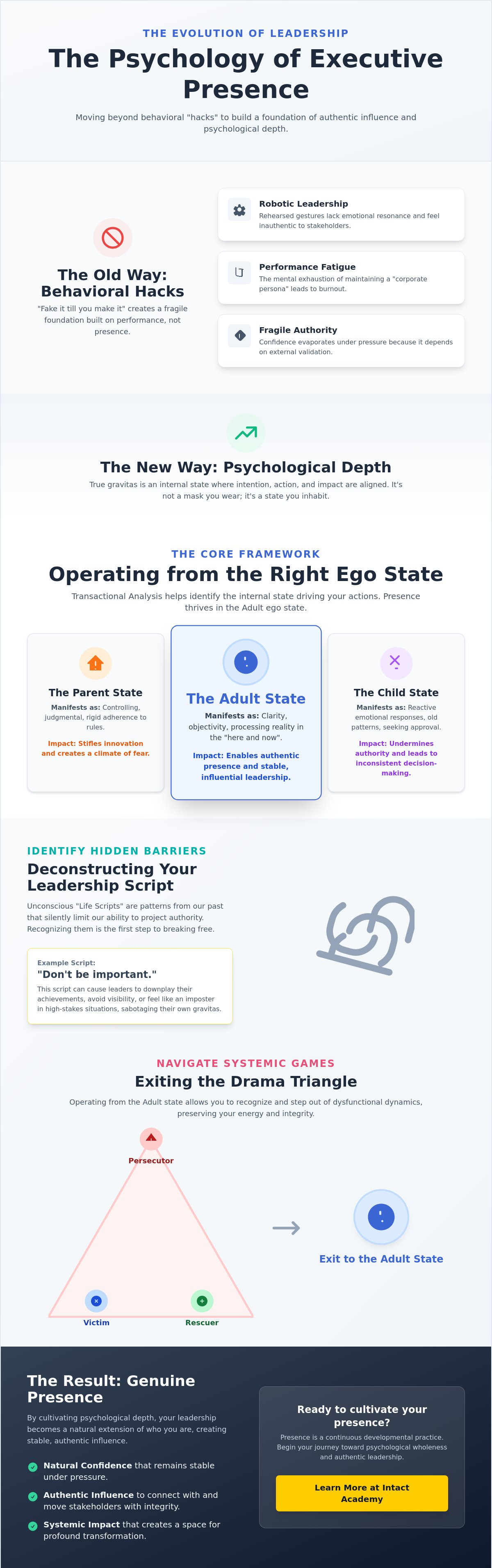
- Robotic Leadership: Rehearsed gestures that lack emotional resonance and human connection.
- Performance Fatigue: The mental load of maintaining a "corporate persona" leads to inevitable burnout.
- Fragile Authority: Confidence that depends entirely on external validation or specific, controlled conditions.
Presence as an Internal State of Being
True gravitas is the alignment of intention, action, and impact. It isn't a mask you put on; it's a state you inhabit. At the heart of this alignment is the ability to operate from the "Adult" ego state. This state allows you to process reality in the here and now, free from the reactive patterns or "scripts" of the past. Sari van Poelje has pioneered the application of these systemic concepts to organizational life, demonstrating that presence is a byproduct of psychological integration. When you are integrated, you don't need to "fake it" because your authority is grounded in your actual presence, not a rehearsed persona. This shift from behavioral modification to systemic transformation is what allows a leader to influence without exertion, creating a space where profound human transformation can occur within the organization.
The Transactional Analysis of Presence: Operating from the Adult Ego State
While the previous section highlighted why behavioral masks fail, we must look at the internal engine that sustains genuine authority. To understand why your presence might fluctuate during high-pressure negotiations, we examine what is transactional analysis. This framework identifies three distinct ego states, Parent, Adult, and Child, that dictate how we relate to ourselves and our stakeholders. Developing executive presence for leaders is not a matter of perfecting a persona; it is about learning to inhabit the right ego state at the right moment.
When a leader operates from the Parent ego state, they often project a controlling or judgmental energy. This manifests as micromanagement or a rigid adherence to "how things should be," which stifles innovation and creates a climate of fear. Conversely, the Child ego state contains our early emotional responses and adaptations. If you've ever felt the sting of imposter syndrome or a desperate need to please a difficult board member, you've likely slipped into this state. Neither of these modes allows for the non-coercive authority that defines true gravitas. Instead, they create a transactional dynamic that feels forced, reactive, and ultimately fragile.
Identifying Your Default Leadership Ego State
Most executives have a default state they retreat to when the stakes are high. You might notice a tendency toward "pleasing" Child energy when facing senior stakeholders, or a shift into "controlling" Parent energy when a deadline is missed. These shifts are often subconscious, yet they lead to ego-state contamination where past patterns bleed into present professional interactions. This contamination compromises your reputation because it signals a lack of internal alignment. To begin the work of transformation, map your reactions in your recent high-stakes meetings. Were you responding to the objective reality of the room, or were you acting out a pattern of control or compliance?
Cultivating the Adult Core for Gravitas
The path to developing gravitas lies in the cultivation of the Adult ego state. This state is characterized by an ability to stay grounded in the "here and now," processing data without the interference of historical baggage or future anxieties. There is a direct connection between your capacity for emotional regulation and how others perceive your authority. When you remain calm and objective during a crisis, the room senses a stable center. The Adult ego state is the primary source of executive presence because it represents an integrated self that is fully present, objective, and responsive to the current organizational reality. If you seek to anchor your leadership in this state of wholeness, our executive coaching offers a structured methodology for this deep developmental journey.
Deconstructing the Leadership Script: Resolving Barriers to Gravitas
Every leader operates from a hidden map. In Transactional Analysis, we call this a "Life Script." It is an unconscious plan formed in early life, reinforced by our environment, and justified by our subsequent experiences. For many, the journey of developing executive presence for leaders is quietly sabotaged by an internal "Don’t be important" script. This isn't a mere lack of confidence. It is a systemic blueprint that dictates how much space you are allowed to take in a room and how much authority you are permitted to wield. When your script conflicts with your professional role, the resulting tension is felt by everyone around you as a lack of gravitas.
Unconscious "drivers" often exacerbate this tension. These are internal commands like "Be perfect," "Try hard," or "Please others" that we use to maintain a sense of OK-ness. While these drivers might have fueled your rise to management, they become liabilities in the C-suite. A leader operating under a "Try hard" driver often appears frantic and overwhelmed, which undermines the calm stability stakeholders expect. True presence requires the courage to identify these scripts and rewrite the narrative, moving from a position of forced performance to one of natural, integrated authority.
Overcoming Imposter Syndrome with TA
Imposter syndrome is often discussed as a permanent hurdle to be managed, but a systemic approach seeks to resolve it at the root. Most executive anxiety stems from a psychological position of "I’m not OK, You’re OK," where the leader perceives others as more competent or deserving. Resolving this requires a deliberate shift into the "I’m OK, You’re OK" position. This isn't about arrogance; it's about a fundamental recognition of mutual value and competence. To challenge a "Don't be a leader" script, you must first identify the early messages you received about power and importance. Once identified, your Adult ego state can provide the "permission" to be seen, to be heard, and to lead without the weight of past expectations.
- Awareness: Notice the physical sensation of "shrinking" in high-stakes meetings.
- Tracing: Identify the internal voice that says "Don't be too much" or "Stay safe."
- Adult Challenge: Evaluate if these old messages are relevant to your current reality as a senior executive.
- New Permission: Consciously replace the old script with a new directive: "It is safe and necessary for me to lead with impact."
Authenticity vs. Adaptation in the C-Suite
In senior leadership, the "Adapted Child" is a frequent visitor. This is the part of us that either over-complies with corporate expectations or rebels against them in counter-productive ways. Both modes are reactive and lack the stability of presence. The transition from a technical expert to a systemic leader involves moving away from these adaptations. A technical expert often relies on "doing" to prove their worth, but a systemic leader relies on "being." By learning to lead from your "Natural Child"—the source of your creativity, intuition, and spontaneity—while maintaining the boundaries of your Adult ego state, you achieve a level of authenticity that cannot be faked. This alignment allows you to navigate high-stakes dynamics with a sense of ease that makes your influence feel effortless rather than coercive.
Systemic Presence in Action: Navigating Games and High-Stakes Dynamics
Presence is often discussed as an individual attribute, yet it never exists in a vacuum. It's a relational and systemic phenomenon. Developing executive presence for leaders involves more than individual posture; it requires a keen awareness of the unconscious currents that pull teams into dysfunctional loops. In the boardroom, these loops often manifest as "Psychological Games." These are repetitive sequences of social interactions that lead to a predictable, often negative, emotional payoff. When you understand these games, you stop being a pawn in them and start becoming the steady center of the system.
The Karpman Drama Triangle provides a vital framework for this awareness. Leaders frequently find themselves trapped in the roles of Rescuer or Persecutor. You might "rescue" a struggling department by over-functioning, which inadvertently creates dependency and weakens the team's autonomy. Or, under pressure, you might slip into the "Persecutor" role, using blame to drive results. Both roles are reactive and lack the stability of an integrated Adult state. True presence is the quiet refusal to rescue, the steady decline to persecute, and the constant invitation for everyone in the room to return to their own Adult competence.
Navigating Boardroom Politics with Adult Awareness
Have you ever encountered the "Yes, but" game? It occurs when a stakeholder asks for your expertise only to reject every solution you offer. A leader without systemic awareness might keep trying harder to provide the "right" answer, which only fuels the game. A leader with presence uses their "Third Eye." They observe the dynamic while participating in it. Instead of offering more advice, they might say, "I notice that every suggestion is met with a reason why it won't work. What do you think is the real hurdle here?" This shift from content to process is how you enhance your influence without needing to "power pose." It's the hallmark of developing executive presence for leaders who value depth over performance.
The Systemic Impact of Leadership Presence
Your internal state sets the "script" for the entire organization. When you operate from a grounded, Adult ego state, you create a systemic invitation for others to do the same. This dynamic is the cornerstone of leading organizational change. Change is rarely about the technical rollout; it's about the psychological safety required for people to move from the known to the unknown. By modeling Adult-to-Adult transactions, you dismantle the culture of blame and compliance, replacing it with a culture of accountability and creativity. If you are ready to master these systemic dynamics and transform your leadership impact, explore our Systemic Supervision programs to anchor your presence in professional mastery.
Cultivating Presence as a Continuous Practice
Presence isn't a destination. It's a process of becoming. For many, developing executive presence for leaders is seen as a final checkbox on a career roadmap, yet those who possess the most profound gravitas understand that it requires constant, reflective maintenance. When you stop looking inward, you risk slipping back into old scripts or allowing your authority to become rigid and coercive. True mastery lies in the ability to return, again and again, to a state of completeness and Adult awareness, regardless of the systemic pressures that seek to pull you off balance.
This evolution involves integrating Transactional Analysis principles into the rhythm of your daily leadership routine. It's about pausing before a high-stakes board meeting to ask: "Which part of me is leading right now?" By choosing the Adult state intentionally, you ensure that your presence remains a tool for connection and clarity rather than a mask for insecurity. As you move deeper into this work, your focus naturally shifts from your own individual presence to the development of others. You become a mentor who creates a systemic environment where everyone can lead with authenticity and integrity.
The Path to Professional Mastery
Professional growth at the senior level demands a stable container for reflection. This is why professional development for coaches and leaders is so critical. Without systemic supervision, even the most self-aware executive can fall prey to "ego inflation," where the external trappings of power begin to cloud internal judgment. Supervision provides a mirror; it helps you spot when your "Life Script" is beginning to influence your decisions or when you are being pulled into a team's psychological games. It's a practice that ensures your gravitas remains grounded in reality rather than performance. By engaging in this ongoing work, you maintain the "Adult" core necessary to navigate the complexities of modern organizational life.
Taking the Next Step toward Systemic Impact
If you've felt the shift that occurs when you lead from an integrated psychological state, you may be ready to deepen that impact. Moving from personal presence to systemic mastery often involves formalizing your understanding of human behavior and organizational dynamics. Our executive coaching certification is designed for those who wish to bring these profound TA-based insights into their teams and organizations. By mastering the intersection of psychology and business, you don't just change how you are perceived; you change the very culture of the systems you lead. We invite you to join the Intact Academy, where we provide the methodology and community required for this level of profound human transformation. Your journey toward genuine, non-coercive authority is the foundation upon which your organizational legacy will be built.
Embodying the Future of Integrated Leadership
The shift from behavioral performance to psychological depth is the defining challenge for the modern executive. By moving beyond the exhausting cycle of "acting" the part, you unlock a state of completeness that naturally commands respect. We've explored how the Adult ego state provides a stable core and how deconstructing your Life Script removes the invisible barriers to your influence. Developing executive presence for leaders is no longer about optics; it's about the courageous work of internal integration and systemic awareness.
This level of transformation requires more than self-study. It demands a structured methodology and a supportive community of peers. At Intact Academy, we offer EMCC and ICF accredited programs taught by international experts in Transactional Analysis. You'll join a global community of leaders from over 14 countries, all committed to the same path of professional mastery. Master Systemic Leadership at the Intact Academy to anchor your authority in wholeness and lead with lasting impact. Your most authentic self is the most powerful tool you have.
Frequently Asked Questions
How long does it take to develop executive presence?
Developing executive presence for leaders is a developmental journey rather than a quick fix. While you might see surface-level improvements in weeks through behavioral coaching, true psychological integration usually takes six to twelve months of consistent practice. This duration allows for the rewriting of Life Scripts and the stabilization of the Adult ego state. It is a methodical process of becoming that requires both patience and deep, reflective inquiry.
Can introverts have strong executive presence?
Introverts often possess a profound executive presence because their authority is rooted in listening and thoughtful reflection rather than loud performance. Presence isn't synonymous with extroversion. It is about being fully present in the here and now. When an introvert operates from an integrated Adult state, their quiet power can be more influential and grounding than the most vocal person in the boardroom. This calmness creates a sense of safety for the entire system.
What is the most common mistake leaders make when trying to improve their presence?
The most frequent error is focusing on external optics while ignoring internal psychological drivers. Leaders often try to master "power poses" or rehearsed scripts, which stakeholders quickly sense as inauthentic. This creates a robotic presence that lacks emotional weight and genuine connection. True gravitas comes from aligning your internal state with your external actions, rather than performing a role that feels disconnected from your core values and integrity.
How does Transactional Analysis help with public speaking anxiety?
Transactional Analysis helps by identifying the ego state that is triggered during a presentation. Speaking anxiety often stems from the Child state, which may be reacting to old messages about being judged or found wanting. By recognizing this trigger, you can consciously return to your Adult state. This shift allows you to view the audience as peers rather than critics, moving from a position of vulnerability to one of mutual competence.
Is executive presence different for women or minority leaders?
While the psychological foundation of presence remains consistent, the systemic context differs significantly. Women and minority leaders often face external scripts and biases that require a more nuanced navigation of the Adult ego state. Developing executive presence for leaders in these groups involves reclaiming their own authority while skillfully managing the projections of others. It requires a high level of systemic awareness to maintain wholeness in environments that may challenge it.
Can I develop executive presence through online training?
You can certainly begin the journey through online platforms, provided the training moves beyond pre-recorded lectures. Effective development requires interactive, systemic supervision and real-time feedback from experienced mentors. Programs that offer a hybrid of theoretical frameworks and experiential practice allow you to apply TA principles to your daily professional life. The key is finding a stable container for deep learning, whether that occurs in person or through a digital environment.
How do I maintain presence when I am being challenged by a superior?
Maintaining presence during a challenge requires a refusal to slip into a reactive Child or Parent state. If a superior challenges you, stay grounded in the objective reality of the situation and observe the dynamic without becoming defensive. By responding from your Adult state, you invite the other person to do the same. This prevents you from falling into the Drama Triangle as a Victim or a Persecutor, keeping the transaction professional and objective.
What is the difference between charisma and executive presence?
Charisma is often a personality trait characterized by high energy and charm, which can be transient and persona-based. Executive presence is a deeper state of being rooted in psychological integration and internal stability. While charisma might capture immediate attention, presence sustains influence under pressure. Presence is the outward manifestation of an integrated self that remains calm and authoritative even when the charismatic energy of the room has faded or shifted.


