

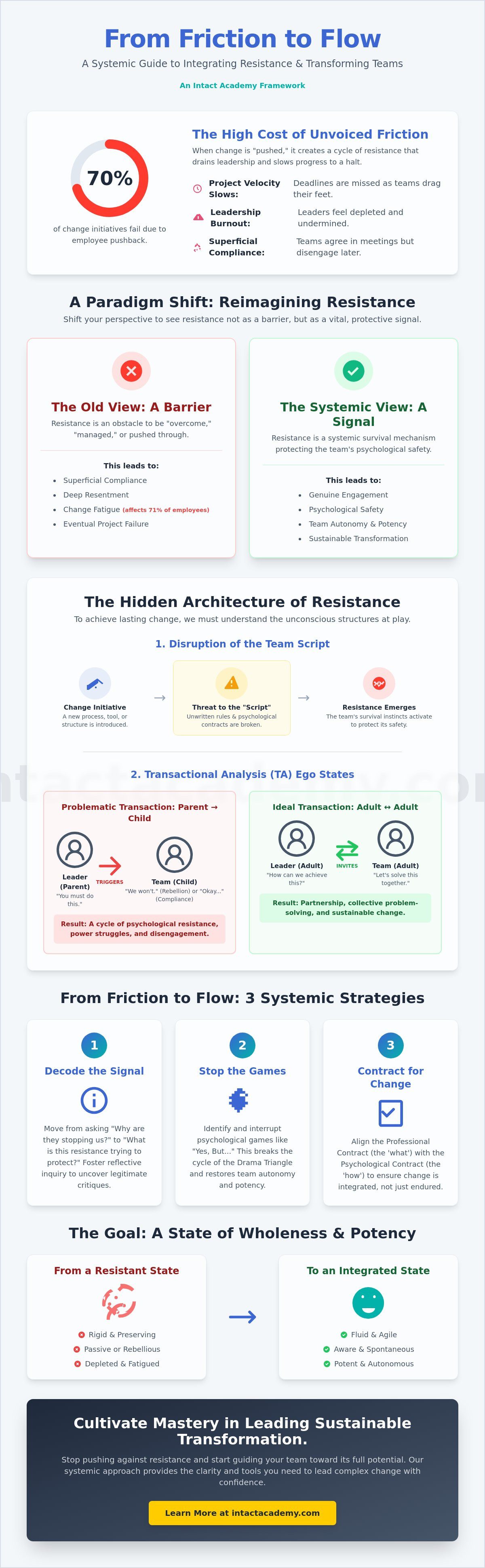
What if the friction you encounter is not a barrier to progress, but a preserved script of safety seeking acknowledgment? Dealing with resistance to change in teams often feels like an uphill struggle against an invisible tide, a reality grounded in the fact that 70% of change initiatives fail due to employee pushback. You likely feel the emotional weight of "pushing" change while project velocity slows under the weight of unvoiced friction. It's a tiring cycle that can leave even the most seasoned leaders feeling depleted and undermined. If you have felt the drain of leading through silence, then you understand the need for a deeper, more systemic methodology.
In this exploration, you'll learn to transform this resistance from a source of exhaustion into a catalyst for profound human transformation. We promise to move beyond surface-level tactics by using Transactional Analysis and systemic coaching to decode the systemic roots of pushback. We will provide a diagnostic framework to facilitate Adult-to-Adult conversations that turn skepticism into engagement, allowing for a state of wholeness and renewed potency within your organization.
Key Takeaways
- Shift your perspective to see resistance as a systemic survival mechanism rather than a barrier. You'll learn how unwritten team scripts dictate group behavior and protect the status quo during times of transition.
- Gain tools for dealing with resistance to change in teams by identifying psychological games like "Yes, But." This insight helps you stop the cycle of the Drama Triangle and restore team autonomy and potency.
- Implement the tripartite "Contracting for Change" model to secure psychological safety. Aligning professional and psychological contracts ensures that organizational change is integrated rather than merely endured.
- Explore the role of systemic supervision in preserving your leadership clarity. This practice allows you to guide your team toward a state of wholeness while maintaining the steady presence needed for complex transformations.
Reimagining Resistance: Why Your Team’s Pushback is a Vital Signal
If you view your team as a living organism, you begin to see that pushback is rarely about the change itself. It's about the perceived threat to the group script, those unconscious, shared beliefs that provide a sense of predictable safety. Most traditional management models suggest we should "overcome" or "manage" this friction, effectively pushing through the barrier. At Intact Academy, we propose a more profound path: the integration model. In this space, we recognize that resistance is a protective mechanism for a team’s existing psychological safety. When we are dealing with resistance to change in teams, we aren't fighting a lack of cooperation; we're engaging with the team's survival instincts.
The ultimate objective of this work isn't just compliance. It's autonomy. In a systemic context, autonomy is the capacity for the team to act with full awareness, spontaneity, and the ability to form intimacy without the interference of outdated scripts. When we integrate resistance instead of crushing it, we return the team to its full potency. The goal is to move from a state of rigid preservation to one of fluid agility, where the team can unfold into its next iteration with integrity.
The Distinction Between Noise and Signal
How do you know if the friction you encounter is a distraction or a vital warning? When resistance is a signal, it often contains a legitimate critique of the change strategy that leadership has overlooked. If you ignore these signals, you risk a hollow victory: superficial compliance. People may nod in meetings, but their deep commitment remains locked away, leading to the "change fatigue" that impacts 71% of employees according to 2022 Capterra data. By fostering a culture of reflective inquiry, you allow the team to voice these signals safely. You move from asking "Why are they stopping us?" to "What is this resistance trying to protect?"
Transactional Analysis: A Lens for Team Dynamics
To navigate these systemic waters, one must understand what is transactional analysis and its power in organizational life. TA allows us to see the ego states at play during transitions. When leaders adopt a "Parental" tone, directing or patronizing the workforce, they inadvertently trigger "Rebellious Child" responses. This creates a loop of psychological resistance to change that feels personal but is actually structural. The transition to Adult-to-Adult contracting is the key. It invites the team into a partnership of equals, where the focus shifts from power struggles to collective problem-solving and sustainable transformation.
The Hidden Architecture of Resistance: Scripts, Ego States, and Survival
Every team operates under a "Team Script," a set of unwritten, unconscious rules that dictate how the group survives and maintains its equilibrium. When leaders begin dealing with resistance to change in teams, they're often actually confronting the disruption of this script. It isn't just about new software or reporting lines. It's about a fundamental breach of the psychological contract. This contract is the invisible web of expectations between the team and the organization. When this web is torn, the team feels a loss of safety, often retreating into the "Adapted Child" ego state. In this state, members might become overly compliant yet passive, or openly rebellious, as a way to preserve their sense of belonging to the old system.
To achieve lasting transformation, we must update the collective script. If you only focus on individual behaviors, the systemic gravity of the group will eventually pull everyone back to the old ways. This is a primary reason why transformation efforts fail, as explored in the classic analysis Leading Change: Why Transformation Efforts Fail. Effective strategies for dealing with resistance to change in teams require more than just better communication; they require a systemic update of the team's shared identity. True agility requires a courageous look at these underlying architectures.
Ego States in Times of Transition
During periods of upheaval, leadership styles often polarize. A "Controlling Parent" approach, issuing mandates without dialogue, almost always triggers a "Rebellious Child" response from the team. Conversely, a "Nurturing Parent" might over-protect the team, inadvertently stifling their growth and autonomy. The goal is to invite the "Adult" ego state. This is the part of us that can process change logically, ask questions, and negotiate new contracts. Sometimes, you'll see a team "acting out" from the "Natural Child" ego state through humor or raw emotion. This isn't a problem. It's a sign of life that needs to be integrated into the new reality.
The Fear of the New: A Systemic Perspective
We often view change as an addition, but for a team, it's frequently experienced as a loss of wholeness. The current identity, however flawed, is known and stable. Moving toward the new requires a period of unfolding where the old must be honored before it can be released. For those seeking to deepen their mastery in this area, exploring our curriculum on leading organizational change provides the necessary systemic tools. By acknowledging what the team is leaving behind, you create the safety required to step into the future. If you're ready to explore these dynamics further, our Team Coaching programs offer a space for this deep integration.
Decoding the 'Games' Teams Play: Recognizing Active and Passive Resistance
In the quiet moments of a team meeting, you might notice a recurring pattern: a proposal is made, followed by a chorus of "Yes, but..." or a detailed explanation of "Look how hard I tried." These aren't just polite disagreements. They're psychological games. In Transactional Analysis, a game is a series of transactions with a hidden agenda that ends in a predictable, often negative, emotional payoff. When we're dealing with resistance to change in teams, we're often caught in the gravitational pull of the Drama Triangle. This systemic trap consists of three roles: the Victim, who feels overwhelmed; the Rescuer, who tries to fix things without a clear agreement; and the Persecutor, who blames others for the disruption.
Understanding the reasons people resist change helps us identify which role is being played and why. To stop a game, you must "cross the transaction." If a team member speaks from a "Victim" position, don't respond as a "Rescuer" by offering more solutions. Instead, respond from your "Adult" ego state with a reflective inquiry: "What resources do you specifically need to move forward?" This disrupts the unconscious script and invites the team back into a space of autonomy and responsibility. It shifts the energy from a scripted drama to a professional dialogue.
Active Resistance: The Gift of Visibility
Vocal dissenters are often the most committed members of your team. Their energy, while it may feel like "Persecutor" energy, is actually a sign of engagement. They care enough to fight. Your task is to transform this friction into "Challenger" energy. This requires potency, the ability to stand firm in the necessity of the change while remaining deeply empathetic to the struggle. By validating their concerns without retreating from the goal, you integrate their passion into the new direction. It's about moving from conflict to co-creation, where the dissenter becomes the guardian of quality during the transition.
Passive Resistance: The Silent Staller
Passive resistance is far more insidious than vocal pushback. It manifests as the "Victim" role, where team members agree in principle but fail to act. This "silent stalling" can drain the life out of a project. The danger here is the temptation to "Rescue" by doing the work for them or lowering standards. This only reinforces the script of helplessness. To break this cycle, you need clear contracts.
- Define the 'What': Establish clear deliverables and timelines that leave no room for ambiguity.
- Define the 'How': Set expected behaviors and communication norms for the transition period.
- Define the 'Why': Reiterate the systemic purpose to anchor the team in a shared reality.
Moving from Friction to Flow: Systemic Strategies for Integration
Empathy is often cited as the primary antidote to friction, yet empathy alone can leave a team adrift in a sea of shared frustration. To move from friction to flow, we must provide a stable container for the transition. Dealing with resistance to change in teams requires more than a listening ear; it demands a structured methodology that addresses the systemic roots of the pushback. This is where the concept of "Contracting for Change" becomes essential. By making the implicit explicit, we remove the ambiguity that fuels psychological games and return the team to its center.
Consider a leader who senses a growing divide between the vision and the team's output. Instead of resorting to pressure, they might "name the elephant" in the room. They might say, "I see us agreeing to the plan while our actions suggest we're still grieving the old way of working." This intervention is a powerful reset. It acknowledges the systemic reality and invites everyone back into an Adult ego state. It's an invitation to return to a state of wholeness where the team's energy is no longer split between compliance and rebellion. It allows for an unfolding of truth that is both grounding and transformative.
Contracting: The Foundation of Adult Change
Effective change is built on three distinct levels of contracting. The administrative contract covers the logistics, timelines, and resources. The professional contract defines the specific outcomes and goals. However, the most critical level is the psychological contract. This is the unspoken agreement about how people feel and how they will support one another. During times of upheaval, this contract is often the first to break. Leaders must proactively update it, moving from hidden expectations to clear, mutual agreements. If you wish to master these frameworks, our Team Coaching Academy provides the deep systemic training needed to facilitate these complex dialogues.
Nurturing Potency, Protection, and Permission
In Transactional Analysis, we speak of the "Three Ps" as the pillars of leadership. Potency is your authority and impact; it's the steady hand that guides the team with clarity and confidence. Protection is the psychological safety you provide, ensuring the team knows they won't be punished for the inevitable stumbles that come with learning. Permission is perhaps the most transformative. It's the explicit right you give the team to let go of old, inefficient scripts. When you grant permission to fail, to feel, and to experiment, you unlock the team's inherent agility. This integration allows for a sustainable unfolding of new capabilities without the exhaustion of "pushing" change uphill.
Cultivating Mastery: The Path to Leading Sustainable Transformation
Dealing with resistance to change in teams in 2026 is no longer a matter of simple management; it's a call to systemic mastery. With 79% of employees reporting low trust in organizational change initiatives, leaders can't rely on surface-level tactics or frantic directives. A psychological lens is non-negotiable because it allows you to see the invisible architectures, such as scripts and ego states, that actually drive behavior. This approach, pioneered by Sari van Poelje through the lens of Agile Transactional Analysis, bridges the gap between rigid theory and the fluid reality of modern business.
True transformation begins with the leader's own script. If you're unwilling to look inward, you'll likely find yourself repeating old patterns that trigger the very resistance you seek to resolve. This is why systemic supervision is a vital practice for any senior practitioner. It provides a reflective space where you can maintain your clarity and potency, ensuring you don't become entangled in the team's drama. It's about becoming a wise mentor who leads from a place of integrity and wholeness, creating a stable container for the team's unfolding.
Beyond Tactics: Developing the Systemic Eye
Moving from solving problems to evolving systems requires a shift in perspective. You're no longer just looking at a project delay; you're observing the unfolding of a collective identity and its survival mechanisms. This level of insight demands more than a cursory understanding of coaching. It requires a commitment to professional development for coaches and leaders who want to make a deep, lasting impact. When you develop a systemic eye, you begin to see how individual growth and organizational success are inextricably linked, allowing you to guide the system toward integration rather than just compliance.
Taking the Next Step with Intact Academy
At Intact Academy, our Senior Team Coach Academy is specifically designed to help you navigate the turbulent waters of team resistance with sophistication and pragmatism. We don't just teach Transactional Analysis theory; we provide a structured methodology for real-world application in executive boardrooms and agile teams alike. Our programs help you return your team to a state of authenticity, where agility isn't just a buzzword but a lived experience. There is a profound beauty in a team that has found its wholeness, moving beyond survival scripts into a space of true autonomy and flourishing. We invite you to join us in this work of profound human transformation, where the courage to change leads to a state of collective excellence.
Embracing the Unfolding of Team Potential
True transformation occurs when we stop fighting the current and begin to understand its source. By viewing pushback as a systemic signal rather than a personal failure, you unlock the ability to return your team to its inherent state of autonomy. Dealing with resistance to change in teams becomes a process of decoding scripts and updating psychological contracts, moving from the friction of the Drama Triangle to the flow of Adult-to-Adult dialogue. It's a journey from surface-level compliance to deep, systemic integration that honors the intelligence of every individual involved.
If you're ready to master these profound tools, we invite you to deepen your impact with our TA EMCC Senior Team Coach Academy. Our EMCC and ICF accredited programs are led by international expert Sari van Poelje and have empowered participants from over 14 countries to lead with quiet power and integrity. By doing the inner work of a leader, you provide the protection and permission your team needs to flourish in an increasingly complex world. Your commitment to this depth is the bridge to a more authentic, agile, and whole organization. The path to sustainable change is open, and it begins with your willingness to look beneath the surface.
Frequently Asked Questions
What are the main causes of resistance to change in teams?
The primary drivers of resistance include a lack of trust in leadership (41%), insufficient awareness of the reasons for change (39%), and a fundamental fear of the unknown (38%). In 2026, these factors are often compounded by pervasive change fatigue, which currently affects 71% of the workforce. Dealing with resistance to change in teams requires addressing these systemic gaps in trust and communication rather than simply treating the symptoms of pushback.
How can Transactional Analysis help in managing team resistance?
Transactional Analysis provides a map of the ego states that drive human interaction. By identifying when a team is stuck in a "Rebellious Child" or "Adapted Child" state, leaders can intentionally shift their own posture to the "Adult." This allows for logical processing and mutual contracting. It transforms a power struggle into a professional partnership where autonomy and potency are restored to every member of the system.
What is the difference between active and passive resistance?
Active resistance is vocal and visible, often manifesting as direct challenges to the new strategy or vocal dissent in meetings. Passive resistance is more insidious, appearing as foot-dragging, "Yes, but" behaviors, or a retreat into the "Victim" role of the Drama Triangle. While active pushback feels more aggressive, it's often easier to integrate because the concerns are out in the open, whereas passive stalling requires careful systemic decoding.
How do you deal with a team member who is actively sabotaging change?
When dealing with resistance to change in teams that has turned into active sabotage, you must use your leadership potency to name the behavior directly. Sabotage often stems from a "Persecutor" position in the Drama Triangle. By crossing the transaction and inviting the individual into an Adult-to-Adult conversation about the psychological contract, you remove the payoff for the game. Clear, administrative contracting is essential to re-establish boundaries.
Can psychological safety actually increase resistance to change?
Psychological safety doesn't increase resistance; rather, it makes the existing resistance visible. In a safe environment, team members feel they have the "Permission" to voice their concerns without fear of retaliation. This is a vital signal that allows leaders to address the root causes of friction before they become systemic blockages. Without this safety, resistance simply goes underground, where it becomes much harder to manage, integrate, and resolve.
How long does it take to shift a team’s script during a major transition?
Shifting a team’s script is a deliberate process of unfolding rather than a single event. While structural changes can happen quickly, the psychological integration of a new script typically takes several months of consistent "Adult" contracting and reinforcement. The pace depends on the depth of the existing script and the level of protection provided by leadership. It's about moving at the speed of trust to ensure the change is sustainable.
What is the "Drama Triangle" and how does it manifest in teams?
The Drama Triangle is a systemic trap consisting of three roles: Victim, Rescuer, and Persecutor. In teams, this manifests when a member feels overwhelmed (Victim), a leader tries to fix things without a clear agreement (Rescuer), or someone blames the system or colleagues for failure (Persecutor). Recognizing these roles is the first step toward stopping the psychological games that drain team energy and stall the unfolding of new, agile ways of working.
Is it possible to eliminate resistance to change entirely?
Eliminating resistance entirely is neither possible nor desirable. Resistance is a natural protective mechanism for a team's current sense of safety and identity. The goal of a systemic approach is to integrate this energy, transforming it from a barrier into a breakthrough. When we stop trying to crush resistance and start listening to the signal it carries, we move the team toward a state of wholeness and authentic, lasting agility.


