

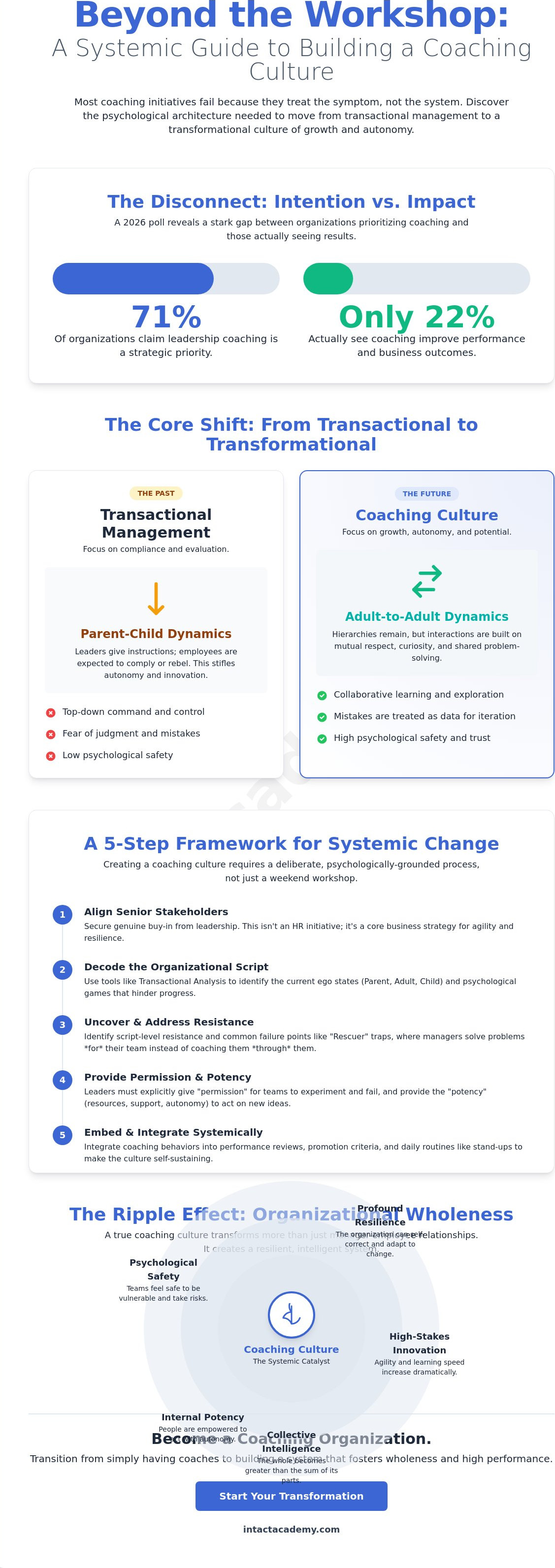
Why do so many organizations invest in expensive workshops only to watch the new skills wither under the weight of an unchanged system? You aren't alone if you've felt the frustration of coaching initiatives that sparkle for a week and then quietly disappear. The reality is that creating a coaching culture in an organization isn't about adding a new set of tasks to a manager's plate. It's about a fundamental transformation from transactional supervision to autonomous, Adult-to-Adult interactions. While 71% of organizations claim leadership coaching is a strategic priority, a 2026 poll reveals that only 22% actually see it improve performance. This gap exists because we often treat coaching as a tool for evaluation rather than a systemic catalyst for human flourishing.
You deserve a strategy that respects the complexity of your system and the maturity of your people. In this guide, you'll discover how to move beyond superficial training to embed a deep, psychologically-grounded coaching culture that drives sustainable change. We'll examine the systemic barriers to vulnerability and provide a roadmap for leaders to act as catalysts for transformation. You'll learn how to foster a self-sustaining environment where psychological safety and high performance aren't just goals, but the natural results of a healthy, integrated organizational script.
Key Takeaways
- Shift your perspective from transactional management to a transformational state where every interaction invites growth and autonomy.
- Use the lens of Transactional Analysis to identify the ego states and psychological games that currently hinder your organization's progress.
- Master a five-step framework for creating a coaching culture in an organization, starting with senior stakeholder alignment and ending with systemic integration.
- Uncover the "Rescuer" traps and script-level resistance that cause most coaching initiatives to fail.
- Transition from simply having coaches to becoming a coaching organization that achieves wholeness through internal potency and professional standards.
What is a Coaching Culture? Moving from Transactional to Transformational
A coaching culture isn't a collection of workshops or a list of competencies in an HR manual. It's a systemic atmosphere where every interaction invites growth and autonomy. Creating a coaching culture in an organization requires looking beneath the surface of behavior to the underlying scripts that dictate how people relate to one another. Most workplaces operate within a transactional culture, characterized by Parent-Child dynamics where instructions are handed down and compliance is expected. In contrast, a true coaching culture fosters Adult-to-Adult dynamics. It's a state where the hierarchy remains, but the psychological distance closes to allow for mutual respect and curiosity.
Surface-level skills often fail because the underlying organizational script remains unchanged. If the system rewards "rescuing" behaviors or penalizes vulnerability, no amount of active listening training will take root. To understand the depth required for this shift, one must first look at the foundational question: What is Coaching? Beyond the basic definition of facilitating performance, systemic coaching involves providing the "permission" to explore and the "potency" to act. Without these psychological anchors, coaching remains a hollow exercise rather than a transformative force.
The Business Imperative for 2026
As we look toward the complexities of 2026, the traditional command-and-control hierarchy has become a liability. In a volatile global market, agility depends on the speed of learning. When leaders move from being "experts" to "facilitators," they create the psychological safety necessary for high-stakes innovation. If employees fear the judgment of their supervisors, they'll hide mistakes. If they feel the support of a coach, they'll iterate and improve. This shift isn't just a soft skill; it's a hard requirement for survival in an era where collective intelligence outpaces individual expertise.
The Systemic Ripple Effect
The transition toward a coaching mindset creates a ripple effect that touches every stakeholder. It moves the organization from individual performance metrics to a culture of collective intelligence. When an organization embeds these principles, it impacts everything from internal collaboration to customer trust. This process often begins with leading organizational change through a psychological lens. By addressing the systemic script, you move from a collection of high performers to a unified, intelligent system capable of self-correction and profound resilience. Creating a coaching culture in an organization eventually leads to a state of wholeness where people don't just do their jobs; they thrive within them.
The Psychological Architecture: Using Transactional Analysis to Shape Culture
To transform a culture, you must first understand the invisible blueprints that govern every conversation, decision, and conflict. Creating a coaching culture in an organization requires more than just teaching new skills; it demands a deep dive into the psychological architecture of the system. Transactional Analysis (TA) provides the necessary lens to decode these patterns, moving us from surface-level behavior to the root of human interaction. By understanding the three ego states—Parent, Adult, and Child—leaders can begin to see why certain initiatives flourish while others are met with silent resistance. When a culture is stuck in a Parent-Child dynamic, employees either wait for instructions or rebel against them, neither of which fosters the autonomy required for a modern, agile workplace.
Psychological Games act as the primary barriers to this evolution. These are repetitive, unproductive sequences of interaction that always end with a familiar, negative feeling for everyone involved. Whether it is the "Yes, But" game that kills innovation or the "Look How Hard I’ve Tried" game that masks a lack of results, these patterns drain organizational energy. These games are often symptoms of the Organizational Script, an unconscious blueprint that determines how change is received and whether growth is permitted. Overcoming Leadership Resistance involves identifying these scripts and replacing them with a shared commitment to awareness, spontaneity, and intimacy—the three pillars of true autonomy.
Mapping Ego States in Leadership
Leadership styles often oscillate between the "Controlling Parent," who focuses on rules and criticism, and the "Nurturing Parent," who may inadvertently stifle growth through over-protection. Both states, while sometimes useful, keep the organization in a state of dependency. The goal of creating a coaching culture in an organization is to invite the Adult state in both the coach and the coachee. The Adult ego state is the part of our personality that processes data in the here-and-now, serving as the primary vehicle for objective problem-solving and coaching. By operating from the Adult, leaders create a neutral space where potency and responsibility can flourish.
Rewriting the Organizational Script
Diagnosing repetitive, unproductive patterns is the first step toward systemic health. Many organizations are governed by "Don't" drivers—unspoken rules like "Don't be successful" or "Don't take risks"—that inhibit potential. To shift this, leaders must move toward permission-based leadership, where the system explicitly encourages growth and authenticity. If you are curious about how these frameworks apply to your specific context, exploring what is transactional analysis can provide a deeper map for your cultural transformation. For those ready to lead this shift, our Executive Coaching services offer a personalized path to mastering these systemic dynamics.
A 5-Step Framework for Creating a Coaching Culture
Creating a coaching culture in an organization isn't a linear project; it's a rhythmic unfolding of systemic capabilities. While traditional models like the 6-Step Framework for a Coaching Culture provide a helpful structure, a truly sustainable shift requires a deeper psychological foundation. Our five-step framework moves beyond surface-level behavior to address the core organizational script. This journey involves five essential movements:
- Step 1: Contracting for Change. This is the alignment of senior stakeholders on a psychological contract. It goes beyond budget approval to ensure a shared commitment to vulnerability and growth.
- Step 2: Developing Internal Potency. We equip leaders with deep systemic coaching competencies. This isn't just about "asking questions"; it's about the leader’s internal capacity to hold the Adult ego state under pressure.
- Step 3: Creating an Adult-to-Adult Feedback Loop. We normalize radical transparency. By shifting away from Parent-Child dynamics, feedback becomes a neutral data point rather than a source of shame or pride.
- Step 4: Systemic Supervision. We establish a rigorous process for quality and ethics. This provides a mirror for the organization to see its own blind spots before they become systemic failures.
- Step 5: Integration and Wholeness. We align the new coaching behaviors with the organizational mission. Coaching stops being a "program" and becomes the primary way the organization breathes.
Contracting for Systemic Impact
The success of the entire cultural shift is often decided in the initial handshake. If senior leaders don't contract for their own transformation, the initiative will eventually fizzle. We move beyond simple ROI to measure the "Return on Relationships" and overall systemic health. This phase emphasizes the need for continuous professional development for coaches within the system. It’s a commitment to a long-term evolution rather than a quick fix.
The Role of Systemic Supervision
Internal coaches often get caught in the same cultural scripts they're trying to change. Without a "stable container" to process these dynamics, they risk burning out or becoming part of the problem. Systemic supervision prevents the re-enactment of old, unproductive patterns. It creates a space where coaches can step back and see the system as a whole. This is the critical boundary that distinguishes mere administrative management from a professional, high-impact coaching practice. Creating a coaching culture in an organization is only possible when the coaches themselves have a safe place to reflect and grow.
Uncovering the Script: Why Most Coaching Initiatives Fail
Most organizations approach coaching as a tactical band-aid. They identify a performance gap and apply a coaching solution, hoping the symptoms will simply disappear. This "Fix-it Tool" mentality is a psychological trap. It positions the coach as a "Rescuer" and the employee as a "Victim" who needs saving. When creating a coaching culture in an organization, this dynamic is lethal because it reinforces dependency rather than autonomy. Even when behaviors appear to change, they often result in "Pseudo-Adult" coaching. This is a state where people use the right vocabulary and follow the steps, but their underlying organizational script remains untouched. They're performing a role rather than inhabiting a new way of being.
If the system ignores the reality of its own problems, a process known as "Discounting," the cultural transformation will inevitably stall. You can't build a culture of growth on a foundation of denial. Discounting happens at various levels: ignoring the problem, its significance, the possibility of change, or the ability of people to act. Similarly, top-down initiatives often trigger a "Rebellious Child" response. When coaching is mandated without genuine engagement, the workforce naturally resists the perceived control. This resistance isn't a sign of bad employees; it's a sign of a system that hasn't addressed its own psychological undercurrents.
Breaking the Drama Triangle
The Drama Triangle consists of three roles: the Persecutor, the Rescuer, and the Victim. In a failing culture, leaders often oscillate between these roles, creating a cycle of blame and dependency. Moving from "Rescuing" to true "Coaching" requires setting clear boundaries and holding people capable of their own solutions. The Drama Triangle acts as a heavy tax on organizational energy, diverting focus from growth to the maintenance of dysfunctional roles.
Addressing Unconscious Resistance
Surfacing the "Undercurrents" of change is essential for progress. These are the unspoken fears and historical grievances that hold the old script in place. By using "Stroking"—the Transactional Analysis term for recognition—leaders can reinforce the specific behaviors that align with the new culture. Recognition acts as the fuel for transformation. Sari van Poelje has dedicated her career to identifying these systemic blocks, helping organizations move past their unconscious resistance toward a state of wholeness. If your organization is ready to move beyond surface-level workshops, our Organizational Change services provide the depth needed for a true systemic shift while creating a coaching culture in an organization.
Scaling Impact: From Individual Skills to Organizational Wholeness
The final evolution of creating a coaching culture in an organization occurs when the practice is no longer a separate activity, but the very way the system breathes. It is the shift from "having coaches" to "being a coaching organization." This stage of maturity requires a Systemic North Star. It is a commitment to returning to a state of wholeness and authenticity. When every leader operates from a place of integration, the organization moves beyond the fragmented scripts of the past. It becomes a space where people don't just perform; they unfold. This isn't a destination reached through a checklist. It is a continuous process of systemic reflection and the courageous choice to remain in the Adult ego state. Even when the pressure of the market invites us to regress, the coaching culture provides the stable container for resilience.
Building Internal Coaching Excellence
Scaling this impact requires an internal engine of growth. Establishing an academy that meets EMCC Senior Practitioner standards ensures that the quality of coaching remains high and the ethics remain sound. Selecting internal coaching champions involves looking for more than just communication skills. You must look for potency, presence, and the ability to navigate complex systemic dynamics. For senior leaders, obtaining an executive coaching certification is more than a credential. It is a commitment to a higher standard of leadership that transcends departmental silos. A community of practice ensures that coaching insights aren't trapped in individual pockets but are shared to benefit the collective intelligence of the whole system.
The Path to Systemic Mastery
The journey toward creating a coaching culture in an organization is ultimately a path toward organizational "Intactness." We define this as a state where the system is aligned, authentic, and capable of profound agility. Momentum is maintained through continuous systemic reflection and the willingness to look at what is truly happening beneath the surface. This path requires the humility to identify remaining blind spots and the courage to address the undercurrents that still pull toward old, transactional behaviors. Profound transformation is not for the faint of heart. It demands a willingness to shed the security of the old script in favor of a future that honors the intelligence and potential of every person. The choice to lead this change is the choice to foster a truly flourishing human ecosystem.
Embarking on Your Systemic Evolution
Creating a coaching culture in an organization is a journey from transactional scripts to systemic wholeness. It requires the courage to move beyond the Drama Triangle and the discipline to maintain Adult-to-Adult interactions. By focusing on potency, permission, and professional supervision, you transform the very fabric of your organization's potential. This work isn't just about professional skills; it's about human flourishing. When you align your organizational script with authenticity, you create a space where agility and innovation occur naturally. This shift doesn't happen overnight, but the results are sustainable and profound.
Ready to lead this change? Explore our TA EMCC Senior Practitioner Academy for systemic mastery. Our programs are EMCC and ICF accredited, led by international expert Sari van Poelje, and have empowered participants from over 14 countries to drive profound change. The path to transformation is open to those willing to look inward and act with integrity. Your organization’s next chapter of growth starts with the courage to be truly intact. We invite you to join a global community dedicated to the art of human and organizational flourishing.
Frequently Asked Questions
How long does it take to create a coaching culture in an organization?
A systemic transformation typically requires two to five years to become fully embedded in the organizational script. While initial workshops provide an immediate spark, the deeper work of shifting from Parent-Child to Adult-to-Adult dynamics takes consistent application across multiple business cycles. It is a process of steady unfolding rather than a fixed, one-time event.
What is the difference between a coaching culture and a high-performance culture?
A coaching culture serves as the psychological foundation for a sustainable high-performance culture. Many high-performance environments are transactional and driven by Parent-level pressure, which frequently leads to burnout. A coaching culture prioritizes autonomy and psychological safety. This ensures that high performance is a byproduct of human flourishing rather than a result of systemic stress.
Can we build a coaching culture without external consultants?
You can initiate the process internally, but external mirroring is often necessary to identify the unconscious scripts that internal teams are too close to see. While building internal potency is the ultimate goal, an outside perspective provides the systemic supervision required to ensure the culture doesn't regress. It is about creating a stable container for profound change.
How do we measure the ROI of a coaching culture shift?
Measuring the ROI involves tracking both financial metrics and human outcomes like engagement, retention, and psychological safety. According to a 2026 poll, while many organizations struggle with this, those successful in creating a coaching culture in an organization see marked improvements in collective intelligence. We often track the "Return on Relationships" as a leading indicator of long-term financial health.
What are the first steps for a CEO wanting to instill a coaching mindset?
The first step for any CEO is to contract for their own personal transformation and model the Adult ego state. Leaders must move away from being the "all-knowing Parent" and instead invite curiosity and feedback. This involves setting a new psychological contract where vulnerability is viewed as a systemic strength and growth becomes the primary objective of every interaction.
How does Transactional Analysis help in building a coaching culture?
Transactional Analysis provides the structural tools to map and decode organizational communication. By identifying ego states and psychological games, TA allows leaders to see the invisible barriers to growth. It helps in rewriting the organizational script. This moves the system away from dependency and toward a state of full autonomy, integration, and wholeness.
Is a coaching culture suitable for all types of industries?
Yes, a coaching culture is suitable for any industry that relies on human collaboration and complex decision-making. Whether in high-stakes manufacturing or creative tech, the need for Adult-to-Adult dynamics remains constant. The specific application may vary, but the systemic principles of potency and permission are universal drivers of organizational health and agility across the global market.
What happens if senior leadership is resistant to coaching?
Resistance from senior leadership often signals a "Don't Change" driver within the organizational script. When creating a coaching culture in an organization, this resistance must be addressed through systemic reflection rather than force. If leaders feel their potency is threatened, they'll retreat into Controlling Parent roles. Surfacing these fears allows for a new, more inclusive psychological contract to emerge.


