

What if the true cost of executive coaching certification isn't measured by the tuition fee, but by the price of remaining at the surface of human complexity? You've likely noticed the staggering range in the 2026 market, where programs fluctuate between $3,999 for basic ICF credentials and over $19,000 for advanced mastery. It's natural to feel a sense of hesitation when faced with such a wide financial chasm. You want more than a transactional certificate; you're seeking the psychological potency to facilitate genuine transformation in the boardroom.
This guide bridges the gap between financial pragmatism and systemic depth. We'll explore why institutions like American University charge $11,990 while others offer entry-level paths for much less. You'll discover a framework to justify this investment, whether you're funding it yourself or seeking organizational backing. By the end of this article, you'll understand how to evaluate long-term ROI, ensuring your training provides the autonomy and integration required for a truly elite global practice. It's time to move beyond the script of traditional training and into a space of profound professional flourishing.
Key Takeaways
- Identify the crucial differences between surface-level attendance certificates and accredited mastery to ensure your training holds global weight and systemic depth.
- Gain clarity on the 2026 market through a tiered pricing breakdown, allowing you to budget accurately for the cost of executive coaching certification at your specific level of expertise.
- Master a value-based framework to justify your investment to stakeholders by calculating the long-term ROI of C-suite credibility and increased project rates.
- Learn why elite programs prioritize psychological integration and the "credibility premium" over simple transactional information or contact hours.
- Discover how specialized lenses like Transactional Analysis provide the potency needed to handle complex organizational scripts and drive authentic, lasting change.
Understanding the Investment: Why Executive Coaching Certification Costs Vary in 2026
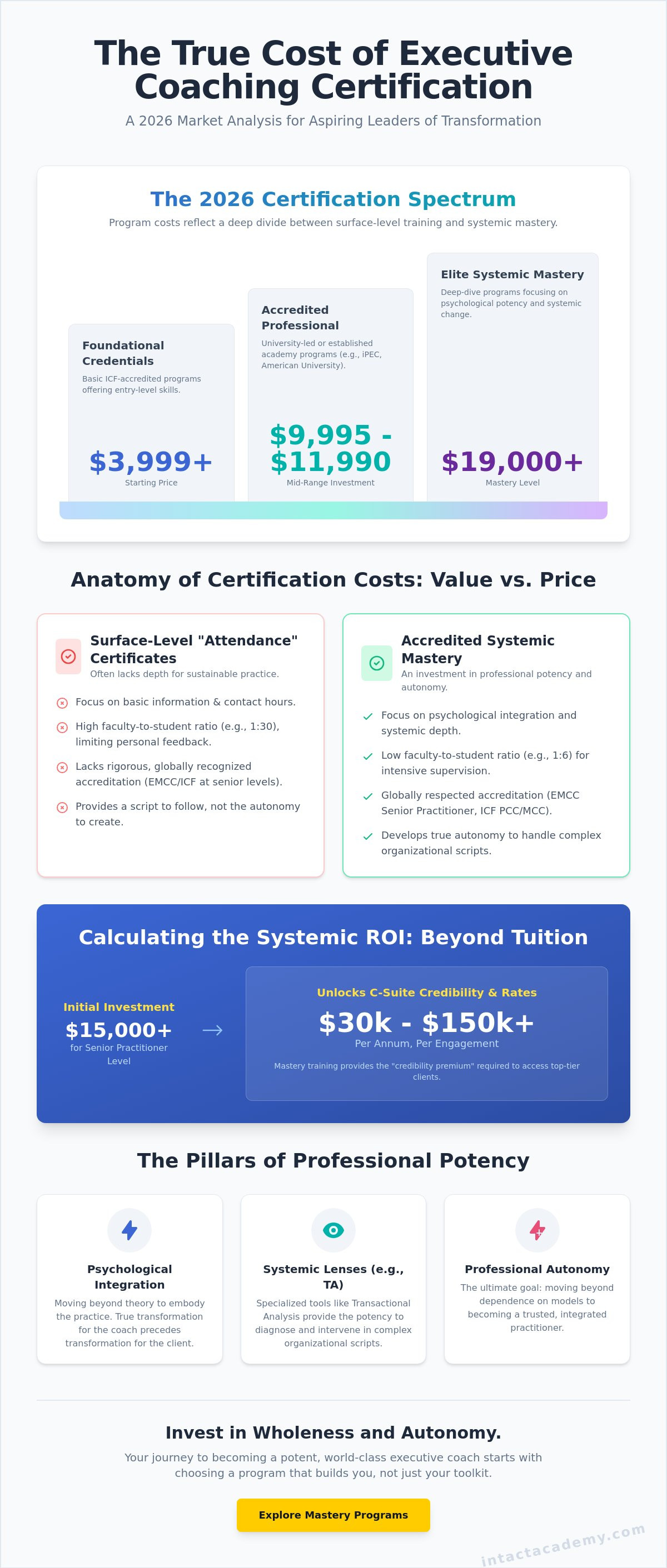
Choosing a path toward professional mastery requires more than a simple financial transaction; it's an invitation to shift your own internal script. As of May 2026, the cost of executive coaching certification spans a vast spectrum, ranging from $3,999 for foundational credentials to over $19,000 for elite, multi-level mastery programs. This variance isn't arbitrary. It reflects the deep divide between programs that offer basic information and those that provide a systemic container for profound human transformation. You aren't just buying hours; you're investing in the psychological depth required to hold space for executive change.
Modern organizations no longer settle for surface-level "attendance certificates." They demand practitioners who possess the potency to navigate systemic blocks and organizational scripts. While a virtual program at American University currently costs $11,990, and iPEC's training sits near $9,995, the true value isn't found in the hours spent on a screen. It's found in the integration of theory and practice. Coaching has evolved from a simple performance tool into a sophisticated methodology for organizational change. The financial price of entry has risen to match the increased complexity of the global business landscape.
The 2026 Market Landscape for Coach Training
Economic shifts in 2026 have bifurcated the market into two distinct paths. On one side, we see "fast-track" digital badges that offer quick entry but often lack the rigor to sustain a high-level practice. On the other, premium academies cater to those who understand that organizational agility requires deep-dive systemic work. Data from May 2026 shows that C-suite coaching engagements now command between $30,000 and over $150,000 per year. To access these tiers, a coach must demonstrate a level of professional potency that only rigorous, accredited mastery can provide. The market is increasingly unforgiving toward those who lack a solid psychological and systemic foundation.
Why Price is Often a Proxy for Program Depth
A higher tuition often signals the presence of international-level faculty and the quality of supervision provided. Programs that integrate Transactional Analysis (TA) require significant investment in specialized mentors who can guide you through the complex scripts of both individuals and systems. Tuition reflects the systemic container provided by the academy. When a program costs $15,000 or more, it typically includes the high-touch supervision necessary for a Senior Practitioner to develop true autonomy. This isn't just an expense; it's the price of building a stable foundation for the often-turbulent work of professional change. If the training is too cheap, it likely lacks the depth to change you, which means it lacks the power to help you change others.
The Anatomy of Certification Costs: Accreditation, Depth, and Rigor
The financial commitment you make is a direct reflection of the structural integrity of the learning environment. Maintaining global standards isn't a passive act; it requires a rigorous audit process that ensures every training hour meets the high bars set by the EMCC and ICF. When evaluating the cost of executive coaching certification, it's essential to distinguish between the Practitioner and Senior Practitioner levels. A Senior Practitioner program demands a higher investment because it requires more intensive supervision, greater faculty involvement, and a curriculum that moves beyond basic competencies into the realm of systemic mastery.
Faculty-to-student ratios are a primary driver of price. A program with a 1:6 ratio ensures your development is observed and refined in real-time, whereas a 1:30 ratio often leaves you with mere information rather than transformation. High-quality programs invest in international-level faculty who can provide the potency required for executive work. For a benchmark of university-led excellence, NYU's Certificate in Executive Coaching demonstrates how institutional prestige and academic rigor contribute to the overall price point.
The Role of Global Accreditation Bodies (EMCC & ICF)
Accreditation bodies like the EMCC and ICF act as the guardians of professional integrity. For an academy to maintain these credentials in 2026, they must undergo frequent, expensive audits of their curriculum and faculty. These costs are woven into your tuition. An EMCC Senior Practitioner level requires a higher investment because it validates your ability to work with complex, multi-layered organizational issues. These credentials offer global portability, allowing you to practice with authority in Edinburgh, Rome, or Poznań. You're paying for a "passport" to the global executive market.
Psychological Depth vs. Surface-Level Skills
Many programs focus on behavioral coaching, which teaches you how to change what people do. However, elite certification focuses on systemic scripts, teaching you how to change who people are. Understanding what is transactional analysis allows a coach to see the hidden psychological patterns driving organizational behavior. This depth prevents coaching burnout by providing you with the tools to handle intense executive dynamics without losing your own autonomy. It’s an investment in your own psychological safety and professional longevity. If you're seeking a path that honors this level of wholeness, exploring a senior-level academy is a vital next step.
Comparing Market Price Points: From Entry-Level to Mastery
The market for professional development is often opaque, leaving many to wonder why one program costs $4,000 while another demands $15,000. As of May 2026, the cost of executive coaching certification generally falls into three distinct tiers. Entry-level programs, often targeting Associate Certified Coach (ACC) credentials, typically range from $4,300 to $7,000. These provide the basic tools but often lack the systemic depth required for organizational change. The professional tier, aimed at those seeking Professional Certified Coach (PCC) status, moves the investment to between $7,500 and $12,000. For those pursuing the highest level of mastery, Senior Practitioner or Master Certified Coach (MCC) programs often exceed $15,000, reflecting the intensity of the supervision and the caliber of the faculty involved.
Mid-career professionals often find their "sweet spot" in programs that offer a executive coaching certification rooted in systemic impact. This level of training provides the professional potency to handle C-suite dynamics without the need to constantly "upskill" with minor workshops. While online-only programs offer convenience and lower price points, hybrid or in-person residencies in locations like Edinburgh or Rome provide a stable container for deep learning. These immersive experiences often add $2,000 to $5,000 to the total tuition but offer a return in terms of networking and psychological integration that digital spaces struggle to replicate. For a broader look at available paths, this guide to executive coach certifications offers a neutral comparison of various market providers.
Short-Term Workshops vs. Comprehensive Academies
It's tempting to piece together a certification through $2,000 workshops. However, this piecemeal approach often costs more in the long run. You lose the rhythmic, methodical build-up of a comprehensive academy. A single, all-inclusive program ensures that your training, supervision, and peer practice are integrated under a consistent theoretical lens, such as Transactional Analysis. This cohesion is what allows you to move from simply "doing" coaching to "being" a coach who can influence organizational scripts.
The Hidden Costs of Professional Accreditation
Tuition is rarely the final figure. To maintain integrity, you must account for the total cost of ownership of your credential. In 2026, mandatory expenses beyond the classroom include:
- Supervision Hours: Senior levels require extensive mentor coaching, which can range from $150 to over $500 per hour depending on the supervisor's experience.
- Application Fees: The ICF currently charges $100 for ACC, $300 for PCC, and $500 for MCC applications for members.
- Membership Dues: Professional membership in bodies like the ICF or EMCC adds approximately $245 annually.
- Specialized Masterclasses: Maintaining your "Senior" status requires ongoing education, often involving specialized modules in systemic supervision or team coaching.
If you don't budget for these elements, your path to certification may stall. True professional autonomy comes from understanding the full financial landscape before you begin your journey toward wholeness.
Calculating the Systemic ROI: Moving Beyond the Tuition Fee
True value reveals itself when your credentials move from a line on a resume to a tool for systemic impact. While the initial cost of executive coaching certification might seem high, a Metrix Global study found that executive coaching delivers a 788% return on investment (ROI). This figure isn't just about individual performance; it reflects the profound financial shift that occurs when a coach possesses the professional potency to handle C-suite complexities. When you can navigate the intricate scripts of a leadership team, you move from charging $150 per hour to bidding on retainer programs that range from $30,000 to over $150,000 per year.
The credibility premium is real. Organizations seeking practitioners for leading organizational change look for more than just hours; they look for a specific psychological depth. By mastering Agile Transactional Analysis, you provide a high ROI for corporate clients by identifying and resolving systemic blocks that stall productivity. This specialized lens allows you to intervene at the root of organizational dysfunction, ensuring that transformation is both authentic and sustainable.
Professional Potency and Client Impact
The ability to map unconscious patterns within a team is what distinguishes a senior practitioner from a transactional coach. Deep psychological insight leads to faster results because you aren't wasting time on symptoms; you're addressing the underlying script. This efficiency justifies a higher fee structure. If you can help a CEO resolve a systemic conflict in six months that has persisted for years, the value of that intervention far outweighs the cost of your training. The coach’s presence is their primary tool, and the refinement of that tool through rigorous certification is what allows for such high-impact outcomes.
The Value of a Global Professional Network
Investing in a high-level academy also grants you entry into a sophisticated global network. This isn't a mere social circle; it's a professional container that increases your value as a global citizen. Learning from a master practitioner like Sari van Poelje provides a bridge between high-level theory and the pragmatic realities of international business. This mentorship helps you integrate your learning into a stable, autonomous practice that can thrive in any market, from Edinburgh to India. Your alumni network becomes a source of referrals, collaborative opportunities, and continued supervision, ensuring your ROI continues to grow long after you've received your certificate.
If you're ready to transition from a transactional coach to a systemic leader, explore our senior-level academies to find the path that honors your potential for professional flourishing.
The Intact Academy Difference: Investing in Wholeness and Autonomy
At Intact Academy, we believe the cost of executive coaching certification should buy more than a credential; it should secure your professional autonomy. Many programs function as high-volume factories, churning out graduates who possess information but lack integration. We invite you to step into a different script. Our academies for Senior Practitioners, Team Coaches, and Supervisors are designed as stable containers where you can explore the profound intersection of individual growth and organizational success. This isn't a mere business training; it's an unfolding of your own psychological potency.
Choosing a path toward mastery requires a commitment to wholeness. While the 2026 market offers many surface-level options, our curriculum is rooted in the depth of Transactional Analysis. This systemic lens allows you to move beyond the frantic energy of typical coaching and into a space of calm, authoritative insight. By investing in a program that prioritizes human transformation, you ensure that your practice remains resilient and relevant in an increasingly complex global landscape. The return on this investment is measured in the agility of your interventions and the authenticity of your presence.
Agile Transactional Analysis as a Competitive Edge
The proprietary lens of Agile Transactional Analysis provides the psychological weight needed to thrive in the executive boardroom. While other programs teach behavioral skills, we focus on the systemic scripts that govern human behavior and organizational culture. This shift from transactional to transformational coaching is what justifies the cost of executive coaching certification for those who seek to lead at the highest levels. You'll learn to identify unconscious patterns, facilitate autonomy, and return systems to a state of wholeness. This expertise distinguishes you as a wise global mentor rather than a simple service provider.
Your Path to Mastery in Utrecht and Beyond
Our journey utilizes a rhythmic, blended learning approach that honors your intelligence and professional maturity. We combine the flexibility of virtual sessions with the grounding experience of in-person residencies in Utrecht. This methodical pace allows deep learning to take root, ensuring that complex concepts become actionable tools. Whether you're enrolling in the TA EMCC Senior Practitioner academy or pursuing systemic supervision, the process is deliberate and deeply human.
Registration for our 2026 and 2027 sessions is an invitation to join a sophisticated global community. We don't rush the process; we build a narrative arc that moves from identifying core struggles to presenting systemic solutions. If you're ready to find a program that offers systemic depth and the courage to change, we're here to guide you. Book a personal consultation today to discuss your professional fit and the investment required for your transformation.
Embracing the Path to Professional Mastery
The decision to pursue a higher credential is an invitation to rewrite your own professional script. We've seen how the cost of executive coaching certification in 2026 is a direct reflection of the psychological depth and systemic rigor provided by the academy. While basic training might offer a digital badge, true professional potency comes from a stable container that allows for deep integration and human transformation. It's the difference between merely performing a role and becoming a catalyst for organizational wholeness.
Our EMCC and ICF accredited programs, led by global expert Sari van Poelje, connect you with an international community spanning 14+ countries. This network provides the safety and support needed to handle the most turbulent executive dynamics with calm authority. You're not just buying a certificate; you're investing in a lifelong capacity for agility and insight. Explore our TA EMCC Senior Practitioner Academy and begin your journey to systemic mastery. Your transformation is the most valuable asset you'll ever possess.
Frequently Asked Questions
What is the average cost of executive coaching certification in 2026?
The cost of executive coaching certification in 2026 typically ranges from $4,344 for entry-level credentials to over $19,000 for advanced mastery. Programs like iPEC are priced near $9,995, while virtual university programs such as American University cost $11,990. These figures generally cover core tuition but often exclude external accreditation fees and mandatory mentor coaching hours.
Does a more expensive certification guarantee a higher salary as a coach?
A higher investment doesn't guarantee a specific salary, but it often provides the professional potency required to command premium rates. While the median salary for coaches is $61,710, those with the depth to handle C-suite retainers can earn over $150,000 per year. The value lies in the credibility and systemic insight that allow you to solve complex organizational issues.
Are there hidden costs beyond the initial tuition fee?
Yes, you must account for application fees, membership dues, and supervision. The ICF application fees range from $100 to $500, and annual membership is approximately $245 as of May 2026. Furthermore, senior-level certifications require specific hours of mentor coaching and systemic supervision, which are often billed separately from the main academy tuition.
Can I get an EMCC or ICF certification through a lower-cost online course?
You can obtain foundational credentials through courses starting at $3,999, but these rarely offer the depth required for Senior Practitioner status. Accreditation bodies require a specific number of supervised hours and a rigorous curriculum audit. Lower-cost options often focus on basic behavioral skills rather than the psychological integration and systemic container provided by premium academies.
Is the cost of executive coaching certification tax-deductible for professionals?
Professional training is generally considered a deductible business expense if it maintains or improves skills required in your current profession. Many practitioners deduct the cost of executive coaching certification as part of their ongoing professional development. You should consult a tax professional to confirm the specific regulations and eligibility in your local jurisdiction.
How long does it typically take to see a return on the investment of certification?
Many coaches see a full return on their investment within 12 to 18 months by transitioning to high-value project fees. With studies showing an average 788% ROI for executive coaching, the financial recovery is often swift once you secure your first organizational contract. The speed of your return depends on your ability to apply systemic tools to high-stakes leadership challenges.
What is the difference in cost between a basic coaching certificate and a Senior Practitioner academy?
Basic certificates usually cost between $4,000 and $7,000 and focus on fundamental coaching competencies. A Senior Practitioner academy requires a higher investment because it includes intensive supervision and advanced frameworks like Transactional Analysis. This price difference reflects the increased faculty-to-student ratios and the psychological depth necessary to facilitate profound human and organizational transformation.
Do academies offer payment plans or scholarships for their certification programs?
Most premium academies offer flexible payment structures to help practitioners manage their financial commitment over time. These plans allow you to align tuition payments with your professional cash flow throughout the duration of the program. Some institutions also provide partial scholarships or grants for talented individuals who demonstrate a strong commitment to systemic change and global citizenship.


