

What if the recurring conflicts in your boardroom aren't failures of individual personality, but the predictable output of an invisible systemic script? Many leaders invest in corporate team coaching programs hoping for a quick fix, yet 70% of individuals report that while performance improves, the underlying dynamics often remain untouched. You likely feel the frustration of workshops that provide a temporary morale boost but fail to address the root causes of dysfunction. It's exhausting to realize that surface-level interventions aren't reaching the actual source of your team's stagnation.
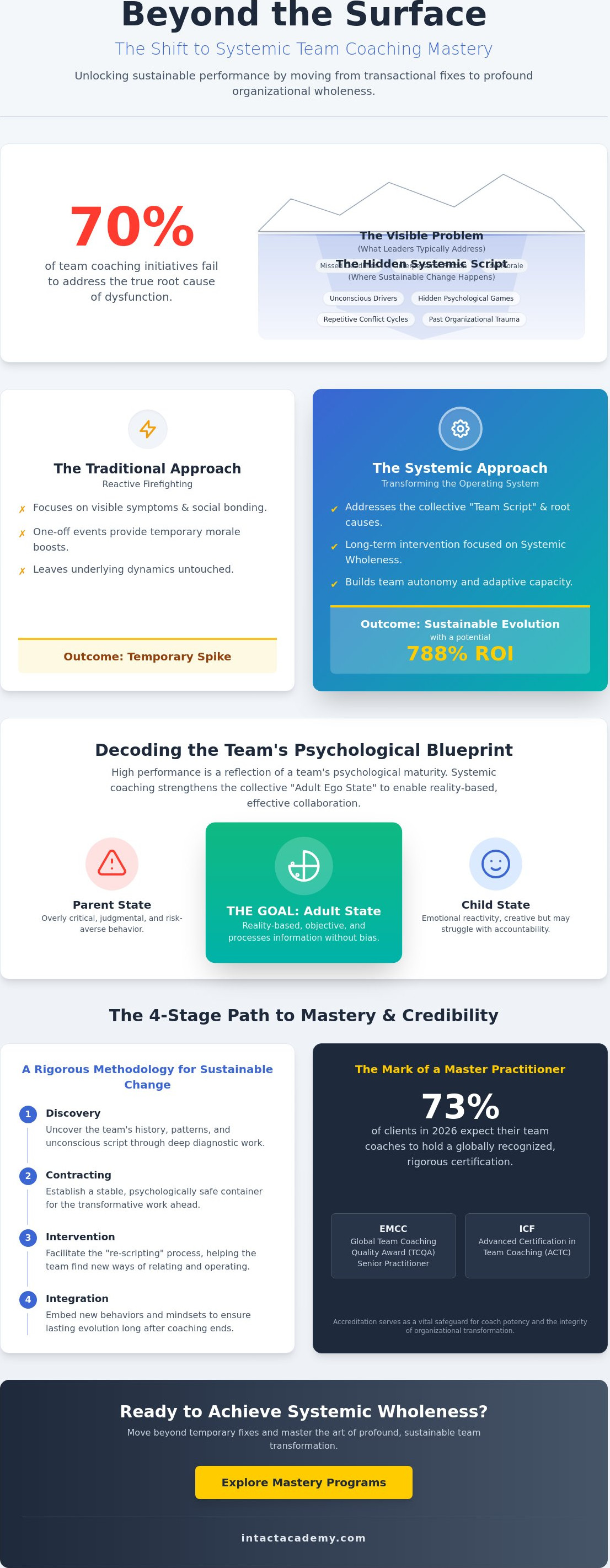
We believe that sustainable performance is a systemic symptom, not just a management objective. This guide will show you how to move beyond transactional fixes toward profound organizational wholeness through systemic team coaching mastery. You'll discover how to map team scripts and explore the rigorous path toward EMCC or ICF Senior Practitioner accreditation. We'll examine how to build a stable container for change that fosters sustainable behavioral evolution and a measurable return on investment, which industry data suggests can reach up to 788%.
Key Takeaways
- Shift your focus from surface-level team building to systemic interventions that address the unconscious "Team Script" and hidden psychological games.
- Navigate the global accreditation landscape by comparing the strategic benefits of ICF ACTC and EMCC Senior Team Coach pathways.
- Evaluate corporate team coaching programs based on their capacity to facilitate profound organizational wholeness rather than temporary performance spikes.
- Master a rigorous four-stage methodology involving Discovery, Contracting, Intervention, and Integration to ensure every coaching engagement delivers sustainable change.
- Discover how systemic supervision serves as a vital safeguard for coach potency and the long-term integrity of organizational transformation.
What Are Corporate Team Coaching Programs in 2026?
By May 2026, the leadership landscape has moved past the era of the "quick fix" workshop. Modern corporate team coaching programs represent a fundamental shift from transactional advice to systemic intervention. While traditional team building might offer a temporary boost in morale through shared activities, systemic coaching addresses the underlying architecture of how a group functions together. It's not about fixing a single broken part. It's about optimizing the entire living organism to ensure it can breathe, grow, and adapt with genuine autonomy.
There's a vital distinction to make here. Individual executive coaching focuses on the leader's personal script and professional potency. In contrast, team coaching treats the collective as the client. The goal is to move the group toward a state of wholeness where internal dynamics are so well-integrated that the team no longer requires external intervention to solve recurring conflicts. To achieve this level of depth, practitioners must adhere to global standards. As of May 2026, 73% of clients expect their coaches to hold rigorous certifications like the EMCC Global Team Coaching Quality Award or the ICF Advanced Certification in Team Coaching.
- Team Building: Often a one-off event focused on morale and social bonding.
- Executive Coaching: A one-on-one relationship focused on individual growth.
- Systemic Team Coaching: A long-term intervention that transforms the team's collective "operating system."
The Shift from Reactive to Systemic Coaching
Reactive coaching often feels like firefighting. It focuses on the visible symptoms, such as missed deadlines or interpersonal friction, without questioning why these patterns repeat. A systemic lens views the team as a single, living entity with its own history and unconscious drivers. By identifying these deep-seated organizational scripts, we can facilitate transformation that lasts long after the coaching engagement ends. Systemic Wholeness is the ultimate objective, serving as a state where the team achieves peak performance through authentic integration rather than forced compliance.
The Evolution of Team Dynamics in 2026
The rise of hybrid work and global citizenship has fundamentally altered how we experience connection. In 2026, creating psychological safety isn't just a soft skill; it's a digital-first necessity for innovation. When teams operate across time zones and screens, the need for clear communication and emotional literacy becomes paramount. This is where understanding what is transactional analysis becomes a competitive advantage. It provides the framework to navigate these complex digital interactions with clarity and grace.
The Psychological Anatomy of High-Performing Teams
High performance isn't merely a result of skill; it's a reflection of a team's psychological maturity. Beneath the surface of every organization lies a "Team Script." This is a set of unconscious decisions made by the collective to ensure survival within the corporate structure. When you observe corporate team coaching programs that fail to yield results, it's often because they only address the visible behaviors while the underlying script remains intact. We must look deeper into the ego states that drive every interaction: the Parent, the Adult, and the Child.
In a boardroom, these states manifest in ways that either foster growth or invite stagnation. A team stuck in a "Parent" ego state might be overly critical and risk-averse, while one operating from a "Child" state might struggle with accountability or emotional reactivity. The goal of systemic intervention is to strengthen the "Adult" state. This reality-based position allows the team to process information without the distortion of past biases. When a team operates from this integrated space, they find the "Permission" to innovate and the "Potency" to execute. This psychological foundation is essential if you want to implement an effective executive coaching program that actually scales across the organization.
Mapping the Team Script
Every team has a history. Past organizational failures, such as a botched merger or a sudden leadership exit, often leave a lasting imprint on the group's psyche. These events create repetitive cycles of conflict that TA tools can identify and map. The coach's role is to facilitate a "re-scripting" process. By bringing these unconscious patterns into the light, the team can consciously choose new, more autonomous ways of working together. It transforms the team from a group of individuals reacting to the past into a unified entity creating its own future.
Agile Transactional Analysis for Organizations
Modern business moves too fast for traditional, slow-moving psychological models. This is why Sari van Poelje developed a proprietary approach to Agile Transactional Analysis. It combines the deep insight of TA with the speed required in today's market. A critical component of this methodology is "Contracting." We don't just coach for "better communication." We contract for clear, observable outcomes that align with the team's strategic goals. This ensures that the psychological work translates directly into business value. If you're ready to explore these depths within your own practice, consider how a systemic approach to leadership can unlock your team's true potential.
According to industry data from May 2026, 80% of individuals who receive this level of depth in coaching report a significant increase in self-confidence and professional potency. This isn't just about feeling better; it's about the team reclaiming its capacity for authentic action.
Evaluating Team Coaching Certifications: EMCC vs. ICF
Choosing a certification path is a strategic decision that defines your professional identity and the depth of your practice. While many corporate team coaching programs offer participation certificates, true mastery requires an accreditation that reflects systemic depth. Clients in 2026 are increasingly discerning. They no longer ask if you're a coach; they ask how you've been validated to handle the complexity of their organizational scripts. This shift has placed the International Coaching Federation (ICF) and the European Mentoring & Coaching Council (EMCC) at the center of a global professionalization movement.
The value of "Senior Practitioner" status for global consultants cannot be overstated. It signals a shift from individual skill to systemic potency. While an entry-level credential might focus on basic facilitation, a senior-level accreditation proves you can hold a stable container for a team's often-turbulent work of change. The distinction between these paths often rests on a philosophical divide: is coaching a collection of hours or a demonstration of competence? One path measures the volume of your experience, while the other measures the integration of your methodology and its impact on the organizational system.
ICF Advanced Certification in Team Coaching (ACTC)
The ICF ACTC is a rigorous path designed for those who want to apply core coaching competencies to group dynamics. It requires more than 60 hours of specialized education and documentation of at least five team coaching engagements. For practitioners with a North American focus, this remains a primary benchmark. The application fee for members is $200, or $300 for non-members, provided you've completed an accredited program. It focuses heavily on the application of the ICF's eight core competencies within a team environment, ensuring a standardized level of professional ethics and practice.
EMCC Senior Team Coach Academy
The EMCC Senior Team Coach Academy path emphasizes reflective practice, supervision, and systemic impact. European and international organizations often favor this holistic approach because it requires coaches to demonstrate how they influence the entire organizational organism. To achieve the EMCC Global Team Coaching Quality Award at the Senior Practitioner level, which carries a fee of €4,195, you must engage in deep specialized training. This path prioritizes the integration of psychological frameworks like Transactional Analysis. It's a competency-based model where your ability to facilitate "Systemic Wholeness" is evaluated through continuous supervision and a portfolio of evidence that proves your transformative reach.
If you're looking to bridge the gap between individual coaching and organizational change, the choice of certification should align with your desired level of autonomy and impact. The EMCC path, in particular, offers a home for those who view the team as a living entity rather than a collection of individuals.
Implementing Sustainable Change: The Practitioner's Toolkit
Effective implementation of corporate team coaching programs requires more than just a list of activities. It demands a disciplined four-stage methodology: Discovery, Contracting, Intervention, and Integration. During the Discovery phase, we look for the hidden scripts and unconscious patterns that dictate current performance. Contracting ensures all parties are aligned on the path forward. Intervention is the active, often turbulent work of change, while Integration ensures that the team's new autonomy becomes a permanent state. Without this rhythmic structure, even the most well-intentioned efforts can falter into temporary fixes.
One of the most common pitfalls when leading organizational change is failing to account for the emotional weight of the transition. Many leaders measure success through surface-level "happiness surveys," yet true ROI is found in tangible metrics like increased productivity and employee retention. Verified data from May 2026 shows that executive coaching can yield a return on investment of up to 788%. This level of impact is only possible when the practitioner uses a toolkit grounded in psychological depth and professional pragmatism.
The Power of Systemic Supervision
In the high-pressure environment of a boardroom, it's remarkably easy for a coach to get "hooked" into the team's psychological games. Systemic supervision acts as a vital container for the coach's own development and potency. It provides a reflective space to examine the dynamics at play, ensuring the coach remains an objective catalyst for change rather than an unwitting participant in the team's dysfunction. For those at the pinnacle of their careers, the TA EMCC Senior Supervisor academy represents a peak goal, offering the methodology to support other practitioners in this demanding work. As of 2026, EMCC standards require a minimum of one supervision session per quarter to maintain accreditation integrity.
Contracting for Hard and Soft Results
Sustainable change begins with clear, unyielding boundaries. We move away from vague aspirations toward concrete systemic shifts that are both observable and measurable. This process necessitates involving all key stakeholders from the outset. A central tool in this stage is the "Triangular Contract," a three-way agreement between the coach, the team, and the organization. This contract ensures that the psychological work of the team aligns perfectly with the strategic needs of the business. It creates a stable foundation where individual growth and organizational success are inextricably linked.
If you're ready to deepen your professional impact and master these systemic tools, explore our TA EMCC Senior Team Coach Academy to begin your journey toward mastery.
Intact Academy: Mastery in Systemic Team Coaching
Intact Academy stands as a stable container for those ready to transcend traditional leadership training. Our TA EMCC Senior Team Coach Academy offers one of the most rigorous corporate team coaching programs available today, blending 80 hours of intensive training with 16 hours of dedicated supervision. This hybrid model combines the flexibility of online learning with the profound connection of in-person sessions in Utrecht. It's a space where high-level theoretical frameworks meet direct, punchy directives, and where professional pragmatism meets psychological depth.
The core of our curriculum is the signature philosophy of Wholeness. We believe that true transformation isn't about adding new skills to a broken system but about returning to a state of authenticity and integration. This thematic North Star guides all our team coaching courses, ensuring that every intervention moves the team toward greater autonomy and potency. By focusing on the unfolding of the collective, we help practitioners identify the core human struggles that prevent organizational flourishing.
A Global Community of Systemic Experts
Participants from more than 14 countries join our cohorts, creating a rich tapestry of global citizenship and diverse organizational experience. You'll network with senior practitioners and consultants who are equally committed to the courageous work of change. Under the mentorship of Sari van Poelje and her international faculty, you'll gain the insights needed to navigate complex boardroom dynamics with calm authority. We provide the structured methodology required to obtain prestigious international certifications, including those from the ICF, EMCC, and EATA, positioning you as a leader at the intersection of psychology and business.
Your Path to Senior Team Coach Mastery
Enrollment is now open for our 2026 cohort. We invite you to apply for an initial consultation or join an upcoming info session to see if this path aligns with your professional evolution. The journey toward mastery is deliberate and rhythmic, mirroring the deep learning process itself. It requires a commitment to looking inward before taking outward action, ensuring that your growth as a coach parallels the success of the teams you lead.
As you reflect on the future of your practice, consider this: is your team ready to move from survival to autonomy? If you're prepared to facilitate profound human transformation and return your organization to its most authentic state, we're here to provide the stable ground for your unfolding.
Embracing the Path to Systemic Wholeness
The journey from reactive problem-solving to systemic mastery requires a fundamental shift in how we perceive organizational life. True transformation isn't found in temporary workshops but in the deep, rhythmic work of re-scripting the collective. By integrating the psychological depth of Transactional Analysis with the professional pragmatism of modern business, you can lead teams toward authentic autonomy. Choosing the right corporate team coaching programs is the first step in building a stable container for this profound human evolution.
Whether you're navigating the rigorous requirements of the ICF or seeking the holistic standards of the EMCC, your path forward should be grounded in integrity and systemic insight. At Intact Academy, we support this unfolding under the mentorship of world-renowned expert Sari van Poelje. Our community brings together senior practitioners from more than 14 countries, all committed to the highest standards of ICF and EMCC accredited excellence. This is where your professional potency meets a global standard of care and expertise.
Is your practice ready to move beyond the surface? Elevate your impact with the TA EMCC Senior Team Coach Academy and discover the power of leading from a state of wholeness. We look forward to supporting your professional flourishing as you guide others toward their own state of integration.
Frequently Asked Questions
What is the difference between team coaching and group coaching?
Team coaching treats the collective as a single living organism working toward a shared purpose and common goals. Group coaching, by contrast, focuses on individuals who share a learning objective but don't necessarily work together. In 2026, 38% of organizations now offer these distinct interventions to mid-level managers to foster broader systemic agility and collective intelligence.
How long does a typical corporate team coaching program last?
A typical engagement spans six to twelve months to allow for deep systemic shifts to take root within the organization. Short-term workshops often fail because they don't address the underlying team script or unconscious patterns. Sustainable transformation requires a rhythmic process of discovery, intervention, and integration over several quarters to ensure behavioral changes are permanent.
Do I need an existing coaching credential to join a team coaching program?
Most senior-level corporate team coaching programs require either a foundational coaching qualification or significant leadership experience. For instance, the EMCC Senior Practitioner path is designed for those who already possess a high level of professional potency. It's about moving beyond basic facilitation to mastering complex organizational dynamics and systemic wholeness.
Can team coaching be done effectively in a remote or hybrid environment?
Digital delivery is highly effective, as 98.3% of professional coaches successfully adopted online models between 2019 and 2021. By May 2026, 85% of coaches prefer virtual or hybrid sessions. These models allow for real-time observation of digital communication patterns and the development of psychological safety within a distributed or global work environment.
What is the role of Transactional Analysis in corporate coaching?
Transactional Analysis serves as a precise psychological lens to identify unconscious boardroom "games" and limiting ego states. It allows the coach to map the team script and facilitate a return to authenticity. By understanding these transactions, teams can move from reactive, child-like patterns to autonomous, adult-to-adult interactions that drive innovation.
How do we measure the success of a team coaching intervention?
Success is measured through a combination of tangible financial ROI and observable behavioral shifts. Research indicates that executive and team coaching can generate a return on investment of up to 788%. We also track the reduction of repetitive conflict cycles and the increase in team potency through structured metrics defined during the initial contracting phase.
Is EMCC or ICF certification better for my career?
Both certifications offer significant global credibility, but they differ in their philosophical focus. The ICF is widely recognized in North American markets and emphasizes core coaching competencies. The EMCC is highly valued in Europe and internationally for its emphasis on systemic impact and reflective supervision. In 2026, 73% of clients expect a formal certification from one of these bodies.
What happens if a team member refuses to participate in coaching?
Resistance from a team member is treated as a vital piece of systemic data rather than a failure of the process. It often signals a lack of safety or an unvoiced conflict within the team script that needs addressing. We handle this through careful "triangular contracting," ensuring every individual feels the psychological safety necessary to move toward organizational wholeness.


