

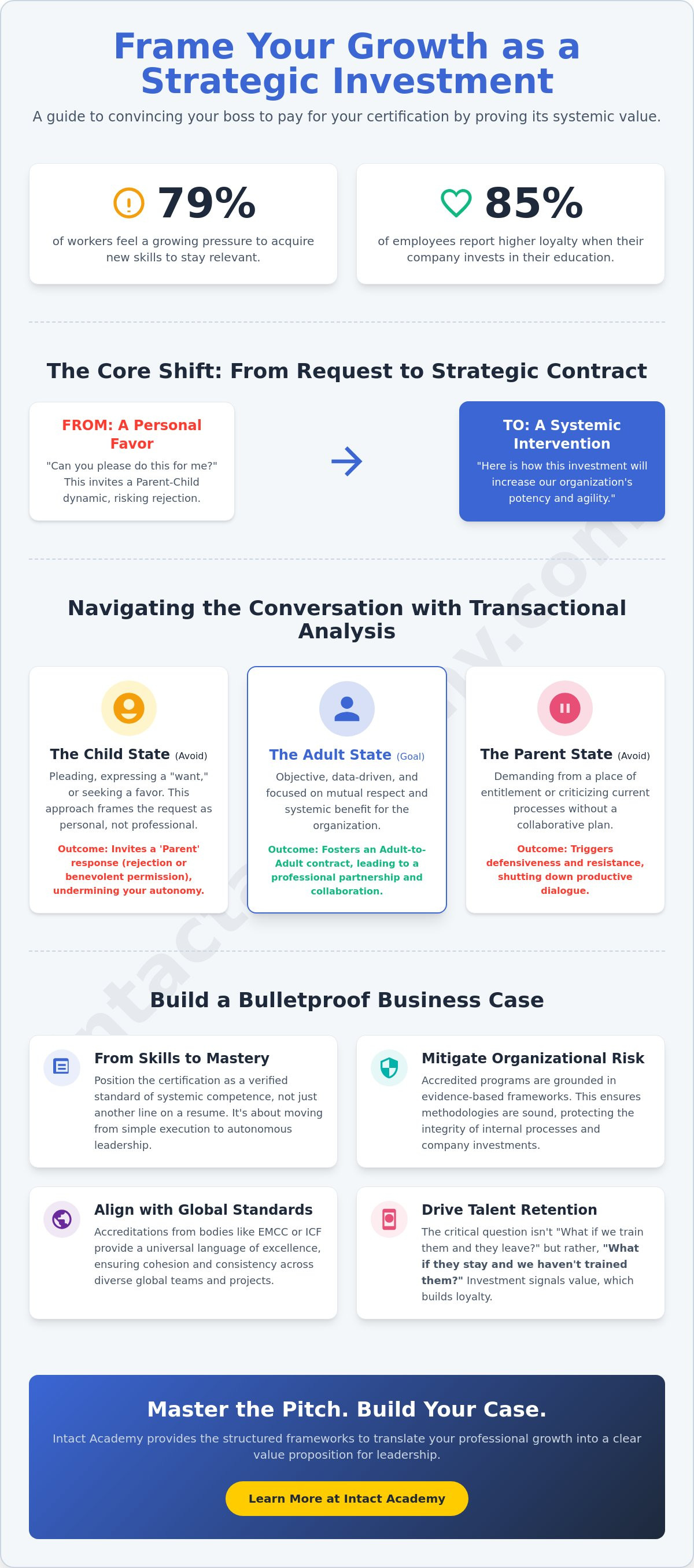
What if your request for professional development wasn't a personal favor, but a strategic intervention to increase your organization's systemic potency? While 79% of workers feel a growing pressure to acquire new skills, many hesitate to ask for funding because they fear rejection or struggle to quantify the human ROI of professional transformation. You might feel that your growth is a private ambition, yet 85% of employees report higher loyalty when their company invests in their education. To convince boss to pay for certification, you must move beyond the role of a passive seeker and step into your autonomy as a vital company asset.
We promise to help you master a structured negotiation framework that reframes your certification as a systemic investment in organizational agility. You'll learn how to align your professional growth with larger company goals, ensuring your boss recognizes your development as a catalyst for reduced cultural friction. We will examine how to leverage the 2026 shift toward skills-first strategies and the latest legal protections for employee mobility. This guide provides you with the clarity and potency needed to secure the funding you deserve while building a more mature, collaborative relationship with your leadership.
Key Takeaways
- Redefine professional development as a verified standard of mastery that enhances organizational potency rather than just personal growth.
- Apply the principles of Transactional Analysis to maintain an Adult ego state during negotiations, ensuring your request is received with professional respect.
- Build a robust business case that uses a structured framework to convince boss to pay for certification by highlighting both tangible efficiency and intangible cultural ROI.
- Utilize high-impact scripts and executive summary templates designed to translate professional aspirations into a clear, punchy value proposition for leadership.
- Transition from a transactional view of training to a systemic integration of psychology and business that fosters long-term organizational agility.
The Business Case for Mastery: Why Certifications Matter in 2026
In the current professional landscape, a professional certification is far more than a decorative credential; it is a verified standard of systemic competence. We have moved beyond the era of surface-level skill-gathering. In 2026, organizations require deep mastery to navigate the complexities of global markets and internal shifts. When you attempt to convince boss to pay for certification, you are essentially asking them to invest in a higher level of organizational potency. You are offering to move from a state of simple execution to one of autonomous leadership and systemic insight.
Choosing an accredited path mitigates risk. It ensures that the methodologies applied within the company are grounded in evidence-based psychological frameworks. This protection is vital for maintaining the integrity of internal processes. If a professional lacks this groundedness, the system risks stagnation. If they possess it, the system gains the agility needed to transform. Mastery provides the stable container required for the turbulent work of professional and organizational change.
The Rise of International Standards (EMCC and ICF)
Global accreditations from bodies like the EMCC or ICF act as a seal of quality that protects a company's financial and temporal investment. There is a fundamental difference between a weekend course and a rigorous academy program. An academy focuses on the integration of identity and practice, ensuring the professional doesn't just "know" the material, but "is" the material. For organizations operating across borders, these international standards provide a universal language of excellence. This commonality is essential for facilitating cohesive organizational change and ensuring that team coaching or supervision remains consistent across diverse global branches.
Certification as a Talent Retention Strategy
Investing in professional development is a powerful antidote to burnout and stagnation. Statistics from early 2026 show that 85% of employees feel significantly more loyal to employers who fund their continuing education. This creates a robust psychological contract; the company acknowledges the individual's value, and the individual returns that value through increased commitment and potency. Leaders often ask, "What if they leave after we train them?" The more pressing question for a healthy system is, "What if they stay and we haven't trained them?" To convince boss to pay for certification, highlight that the cost of stagnation and the subsequent loss of institutional knowledge far outweighs the investment in a practitioner's growth.
Navigating the Conversation: A Transactional Analysis Approach
The shift from a simple request to a professional contract begins with deep self-awareness. In Transactional Analysis, we recognize that every workplace interaction stems from one of three ego states: Parent, Adult, or Child. When you prepare to convince boss to pay for certification, the internal state you bring to the table determines the outcome. A 'Child' request often sounds like pleading for a favor, which invites the boss to respond from a 'Parent' state of either benevolence or rejection. Conversely, a 'Parent' demand rooted in entitlement can trigger a defensive reaction. To foster a partnership, you must ground yourself in the Adult ego state, focusing on objective data, mutual respect, and systemic benefit.
Adult-to-Adult contracting is the foundation of professional growth. It moves the dialogue away from psychological games like "Yes, But," where a boss offers an alternative and the employee immediately finds a reason it won't work. By staying in your Adult state, you avoid these circular traps. You present the certification not as a personal "want," but as a strategic "need" for the organization's evolution. Developing this level of relational agility is a core component of our executive coaching certification, which bridges the gap between psychological theory and professional impact.
The Art of Professional Contracting
Success requires setting clear boundaries before the meeting begins. If you enter the room with a firm understanding of your value, then the negotiation becomes a shared exploration of potential. Use "if-then" scenarios to demonstrate commitment: "If the company invests in this Senior Practitioner academy, then I will implement a new systemic supervision framework by the third quarter of 2026." This approach maintains the "I'm OK, You're OK" stance, signaling that you value the company's resources as much as your own development. It transforms the conversation from a cost-centered debate into a value-driven agreement.
Overcoming Resistance Through Empathy
Resistance is rarely about the money itself; it's often about the boss's internal scripts or fears. Perhaps they fear that your increased autonomy will lead to your departure, or they're under pressure to meet specific KPIs. Use active listening to uncover the real objection. Is it the 15-month time commitment, or is it a lack of clarity on the ROI? When you convince boss to pay for certification, you must reframe your request to mirror their goals. If their priority is team retention, show how your training will reduce the cultural friction that leads to turnover. By meeting their systemic needs, you make the approval of your request the only logical choice for the organization's flourishing.
Building Your Systemic ROI Framework
To effectively convince boss to pay for certification, you must shift the narrative from personal gain to systemic efficiency. If you view your growth as an isolated event, the organization sees a cost; if you view it as a systemic upgrade, they see an investment. Transactional Analysis offers a unique lens to identify the "hidden costs" of organizational friction. Consider the hours lost to misaligned communication or the energy drained by unresolved conflict. By integrating TA principles, you provide the tools to dissolve these blockages, allowing the entire system to function with greater potency and clarity.
ROI is best presented through a dual lens of tangible and intangible assets. Tangible returns include increased productivity and the retention of high-potential talent. Intangible returns, though harder to measure on a spreadsheet, are often more impactful. They include the unfolding of psychological safety and the strengthening of the corporate culture. A structured framework for tracking these shifts after the certification begins ensures that the investment remains visible and valued throughout the 15-month journey of transformation. This approach moves the conversation beyond "I will work better" to "the system will function more efficiently."
Quantifying the Intangible: Culture and Agility
A deep understanding of systemic organizational change directly correlates with reduced project failure rates. Organizations that prioritize psychological agility see a 20% increase in team performance according to 2026 industry benchmarks. When you pursue a team coaching certification, you aren't just learning to lead; you're learning to diagnose and heal the dysfunctional dynamics that cost companies thousands in lost time. This level of executive presence is indispensable in high-stakes stakeholder management, where the ability to remain grounded in an Adult state determines the success of complex negotiations.
The Multiplier Effect: Internal Knowledge Transfer
Your certification should act as a catalyst for wider organizational learning. Propose a "Lunch and Learn" series where you translate complex TA concepts into actionable scripts for your colleagues. By acting as an internal consultant for culture assessments, you reduce the company's reliance on expensive external firms. This shift creates a self-sustaining cycle of growth. If you can demonstrate that your training will eventually save the company the cost of external supervision or change management consultants, you make it much easier to convince boss to pay for certification. You become the bridge between psychological depth and practical business results.
The Pitch: Scripts and Templates for Approval
To successfully convince boss to pay for certification, your pitch must be a distillation of systemic value rather than a list of personal benefits. Start with a single, potent value proposition: "This certification empowers me to diagnose and resolve underlying team dysfunctions through a verified psychological lens, directly increasing our organizational agility and project success rates." This sentence shifts the focus from your education to the company's evolution. It signals that you're operating from an Adult ego state, looking at the business as a living system that requires specialized care to flourish.
Your written request should follow an "Executive Summary" approach. Busy leaders don't have the capacity for long-winded justifications. They need to see the "why," the "how," and the "what" in a punchy, professional format. Timing is equally critical. Don't send your proposal during a high-stress quarterly close or immediately after a budget cut. Instead, wait for a moment of stability or following a successful project where your current skills were highlighted. If the answer is "not now," don't retreat into a Child ego state of disappointment. Maintain your autonomy by asking, "What specific systemic milestones should we reach before we revisit this investment in the next budget cycle?"
The 'Systemic Impact' Email Template
When drafting your email, frame professional development for coaches as a strategic move to bring high-level expertise in-house. Highlight that the program is accredited by the EMCC, a global standard that ensures the quality of the investment. Link specific modules, such as team coaching or systemic supervision, to current company pain points. For instance, if the organization is struggling with "siloed thinking," explain how the academy's focus on Transactional Analysis provides the tools to break down these communication barriers. This level of specificity shows you've considered the company's script, not just your own.
Preparing for the Q&A Session
Expect questions about the 15-month time commitment. Have a "performance maintenance" plan ready that demonstrates how you'll balance your unfolding studies with your current responsibilities. In the 2026 legal landscape, particularly with California’s AB 692 prohibiting most "stay-or-pay" agreements since January 1, 2026, the conversation should focus on loyalty and engagement rather than legal handcuffs. If budget is a firm barrier, propose a cost-sharing model or a phased payment plan. Compare the depth of an accredited academy to shorter, surface-level courses to emphasize that quality mastery always yields a higher systemic ROI than quantity-based training. Ready to take the next step in your professional unfolding? Explore our TA EMCC Senior Practitioner academy to find the right fit for your career trajectory.
Investing in Wholeness: Why Intact Academy is the Logical Choice
Choosing a training provider is a strategic decision that reflects the level of maturity you wish to bring to your organization. Intact Academy offers a unique synthesis of psychological depth and professional pragmatism, moving beyond surface-level coaching into the realm of profound human transformation. When you convince boss to pay for certification, you aren't just selecting a course; you're choosing a partnership that values wholeness and authenticity. Our philosophy, led by Sari van Poelje and a faculty of international experts, centers on the integration of the individual's inner script with the outer demands of the corporate system. This ensures that every insight gained is grounded in reality and ready for immediate application.
The executive coaching certification serves as a rigorous path to systemic mastery. We employ an "Agile TA" approach, which translates the complex frameworks of Transactional Analysis into punchy, actionable directives for the modern workplace. This methodology allows you to address the root causes of organizational friction rather than merely treating the symptoms. By fostering autonomy and potency within yourself, you become a catalyst for the flourishing of the entire system. It's a journey of unfolding that benefits both the practitioner and the enterprise.
Accreditation That Carries Weight
Our academy provides clear pathways through the EMCC Senior Practitioner and Team Coach Academy programs, ensuring your credentials meet the highest global standards. We foster a diverse learning environment with a network of professionals spanning 14 countries, offering a rich, international perspective on systemic change. Deeply understanding what is transactional analysis gives you a unique competitive edge. It provides you with a precise vocabulary to describe and transform the invisible dynamics that govern team behavior, making you an indispensable asset to any leadership team.
Next Steps: From Proposal to Enrollment
To successfully convince boss to pay for certification, move the conversation from abstract theory to concrete collaboration. Invite your manager to a discovery call with our Academy directors to answer any technical questions regarding the 15-month commitment or specific learning outcomes. Review the curriculum together to align the program modules with your current departmental goals. This collaborative approach reinforces the Adult-to-Adult contract you've built and ensures the investment is viewed as a shared organizational victory. Explore our Academy programs and download the brochure for your manager to start your journey toward professional wholeness today.
Stepping Into Your Systemic Potency
The journey from professional aspiration to organizational transformation requires more than a simple request. It demands a shift in identity. You now possess the framework to reframe your development as a strategic asset and the psychological agility to maintain an Adult ego state during high-stakes negotiations. By anchoring your request in systemic ROI rather than individual perks, you invite your leadership into a narrative where your personal growth becomes a catalyst for the company's collective flourishing.
When you are ready to convince boss to pay for certification, you need a partner that understands the intersection of psychology and business. Our EMCC and ICF accredited programs are led by global TA expert Sari van Poelje and bring together participants from 14+ countries. These academies provide the intellectual rigor and practical potency required to navigate the complexities of organizational life.
Request a Program Brochure to Share with Your Manager to begin your unfolding. Embrace the courage to change and return to a state of professional wholeness that elevates your entire organization.
Frequently Asked Questions
How do I ask my boss to pay for a certification if there's no set training budget?
If your company lacks a dedicated training budget, you should propose the funding as a strategic investment drawn from operational or project-specific funds. Managers often have discretionary budgets for improving team performance or reducing turnover. By linking the certification to a specific business problem, you move the request from an HR line item to a direct business solution.
What should I do if my boss says the certification is too expensive?
When a boss cites high costs, you should offer a phased payment plan or a cost-sharing model to lower the immediate financial barrier. Emphasize that the long-term cost of organizational dysfunction far exceeds the one-time investment in mastery. You can also compare the depth of an academy program to the recurring costs of hiring external consultants to solve the same systemic problems.
How can I prove the ROI of a coaching certification like Transactional Analysis?
To convince boss to pay for certification, you must quantify the soft skills of Transactional Analysis by linking them to reduced project failure rates and a 20% increase in team performance. Highlight how resolving communication scripts prevents the hidden costs of workplace friction. This systemic approach demonstrates that the ROI isn't just for you, but for the entire organizational structure.
Is it better to ask for certification funding during a performance review?
A performance review is an ideal time to ask, provided you frame the certification as the primary tool for achieving your next set of KPIs. Use the review to establish an Adult-to-Adult contract regarding your future role within the company. This ensures your growth is seen as a commitment to the organization's long-term strategy rather than a fleeting personal interest.
How do I handle a 'clawback' agreement if my company pays for my training?
You should approach clawback discussions with an understanding of the current legal landscape, such as California’s AB 692 which restricts these agreements as of January 1, 2026. Focus on the psychological contract instead of legal penalties. Proposing a knowledge-transfer plan, where you share your learning with the team, often provides the security employers seek without the need for restrictive stay-or-pay clauses.
What are the most important EMCC levels to mention to an employer?
The most impactful levels to mention are the EMCC Senior Practitioner and Team Coach designations. These levels signal that you've moved beyond basic coaching skills into systemic mastery and organizational change. They represent a verified international standard that ensures the company is investing in a professional capable of managing high-stakes, complex human dynamics.
How much time should I expect to spend on an EMCC Senior Practitioner program?
You should expect to dedicate approximately 15 months to a comprehensive EMCC Senior Practitioner program. This deliberate pacing allows for the deep integration of theory and practice, ensuring the transformation is sustainable. It's not a quick fix; it's a methodical unfolding of professional potency that respects the maturity of the practitioner and the complexity of the organization.
Can I get my company to pay for coaching supervision as well?
Yes, you can convince boss to pay for certification and supervision by framing supervision as essential risk mitigation and quality control. Systemic supervision ensures that the coaching provided remains ethical and effective, protecting the organization's investment in its people. It provides a stable container for continuous learning, which is vital for maintaining high performance in turbulent environments.


