

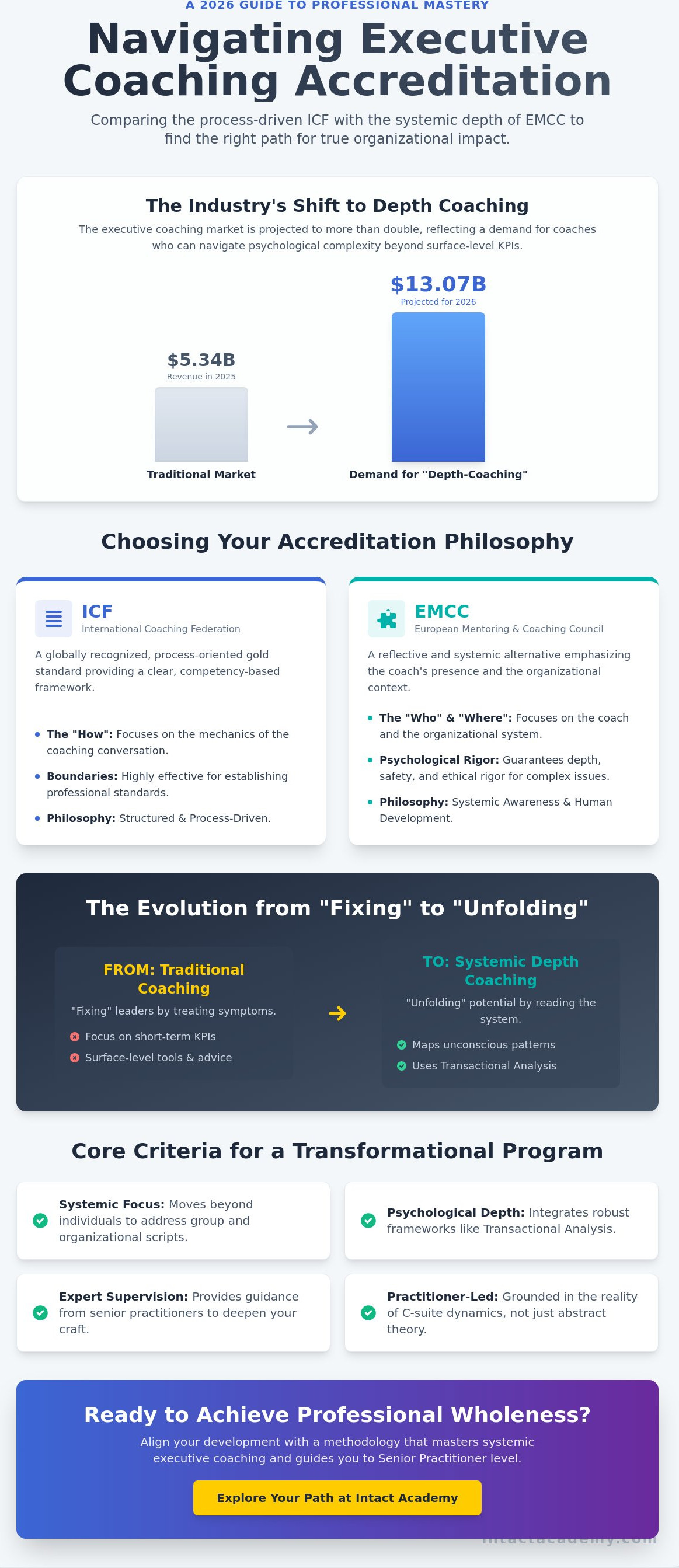
The most sophisticated leadership tools often fail because they treat symptoms while ignoring the underlying organizational script. If you've felt that traditional, surface-level coaching models crumble within complex corporate environments, you aren't alone. With the executive coaching certification programs market projected to reach $13.07 billion in 2026, the industry is saturated with options that promise results but often lack the psychological depth required for true systemic transformation. You're likely seeking a path that moves beyond checkboxes toward a state of professional potency and wholeness.
This guide provides the clarity you need to evaluate global credentials, comparing the process-focused ICF pathways with the reflective EMCC standards. We'll examine how to select a program that offers a sophisticated toolkit grounded in Transactional Analysis. You'll discover how to transition from a foundational coach to a Senior Practitioner capable of mapping unconscious patterns and shifting organizational dynamics. It's time to align your professional development with a methodology that honors both human complexity and organizational agility.
Key Takeaways
- Discover why the 2026 landscape favors depth-coaching, requiring executive coaching certification programs that move beyond surface-level tools to address systemic patterns.
- Compare the global standards of the ICF and EMCC to determine which accreditation body best honors your commitment to professional autonomy and psychological rigor.
- Learn how Transactional Analysis provides a unique lens for identifying the unconscious scripts that shape both individual leadership and collective corporate culture.
- Establish clear criteria for selecting a program that offers the supervision and faculty expertise necessary to guide you toward a state of professional wholeness.
Navigating the Landscape of Executive Coaching Certification Programs in 2026
The journey toward professional mastery is rarely a straight line. It's a deliberate process of integration that requires more than a collection of leadership tools. In 2026, the landscape for executive coaching certification programs has matured, reflecting an industry that reached $5.34 billion in revenue the previous year. This growth signals a shift in what organizations demand from their advisors. Certification is no longer viewed as a simple merit badge; it's understood as a multifaceted journey involving rigorous theory, intensive practice, and the grounding presence of systemic supervision. For the serious professional, achieving executive coaching certification acts as a pillar of identity, distinguishing those who provide surface-level advice from those who facilitate deep, lasting change.
We are witnessing a profound move toward "depth-coaching" over traditional performance-based models. While early coaching iterations focused heavily on short-term KPIs, the modern executive requires a partner who understands the psychological undercurrents of the boardroom. This shift demands that practitioners move beyond foundational certificates into advanced academies that prioritize the coach's own development as much as their methodology. If you seek to influence the highest levels of an organization, your training must match the complexity of that environment.
The Evolution of Executive Leadership Development
The role of the coach has expanded into systemic organizational stewardship. We've moved away from the outdated desire to "fix" leaders, opting instead for a philosophy of unfolding their inherent potency. This approach acknowledges that every leader operates within a larger script. By using Executive coaching as a lens for systemic insight, you can help clients identify the invisible patterns that drive their behavior. High-quality executive coaching certification programs now frequently integrate Agile methodologies, ensuring that these deep psychological transformations remain responsive to the rapid cycles of global business. It's about fostering agility through authenticity.
Distinguishing Between Academic and Practitioner-Led Paths
Choosing your path requires a reflection on your professional trajectory. University-backed programs offer undeniable prestige and a solid theoretical base. However, practitioner-led academies often provide more robust professional development for coaches because they're rooted in the visceral reality of organizational life. These programs focus on the core competencies required to coach the C-Suite, such as managing the intensity of power dynamics and holding space for organizational anxiety. If your goal is leading organizational change, you need a training environment that values psychological depth and community over abstract academic requirements. This ensures your toolkit is as pragmatic as it is profound.
Evaluating Accreditation: ICF vs. EMCC and the Path to Senior Practitioner Level
Choosing between accreditation bodies is a decision of both professional strategy and personal alignment. For many, the International Coaching Federation (ICF) represents a widely recognized, process-oriented gold standard. It provides a clear, competency-based framework that is highly effective for establishing professional boundaries. However, as the 2026 market matures, many experienced leaders find that the European Mentoring and Coaching Council (EMCC) offers a more reflective and systemic alternative. While the ICF focuses heavily on the "how" of the coaching conversation, the EMCC emphasizes the "who" of the coach and the "where" of the organizational system. These executive coaching certification programs aren't merely different paths to the same destination; they represent distinct philosophies of human development.
Senior executives increasingly prefer coaches who possess an accredited background because it guarantees a level of psychological safety and ethical rigor. This preference is rooted in the complexity of the modern boardroom. A coach must be able to hold the tension of conflicting organizational needs without losing their own center. Much like the science-based approach found in Harvard's executive coaching program, global accreditation ensures that a practitioner has moved beyond intuition into a structured, evidence-based methodology.
The Rigor of the EMCC Senior Practitioner Pathway
Attaining the Senior Practitioner level requires a significant commitment to both practice and self-reflection. Unlike foundational levels, this pathway demands a minimum of 500 hours of coaching practice across a diverse range of clients. It also requires a documented journey of reflective learning, where the coach analyzes their own internal scripts and systemic impact. This accreditation validates a coach’s ability to work with complex organizational dynamics, proving they can navigate the "unspoken" rules of corporate culture. The Senior Practitioner level stands as the benchmark for global executive coaching excellence.
Why Accreditation Bodies Matter for Corporate Credibility
Global organizations use ICF and EMCC standards as a primary vetting mechanism for external consultants. These bodies provide essential ethical safeguards, ensuring that the coach operates with integrity and transparency. For the coach, this alignment translates into professional potency and market trust. At Intact Academy, we align our curricula with these global standards to ensure our graduates possess both the psychological depth of Transactional Analysis and the professional standing required by the C-Suite. If you're ready to deepen your impact, exploring a specialized practitioner academy can provide the stable container needed for this transformation.
A critical distinction in this journey is the role of "Mentor Coaching" versus "Supervision." Mentor coaching, often associated with the ICF, focuses on sharpening specific coaching skills to meet credentialing requirements. Supervision, a cornerstone of the EMCC approach, is a more systemic and psychological process. It provides a space for the coach to explore their own reactions to a client and the broader organizational patterns at play. This distinction is vital; while mentoring helps you do the work, supervision helps you understand the work on a profound level.
Beyond Surface-Level Skills: Why Systemic Depth and Transactional Analysis Matter
While many executive coaching certification programs focus on behavioral checklists, true transformation happens when we address the "script" of the individual and the organization. Understanding what is transactional analysis allows a coach to see the hidden architecture of human interaction. It's a shift from asking "what happened?" to "what is the pattern here?" By looking beneath the surface, you begin to see that most corporate friction isn't about personality clashes, but about unaddressed systemic echoes. This perspective allows the coach to remain a calm, steady presence amidst organizational turbulence.
In the corporate environment, these patterns manifest as "Life Scripts", unconscious plans formed early in life that dictate how a leader handles power, conflict, and success. When these scripts collide with an organization's culture, the result is often stagnant growth or chronic turnover. Systemic team coaching moves beyond the individual to address these collective scripts, treating the team as a single living organism rather than a collection of parts. Understanding What it takes to become a successful executive coach in 2026 involves mastering this ability to navigate deep psychological waters while maintaining professional pragmatism. It's a journey from being a facilitator to becoming a catalyst for wholeness.
Mapping Unconscious Patterns in Organizations
Within the executive context, we utilize the framework of Ego States to bring clarity to chaotic interactions. Is a leader operating from a "Parent" state, perhaps being overly critical or restrictive? Or are they in a "Child" state, reacting with compliance, rebellion, or creative impulsivity? The goal is to return to the "Adult", the state of objective, present-centered awareness where effective decisions are made. By identifying "Psychological Games", those repetitive, unproductive interactions that follow a predictable path to a negative payoff, a coach can help a leadership team break cycles of blame and move toward collaborative potency. Systemic mapping further visualizes these hidden power dynamics, allowing the team to see the system they are actually part of, rather than the one they imagine.
The Role of Agile Transactional Analysis in 2026
Modern organizations move too fast for static models or rigid interventions. This is where Agile Transactional Analysis becomes essential. This proprietary framework, pioneered by Sari van Poelje, bridges the gap between deep psychological insight and the need for rapid, sustainable transformation. It's a method that allows coaches to stay flexible and responsive without losing their intellectual rigor. By integrating these concepts, executive coaching certification programs prepare practitioners to handle the high-stakes, often turbulent work of organizational evolution with a sense of quiet power. You aren't just teaching leaders how to lead; you're helping them rediscover their autonomy within the system.
Selection Criteria: How to Match a Program to Your Professional Trajectory
Choosing the right path for your development requires an honest assessment of your current professional identity. Are you an internal HR leader tasked with shifting a stagnant culture, or a seasoned consultant seeking to deepen your systemic impact? Your choice of executive coaching certification programs should mirror the complexity of the environments you inhabit. If you're transitioning from a different field, you might prioritize a program that provides a foundational structure. If you're already established, you likely need a program that challenges your existing scripts and expands your professional potency. True mastery isn't about collecting more tools; it's about refining the instrument that is yourself.
The pedigree of the faculty is a critical factor. Look for mentors who haven't only studied theory, but have spent decades leading organizational change within global enterprises. This real-world experience ensures the program acts as a stable container for deep personal reflection. It's equally vital to confirm that the curriculum includes consistent, professional supervision. Supervision is the safeguard of our profession; it's the space where you examine your reactions to the system and ensure you're operating from a place of Adult autonomy rather than unconscious bias.
The Importance of a Global Peer Network
Modern leadership development doesn't happen in a vacuum. Learning alongside participants from diverse backgrounds, often spanning 14+ nationalities, provides a rich tapestry of cross-cultural insights. This diversity forces you to move beyond your local perspective to understand how systemic patterns manifest differently across the globe. An academy alumni network isn't just a list of names; it's a living community of practice that supports your ongoing unfolding long after the formal training ends. These connections often become the bridge to international opportunities and collaborative systemic interventions.
Duration and Depth: Avoiding the "Short-Course" Trap
The coaching market's rapid expansion has led to a surge in fast-track certifications. However, true mastery cannot be achieved in a weekend or a 2-day seminar. Integrating systemic concepts requires significant "soak time," a period where theory is tested in practice and refined through reflection. When evaluating executive coaching certification programs, consider the depth-to-duration ratio. A program offering 125+ hours of instruction over several months provides the necessary pacing for deep learning. If you're ready to commit to this level of professional rigor, apply to our Senior Practitioner academy to begin your journey toward systemic mastery.
- Does the program offer at least 100 hours of synchronous learning?
- Is there a requirement for documented coaching hours with real clients?
- Does the faculty maintain an active practice in executive coaching?
- Is the methodology grounded in a recognized psychological framework like Transactional Analysis?
The Intact Academy Difference: Mastering the Art of Systemic Executive Coaching
Most executive coaching certification programs promise to sharpen your skills, but few invite you to transform your essence. At Intact Academy, we view the coach not merely as a facilitator of business goals, but as a living instrument of systemic change. Our flagship TA EMCC Senior Practitioner Academy is designed for those who have outgrown the transactional nature of standard leadership models. We operate from a philosophy that coaching is a return to authenticity and wholeness. This "North Star" distinguishes our approach from competitors who focus solely on performance metrics. We believe that when a coach achieves internal alignment, they gain the potency required to shift even the most rigid organizational scripts.
Our curriculum represents an integration of individual, team, and organizational systemic training. You aren't just learning to coach a person; you're learning to read the invisible lines of force that shape an entire culture. This holistic perspective ensures that your interventions are sustainable and deeply rooted in reality. By the time you complete the program, you'll possess a sophisticated toolkit that bridges the gap between high-level psychological theory and the direct, punchy needs of the executive boardroom. It's a path for those who seek to lead with quiet power and global citizenship.
A Holistic Path to Senior Practitioner Status
The Intact curriculum is meticulously mapped to meet the rigorous requirements for EMCC accreditation at the Senior Practitioner level. We combine the intellectual depth of Transactional Analysis with the practical agility required in the 2026 business environment. This unique blend allows you to remain flexible during rapid organizational shifts while maintaining a grounding in proven psychological frameworks. Intact Academy provides a stable container for professional evolution, ensuring that the process of deep learning is both safe and structurally sound. You'll emerge not just with a credential, but with a refined sense of professional autonomy.
From Team Coaching to Systemic Supervision
For many of our graduates, the journey doesn't end with individual mastery. The TA EMCC Senior Team Coach Academy serves as a natural progression for those who wish to address collective dynamics. We also emphasize the vital role of systemic supervision, which is essential for maintaining the "potency" of the coach over a long career. Supervision provides the necessary space to examine your own reactions to complex systems, preventing burnout and ensuring ethical integrity. If you're ready to move beyond surface-level tools, we invite you to join a masterclass or enroll in our foundation year to experience the Intact approach firsthand. This is your invitation to step into a higher level of professional mastery and human flourishing.
Stepping Into Systemic Mastery
The journey toward Senior Practitioner status is an invitation to inhabit your professional potency with greater depth. You've seen how the choice between ICF and EMCC standards defines your professional identity and how Transactional Analysis serves as a lens for shifting deep-seated organizational patterns. In an era where executive coaching certification programs often focus on surface-level metrics, the path to true mastery requires a commitment to psychological rigor and systemic insight. It's about moving beyond the "how-to" toward an integrated state of being that fosters sustainable change within the corporate landscape.
Our academy, led by global expert Sari van Poelje, creates a unique space for this transformation, drawing together participants from 14+ countries. With programs accredited by both the EMCC and ICF, we provide the global recognition and reflective supervision needed to coach at the highest levels of leadership. If you're ready to transition from a facilitator to a catalyst for wholeness, explore the TA EMCC Senior Practitioner Academy and elevate your impact. The world of complex systems is waiting for your unique contribution, and your evolution starts here.
Frequently Asked Questions
What is the difference between an executive coaching certificate and a certification?
A certificate is proof of completion from a specific training provider, whereas a certification is an independent credential awarded by a global body like the ICF or EMCC. Training providers grant certificates for finishing their curriculum; however, professional bodies validate your expertise through practice hours and competency exams. In 2026, corporate buyers increasingly require these independent credentials to ensure a high standard of psychological safety and ethical conduct.
How long does it typically take to complete an EMCC Senior Practitioner program?
Completing an EMCC Senior Practitioner program typically requires 12 to 18 months of structured study and reflective practice. This duration ensures you have the necessary "soak time" to integrate complex systemic concepts and complete the 125+ hours of synchronous learning. To achieve this senior-level status, you must also document 500 hours of coaching practice with a diverse range of clients and organizational systems.
Can I apply for executive coaching certification programs if I don’t have a psychology degree?
You don't need a formal psychology degree to apply for most executive coaching certification programs. Academies often prioritize your professional background, leadership experience, and capacity for self-reflection over specific academic credentials. Choosing a curriculum grounded in Transactional Analysis provides the necessary psychological depth, allowing you to master organizational dynamics and human behavior through a structured, pragmatic framework rather than a clinical degree.
Is Transactional Analysis still relevant for modern executive leadership development programs?
Transactional Analysis remains a cornerstone of effective leadership development because it addresses the unconscious scripts that drive human interaction. While many 2026 programs focus on surface-level behavioral changes, TA provides a sophisticated lens for understanding ego states and systemic patterns. This depth allows leaders to move from reactive patterns to Adult autonomy, creating a sustainable foundation for organizational agility and human flourishing.
What is the ROI of an accredited executive coaching certification for independent consultants?
The ROI of an accredited certification manifests in significantly higher daily rates and access to premium corporate contracts. Data from 2025 indicates that accredited coaches command fees 25% to 40% higher than non-accredited practitioners. For independent consultants, these executive coaching certification programs serve as a vital signal of professional potency, distinguishing you in a market projected to grow to $13.07 billion by 2026.
How does systemic team coaching differ from standard group coaching?
Systemic team coaching treats the team as a single living entity, whereas standard group coaching focuses on the individual development of participants within a shared space. In a systemic approach, the coach maps the collective scripts and hidden power dynamics that influence the entire group's performance. This method shifts the focus from individual behavior to the health and autonomy of the entire organizational system.
What should I look for in a coaching supervisor during my certification?
Seek a supervisor who holds a Senior Practitioner or Master level accreditation and possesses deep experience in systemic organizational change. They should offer a stable container where you can safely explore your internal reactions to clients and identify where your own script might interfere with your work. A skilled supervisor helps you maintain your professional potency by fostering continuous integration of theory and practice.
Are online executive coaching programs as effective as in-person training?
Online programs are exceptionally effective when they prioritize synchronous, live interaction and provide a global peer network. By 2024, online delivery represented 68.5% of the market share, reflecting a shift toward digital learning environments that offer both depth and flexibility. The most successful online paths include real-time supervision and break-out sessions that allow for the same psychological intimacy and rigorous practice found in traditional classrooms.


