

What if the reason your coaching feels like a temporary fix is that you're designing for an individual's performance instead of the organization's underlying script? In a global market reaching $112.98 billion in 2026, the demand for depth has never been more urgent. Many senior practitioners find themselves caught in a cycle of misalignment between the board, HR, and the executive. You've likely felt the exhaustion of an executive coaching program design that acts merely as a "band-aid" for systemic issues that require a more profound architectural approach.
We understand that you seek more than just another logistical roadmap. You want work that resonates with integrity and results in lasting autonomy. This article shows you how to design coaching programs that move beyond surface-level goals to achieve deep systemic transformation. We'll explore a framework for 2026 that integrates the April 14, 2026, ICF Core Competency updates with psychological potency. This approach ensures your practice delivers both human flourishing and the clear corporate ROI that today's sophisticated organizations demand.
Key Takeaways
- Move beyond transactional schedules by viewing executive coaching program design as a systemic architecture that creates a safe container for profound human unfolding.
- Identify the hidden organizational scripts that drive leadership behavior to ensure your interventions address root causes rather than just surface-level symptoms.
- Master multi-party contracting to align the executive, HR, and stakeholders, creating a unified foundation for sustainable corporate ROI.
- Learn to translate complex psychological insights into boardroom-ready language that addresses stakeholder concerns without losing systemic rigor.
- Integrate Agile Transactional Analysis to foster rapid growth while returning leaders to a state of authentic wholeness and professional autonomy.
What is Executive Coaching Program Design? Defining the Architecture
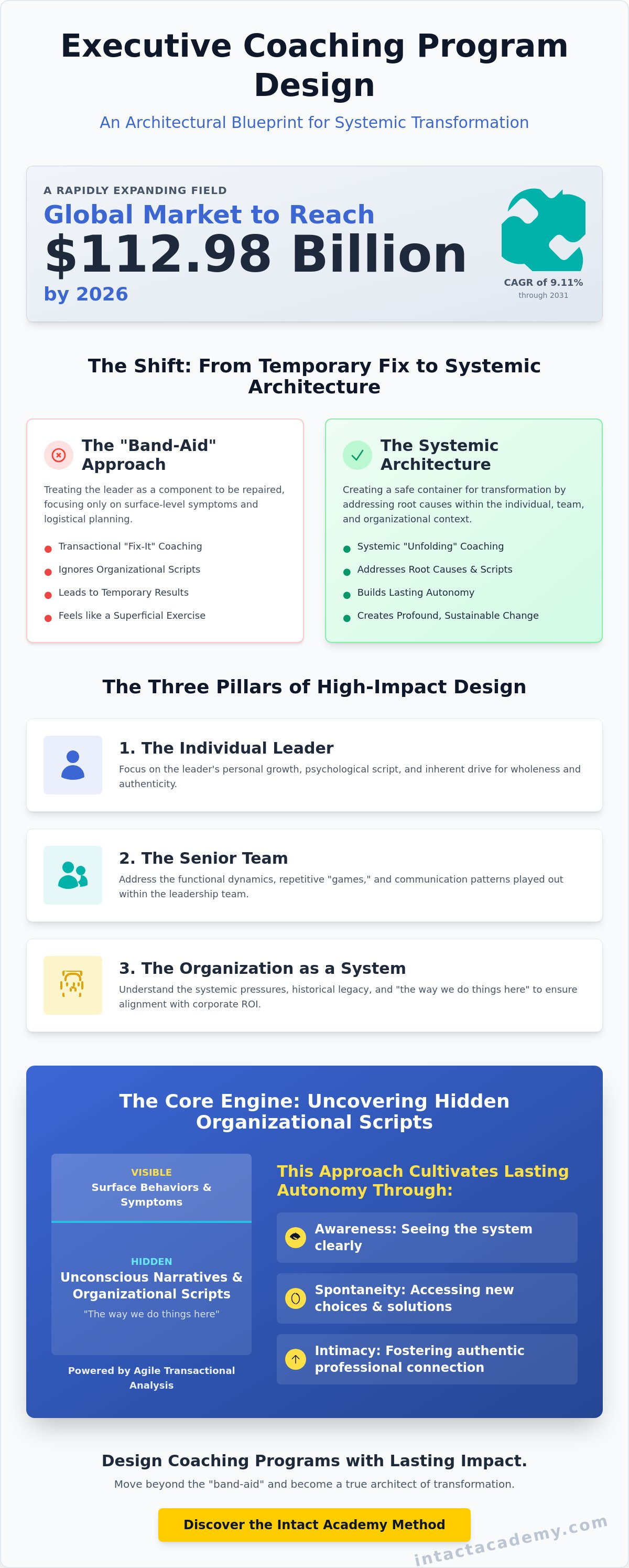
Effective executive coaching program design is far more than a calendar of sessions or a series of milestones. It's the intentional creation of a container for transformation. In a market projected to reach $112.98 billion by the end of 2026, the distinction between transactional "fix-it" coaching and systemic "unfolding" coaching has never been more critical. Transactional coaching treats the leader as a component to be repaired; systemic coaching invites the leader’s inherent potency to emerge within their organizational context. This design process must precede the first session to ensure the work carries the necessary weight and focus.
To understand What is Executive Coaching? in its highest form, one must look at it through the lens of architecture. Coaching architecture is the integration of individual growth and systemic health.
The Shift from Logistics to Transformation
Many practitioners mistake logistics for design. While scheduling and pricing are necessary, they're secondary to the psychological safety and rigorous contracting that allow for deep work. In 2026, the coach acts as a systemic architect. This role requires identifying the "script" of the organization before the intervention begins. If the organization has a script of "don't be successful," even the most talented executive will struggle to implement change. By designing the program around these systemic realities, you move from being a temporary consultant to a catalyst for lasting autonomy. It's about creating a space where complex issues feel manageable through insight and structured methodology.
The Three Pillars of Design: Individual, Team, and System
A robust design balances three distinct, often competing pillars. The executive seeks personal growth, the board demands corporate ROI, and the team requires a leader who is present and authentic. Ignoring any of these creates cultural "undertows" that can pull a coaching engagement off course. To mitigate this, senior practitioners use the initial assessment phase to explore what is transactional analysis and how its concepts apply to the current organizational climate. This ensures the executive coaching program design accounts for:
- The psychological script of the individual leader and their drive for wholeness.
- The functional dynamics and repetitive "games" played within the senior team.
- The systemic pressures and historical legacy of the organization itself.
When these pillars are aligned, the coaching process becomes a stable container for profound change rather than a superficial exercise in behavior modification. It allows the leader to look inward before taking outward action, ensuring that every step forward is grounded in both personal truth and organizational reality.
The Systemic Pillars of High-Impact Program Design
High-impact executive coaching program design requires a foundational lens that can decode the complexity of human interaction within a corporate structure. In a market projected to grow at a CAGR of 9.11% through 2031, the ability to provide deep value is a competitive necessity. At Intact Academy, we use Transactional Analysis (TA) as this primary tool. TA allows us to see beyond the surface of professional behavior into the underlying patterns that either foster or inhibit growth. By understanding these dynamics, we design programs that don't just teach skills but actually shift the leader’s internal operating system.
Central to this architecture is the concept of Organizational Scripts. Just as individuals follow a life script, organizations possess unconscious narratives that dictate what's possible. These scripts often manifest as "the way we do things here," acting as invisible barriers to innovation or health. If a design fails to address these scripts, the coaching remains a surface-level intervention. We seek to foster true autonomy, which in a systemic context means helping leaders regain their capacity for awareness, spontaneity, and intimacy within their roles. This transition is accelerated through the Agile TA approach pioneered by Sari van Poelje. This methodology blends the depth of psychological insight with the speed required in modern business, ensuring that transformation is both profound and sustainable.
Mapping Ego States in the Boardroom
Effective design must account for the shift from Parent or Child ego states to Adult autonomy. In high-pressure environments, leaders often slip into "Critical Parent" or "Adapted Child" modes, triggering repetitive psychological games that stall progress. A systemic executive coaching program design builds in specific check-points for Potency, Permission, and Protection. This framework provides the leader with the inner strength (potency) to change, the psychological clearance (permission) to act differently, and a safe container (protection) to practice new behaviors without fear of systemic rejection. It turns the boardroom from a theatre of conflict into a space of adult collaboration.
Systemic Integration and Organizational Agility
Transformation never happens in isolation. A leader's growth ripples through their team, often meeting resistance from the existing culture. While state government coaching programs demonstrate the value of structured 360-degree feedback and one-on-one sessions, a systemic design goes further by aligning the coaching plan with the organization’s evolution. To maintain this alignment, we emphasize systemic supervision. This practice ensures the coach remains "intact" and objective, preventing them from being swallowed by the organization's script. If you're ready to deepen your impact, exploring our senior practitioner programs provides the methodology needed to navigate these complexities with grace. By designing for the whole system, you ensure that individual breakthroughs lead to organizational agility.
A Step-by-Step Guide to Designing an Executive Coaching Program
Designing a program that holds the weight of systemic change requires a methodical, architectural approach. While linear models often focus on simple goal-setting, a sophisticated executive coaching program design incorporates iterative feedback loops to ensure the work remains relevant as the organization evolves. We begin with a systemic assessment to uncover the hidden dynamics influencing the leader's performance. This process isn't just about identifying missing skills; it's about mapping the script of the entire organizational unit. By the time we reach Step 2, we're ready to align all stakeholders through a rigorous contracting phase.
Step 3 involves defining the transformative arc, mapping the journey from the current state of script-bound behavior to one of professional autonomy. Step 4 ensures the work sticks through integration and supervision, providing a space where the coach can reflect on the systemic "undertows" that might pull the engagement off course. Finally, Step 5 measures the systemic impact. We move beyond simple ROI to evaluate the "Return on Integration," looking at how deeply the new behaviors have taken root in the organizational culture. This ensures the $112.98 billion market value of coaching in 2026 translates into real, human progress.
Mastering the Multi-Party Contract
The contract is the heartbeat of the design. We distinguish between three essential layers: the administrative contract, which covers logistics and fees; the professional contract, which defines business goals and ROI; and the psychological contract, which addresses unspoken expectations and emotional needs. Handling conflicting goals between the coachee and the board happens here, not mid-way through the sessions. A clean contract is the foundation of ethical coaching, ensuring that all parties have a mutual, transparent understanding of the goals and the limits of the intervention.
Designing the Transformative Arc
A successful arc structures sessions to allow for both "Human Being" and "Human Doing." We balance the immediate need for skill acquisition with the deeper psychological insight required for lasting change. This balance is a core component of our executive coaching certification, which prepares practitioners to handle the high-stakes pressure of C-suite environments. Similar to Harvard's executive coaching program design, our methodology relies on evidence-based principles of human development. We ensure that every session moves the leader closer to their authentic, potent self, allowing their professional growth to mirror their personal unfolding.
Navigating Complexity: Stakeholders and Organizational Culture
Can a corporate environment truly hold the weight of psychological depth? This is the primary objection senior practitioners encounter when proposing a systemic approach. In a landscape where large enterprises account for 57.61% of the executive coaching market as of 2025, the challenge isn't the depth itself but the language used to describe it. If the executive coaching program design feels too abstract, the board will likely retreat into transactional metrics. However, if the design is framed as a tool for systemic health and efficiency, it becomes an essential asset for organizational survival.
Designing for resistance is a core competency of the systemic architect. Every organization has an "immune response" to change; it seeks to maintain the status quo, even if that status quo is dysfunctional. A robust program design anticipates this pushback. It incorporates stakeholders early in the process to ensure that the leader's transformation doesn't become a threat to the existing hierarchy. By mapping these potential friction points before the first session, you protect the coachee and ensure the longevity of the results. It's about creating a safe container where the often-turbulent work of change can unfold without being sabotaged by the system's defensive mechanisms.
Translating TA into Corporate Value
Success in the boardroom requires translating Transactional Analysis concepts into language that speaks to ROI. Instead of discussing ego states, we talk about "Leadership Agility" and the ability to respond to market shifts with an Adult mindset. When we address psychological games, we frame it as a strategy for "Operational Alignment." Resolving these repetitive patterns saves significant time and capital that is otherwise wasted on miscommunication and internal politics. This approach positions the coaching as a vital mechanism for leading organizational change, moving beyond individual performance into the realm of strategic transformation.
The Role of the Coach in Systemic Redesign
The coach serves as a mirror for the organizational culture, reflecting the unconscious scripts that dictate behavior. This requires a presence that is both neutral and potent. You must stay outside the system's "undertow" while remaining deeply connected to its people. If a major organizational shift occurs during the engagement, the executive coaching program design must pivot without losing its core integrity. This agility ensures that the coaching remains relevant even in the most turbulent corporate climates. If you're ready to master these systemic nuances, explore our senior practitioner academies to refine your architectural skills and increase your potency as a practitioner.
Designing for Mastery: The Intact Academy Methodology
At the heart of the Intact Academy methodology lies the philosophy of wholeness. We believe that effective executive coaching program design isn't just about adding new skills; it's about stripping away the script-bound behaviors that prevent a leader from being their authentic self. In a global market reaching $112.98 billion in 2026, the distinction between a coach who follows a checklist and one who designs a systemic architecture is what defines professional potency. Our approach invites leaders to return to a state of authenticity, ensuring that their professional growth is an extension of their personal unfolding rather than a mask they wear in the boardroom.
The 2026 coaching landscape demands a level of rigor that transcends traditional training. Following the ICF Core Competency updates on April 14, 2026, the focus has shifted toward embodying a coaching mindset and navigating technological change with psychological agility. Our integration of Agile Transactional Analysis provides the necessary framework for this evolution. It allows for rapid interventions that don't sacrifice depth, enabling coaches to design programs that address the immediate needs of a $5.8 billion AI-augmented market while maintaining the human connection essential for deep transformation. This methodological precision ensures that every executive coaching program design we teach is both grounded in theory and sharpened by professional pragmatism.
The Path to Senior Practitioner Level
Deep design skills are the hallmark of advanced professional development for coaches. As you move from "doing coaching" to "being a coach," the complexity of your designs must reflect your internal growth. This transition requires more than just hours in the field; it requires systemic supervision to refine your capability and keep your presence intact. By analyzing the parallel processes between your client's organizational script and your own professional script, you gain the clarity needed to handle C-suite engagements where the stakes often exceed $150,000 annually. You learn to hold the space for a leader’s transformation while remaining a neutral, potent observer of the system's dynamics.
Join a Global Community of Systemic Experts
Mastery is rarely achieved in isolation. Learning within an international, diverse cohort allows you to see how systemic scripts vary across cultures and industries. You'll gain direct access to the wisdom of Sari van Poelje and our expert faculty, who bridge the gap between high-level psychological frameworks and direct corporate application. This community provides a stable container for your own development as you learn to design for the future of leadership. If you're ready to move beyond transactional models and embrace a systemic architecture, we invite you to explore our TA EMCC Senior Practitioner Academy to master the art of transformative design.
Architecting the Future of Systemic Leadership
The leadership landscape of 2026 demands a departure from superficial fixes toward a more profound architectural approach. By mastering executive coaching program design, you move beyond mere logistics to create a stable container for human unfolding. We've explored how systemic assessment and multi-party contracting align individual growth with the complex needs of the board. You now understand that true autonomy is achieved when a leader’s personal script aligns with organizational agility and systemic health.
If you're ready to elevate your practice to the Senior Practitioner level, join our global community of experts. Our EMCC and ICF accredited programs are led by global expert Sari van Poelje, bringing together participants from 14+ countries to solve high-stakes organizational challenges. You can Master the Art of Systemic Program Design at Intact Academy to increase your potency and professional impact. Step into your role as a systemic architect and help leaders return to their most authentic, intact selves. Your journey toward mastery begins with the courage to look deeper.
Frequently Asked Questions
What is the most critical element in executive coaching program design?
The most critical element in executive coaching program design is the establishment of a robust, multi-party contract. This agreement creates a secure container for transformation by aligning the expectations of the executive, the HR department, and the board. Without this foundational clarity, the coaching risks becoming a temporary fix for deeper systemic issues. It ensures every stakeholder understands the boundaries and goals of the professional relationship.
How do you align coaching goals with organizational business outcomes?
Alignment is achieved by translating internal psychological shifts into measurable corporate metrics like leadership agility and operational efficiency. In a market where large enterprises represent 57.61% of the total coaching spend as of 2025, practitioners must demonstrate how individual growth drives systemic health. We use initial assessments to ensure that the coachee’s development objectives directly support the organization’s strategic roadmap and long-term flourishing.
What is the difference between a coaching plan and a coaching contract?
A coaching contract is the ethical and psychological agreement between all parties, whereas a coaching plan is the tactical roadmap of the engagement. The contract defines the "how" and "why" of the relationship, addressing unspoken needs and professional boundaries. The plan outlines the "what" and "when," focusing on specific session topics and skill acquisition. Both are essential components of a sophisticated executive coaching program design.
How long should a typical executive coaching program last for systemic impact?
For profound systemic impact, a program typically lasts between 6 and 12 months. This timeframe is necessary to move beyond surface-level behavior changes and address the underlying organizational scripts. Shorter engagements often fail to navigate the cultural "undertow" that resists new ways of being. A year-long commitment provides the stability needed for a leader to fully integrate their new-found autonomy into the corporate structure.
Can Transactional Analysis be used effectively in a corporate setting?
Transactional Analysis is exceptionally effective in corporate settings when focused on professional autonomy and communication dynamics. It provides a pragmatic vocabulary for understanding boardroom interactions and resolving repetitive psychological "games" that waste organizational time. By using TA, leaders gain insight into their own scripts. This allows them to lead with greater spontaneity and intimacy without the need for clinical psychotherapeutic interventions.
How do you measure the ROI of a psychologically-informed coaching program?
ROI is measured by evaluating "Return on Integration" alongside traditional business KPIs like retention and performance levels. we look for specific evidence of behavioral shifts that have become a permanent part of the organizational culture. In the 2026 market, where the AI coaching tools market has reached $5.8 billion, human coaches prove their value by demonstrating deep, systemic changes that technology cannot replicate.
What happens if the coachee’s goals conflict with the organization’s goals?
Conflicting goals are identified and resolved during the initial multi-party contracting phase. If an executive’s personal aspirations clash with the board’s vision, the coach facilitates a transparent dialogue to find a state of functional alignment. It's better to address these tensions at the design stage than to let them sabotage the engagement later. This clarity protects the integrity of the process and all individuals involved.
Why is systemic supervision necessary for program design?
Systemic supervision is vital because it provides the coach with an external perspective to remain objective and "intact." It helps the practitioner recognize when they are being pulled into the organization’s unconscious script or defensive patterns. Supervision ensures that the coach maintains their potency and continues to serve as a clear mirror for the client’s transformation. It's the hallmark of a senior practitioner.


