

What if the fee you pay for leadership development is actually the first psychological contract that determines whether your executives truly transform or simply repeat their old scripts? You've likely felt the frustration of seeing 86% of organizations report a positive return on investment while your own budget feels wasted on conversations that lack a clear "contract" for change. It's difficult to reconcile the massive gap between a $150 junior practitioner and a $1,000 Master Certified Coach when the link between executive coaching pricing models 2026 and systemic impact remains opaque.
This guide explores the landscape of investment through a lens of psychological depth and professional pragmatism. We'll move beyond simple costs to help you choose a framework that ensures deep transformation and measurable organizational impact. You'll gain a clear framework for comparing 2026 rates, from $5,000 monthly C-suite retainers to $30,000 full-scale engagements; and you'll learn how to select a model that honors both human flourishing and bottom-line agility. Our goal is to provide the insight needed to move from transactional spending to an integrated state of organizational wholeness.
Key Takeaways
- Shift from hourly check-ins to value-based structures to ensure coaching moves beyond surface-level skill-building into deep behavioral change.
- Identify how executive coaching pricing models 2026 serve as the primary "contract" for transformation, establishing an Adult-Adult dynamic that fosters true autonomy.
- Recognize the systemic value of senior accreditation levels, understanding why EMCC Senior Practitioner and Team Coach status is essential for navigating complex organizational scripts.
- Move beyond traditional financial metrics to measure ROI through "Systemic Value," capturing the unfolding impact on culture, retention, and collective agility.
- Utilize a structured buying guide to align your organizational goals with fee structures that support high-potency outcomes and authentic leadership.
The Landscape of Executive Coaching Pricing Models in 2026
The 2026 coaching market reflects a profound evolution in how organizations value human transformation. The Landscape of Executive Coaching has shifted from transactional "pay-per-hour" interactions toward value-based investments that prioritize systemic change over surface-level advice. With the global coaching industry projected to reach $5.8 billion by the end of 2026, the focus is no longer on simply buying time. Instead, leaders are investing in the potency of the coach to facilitate a return to wholeness. This shift ensures that the engagement isn't just a series of conversations but a structured process of unfolding autonomy.
Understanding executive coaching pricing models 2026 requires a look at the three dominant structures currently shaping the industry:
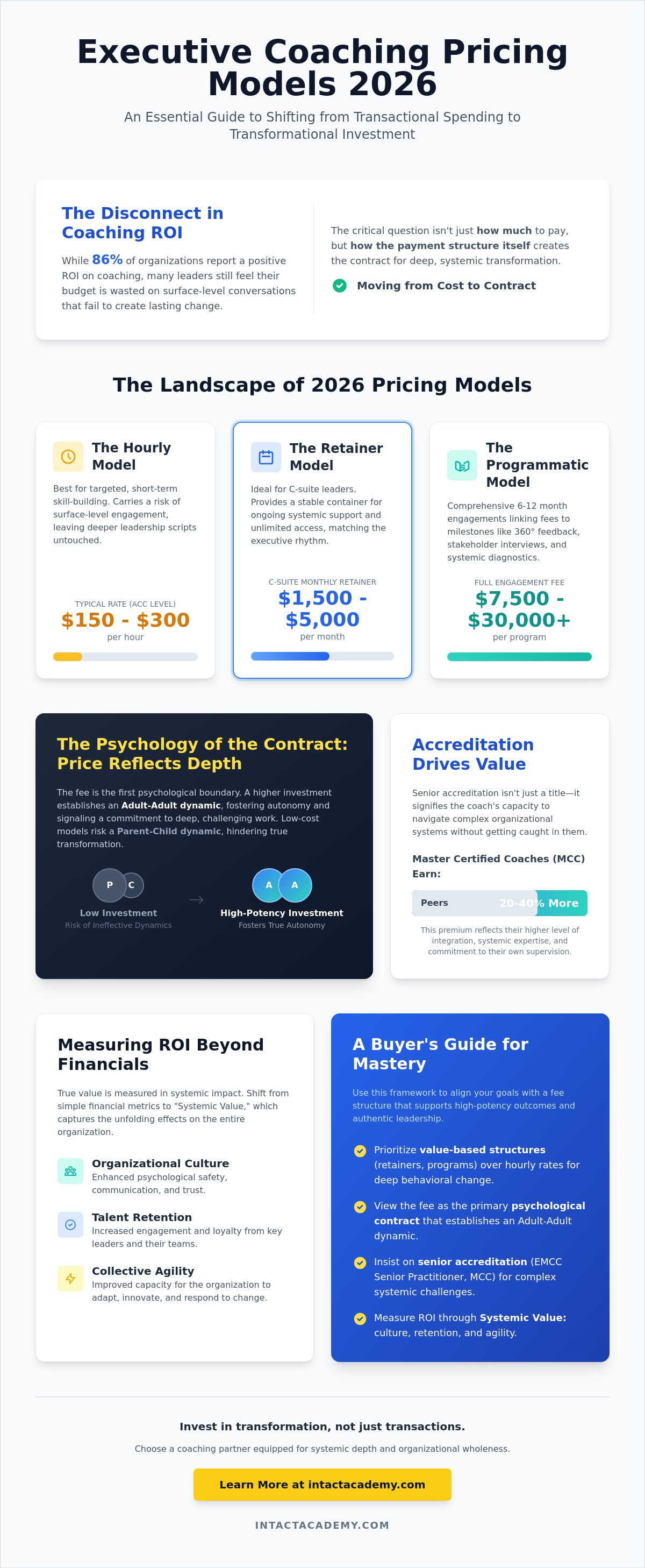
- The Hourly Model: While Associate Certified Coaches (ACC) charge between $150 and $300 per hour, this model is increasingly reserved for targeted skill-building. It carries a risk of surface-level engagement where the deeper script of the leader remains untouched.
- The Retainer Model: CEO and C-suite retainers often range from $1,500 to $5,000 per month. This provides a stable container, allowing for systemic support and unlimited access that mirrors the unpredictable rhythm of executive life.
- The Programmatic Model: These comprehensive engagements, typically spanning 6 to 12 months, range from $7,500 to $30,000. They link fees to specific milestones such as 360-degree feedback, stakeholder interviews, or organizational redesign.
Fixed-Fee vs. Variable Coaching Rates
In 2026, we see a distinct move away from open-ended hourly billing. Organizations now favor engagement fees that cover essential diagnostic and systemic assessment phases. This structure ensures the coach isn't just a visitor but a partner in the leader's development. When you evaluate these programs, look for the inclusiveness of the fee. A robust model should encompass initial psychological contracting, diagnostic tools, and the integration of feedback from the wider organizational system.
2026 Benchmarks for Senior Executive Rates
C-suite interventions at enterprise firms now command $800 to $2,000 per session. While geographic location in Utrecht or New York has become less relevant due to digital-first delivery, systemic expertise remains the primary price driver. Master Certified Coaches earn 20% to 40% more than their peers because they bring a higher level of integration to the work. Crucially, the best-priced coaches in 2026 are those who invest in their own systemic supervision. This ensures they remain a clear mirror for the client, preventing their own scripts from interfering with the leader's growth.
The Psychology of the Contract: Why Price Reflects Depth
Professional transformation begins with the primary boundary of the relationship: the price. It's not merely a financial transaction; it's the foundation of the systemic "contract." To understand what is transactional analysis is to recognize that every exchange between a coach and a leader happens on multiple levels. While the administrative contract defines the fees and hours, the psychological contract determines the depth of the work. If the investment is too low, it often fails to provide the necessary friction to challenge a leader's existing script. High-potency work requires a financial commitment that mirrors the weight of the organizational change being sought.
When selecting executive coaching pricing models 2026, organizations must consider how the fee structure influences ego states. Low-cost models often inadvertently trigger Parent-Child dynamics. The organization acts as a controlling parent, and the coach becomes a compliant child, or vice versa. This prevents the development of Adult-Adult autonomy. Leading evidence-based coaching frameworks demonstrate that a clear, professional financial agreement is essential for maintaining the "Adult" state, where real behavioral change occurs. A higher price point often signals the coach’s capacity to stay grounded when the organization’s systemic pressure becomes intense.
Avoiding the "Commodity Trap" in Coaching
Searching for the cheapest model often leads to "Game" playing within the relationship. If a coach feels undervalued, they may subconsciously "rescue" the client instead of challenging them, leading to superficial results that ignore systemic resistance. Contracting is the alignment of goals, methods, and fees to ensure systemic wholeness and professional integrity. Without this alignment, the coaching remains a surface-level activity rather than a tool for deep integration. If you seek a partner capable of navigating these complexities, exploring executive coaching that prioritizes systemic depth is the next logical step.
Agile Transactional Analysis and Pricing
An agile approach to pricing recognizes that systemic issues often emerge only after the work has begun. It allows for pivots in the engagement without breaking the psychological safety of the contract. This flexibility supports the autonomy of both the leader and the organization, ensuring the pricing model evolves as the leader's needs unfold. By keeping the financial agreement transparent and adaptable, you maintain the "Adult" ego state, allowing for a partnership that is as fluid as the market itself.
Accreditation Impact: Pricing for Senior Practitioners and Team Coaches
Accreditation isn't just a badge; it's a measure of professional potency and systemic depth. In 2026, executive coaching certification levels directly dictate market rates because they represent a coach's capacity to hold complex organizational scripts. While an Associate Certified Coach (ACC) might command $150 to $300 per hour, a Master Certified Coach (MCC) or an EMCC Senior Practitioner often secures fees between $500 and $1,000 per hour. This price gap reflects the thousands of hours spent refining the ability to stay grounded while a leader’s psychological script unfolds. Organizations don't just pay for time; they pay for the stability of the container the coach provides.
The premium for EMCC Senior Practitioner and Senior Team Coach status is rooted in their ability to work with the "whole" rather than just the "part." Organizations are increasingly seeking these senior levels to ensure that their investment leads to measurable organizational agility. When you examine Executive Coaching Pricing Models, you'll see that credentialed coaches earn 20% to 40% more than their non-credentialed peers. Advanced accreditation acts as a guarantee of ethical rigor and systemic insight. Coaches who have reached the level of Senior Supervisor command an additional 20% to 30% premium. They don't just coach; they hold the systemic integrity of the entire engagement, ensuring that the coach-client relationship remains clear and productive.
1:1 Executive Coaching vs. Systemic Team Coaching Fees
Pricing for systemic team coaching is inherently more complex than individual sessions. These interventions often require a co-coaching model to manage the multiple layers of group dynamics, leading to monthly retainers ranging from $5,000 to $10,000. Hidden costs often include diagnostic interviews, shadow coaching, and cultural mapping. However, the ROI is significant; organizations offering coaching to executives see 32% higher employee engagement. By coaching the team as a single entity, you multiply the impact across every direct report, ensuring that executive coaching pricing models 2026 reflect the collective growth of the business.
The Value of Global Accreditation Standards
EMCC and ICF credentials remain the gold standard for pricing transparency. They allow organizations to verify a coach’s level, whether Practitioner or Senior Practitioner, before signing a contract. This verification is crucial for ensuring that the coach possesses the advanced Transactional Analysis training needed to identify the underlying scripts that block team performance. A senior practitioner brings the autonomy and potency required to move beyond "coffee-chat" coaching into a space of profound, systemic transformation.
Measuring ROI: Beyond the Financial Statement
The traditional calculation of return on investment often falls short when applied to the complexities of human transformation. While studies from 2024 indicate that organizations frequently see a 3x to 7x return on their coaching spend, focusing solely on the balance sheet ignores the deeper systemic value created. In the context of executive coaching pricing models 2026, ROI is increasingly measured by the leader's ability to move from a reactive script to a state of integrated autonomy. This shift doesn't just improve individual performance; it recalibrates the entire organizational system, fostering a culture where agility and potency become the norm.
To ensure these outcomes, the coach's own level of integration is paramount. Investing in professional development for coaches ensures that the practitioner is equipped to navigate the turbulent psychological undercurrents of a C-suite environment. A coach who hasn't mastered their own systemic awareness cannot facilitate it in others. When the coach operates from a place of wholeness, the ROI manifests as a "Script Change" metric. This qualitative shift is visible when a leader stops playing psychological games and starts leading with authentic Adult-Adult clarity, directly impacting team retention and engagement rates, which are 32% higher in coached organizations.
The Cost of "Non-Coaching": A 2026 Perspective
The financial drain of toxic leadership scripts is a silent killer of organizational value. In 2026, the price of failed mergers often reaches millions in integration costs because the underlying systemic patterns were never addressed. The highest cost in leadership is not the coaching fee, but the perpetuation of unconscious organizational patterns. When a C-suite leader remains stuck in a defensive script, the resulting lack of psychological safety can lead to a 5x increase in the likelihood of key talent leaving the organization. Identifying these patterns early through systemic interventions prevents the slow erosion of capital and culture.
KPIs for Systemic Organizational Change
Measuring the impact of coaching requires a blend of quantitative data and qualitative insight. Organizations now use 360-degree reviews not just as a diagnostic tool, but as a validation of the ROI inherent in their chosen executive coaching pricing models 2026. Key Performance Indicators (KPIs) have evolved to include metrics for systemic integration and collective agility. Some forward-thinking firms even structure a success fee based on these measurable behavioral shifts. If you're ready to move beyond transactional metrics toward true organizational flourishing, explore our organizational change services to begin your systemic transformation.
Choosing Your Model: A Buying Guide for Mastery
Selecting the right framework for leadership development requires more than a budget allocation; it necessitates an alignment between your organizational stage and the depth of the intervention. When evaluating executive coaching pricing models 2026, the goal is to move beyond mere skill acquisition toward a state of systemic integration. A well-structured model serves as a mirror for your organization's maturity. If your business is navigating a period of intense volatility, a retainer model providing a "stable container" is more effective than a series of disconnected hourly sessions. Mastery lies in recognizing that the fee structure is the first boundary of the professional relationship.
In the Intact Academy philosophy, Sari van Poelje emphasizes the "contract" as a vital tool for authenticity. This isn't just a legal document but a psychological agreement that ensures all parties are working toward the same unfolding of potential. Red flags in pricing are often easy to spot if you look for what's missing. Avoid any model that lacks a dedicated diagnostic phase or fails to account for the coach's own systemic supervision. Without these elements, the coaching risks becoming a "coffee-chat" that reinforces existing scripts rather than challenging them. The Intact approach integrates Transactional Analysis and systemic mastery into every contract, ensuring that high-impact results are built into the financial agreement from day one.
Questions to Ask During the Contracting Phase
To ensure your investment supports long-term agility, use the following inquiries during your selection process:
- "How does your pricing model account for systemic diagnostics and cultural mapping before the sessions begin?"
- "What is your specific level of EMCC accreditation, and how does that level of mastery influence the potency of your intervention?"
- "How do you handle the psychological contract between the coach, the leader, and the organization to ensure Adult-Adult autonomy?"
- "Does this fee include stakeholder interviews or 360-degree feedback to validate systemic change?"
Finalizing the Investment
The final agreement should be structured for flexibility. In 2026, the most effective contracts allow for "Agile" pivots, recognizing that as a leader's script unfolds, the focus of the work may need to shift. Transparency in reporting is essential, yet it must be balanced with the strict confidentiality required for deep psychological work. By choosing a model that honors these boundaries, you create a space where true transformation can occur. Ready to deepen your impact and master the art of systemic change? Explore our TA EMCC Senior Practitioner Academy to begin your journey toward professional mastery and wholeness.
Charting Your Path Toward Systemic Wholeness
The transition from viewing fees as a cost to understanding them as a psychological contract is the first step toward genuine organizational transformation. By aligning your chosen executive coaching pricing models 2026 with the depth of change you seek, you ensure that every investment serves the unfolding of your leaders' potential. We've explored how senior accreditation and systemic supervision provide the stability needed to challenge deep-seated scripts and achieve measurable ROI through cultural integration. When pricing reflects the potency of the intervention, the organization moves from reactive patterns to proactive autonomy.
Authentic leadership isn't a destination but a continuous process of returning to wholeness. At Intact Academy, we bring together international expertise and psychological rigor to help you navigate this complexity. Our programs are accredited by the EMCC and ICF, led by world-renowned expert Sari van Poelje, and have empowered participants from over 14 countries to lead with greater clarity. If you're ready to move beyond surface-level coaching and lead your organization toward lasting agility, join the TA EMCC Senior Team Coach Academy to master systemic transformation. Your commitment to depth is the catalyst for a more autonomous and integrated future.
Frequently Asked Questions
What is the average hourly rate for executive coaching in 2026?
The average rate depends heavily on the coach's credential level and the complexity of the systemic work required. Associate Certified Coaches (ACC) typically charge $150 to $300 per hour; while Master Certified Coaches (MCC) command $500 to $1,000 per hour. At the enterprise level, specialized firms often charge between $800 and $2,000 per session for C-suite interventions.
How do executive coaching pricing models differ for small businesses vs. global corporations?
Small businesses often utilize hourly models or boutique firm rates ranging from $400 to $700 per session to address specific skill gaps. Global corporations favor comprehensive executive coaching pricing models 2026 that include monthly retainers of $3,000 to $8,000 for hybrid advisory. These larger organizations prioritize systemic integration and cultural mapping across multiple leadership tiers.
Is a monthly retainer better than pay-per-session for C-suite leaders?
A monthly retainer is generally superior for C-suite leaders because it provides a stable container for deep psychological work. Retainers ranging from $1,500 to $5,000 per month allow for unlimited access and systemic support; which is essential when a leader is navigating high-stakes organizational change. Pay-per-session models often lack the continuity required to challenge a long-standing executive script.
Can we use performance-based pricing for executive coaching?
Performance-based pricing is an emerging trend where a portion of the fee is tied to measurable behavioral shifts or recovered leader time. This model requires a robust psychological contract to ensure the coach maintains their professional autonomy and doesn't become a "rescuer." Success is often validated through 360-degree reviews and specific KPIs related to team engagement and retention.
What factors most influence the cost of a systemic team coaching engagement?
The primary cost drivers are the number of participants and the necessity of a co-coaching model to manage complex group dynamics. Monthly retainers for team coaching typically range from $5,000 to $10,000. This fee reflects the depth of diagnostic interviews, shadow coaching sessions, and the mapping of the collective organizational script.
How does EMCC Senior Practitioner accreditation affect a coach’s pricing?
Coaches with EMCC Senior Practitioner status command a 20% to 40% premium over their non-credentialed peers. This higher rate reflects their advanced training in Transactional Analysis and their capacity to stay grounded during turbulent systemic changes. Organizations pay for this potency to ensure the coaching moves beyond surface-level advice into profound human transformation.
What should be included in a comprehensive executive coaching program fee?
A comprehensive fee should encompass initial systemic diagnostics, stakeholder interviews, and 360-degree feedback tools. It's not just about the sessions; it includes the preparation, the psychological contracting, and the integration work that happens between meetings. These executive coaching pricing models 2026 ensure the engagement is a structured journey toward wholeness rather than a series of disconnected chats.
How can I justify the cost of executive coaching to my board of directors?
Justify the investment by highlighting the 3x to 7x ROI and the 32% increase in employee engagement reported by organizations with coached executives. Focus on the cost of "non-coaching," such as the financial drain caused by toxic leadership scripts or failed mergers. Emphasize that coached leaders are five times less likely to leave, saving the organization significant recruitment and integration capital.


