

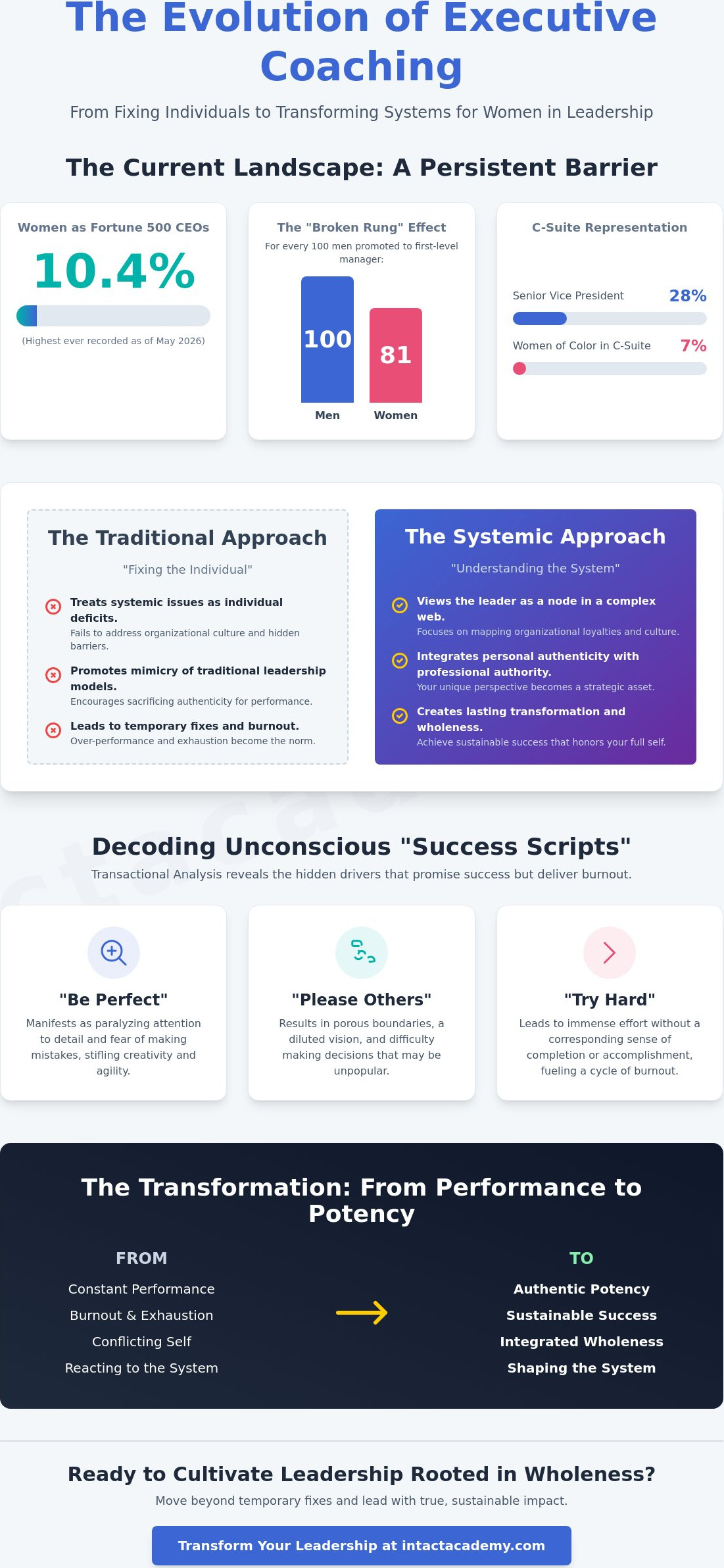
As of May 2026, women represent 10.4% of Fortune 500 CEOs, the highest percentage ever recorded. Yet, the "broken rung" remains a persistent barrier; for every 100 men promoted to their first manager role, only 81 women make that same leap. This structural bottleneck suggests that traditional executive coaching for women in leadership often fails because it treats systemic organizational patterns as individual deficits. You likely recognize the exhaustion of over-performing to prove your worth, battling invisible culture barriers while navigating internalized scripts of being "too much" or "not enough."
We understand that your professional authority shouldn't require the sacrifice of your personal authenticity. This article demonstrates how systemic executive coaching and Transactional Analysis empower you to transcend unconscious Life Scripts and lead with true potency. We'll explore a methodology for identifying the hidden patterns that drive burnout, providing a clear path to integrate your inner truth with your external impact. You'll discover how to move beyond mere performance into a state of wholeness, achieving sustainable success that honors your intelligence and your humanity.
Key Takeaways
- Shift your perspective from "fixing the individual" to understanding leadership as a systemic intervention that addresses organizational culture and hidden barriers.
- Identify the unconscious "Success Scripts" and driver behaviors, such as the need to be perfect, that frequently undermine the effectiveness of executive coaching for women in leadership.
- Distinguish between surface-level behavioral coaching and deep-rooted systemic integration to ensure your professional development leads to lasting transformation rather than temporary fixes.
- Utilize contractual clarity and systemic awareness to map organizational loyalties and negotiate boundaries that protect your energy and enhance your potency.
- Cultivate a leadership style rooted in wholeness, where personal authenticity and professional authority are no longer in conflict but serve as a unified source of power.
The Evolution of Executive Coaching for Women in Leadership
The historical approach to executive coaching for women in leadership often mirrored a remedial classroom. It focused on teaching women how to mimic traditional male leadership archetypes or how to "lean in" harder to overcome structural resistance. By May 2026, this model has proven insufficient. True mastery requires a systemic intervention that views the leader not as a broken part to be fixed, but as a vital node within a complex organizational web. This evolution marks a shift from individual skill-building to profound human transformation. It moves the focus from "fixing the woman" to "understanding the system" that shapes her professional reality.
Modern organizations are increasingly agile and complex. They're often governed by unconscious cultures that reward over-performance while maintaining invisible barriers. Statistics from 2026 show that while women hold 28% of Senior Vice President roles, women of color occupy just 7% of C-suite positions. These numbers aren't just data points; they're symptoms of a system that lacks integrated psychological safety. To lead effectively, you must navigate these currents without losing your sense of self. If you seek to change the outcome of your leadership, you must first understand the systemic origins of your current patterns.
Beyond Surface-Level Empowerment
Tactical performance coaching might help you manage a difficult board meeting, but it won't resolve the underlying script that compels you to "Try Hard" or "Be Perfect" at the expense of your own vitality. We've moved beyond the era where professionalizing the self meant masking one's true nature. Authentic self-expression is the new currency of power. In a world where gender-diverse companies are 25% more likely to see above-average profitability, your unique perspective isn't a liability; it's a strategic asset. Systemic coaching facilitates this integration, allowing you to move from a state of constant performance to a state of authentic potency.
The Need for a Systemic Perspective
A leader doesn't exist in a vacuum. You're part of a wider organizational and family system, carrying historical scripts that influence how you exercise authority. These hidden loyalties often dictate your professional boundaries more than any job description ever could. Sari van Poelje emphasizes that organizational agility depends on our ability to see these invisible structures. By mapping these loyalties, you gain the clarity needed to rewrite your leadership narrative. This systemic awareness is what distinguishes a competent manager from a transformative executive who can foster wholeness within their entire team.
Uncovering the "Success Script": A Transactional Analysis Approach
Many high-achieving women reach the C-suite only to find themselves haunted by a sense of exhaustion that no vacation can cure. This fatigue often stems from an unconscious Life Script, a psychological blueprint formed in early childhood that dictates how we must act to be "okay." Within the framework of executive coaching for women in leadership, we use what is Transactional Analysis to decode these scripts. By analyzing the "transactions" between individuals, we reveal the hidden motivations that drive professional behavior. When you understand your script, you move from reactive performance to intentional mastery.
Female leaders frequently operate under the influence of specific "Drivers"—internalized commands that promise success but often deliver burnout. You might recognize the "Be Perfect" driver, which manifests as paralyzing attention to detail, or "Please Others," which results in porous boundaries and a diluted vision. The "Try Hard" driver often leads to immense effort without a corresponding sense of completion. These patterns aren't just personality traits; they're archaic survival strategies. Recognizing these drivers is the first step toward reclaiming your autonomy and shifting your leadership energy from proving your worth to exercising your influence.
In the high-pressure environment of the boardroom, it's easy to fall into the Drama Triangle. This systemic trap involves three roles: the Victim, who feels powerless; the Rescuer, who over-functions to save others; and the Persecutor, who uses blame to maintain control. Women are often socialized into the Rescuer role, taking on the emotional labor of the entire organization. Breaking this cycle requires a move toward the "Winner’s Triangle," where vulnerability replaces victimhood, caring replaces rescuing, and assertiveness replaces persecution. If you're ready to step out of these repetitive cycles, exploring our executive coaching programs can provide the systemic tools needed for this shift.
Ego States and Executive Presence
Leadership presence is fundamentally about which "Ego State" you occupy during a transaction. The Parent state holds our "shoulds" and rules, the Child state holds our archaic feelings and creative impulses, and the Adult state processes data in the here-and-now. When facing systemic bias or intense pressure, the Child state may feel small or the Parent state may become overly critical. Potency is achieved when a leader integrates the wisdom of their Ego States to act with Adult clarity and decisive presence. This integration allows you to remain grounded and objective, even when the organizational system is in flux.
Rewriting the Script for Autonomy
Transformation begins when you identify how you might be unconsciously re-enacting family dynamics within your team. Are you treating your board like critical parents or your direct reports like siblings? Moving toward professional autonomy requires clear "contracting"—the practice of making explicit, Adult-to-Adult agreements about goals and boundaries. By giving yourself "Permission" to succeed without apologizing, you break through the internal glass ceilings that your original script once imposed. This shift doesn't just change how you lead; it changes the systemic permission levels for every woman following in your footsteps.
Empowerment vs. Integration: Evaluating Your Coaching Options
Choosing the right support is often the difference between temporary professional gains and a permanent shift in your leadership capacity. Many programs marketed as executive coaching for women in leadership focus on "empowerment" through surface-level behavioral hacks. While learning to "power pose" or "speak up" might offer a momentary boost, these tactics don't address the psychological cost of maintaining a persona that isn't yours. Research shows that companies investing in executive coaching see an average ROI of 5.7 times the initial cost, but this value is only realized when the coaching addresses the root causes of leadership friction rather than just the symptoms.
In 2026, the landscape of professional development has shifted toward high-stakes accountability. By April 1, 2027, the International Coaching Federation (ICF) will require even stricter curriculum alignment with updated core competencies. This regulatory evolution reflects a growing demand for coaches who can navigate the intersection of psychology and business. If your coaching doesn't match your current organizational script, you'll likely find yourself repeating the same cycles of over-performance and exhaustion. Integration means aligning your personal authenticity with your professional authority, ensuring that your impact is both potent and sustainable.
Behavioral vs. Systemic Models
Behavioral coaching focuses on "doing." It provides you with a toolkit of scripts and strategies to manage your environment. Systemic coaching, however, focuses on "being." It invites you to examine the underlying loyalties and drivers that dictate your choices. If you only fix the behavior, you're merely decorating the cage of your existing script. Choosing a systemic approach allows you to step out of the cage entirely. It's the difference between a tactical mentor who tells you how to win and a systemic supervisor who helps you understand why you're playing the game in the first place.
The Role of Supervision in Executive Coaching
A hallmark of quality in high-level coaching is the presence of systemic supervision. You should ask any potential partner if they're currently in supervision themselves. This practice ensures that the coach doesn't become an unconscious participant in your organizational "games." Supervision provides an ethical safeguard and a secondary lens, maintaining the clarity needed for deep transformation. When evaluating an executive coaching certification, look for programs that emphasize this reflective practice. It's the standard that separates transactional trainers from the wise mentors capable of guiding you toward true wholeness.
The 4 Pillars of Systemic Growth for Women Leaders
To achieve mastery, executive coaching for women in leadership must move beyond individual charisma and focus on structural integrity. We define this journey through four foundational pillars that bridge the gap between individual desire and organizational reality. If you neglect these pillars, your leadership remains a performance rather than an expression of your true potency. These pillars provide the framework for a leader to remain grounded while navigating the turbulent currents of 2026's corporate landscape.
- Pillar 1: Contractual Clarity. Learning to negotiate boundaries and expectations through Adult-to-Adult agreements.
- Pillar 2: Systemic Awareness. Mapping the hidden loyalties and "ghosts" of previous leaders within the organization.
- Pillar 3: Emotional Agility. Moving beyond gendered labels like "bubbly" or "loud" into a state of regulated potency.
- Pillar 4: Integrative Leadership. Returning to wholeness by aligning your deeply held values with your professional actions.
Each pillar supports the next, creating a stable container for professional evolution. When these elements are integrated, the leader no longer feels like a guest in the boardroom but becomes a primary architect of the organizational culture. This shift is not about gaining more power; it's about claiming the autonomy that is already yours.
Mastering Contractual Clarity
In high-stakes corporate settings, a contract isn't merely a legal document; it's a psychological safeguard. Transactional Analysis teaches us to use multi-party contracts that involve the leader, the coach, and the organization. This transparency reduces the "psychological games" where expectations are implied but never explicitly stated. If the contract is clear, you avoid the "over-responsibility" trap that often leads to burnout. You gain the freedom to lead without the invisible weight of unvoiced demands, ensuring your energy is reserved for high-impact decision-making.
Navigating Organizational Scripts
Every company operates under an unconscious narrative, often described as "The Way We Do Things Here." This systemic script frequently contains gendered expectations that can stifle female authority. Understanding that leading organizational change is a core executive competency allows you to identify these scripts before they trigger resistance. By mapping the system's loyalties, you can introduce change with agility rather than force. If you're ready to master these systemic pillars, explore our executive coaching pathways to begin your transformation.
Transforming Leadership at Intact Academy
At Intact Academy, we don't view leadership as a series of tasks to be completed, but as an unfolding process of profound human transformation. Our philosophy centers on the idea of returning to a state of wholeness, where your professional authority is a direct reflection of your personal authenticity. This approach to executive coaching for women in leadership is designed for the mature professional who has already achieved outward success and now seeks internal integration. If you've spent years over-performing to prove your worth, then our systemic methodology provides the stable container needed to finally put down that burden and lead with quiet power.
You gain direct access to the expertise of Sari van Poelje and our international faculty, who bring decades of experience from the executive boardroom to the systemic coaching space. Our cohort is truly global, representing leaders from over 14 countries. This diversity ensures that your learning isn't confined to a single cultural lens; it's enriched by a multitude of perspectives and lived experiences. This global citizenship is essential for navigating the complex, agile organizational cultures that define the corporate landscape in 2026.
The journey often begins with individual transformation but frequently evolves into a deeper commitment to the craft of development itself. Many of our clients transition from being coached to pursuing professional development for coaches. This progression allows you to master the "art and science" of systemic intervention, turning your personal growth into a professional asset that can transform entire organizational systems.
The Executive Coaching Experience
A systemic coaching engagement with Intact is a methodical and steady process. It doesn't rush the reader; it builds a narrative arc from identifying core human struggles to implementing sustainable systemic solutions. We support women in achieving the prestigious EMCC Senior Practitioner status, providing the rigorous hours, structured methodology, and supervision required for such a high-level credential. This isn't a surface-level training program; it's a path to mastery that honors both your intelligence and your ambition.
Join a Global Community of Mastery
The power of our academy model lies in its collective wisdom and shared commitment to integrity. Unlike working with solo practitioners, we offer a structured environment where you can network with systemic thinkers across Europe and North America. This community acts as a mirror, reflecting your growth and challenging your assumptions in a safe, empathetic space. If you're ready to integrate your personal potency with your professional authority, we invite you to take the next step. You can book a discovery call to discuss individual coaching or academy enrollment, beginning your own systemic path to mastery.
Claiming Your Authentic Authority
The journey toward mastery isn't about working harder within a broken system; it's about seeing the system clearly enough to change your place in it. We've explored how executive coaching for women in leadership transcends tactical advice to address the deep psychological scripts that drive burnout. By integrating Transactional Analysis with systemic awareness, you move from reactive over-performance to a state of calm, decisive potency. This transition is what allows you to lead with wholeness rather than sacrifice, ensuring your professional impact is both significant and sustainable.
If you're ready to move beyond surface-level hacks and embrace profound transformation, we invite you to join our global community. Our EMCC and ICF accredited programs are led by an international faculty under the guidance of Sari van Poelje. With participants from over 14 countries, you'll find a space that honors your maturity and your ambition. Explore our Executive Coaching and Academy programs at Intact Academy to begin your unfolding. Your path to integration starts with a single, courageous choice to return to your most authentic self.
Frequently Asked Questions
How is executive coaching for women different from general leadership coaching?
It addresses the specific systemic barriers and gendered Life Scripts that general coaching often overlooks. While standard programs focus on universal skill-building, executive coaching for women in leadership integrates the unique cultural pressures, such as the 10.4% representation ceiling in Fortune 500 roles, into the developmental narrative. It moves beyond generic performance to address the "broken rung" phenomenon that affects advancement at every level of the organization.
What is Transactional Analysis and why is it used in executive coaching?
Transactional Analysis (TA) is a psychological framework that analyzes social transactions to understand how individuals relate to themselves and others. In an executive context, it's used to identify "Success Scripts" and ego states that influence decision-making and authority. This methodology helps leaders move from reactive patterns, like the "Please Others" driver, into a state of professional autonomy and potency by making unconscious behaviors conscious and manageable.
How long does a typical executive coaching engagement last?
Engagement lengths vary based on the depth of the transformation required. As of May 2026, three to six month packages are standard for specific tactical goals, while comprehensive six to twelve month programs are used for deep systemic change. These longer durations allow for the thorough integration of new patterns and the mapping of complex organizational loyalties that cannot be shifted in a few weeks.
Can executive coaching help with imposter syndrome in the C-suite?
Yes, it addresses this by reframing "imposter syndrome" as a systemic symptom rather than an individual defect. Instead of trying to fix the woman, we analyze the internalized scripts and organizational cultures that foster these feelings of inadequacy. This shift allows C-suite leaders to reclaim their authority by recognizing that their competence is a fact, while the feeling of being an "imposter" is often a reaction to invisible systemic barriers.
What should I look for in an executive coach for female leaders?
Prioritize accredited credentials and systemic expertise. Look for coaches with EMCC or ICF accreditation, as these bodies ensure high ethical standards and rigorous training. A high-quality coach should also be in their own systemic supervision to maintain clarity and objectivity. This ensures they don't become part of your organizational "games" and can guide you toward genuine wholeness rather than surface-level hacks.
Is executive coaching effective for women in male-dominated industries?
It's highly effective because it provides tools to navigate cultures where representation is historically low. For instance, in sectors like UK energy, 73% of companies have no female executive directors. Systemic coaching helps women build resilience and potency without adopting a "survival persona." It focuses on creating a sustainable presence that influences the system rather than just reacting to its biases.
What is the difference between coaching and systemic supervision?
Coaching focuses on the individual leader's growth and the achievement of specific professional goals. Systemic supervision is a reflective practice where the coach or leader examines their work within the context of the wider organizational system. While coaching drives outward action, supervision provides the "meta-view" necessary to ensure those actions are ethically sound, sustainable, and systemically aligned with the leader's core values.
How does systemic coaching address organizational culture issues?
It addresses culture by treating the leader as an influential node within a web of relationships. By mapping the "Way We Do Things Here" script, the coach helps the leader identify and interrupt toxic patterns or stagnant loyalties. This approach ensures that change isn't just an individual effort but a strategic intervention that ripples through the entire organization, fostering a culture of psychological safety and authentic authority.


