

What if the isolation you feel at the pinnacle of your career isn't an inevitable byproduct of your success, but a symptom of a systemic script that has finally reached its limit? You've likely reached a stage where traditional, performance-based feedback feels hollow. It's frustrating when executive coaching for C-suite leaders addresses only the surface of your professional output while ignoring the deep, underlying tensions between your personal authenticity and the rigid expectations of the boardroom. You deserve a space where your intelligence is met with equal depth; a container where your complexity is understood rather than simplified.
This guide will show you how to move beyond tactical fixes to find a coaching partnership that facilitates profound systemic transformation and a return to your natural state of wholeness. We'll explore how to identify coaches who use Agile Transactional Analysis to rewrite limiting scripts and ensure your leadership potency remains sustainable through 2026. You'll learn to distinguish between coaches who merely observe your performance and those who help you integrate individual growth with organizational success for lasting, rhythmic change.
Key Takeaways
- Recognize why traditional methods often fall short in high-stakes environments and how to identify a thinking partner who matches your systemic complexity.
- Decode the psychological scripts and Ego States that influence boardroom communication through the lens of Transactional Analysis.
- Navigate the selection of executive coaching for C-suite leaders by comparing the rigorous depth of psychology-based practitioners with traditional experience-based models.
- Utilize a professional readiness checklist to verify that your chosen partner can maintain a stable container for profound human transformation.
- Embrace the philosophy of returning to wholeness to resolve the tension between your corporate expectations and your personal authenticity.
The Unique Weight of C-Suite Leadership: Why Traditional Coaching Often Fails
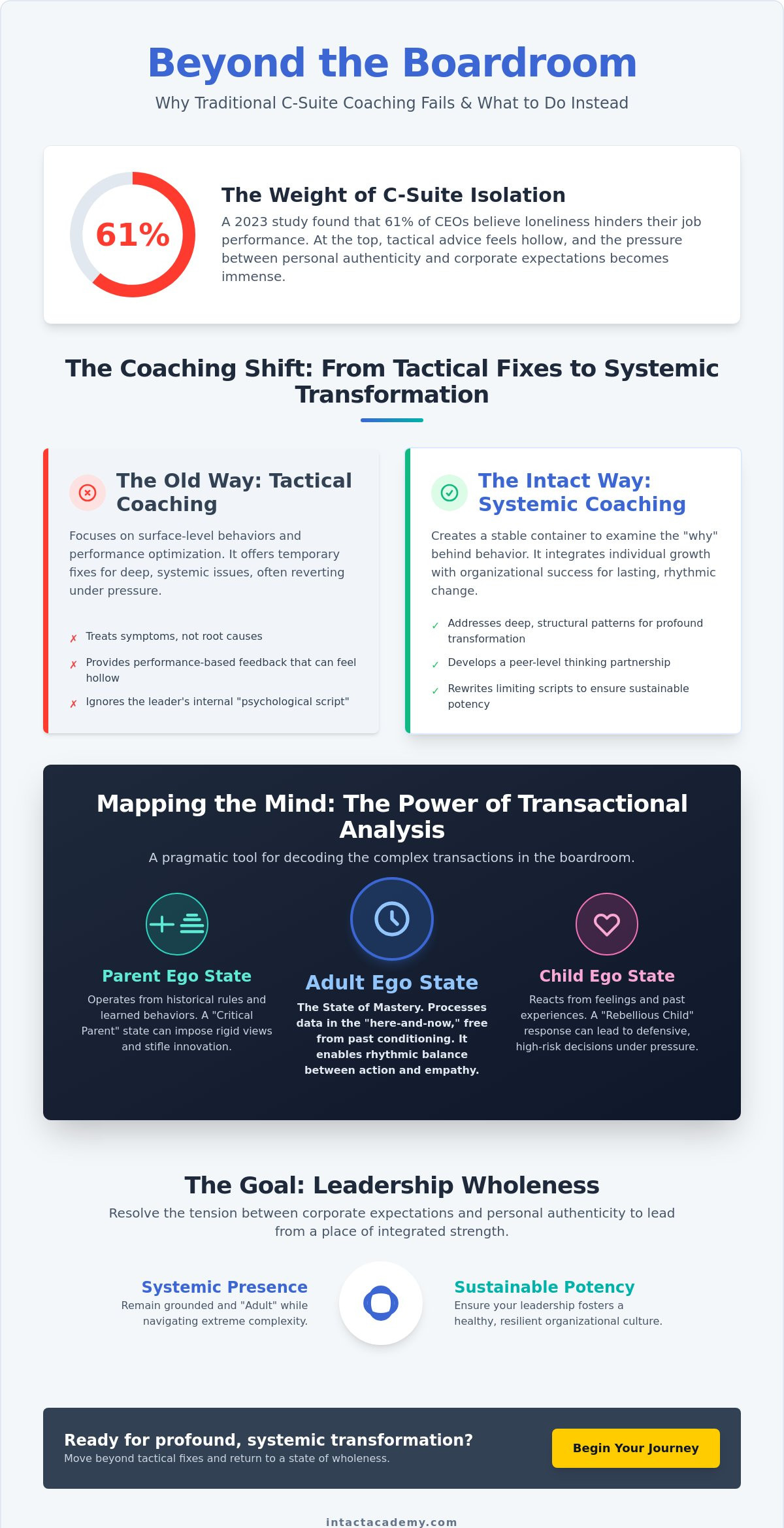
At the C-suite level, your decisions don't just affect quarterly reports; they create systemic ripples that touch every employee, stakeholder, and customer. This weight is often carried in isolation. It's heavy. While Business and executive coaching has become a standard tool in corporate development, most traditional models fail because they treat leadership as a set of skills to be optimized rather than a systemic identity to be integrated. They offer bandages for wounds that require deep, structural healing.
When you're managing the tension between personal authenticity and corporate expectations, tactical advice isn't enough. You need a peer-level thinking partner who understands that your internal script is the blueprint for your organizational impact. This is where executive coaching for C-suite leaders must evolve. It's not about acquiring new tactics; it's about building a stable container where you can examine the root causes of your leadership patterns without judgment. If you find yourself performing a role rather than leading from a place of wholeness, then the system you lead will inevitably feel the strain.
Moving Beyond Tactical Fixes to Systemic Presence
Tactical coaching focuses on behavior. Systemic transformation focuses on the "why" behind the behavior. A 2023 study on executive isolation found that 61% of CEOs believe loneliness hinders their job performance. When you're under extreme pressure, you don't rise to the level of your training; you sink to the level of your systemic scripts. Surface-level changes often revert because they don't address the underlying psychological architecture. Systemic Presence, however, is the ultimate C-suite competency. It's the ability to remain grounded and "Adult" while navigating extreme complexity, ensuring your internal state fosters a healthy organizational culture.
The Architecture of a High-Stakes Coaching Relationship
The relationship between a C-suite leader and their coach isn't a typical mentorship. It's a high-stakes architecture built on trust and professional pragmatism. You need someone who can sense the unspoken dynamics in the boardroom and challenge your underlying assumptions. This foundation is essential for leading organizational change effectively. Without a stable container for your own growth, your attempts to transform the system will likely face systemic resistance. Mastery in 2026 requires more than just agility; it requires the courage to look inward before taking outward action.
Mapping the Executive Mind: The Power of Transactional Analysis in the Boardroom
To lead a global organization in 2026, you must first lead the internal system that governs your reactions. Understanding what is Transactional Analysis (TA) provides the map for this journey. In the context of executive coaching for C-suite leaders, TA is far more than a psychological theory; it's a pragmatic tool for decoding the complex transactions that occur every day in the boardroom. By observing the flow of communication between yourself and your peers, you can pinpoint exactly where systemic friction begins.
Consider the three primary Ego States: the Parent, the Adult, and the Child. When a CEO operates from a "Critical Parent" state, they may inadvertently stifle innovation by imposing rigid, historical rules on a modern problem. Conversely, a "Rebellious Child" reaction to board pressure can lead to defensive, high-risk decision-making. Mastery lies in the "Adult" state, where you process data in the here-and-now, free from the distortions of past conditioning. This state allows for a rhythmic balance between decisive action and empathetic listening, which is essential for maintaining a healthy organizational system.
Uncovering the Unconscious Scripts of Corporate Culture
Leadership scripts are the unconscious life plans we create in childhood. If your script is "I must do it alone to be safe," you'll likely create a systemic bottleneck by refusing to delegate, even as your company scales. These scripts often manifest as "Psychological Games", repetitive patterns of interaction that end in familiar, negative feelings. By identifying these games, you move toward greater autonomy and potency, ensuring your strategy is driven by current reality rather than old survival mechanisms. When you change your script, the entire organizational culture begins to shift, as the system no longer has to compensate for your unconscious biases.
Agile Transactional Analysis: The Modern Executive's Edge
Agile TA integrates this psychological depth with the rapid pace of modern business. It's the science of human relationships applied to systemic leadership. While traditional executive coaching for C-suite leaders might focus on temporary behavioral compliance, Agile TA facilitates a fundamental unfolding of your leadership potential. Research suggests that 85% of executive success depends on relational intelligence rather than technical skill alone. If you're ready to explore these dynamics further, you might consider how systemic training can enhance your executive presence. This approach ensures that your transformation is not just a temporary shift, but a sustainable evolution into wholeness that resonates throughout your entire organization.
Evaluating Executive Coaching Models for C-Suite Impact
Choosing the right partnership requires a discerning eye. Many leaders gravitate toward "Experience-Based" coaching, seeking a mentor who has sat in the same seat. While a former CEO can offer tactical industry insights, they often inadvertently impose their own leadership scripts onto your unique organizational context. In contrast, "Psychology-Based" coaching, delivered by certified practitioners, focuses on your internal architecture. This approach doesn't just tell you what to do; it helps you understand why you do it, fostering a level of autonomy that tactical advice cannot reach.
A critical differentiator in 2026 is the executive coaching certification. A certified coach has undergone rigorous training to hold a stable container for your growth, ensuring that the work remains focused on systemic transformation rather than mere performance optimization. For those at the highest levels, the need may even shift from a coach to a supervisor. A supervisor provides a reflective space to navigate the ethical complexities and systemic entanglements inherent in global leadership, ensuring your potency remains untainted by unconscious biases.
Performance vs. Systemic Coaching: A Framework
Performance coaching is often transactional. It targets specific KPIs, immediate goals, and behavioral modifications. While useful for short-term gains, it rarely addresses the root causes of systemic friction. Systemic coaching, however, looks at the patterns and the "wholeness" of the leader within the organization. It treats the leader and the company as an evolving system. For executive coaching for C-suite leaders to be truly effective, it must be a hybrid approach with a heavy systemic bias. You need the agility to hit targets, but the depth to ensure those targets serve the long-term health of the entire system.
The ROI of Systemic Mastery in 2026
Measuring the impact of deep work requires looking beyond the balance sheet. In 2026, the ROI of systemic mastery is found in "soft" metrics that have hard consequences. A 2024 industry report indicates that organizations with high levels of psychological safety see a 27% reduction in senior-level turnover. Systemic coaching facilitates this by helping leaders operate from a state of wholeness, reducing the frantic energy that often leads to burnout. When a leader is integrated and authentic, the culture follows. This alignment creates a rhythmic stability that allows the organization to unfold its full potential without the drag of unresolved internal conflict.
Selecting Your Partner: A Checklist for C-Suite Coaching Readiness
The selection of a thinking partner is a rhythmic act of professional trust. Selecting the right partner for executive coaching for C-suite leaders requires moving beyond the subjective "click" of a first meeting. While rapport is necessary, it's insufficient for the depth of work required at the highest organizational levels. You need a partner whose professional maturity matches your own. This begins with verifying accreditation levels. A Senior Practitioner with the EMCC or a Master Certified Coach (MCC) with the ICF has demonstrated the capacity to handle extreme complexity. These designations signify over 2,500 hours of high-stakes practice and a commitment to rigorous ethical standards.
A coach's ability to hold a stable container is perhaps their most vital attribute. In the turbulence of a C-suite role, you need a space that remains unshakeable, even when you bring your most vulnerable or high-stakes dilemmas to the surface. This stability allows you to explore the systemic principles championed by Sari van Poelje, ensuring that your growth isn't isolated from the health of the company. A 2024 industry survey found that 72% of executives value "challenging perspectives" over "supportive listening." Pay attention to the nature of the challenge; if a coach only comforts your current perspective, they're a cheerleader. If they have the potency to challenge the scripts that limit your impact, they're a partner in transformation.
Contracting for Transformation, Not Just Tasks
Clear contracting is the silent engine of successful coaching. This involves both a professional contract, covering logistics and reporting, and a psychological contract, which defines the depth of the work. You must establish clear boundaries regarding confidentiality, especially when stakeholders or boards are involved. It's vital to ensure your coach has their own professional supervision. A coach without a supervisor is a leader without a mirror. At this level, that's a systemic risk you can't afford.
Questions to Ask Your Potential Executive Coach
When interviewing a potential partner, move beyond their track record to their underlying methodology. Consider asking these specific questions to gauge their depth:
- How do you work with the unconscious dynamics and hidden agendas within a leadership team?
- What specific systemic frameworks or psychological models inform your daily practice?
- Can you describe a specific instance where you challenged a C-suite leader's primary script to facilitate a breakthrough?
If you're ready to engage with a partner who possesses this level of systemic insight, view our executive coaching programs to begin your transformation.
The Intact Academy Approach: Returning to Wholeness in Leadership
The ultimate goal of leadership isn't simply to achieve more; it's to become more integrated. At Intact Academy, we believe that wholeness is the bedrock of sustainable impact. While many firms focus on behavior modification, our executive coaching for C-suite leaders facilitates a profound return to your authentic self. This process involves stripping away the defensive scripts that once served you but now limit your systemic agility. When you lead from a place of wholeness, you no longer feel the exhaustion of performing a role. Instead, your presence becomes a stabilizing force for the entire organization, creating a rhythmic stability that others can trust.
Our methodology is uniquely robust because it's constantly refined through our professional development for coaches. This dual focus means we don't just practice coaching; we advance the science of systemic change. We integrate the precision of Transactional Analysis with the speed of Agile methodologies and the depth of systemic work. This blend allows us to address the complex isolation of the boardroom by providing a peer-level thinking partnership that's as intellectually rigorous as it is emotionally safe. It ensures that the insights you gain are not just theoretical, but deeply actionable within your specific corporate context.
Bespoke C-Suite Coaching Journeys
No two leadership contexts are identical. We design bespoke journeys that respect the specific systemic pressures of your role. Whether you're navigating a global merger or leading a cultural transformation, the intensity and duration of our engagement are tailored to your needs. We often incorporate systemic 360-degree feedback, but we do so within a stable container that protects your psychological safety. Our focus is never on the "quick win" fix that fails under pressure. We aim for sustainable evolution that holds steady through the complexities of 2026 and beyond, allowing your leadership to unfold naturally and powerfully.
Next Steps: Embarking on Your Systemic Evolution
The transition from "doing" leadership to "being" an integrated leader requires a deliberate shift in perspective. It's a move from control to curiosity, from isolation to integration. This evolution begins with a diagnostic conversation where we explore your current systemic challenges and identify the scripts that may be dampening your potency. If you're ready to transcend surface-level performance and step into a journey of profound impact and authenticity, we invite you to connect with us. Your return to wholeness is the most significant contribution you can make to your organization's future. It's the path to true mastery in executive coaching for C-suite leaders.
Embracing the Future of Systemic Leadership
Mastery in 2026 requires more than tactical agility; it demands a fundamental shift from performing a role to being an integrated presence. We've explored how decoding your internal scripts and choosing a thinking partner with psychological depth can transform your organizational impact. By moving beyond surface-level behavioral fixes, you can resolve the chronic tension between your corporate responsibilities and your personal authenticity. This journey is about more than professional success; it's about a return to your natural state of wholeness.
At Intact Academy, our executive coaching for C-suite leaders is led by Sari van Poelje, a world-renowned expert in Transactional Analysis and Systemic Change. Our EMCC and ICF accredited methodologies have already supported participants from 14 countries worldwide in achieving profound human transformation. If you're ready to move beyond the isolation of the top and lead with renewed potency, the path is open. Begin your systemic journey to wholeness with Intact Academy's Executive Coaching. Your evolution is the catalyst for your system's flourishing.
Frequently Asked Questions
What is the primary difference between executive coaching and business consulting?
Business consulting focuses on providing external solutions and strategic reports to solve specific organizational problems. In contrast, executive coaching develops your internal capacity to solve those problems yourself. While a consultant might deliver a 200 page strategy document, a coach helps you identify the systemic scripts that made that document necessary in the first place.
How long does a typical C-suite coaching engagement last for sustainable results?
Sustainable transformation usually requires a commitment of 6 to 18 months. While behavioral shifts can occur within the first 180 days, rewriting deep systemic scripts and ensuring long term integration typically takes over a year of rhythmic work. This duration allows for the unfolding of new leadership patterns that can withstand high pressure environments. Effective executive coaching for C-suite leaders prioritizes this steady evolution over temporary fixes.
Is Transactional Analysis (TA) too clinical for a corporate environment?
Transactional Analysis is a highly pragmatic tool designed to decode the complex human transactions that occur in every boardroom. Over 10,000 certified practitioners globally use TA to help leaders move from reactive states into a grounded, Adult presence. It isn't about therapy; it's about providing a clear, intellectual framework to manage professional relationships and organizational dynamics with greater potency.
How do you measure the success of executive coaching for a CEO?
Success is measured through a blend of qualitative systemic feedback and quantitative organizational health metrics. We look for a 27% or higher improvement in senior team engagement and a measurable reduction in executive friction. Beyond the numbers, success is evident when a CEO can navigate high stakes decisions from a state of wholeness rather than from a place of defensive isolation.
Can systemic coaching help with a culture shift following a merger or acquisition?
Systemic coaching is essential for aligning divergent corporate scripts after a merger. Since 70% of acquisitions fail due to cultural incompatibility, coaching helps leaders integrate the "shadow" elements of both organizations. It provides a stable container to address the unspoken anxieties of the system, ensuring that the new entity moves toward a unified state of autonomy and growth.
What should I look for in a coach's credentials (EMCC vs. ICF)?
You should prioritize coaches who have reached the Senior Practitioner level with the EMCC or the Master Certified Coach (MCC) level with the ICF. These designations require a minimum of 2,500 hours of verified coaching experience. Both organizations ensure that the coach adheres to strict ethical standards and possesses the professional maturity to handle the systemic complexity of a global executive role.
How does coaching for the C-suite differ from coaching for middle management?
Coaching at the highest level addresses the systemic ripples of every decision rather than just functional performance. Executive coaching for C-suite leaders focuses on the unique isolation of the role and the tension between personal authenticity and public expectation. Middle management coaching is often about skill acquisition; C-suite coaching is about the profound transformation of the leader's internal architecture.
What is 'Agile Transactional Analysis' and how does it apply to my leadership?
Agile Transactional Analysis is the application of deep psychological principles at the speed of modern business. It allows you to pivot quickly in response to market changes without losing your psychological grounding. By using this lens, you can identify and resolve systemic bottlenecks in real time, ensuring that your leadership remains both flexible and integrated during periods of rapid organizational evolution.


