

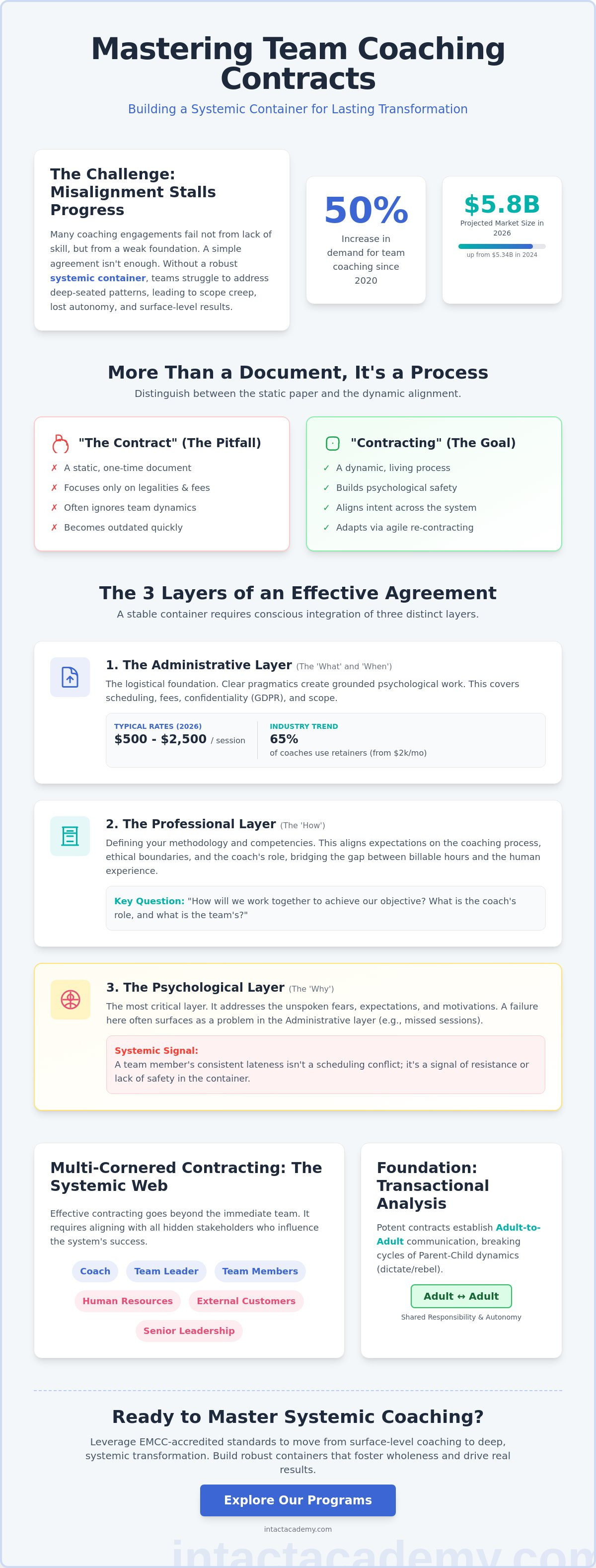
What if the hidden reason your coaching engagements stall isn't a lack of team chemistry, but a fundamental misalignment in the initial agreement? The process of contracting for team coaching is far more than a legal formality; it's the creation of a systemic container that determines the potency of every future interaction. With the demand for group and team coaching increasing by 50% since 2020, the pressure to deliver results has never been higher. Yet, many practitioners find themselves caught between a leader’s specific agenda and the team’s authentic needs, leading to scope creep and a loss of professional autonomy.
You recognize that a team is a living organism with its own unique script and potential for autonomy. If you don't secure alignment across every layer of the system, then even the most brilliant intervention will likely falter. This article offers a clear framework for multi-layered alignment that honors the maturity of your clients. You'll learn how to build a robust foundation for systemic transformation, ensuring your practice remains grounded while the global coaching market expands toward $5.8 billion in 2026. We'll explore how to transition from surface-level agreements to deep, systemic containers that allow for true wholeness and lasting change.
Key Takeaways
- Distinguish between simple transactional documents and the creation of a systemic container that holds the team’s collective evolution.
- Learn to align the administrative and professional layers of contracting for team coaching to prevent scope creep and ensure methodological clarity.
- Identify the hidden stakeholders in the systemic web, including HR and external customers, to create a multi-cornered agreement that supports the whole organization.
- Utilize agile re-contracting techniques to manage emerging needs and leadership changes without compromising the safety or integrity of the coaching space.
- Leverage EMCC-accredited standards to move from surface-level business coaching into the realm of deep, systemic transformation and professional wholeness.
What is Contracting for Team Coaching?
Contracting for team coaching is the explicit, systemic alignment of intent and boundaries between the coach, the team leader, and the team members themselves. While individual coaching often focuses on a singular path of growth, team coaching involves a web of intersecting scripts and agendas. It's the process of building a "Coaching Container." This container provides the psychological safety required for vulnerability and the professional potency required for change. If the container is weak, the work remains surface-level; if it's robust, the team can confront deep-seated patterns with confidence. In 2024, the global coaching industry reached $5.34 billion, yet many engagements failed because the "how" was never clearly defined within the system.
Team contracting is exponentially more complex than one-on-one work because you aren't just managing one relationship. You're managing the space between people. To create a stable foundation, you must align on three core elements: the primary objective, the methodological approach, and the boundaries of confidentiality. Without this clarity, the coach often becomes an accidental participant in the team's internal conflicts rather than an objective catalyst for their evolution.
The Distinction Between "The Contract" and "Contracting"
Many professionals mistake the signed document for the work itself. While the legal agreement provides a framework, the act of contracting is a continuous, living process. It's the rhythmic check-in that ensures everyone is still moving toward the same North Star as the organizational landscape shifts. The value lies in the negotiation. When you discuss boundaries and expectations openly, you're already coaching; you're modeling the transparency you want the team to adopt. Contracting is a systemic alignment of intent and boundaries.
Transactional Analysis: The Foundation of Potent Contracts
To understand the psychological depth of these agreements, we look to what is transactional analysis. This framework provides a lens for clarity, emphasizing Adult-to-Adult communication as the standard for professional partnership. In many organizations, teams fall into Parent-Child dynamics where the leader dictates and the team complies or rebels. A potent contract breaks this cycle. It establishes an agreement where every participant takes 100% responsibility for their role and their contribution to the whole. This clarity prevents the "Psychological Games" that often derail progress. Instead of acting out unconscious scripts, the team learns to operate with autonomy, integration, and a shared sense of purpose.
The Three Layers of an Effective Team Coaching Agreement
A stable container requires more than a signature on a page; it demands a conscious integration of three distinct layers. The first is the Administrative Layer. This covers the pragmatics of the engagement, such as GDPR compliance, scheduling, and fee structures. In 2026, team coaching rates typically range between $500 and $2,500 per session, with 65% of practitioners moving toward multi-session packages or monthly retainers starting at $2,000. While these details seem mundane, they provide the physical boundaries of the work. If the logistics are fuzzy, the psychological work will feel ungrounded.
The second layer is the Professional Layer. This is where you define your methodology and competencies. It involves aligning on the "how" of the coaching process. To navigate the complexity of organizational systems, practitioners often refer to research on Multi-stakeholder contracting in executive/business coaching to ensure all parties understand the technical scope. This layer bridges the gap between the billable hours and the human experience, setting the standard for professional excellence and ethical conduct.
The final, and most critical, is the Psychological Layer. This encompasses the implicit expectations and fears that participants bring to the room. When contracting for team coaching, a failure to address this layer often manifests as a breach in the administrative layer. If a team member is consistently late or misses sessions, it's rarely just a scheduling conflict. It’s often a systemic signal of resistance or a lack of psychological safety within the container. You aren't just managing a calendar; you're managing a field of energy and intent.
Deep Dive into the Psychological Contract
Every team carries a "hidden agenda." Perhaps the leader secretly wants the coach to "fix" a difficult employee, or the team fears that honesty will lead to retaliation. These are script patterns. During the intake phase, you must make these implicit dynamics explicit. Ask the uncomfortable questions: "What are we not allowed to talk about here?" or "What happens if we fail?" By bringing these shadows into the light, you increase the potency of the entire intervention and allow the team to move toward authentic autonomy.
Defining Professional Boundaries and Ethics
Confidentiality in a group setting is a complex web. You must establish clear rules about what stays within the team and what gets reported to stakeholders. This boundary prevents the coach from being triangulated into organizational politics. It's also vital to monitor your own life script. If you have a personal drive to be a "rescuer," you might over-contract or blur the lines between coaching and therapy. Maintaining professional wholeness requires constant self-reflection and supervision. If you're ready to deepen your systemic impact, exploring an accredited team coaching program can provide the structured methodology needed to master these nuances.
Multi-Cornered Contracting: Navigating the Systemic Web
A team does not exist in isolation. It's a vital organ within a larger organizational body. When we begin contracting for team coaching, we must look beyond the immediate participants to identify the entire systemic web. This includes HR, the CEO, the team leader, the team members, and even the customers they serve. Each of these stakeholders holds a different expectation, a different set of values, and often, a different definition of success. To ignore these layers is to risk the entire engagement being rejected by the organizational immune system.
In smaller engagements, we often work with a three-cornered contract involving the coach, the team, and the sponsor. However, in complex environments, this must evolve into a multi-cornered agreement. This systemic approach ensures that the coaching work is integrated into the broader strategy of leading organizational change. It requires the coach to hold a space where conflicting goals can be acknowledged. If the sponsor demands a specific performance metric while the team is struggling with internal trust, the contract must address this tension directly. You aren't there to take sides; you're there to facilitate a higher level of systemic alignment.
The Role of the Sponsor in Team Alignment
The sponsor is often the architect of the coaching initiative. Their vision provides the initial spark, yet it must be congruent with the team’s current reality. A common trap for practitioners is being used as a "tool" to fix a team that the organization has labeled as broken. This dynamic creates a Parent-Child relationship that stifles autonomy. Instead, use the contracting process to create a shared language for success. Ensure the sponsor understands that transformation is an unfolding process, not a mechanical repair. When all levels of the organization speak the same language, the potential for potency increases exponentially.
Systemic Mapping of the Contractual Field
Before the first session, it's helpful to visualize the relationships and loyalties that influence the team. These systemic loyalties often prevent change because the team feels an unconscious need to remain "loyal" to old ways of working or past leaders. By mapping these influences during the contracting for team coaching phase, you can address them before they manifest as resistance. The contract acts as a shield, protecting your neutrality and autonomy. It allows you to move freely within the system without being captured by its internal politics. This distance is essential for maintaining the integrity of the coaching container.
Agile Contracting: Re-aligning in the Face of Change
Teams are not static monuments; they are fluid systems in a state of constant flux. Because of this inherent movement, the initial agreement you forge must be elastic. Re-contracting is essential whenever the team’s composition shifts, such as when a new leader is appointed or a key member departs. In these moments, the "Distance Contract" becomes a vital tool. This is a secondary agreement that addresses emerging needs and unforeseen systemic ripples that weren't visible during the intake phase. When you practice contracting for team coaching, you must accept that the landscape will change as soon as the work begins.
To maintain the container's integrity, schedule formal re-alignment milestones. Using a "Stop-Start-Continue" framework allows the team to evaluate the work with professional pragmatism. They can identify which behaviors are stalling progress and which new methodologies will increase their potency. Ending a specific phase of a contract carries an emotional weight; it marks the death of an old way of being so that a new, more integrated phase can begin. This rhythmic approach ensures that the coaching remains relevant and that the team’s energy is focused on their most current challenges.
Managing Scope Creep and Goal Drift
Healthy evolution is often confused with goal drift. If the team starts focusing on surface-level logistics to avoid the deep work of script transformation, the coach must intervene. You must bring the group back to the "Adult" agreement. This requires the courage to name the avoidance. If the system remains resistant and the original goals are no longer achievable, the most ethical choice may be to terminate the contract. Honoring the system means knowing when a container can no longer hold the work. This level of integrity distinguishes a master practitioner from a transactional one.
Contracting for Psychological Safety and Agility
A robust Working Alliance is the foundation of psychological safety. It creates a space where radical honesty is not just permitted, but expected. Sari van Poelje masterfully integrates Agile principles into Transactional Analysis contracting, ensuring that the work remains responsive to real-time organizational shifts. This approach moves away from rigid, linear plans toward a rhythmic, iterative unfolding. If you want to master these dynamic pivots, consider joining our advanced team coaching certification to refine your systemic agility. Re-contracting is a sign of health, not a sign of failure.
Mastering Team Coaching with Intact Academy
Mastering the art of contracting for team coaching is the threshold between being a facilitator and becoming a systemic catalyst. At Intact Academy, we believe that your professional identity is your most potent tool. We don't just teach you how to manage a meeting; we invite you to integrate the profound principles of Transactional Analysis into your way of being. This shift allows you to hold the complexity of an entire organization while remaining grounded in your own autonomy. Our EMCC-accredited program at the senior practitioner level is specifically designed for those who seek to move beyond surface-level techniques toward true systemic mastery.
The curriculum is a deliberate journey of unfolding expertise. It consists of six two-day workshops, providing 80 hours of intensive training and 16 hours of dedicated supervision. In a global coaching market projected to reach $5.8 billion by 2026, the demand for certified, high-level practitioners is accelerating. Clients now expect more than just presence; they demand evidence of credentialing and a structured methodology. By joining our academy, you align yourself with a global standard of excellence that honors both the intelligence of the practitioner and the humanity of the team.
Deepen Your Impact through Professional Supervision
Within our framework, the nuances of contracting for team coaching are explored through the lens of professional supervision. This is where the "wise mentor" helps you review the multi-cornered contracts that often feel like a systemic tangle. Supervision ensures that your coaching container remains stable, even when organizational turbulence threatens to breach its boundaries. It's a space for reflective inquiry, where you can examine how your own script might be influencing the contractual field. To maintain this high ethical standard, a fee of €300 is charged to team coaching clients to cover these essential supervision costs, ensuring that every intervention is held with integrity and care.
Your Systemic Journey Starts Here
Choosing to evolve your practice is a commitment to your own wholeness and the flourishing of the systems you serve. Our curriculum covers everything from the initial intake to the final integration of change. If you're ready to advance, our team coaching course provides the roadmap you need for senior practitioner accreditation. Staying current with professional development for coaches is no longer optional in a world shaped by AI and rapid organizational pivots; it's the foundation of your future potency. Join our next cohort and master the art and science of profound team transformation.
Cultivating Systemic Wholeness through Potent Agreements
The path to profound transformation begins with the courage to look beneath the surface of professional agreements. By mastering the art of contracting for team coaching, you move beyond the role of a mere observer and become a steady anchor for organizational evolution. You've seen how a three-layered approach, integrating administrative clarity, professional methodology, and psychological depth, creates the safety necessary for a team to rewrite its collective script. If you choose to honor the systemic complexity of the multi-cornered field, then you allow for a state of wholeness that surface-level interventions cannot reach.
This journey toward mastery requires a stable container. Our programs, led by Transactional Analysis expert Sari van Poelje, bring together participants from over 14 countries to explore these deep systemic dynamics. Whether you're navigating goal drift or managing the intricate loyalties of a global boardroom, our EMCC and ICF accredited curriculum provides the intellectual rigor your practice deserves. Apply for the TA EMCC Senior Team Coach Academy to begin your next chapter of professional unfolding. The transition to systemic mastery is yours to claim.
Frequently Asked Questions
What is the primary difference between individual and team coaching contracting?
The primary difference lies in the shift from a dyadic relationship to a complex systemic web. While individual work focuses on a singular person's growth, contracting for team coaching requires aligning multiple intersecting scripts and organizational agendas simultaneously. You aren't just managing one person's goals; you're holding the space for the collective autonomy of the group while honoring the needs of the wider system.
How do you handle a team leader who refuses to engage in the psychological contract?
You must address this refusal as a systemic signal rather than a personal failure. If a leader avoids discussing the unspoken "rules" or fears within the team, the coaching container loses its potency. You should name this resistance with empathy and professional pragmatism. If the leader continues to block the psychological layer, you must evaluate whether the engagement can ethically move beyond surface-level transactions.
What should be included in the administrative layer of a team coaching contract?
The administrative layer must detail the logistics that provide the physical boundaries for the work. This includes session frequency, GDPR compliance, and specific fee structures, which in 2026 often range from $500 to $2,500 per session. It's also vital to include clear cancellation policies and protocols for data handling. These details ground the engagement, ensuring that the psychological work isn't disrupted by logistical ambiguity.
How often should a team coaching contract be reviewed or updated?
You should review the contract at every major milestone or whenever a significant systemic shift occurs. This includes changes in team membership, leadership transitions, or shifts in organizational strategy. Treating the agreement as a living process ensures that the work remains relevant. Rhythmic re-alignment prevents goal drift and allows the team to move through different phases of their transformation with clarity and intent.
What is a multi-cornered contract in an organizational context?
A multi-cornered contract is a systemic agreement that involves all relevant stakeholders, such as HR, the CEO, the team leader, and the team members. This approach prevents the coach from being triangulated into internal politics or secret agendas. By establishing transparency across all corners of the system, you create a robust foundation for change. This ensures that everyone is moving toward a shared definition of professional success.
Can a team coaching contract be verbal, or must it always be written?
While the act of contracting is a verbal and relational process, the administrative agreement must always be written to meet professional standards. Organizations like the ICF and EMCC emphasize that written contracts protect both the practitioner and the system. A written document provides a stable point of reference. It ensures that the professional boundaries, fees, and ethical guidelines are explicit and understood by every party involved.
How does Transactional Analysis help in the contracting process?
Transactional Analysis provides a sophisticated lens for establishing Adult-to-Adult communication from the very first interaction. It helps the coach identify "Psychological Games" and unconscious script patterns that might otherwise derail the agreement. By using this framework, you can ensure that the contracting for team coaching is transparent and autonomous. This prevents the team from falling into Parent-Child dynamics, allowing for a more integrated and potent coaching experience.
What happens if the team’s goals conflict with the organization’s goals?
The coach must facilitate a systemic negotiation to name and address these tensions directly. You aren't there to force compliance but to help the system find a state of alignment and wholeness. If the conflict remains irreconcilable, you must refer back to the multi-cornered agreement to determine the next steps. Maintaining your neutrality is essential to protect the integrity of the coaching container and your own professional autonomy.


