

What if the hours you spend accumulating certificates are actually distancing you from the profound impact you're meant to have? It's easy to feel like a transactional practitioner when you're overwhelmed by generic webinars that barely scratch the surface of human complexity. True continuous professional development for coaches isn't about ticking a box for a three-year renewal cycle; it's about the systemic integration of your own personal evolution with your professional methodology. If you feel your growth has plateaued, it's often because your current script for development lacks the psychological depth required for true mastery.
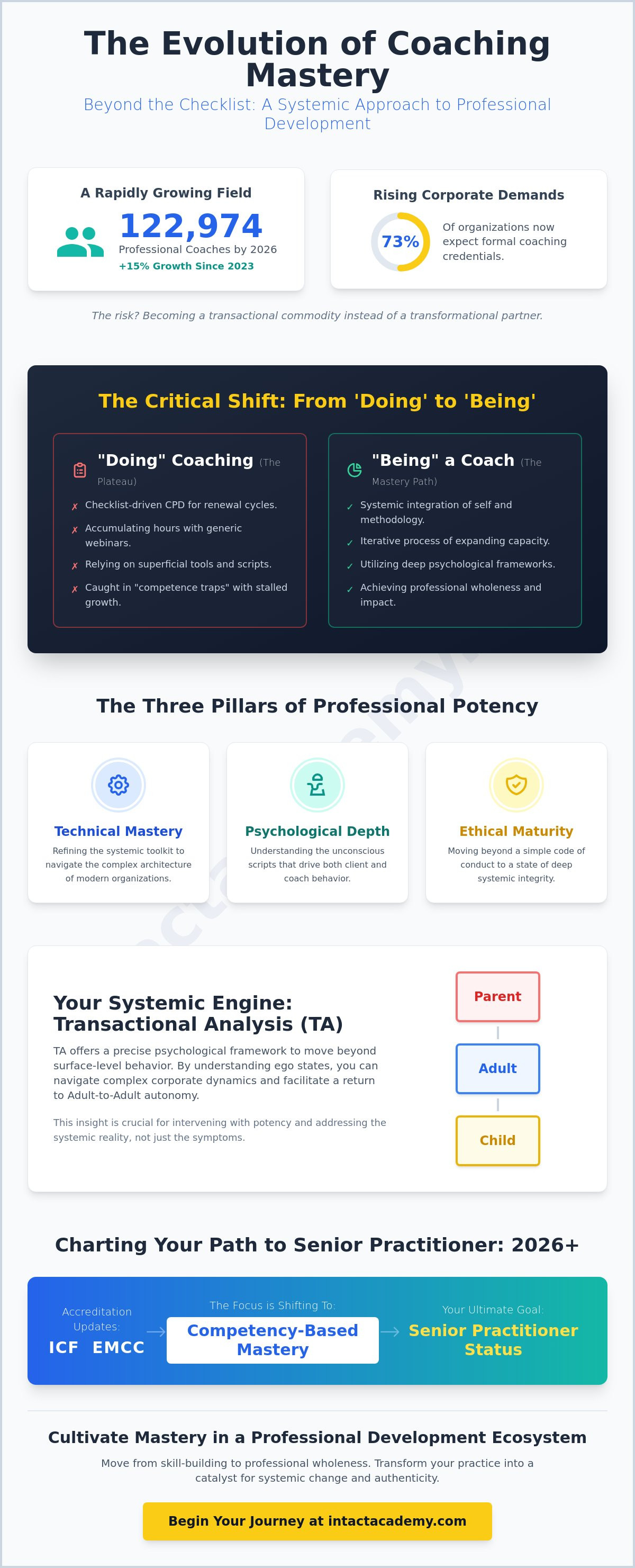
You likely recognize the frustration of managing complex client issues with tools that feel increasingly superficial. With 73% of organizations now expecting formal credentials and the global coaching market reaching 122,974 practitioners as of early 2026, the need for deep differentiation is vital. This article shows you how to move beyond credit-collecting to achieve professional potency and Senior Practitioner status. You'll discover how to master systemic interventions and utilize professional supervision to transform your practice into a catalyst for wholeness and authenticity.
Key Takeaways
- Shift your perspective on continuous professional development for coaches from a simple hours-based checklist to an iterative process of expanding your capacity to hold systemic complexity.
- Learn how Transactional Analysis provides a robust framework to navigate the intricate Parent-Child dynamics often found within corporate hierarchies.
- Understand the 2026 updates for ICF and EMCC pathways, specifically focusing on how to achieve Senior Practitioner status through competency-based learning.
- Discover how to conduct a systemic audit of your practice to identify psychological gaps and move from "doing coaching" to "being a coach."
- Explore how a deep-dive professional ecosystem can help you achieve professional wholeness and greater systemic impact in executive settings.
Beyond the Checklist: Why Continuous Professional Development for Coaches Must Evolve
The evolution of the coaching market has turned the traditional credit-collecting model into a relic. By April 2026, the number of professional coach practitioners worldwide has reached a record 122,974, representing a 15% increase since 2023. In this saturated landscape, continuous professional development for coaches must move beyond the mere accumulation of hours. It is the iterative process of expanding your capacity to hold systemic complexity. True mastery is found when you stop merely "doing coaching" and begin "being a coach." This shift is the hallmark of a Senior Practitioner who understands that their own internal state is the primary instrument of change.
Relying on surface-level tools in high-stakes organizational environments is a recipe for irrelevance. When a system is in crisis, it does not need another generic webinar; it needs a practitioner with the psychological depth to see the invisible scripts at play. Stagnation in a volatile market carries heavy emotional stakes. It creates a sense of being a transactional commodity rather than a transformational partner. To remain relevant, you must engage in Continuing Professional Development that challenges your existing worldview and invites a deeper integration of self and methodology.
The Three Pillars of Professional Potency
Technical mastery is the first pillar. It focuses on refining the systemic toolkit for organizational interventions, ensuring you can navigate the complex architecture of modern business. Psychological depth follows, requiring a deep understanding of the unconscious scripts that drive both client and coach behavior. Finally, ethical maturity moves beyond basic codes of conduct to a state of deep systemic integrity. These pillars provide the stability needed to navigate the turbulent work of personal and professional change, allowing you to remain grounded while your clients transform.
Recognizing the Professional Plateau
Many coaches experience a plateau where their growth feels stalled. You may be highly skilled, yet find yourself caught in "competence traps" where you repeat successful patterns that no longer yield profound results. Systemic blindness is a common symptom of this plateau, especially when working with C-suite clients. If you cannot see how individual behavior is a reflection of the larger organizational script, your interventions will remain superficial. Recognizing these signs is the first step toward reclaiming your autonomy. True professional development requires the courage to look inward before taking outward action.
The Systemic Engine: Integrating Transactional Analysis into Your CPD
If the coach is the instrument of change, then a robust psychological framework serves as the tuning fork. Transactional Analysis (TA) offers this precision, moving beyond surface-level behavior to the root of human interaction. For many, what is transactional analysis begins with a simple study of ego states, but it evolves into a lifelong path of continuous professional development for coaches. By understanding the Parent, Adult, and Child states, you gain the ability to navigate the complex power dynamics inherent in corporate hierarchies. You can see when a leader is stuck in a 'Rebellious Child' state or when an organization’s 'Parent' culture stifles innovation. This insight allows you to offer more than just advice; it allows you to facilitate a return to Adult-to-Adult autonomy.
Agile Transactional Analysis provides a necessary lens for high-velocity environments where flexibility and depth must coexist. It allows you to intervene with potency, ensuring that your work addresses the systemic reality rather than just the symptoms presented in a single session. This methodology is central to continuous professional development for coaches who seek to influence organizational culture at its core. It creates a space where complex systemic issues feel manageable through insight and structured methodology. If you're looking to refine your systemic lens, exploring what is transactional analysis is a profound starting point for your next stage of growth.
Mapping Unconscious Patterns in Leadership
Leaders often repeat self-sabotaging behaviors because of their Life Scripts. These are unconscious plans made in childhood that continue to dictate adult choices. Identifying these patterns is vital for any advanced practitioner. The power of 'Contracting for Change' becomes a core professional competency here. It's not just an administrative agreement; it's a psychological commitment to moving from psychological 'Games' to true autonomy. This clarity helps drive the 7-times ROI often reported in high-level coaching engagements according to PricewaterhouseCoopers studies.
Systemic Impact and Organizational Culture
Organizations have scripts just as individuals do. These cultural blockages often prevent even the most brilliant strategies from taking root. When you use TA to diagnose these organizational scripts, you transition from being a conversation partner to a systemic intervenor. You begin to facilitate sustainable transformation through systemic integration. This level of impact is what distinguishes a Senior Practitioner from a transactional provider. It allows for a profound human transformation that ripples through every level of the company.
Navigating Accredited Pathways: EMCC and ICF Requirements for 2026
Professional growth isn't a solitary endeavor; it's a commitment to global standards that ensure your practice remains safe and potent. As the coaching industry matures, the distinction between different accreditation bodies becomes more pronounced. If you seek a path that honors the complexity of systemic work, you must choose a framework that aligns with your specific professional philosophy. Choosing the right continuous professional development for coaches involves understanding how your personal learning journey intersects with these global benchmarks. By April 2026, the two primary bodies—the ICF and EMCC—have refined their requirements to emphasize depth over mere attendance.
The International Coaching Federation (ICF) maintains a structured, hours-based approach, while the European Mentoring and Coaching Council (EMCC) favors a portfolio-based, competency-driven model. For those pursuing an executive coaching certification at the Senior level, the EMCC’s focus on a "Portfolio of Evidence" allows for a richer reflection on systemic impact. Rather than a simple log of hours, this portfolio requires you to demonstrate how you've integrated your learning into your actual client work. It's a shift from proving you were present to proving you have evolved.
The Path to EMCC Senior Practitioner
Achieving Senior Practitioner status through the EMCC requires a deep dive into eight core competencies. This process isn't just about skill acquisition; it's about reflective practice. You're required to provide evidence of ongoing supervision, with a minimum of one session per quarter as of March 2026. This regular cadence of reflection ensures that systemic mastery remains a living part of your practice. The accreditation is valid for five years, with a renewal fee of €245 for the Senior Practitioner level, making it a stable long-term investment in your professional wholeness. This pathway is particularly suited for those who view coaching as an unfolding of human potential within organizational systems.
ICF Credential Renewal in 2026
The ICF renewal process follows a three-year cycle, requiring 40 Continuing Coach Education (CCE) units. At least 24 of these must be in Core Competencies, while the remaining 16 can be in Resource Development. A significant update on April 13, 2026, replaced the traditional Performance Evaluation for ACC and PCC credentials with an "Enhanced Mentor Coaching Requirement." This change emphasizes the importance of relational learning. Renewal fees are currently set at $175 for members and $275 for non-members. Integrating professional supervision into your continuous professional development for coaches is increasingly recognized by the ICF as a valid way to meet these rigorous standards while deepening your systemic integrity.
Designing Your Roadmap: From Skill-Building to Professional Wholeness
A roadmap for continuous professional development for coaches begins with a systemic audit of your current practice. Look beyond satisfaction scores; examine your client outcomes from the past 12 months. Are you facilitating lasting transformation, or are you offering temporary relief? Once you've audited your results, identify the psychological gaps in your toolkit. These are the moments where you feel triggered, stuck, or overly responsible for a client’s success. These gaps represent the edge of your current script and the beginning of your next stage of mastery. Identifying these patterns is the first step toward reclaiming your autonomy as a practitioner.
Effective development requires a blend of long-term learning and intensive masterclasses. While short sessions offer quick tools, a multi-month program allows for the unfolding of deep professional potency. Secure professional supervision to ensure quality and prevent the burnout often associated with high-stakes executive work. Finally, integrate this learning into active client engagements through live-action practice. This ensures that theory doesn't remain abstract but becomes a living part of your systemic interventions. To begin this journey of deep integration, consider how our TA Foundation Year can serve as your roadmap to systemic mastery.
The Critical Role of Professional Supervision
Supervision is the gold standard of continuous professional development for coaches. It utilizes the 7-Eyed Model to examine the client, the coach, and the wider organizational system simultaneously. This model allows you to see the "parallel processes" where the dynamics of the client's organization are unconsciously mirrored in the coaching relationship. It's essential to distinguish between supervision, which focuses on the quality of the work; mentoring, which focuses on skill acquisition; and therapy, which addresses personal healing. As of March 2026, the EMCC requires at least one supervision session per quarter, recognizing that a coach’s internal state is their most powerful tool.
Reflective Practice as a Daily Habit
Systemic journaling after high-stakes sessions turns "mistakes" into valuable data points. Instead of asking what went wrong, ask what systemic script was being played out. Peer-supervision groups further this growth by building a community of wise mentors who challenge your assumptions in a safe container. These habits move you away from a "doing" mindset into a "being" state of professional wholeness. When you treat every interaction as a learning opportunity, your growth becomes a steady, methodical unfolding rather than a frantic search for credits. This reflective rhythm creates the stability needed for the often-turbulent work of organizational change.
Cultivating Mastery: The Intact Academy Professional Development Ecosystem
The journey toward professional potency requires a stable container. At Intact Academy, we provide a structured ecosystem designed for continuous professional development for coaches who refuse to settle for surface-level training. Our programs are built on the philosophy of returning to wholeness and authenticity. This isn't just about learning techniques; it's about the unfolding of your own autonomy as a systemic intervenor. By joining a global cohort representing over 14 countries, you gain a cross-cultural perspective that is essential in a market where 72% of coaches now offer virtual, borderless services.
The TA Foundation Year serves as the springboard for this depth. It provides the psychological rigor necessary to bridge the gap between abstract theory and tangible business results. The curriculum is shaped by Sari van Poelje, whose personal insights into Agile Transactional Analysis act as a bridge between the inner workings of the individual and the success of the organization. For those ready to lead at the highest levels, our EMCC Senior Practitioner and Team Coach Academies offer a pathway to recognized mastery and systemic impact.
Long-term Growth vs. Intensive Masterclasses
Choosing between a year-long certification and a targeted masterclass depends on your current professional script. If you're looking to refine a specific systemic tool, a masterclass provides immediate, punchy directives for your toolkit. However, achieving Senior Practitioner status requires the steady, methodical learning found in our year-long programs. These academies ensure that the profound concepts of Transactional Analysis remain actionable without losing their intellectual rigor. Our goal is to help you move beyond "doing" to "being," ensuring your presence alone becomes a catalyst for transformation within the systems you serve.
Your Next Step Toward Systemic Impact
The path to mastery is a choice to prioritize depth over convenience. You can apply for our upcoming Senior Practitioner Academy to begin your transition from a transactional coach to a systemic leader. If you're unsure which path aligns with your current roadmap, booking a discovery call allows us to co-create a developmental journey that honors your maturity and intelligence. This alignment is vital for continuous professional development for coaches who seek to leave a lasting legacy. As Sari van Poelje often says, "The courage to change your own script is the prerequisite for helping a system change theirs."
Embracing the Path to Systemic Mastery
True professional evolution occurs when you move beyond the administrative burden of credit-collecting and step into the role of a systemic intervenor. By integrating the psychological depth of Transactional Analysis and aligning with the rigorous 2026 standards of the EMCC and ICF, you transform your practice from a series of transactions into a catalyst for profound human change. This journey requires the courage to look inward and the discipline to maintain a consistent rhythm of reflective practice and professional supervision. Your internal state is the primary instrument of change; keep it finely tuned.
If you're ready to deepen your impact, our ecosystem provides the stable container needed for this unfolding. Our programs are led by global TA expert Sari van Poelje and bring together a diverse cohort of professionals from over 14 countries. As an academy accredited by the ICF, EMCC, and EATA, we ensure your learning meets the highest global benchmarks of excellence. It's time to align your continuous professional development for coaches with your true potential for professional wholeness. Explore our EMCC-Accredited Senior Practitioner Academies today and begin the next chapter of your professional story. Your evolution is the key to your clients' flourishing.
Frequently Asked Questions
What is the difference between CCE and CPD for coaches?
CCE units are the specific "currency" used by the ICF for credential renewal, while CPD is the universal term for the iterative process of expanding your professional capacity. CCEs focus on credit accumulation within three-year cycles. In contrast, continuous professional development for coaches focuses on the practitioner’s unfolding potency and systemic integration. Both are essential for maintaining a record of growth in an industry where 73% of clients expect formal certification.
How many hours of CPD are required for ICF credential renewal in 2026?
You must complete 40 CCE units every three years to maintain your credential. A minimum of 24 units must be in Core Competencies, including the mandatory 3 hours of ethics training. This structured approach ensures that as the global coaching market reaches its record 122,974 practitioners in 2026, practitioners remain grounded in rigorous ethical and professional standards. These requirements help maintain your credibility in a competitive global market.
Does coaching supervision count as CPD?
Coaching supervision is recognized as a gold standard for continuous professional development for coaches. The ICF permits you to count supervision hours toward your Core Competency requirements for renewal. Meanwhile, the EMCC requires a minimum of one session per quarter as of March 16, 2026. This practice is vital for managing the emotional weight and complexity of high-stakes organizational interventions while preventing professional stagnation.
Why is Transactional Analysis relevant for professional development in business?
Transactional Analysis offers a precise language for navigating the Parent-Child dynamics prevalent in modern business hierarchies. It allows coaches to diagnose organizational scripts and cultural blockages that hinder autonomy and innovation. By understanding these unconscious patterns, you can facilitate profound human transformation that ripples through a company’s entire system. This depth is what distinguishes a Senior Practitioner from a provider who only offers transactional advice.
Can I use systemic team coaching training for my individual coach accreditation?
Training in systemic team coaching is highly applicable to individual accreditation because many core competencies overlap. The skills required to manage group dynamics and organizational scripts directly enhance your individual coaching potency. Both the ICF and EMCC recognize these advanced hours, as they demonstrate your ability to hold systemic complexity. This integration is key to achieving the 7-times ROI often reported by organizations in PricewaterhouseCoopers studies.
What is the EMCC Senior Practitioner level, and how do I reach it?
The Senior Practitioner level is an EMCC accreditation for those managing complex, systemic client issues in organizational settings. You reach it by submitting a portfolio of evidence that demonstrates mastery of 8 core competencies. This process requires significant reflective practice and verified ongoing supervision. It signals that you possess the professional maturity and psychological depth to work effectively with C-suite clients and navigate large-scale change.
Is online professional development as effective as in-person sessions?
Online development is exceptionally effective when it mirrors the process of deep, methodical learning through interactive cohorts. Since 72% of coaches transitioned to virtual models by 2023, digital fluency is now a baseline requirement for global practitioners. High-quality online programs provide a safe, stable container for personal evolution while connecting you with peers from over 14 countries. This format allows for a rhythmic balance between theory and live-action practice.
How do I choose between ICF and EMCC accreditation paths?
Your choice depends on whether you value a structured, hours-based system or a reflective, portfolio-driven path. The ICF is widely recognized in corporate boardrooms, while the EMCC emphasizes systemic depth and mandatory quarterly supervision. Many leaders in continuous professional development for coaches suggest pursuing the path that best aligns with your personal philosophy of wholeness. Many practitioners now hold both credentials to demonstrate a comprehensive commitment to mastery.


