

What if the resistance you encounter isn't a lack of professional commitment, but a systemic script designed to protect the status quo? You've likely felt the weight of repetitive failure, watching 70% of change initiatives documented by McKinsey research collapse under the pressure of unaddressed human dynamics. It's exhausting to treat culture as a black box while common mistakes in organizational change continue to drain your team's potency. You know that top-down pressure rarely yields the deep, lasting integration your organization needs to flourish.
We recognize that the frustration of repetitive failure is a signal for deeper inquiry rather than more forceful management. This article promises to reveal the hidden psychological patterns and systemic traps that cause transformation to stall. You'll learn how to apply frameworks like Transactional Analysis to facilitate sustainable change and move toward EMCC-level mastery. We'll begin by examining the invisible scripts that govern behavior and conclude with actionable pathways to achieve authentic organizational wholeness.
Key Takeaways
- Bridge the gap between logical strategy and psychological reality by understanding how different ego states respond to the pressure of transition.
- Recognize why volume is not value, avoiding the common mistakes in organizational change that stem from informative messaging rather than transformative dialogue.
- Decode your "Organizational Script" to identify the unconscious patterns and historical myths that may be predictably undermining your progress.
- Break the cycle of passive compliance by identifying "symbiosis traps" where teams sacrifice autonomy for perceived safety.
- Evolve from a tactical facilitator into a systemic Change Architect capable of guiding an organization toward lasting integration and wholeness.
The Psychological Architecture of Change: Why Logic Often Fails
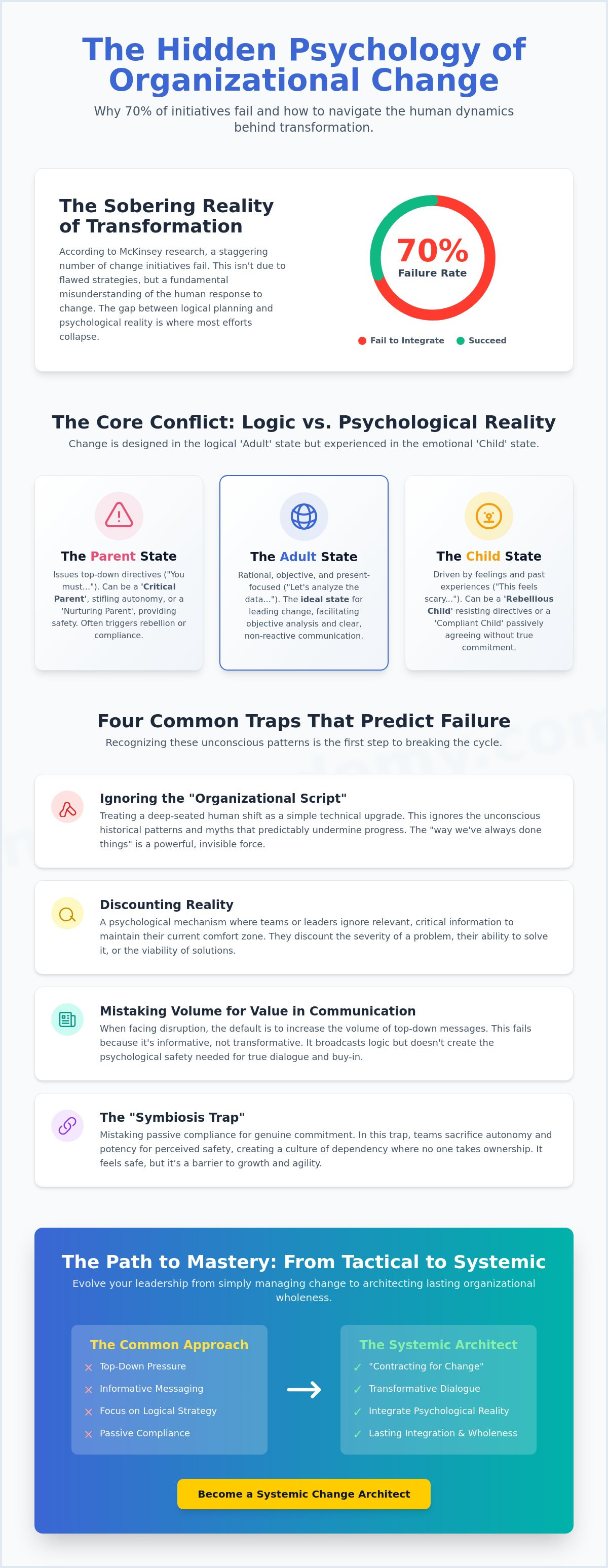
Most leaders approach transformation as a purely logical exercise. They map out workflows, set timelines, and distribute spreadsheets, yet they often overlook the deep-seated human scripts that dictate how these changes are actually received. One of the most common mistakes in organizational change is treating a systemic human shift as a mere technical upgrade. According to research from McKinsey, approximately 70% of change initiatives fail, not because the strategy was flawed, but because there was a systemic mismatch between the boardroom's vision and the workforce's psychological reality.
Strategy usually lives in the Adult ego state. It's rational, objective, and future-oriented. However, the experience of change often pulls individuals into the Child ego state, where fear of the unknown and a loss of autonomy dominate the internal narrative. Intellectual buy-in is merely a surface-level agreement; it doesn't guarantee the emotional or systemic integration required for lasting transformation. If the transition doesn't address these underlying states, the organization remains fragmented. Establishing "Contracting for Change" is a foundational competency that leaders must master. It’s the process of making the implicit explicit, ensuring that everyone involved understands not just the "what," but the psychological "how" of the transition. Without this clear agreement, leaders fail to establish the safety needed to move beyond resistance and into true potency.
To understand why these efforts stall, we must look at a comprehensive overview of change management through the lens of Transactional Analysis. This perspective reveals that the architecture of an organization isn't just made of roles and responsibilities, but of complex ego-state interactions that can either fuel or freeze progress.
The Parent-Adult-Child Dynamic in Corporate Shifts
Top-down initiatives frequently trigger a "Rebellious Child" response across the workforce. When leadership adopts a "Critical Parent" style, issuing directives without empathy or inquiry, they inadvertently stifle the autonomy they claim to value. In these environments, teams often become stuck in a "Child" state, passively waiting for permission to take any action or move forward. This dynamic creates a culture of dependency that is the antithesis of the agility required in today's 24/7 global market. If the leadership doesn't shift their stance, the workforce will remain trapped in a cycle of compliance rather than contribution.
Why the Adult State is Missing from the Boardroom
High-pressure environments often force even the most seasoned executives into reactive "script" behaviors. Instead of observing the here-and-now, they repeat historical patterns of control or avoidance that they learned early in their careers. The Adult ego state is the objective, here-and-now processing center of the personality. Staying in this state is essential to facilitate objective systemic analysis and maintain the integrity of the change process. When the Adult state is absent from the boardroom, leaders aren't leading the people in front of them; they're leading a memory of a past challenge. This lack of presence is a primary driver of the common mistakes in organizational change that derail even the most well-funded projects. Achieving wholeness requires leaders to step out of these historical scripts and engage with their teams with fresh, Adult-to-Adult clarity.
The Communication Trap: Moving Beyond Vague Messaging
When a system faces disruption, the reflexive response is often to increase the volume of communication. Leaders broadcast more frequently, assuming that clarity is a matter of repetition. This is one of the most persistent common mistakes in organizational change. If the underlying transaction is flawed, more communication simply accelerates the breakdown. True transformation requires moving beyond informative messaging into transformative dialogue. This shift demands that we address "discounting," a psychological mechanism where stakeholders ignore relevant information about the change to maintain their current script. By discounting the severity of a problem or their own capacity to solve it, individuals stay stuck in old patterns despite new data.
A 2024 analysis of corporate failures suggests that 70% of change efforts stall because leaders overlook the quality of their human transactions. They fall into common leadership mistakes in change management by prioritizing the frequency of emails over the depth of the connection. Effective change isn't about telling people what's happening; it's about creating a container where the workforce can integrate the new reality without losing their sense of autonomy.
Psychological Games That Sabotage Strategy
Within change management teams, the Drama Triangle often replaces productive collaboration. You'll see the Victim (the overwhelmed employee), the Rescuer (the manager over-functioning to fix things), and the Persecutor (the rigid policy maker). These roles prevent real work. Another hurdle is the "Blemish" game. Here, stakeholders obsess over a 3% error in a spreadsheet to avoid discussing a 90% shift in company culture. This nitpicking serves as a shield against the vulnerability of change. To regain potency, coaches must cross these transactions. They must invite participants back to an Adult-to-Adult state where the actual problem can be addressed without the noise of psychological scripts.
From Informing to Contracting: A Systemic Shift
Moving from "telling" to "contracting" provides the systemic stability needed for growth. In leading organizational change, we emphasize that a contract isn't just a legal document. It's a three-layered agreement that creates safety.
- Administrative: The "what," "where," and "when" of the change process.
- Professional: Defining roles, competencies, and the "how" of the work.
- Psychological: Addressing the unspoken expectations, fears, and the hidden "why."
Uncovering the Organizational Script: Why Failures are Predictable
Every organization follows an unconscious life plan. We call this the Organizational Script. It isn't found in the employee handbook or the quarterly reports; instead, it lives in the shared psyche of the collective. When leaders wonder why 70% of change programs fail to meet their goals, a statistic that has remained stubbornly consistent since John Kotter's 1995 research, they often overlook this hidden blueprint. These common mistakes in organizational change happen because we address the symptoms while the script remains untouched. The script is a set of decisions made early in the company's history, often in response to a crisis or the founder's personal drive. It creates a predictable path. If the script says "We are the underdog," the company will unconsciously sabotage its own growth to maintain that familiar identity.
Identifying Repetitive Failure Patterns
You might notice your team fighting against an underlying "Never" or "Always" script. Perhaps you "always" struggle with internal silos despite three restructures in the last five years. Or maybe you "never" quite reach the market leader position despite superior technology. These aren't accidents; they're re-enactments. The "Founder’s Ghost" often haunts these patterns. The original cultural imprints, created during the first 1,000 days of the company's life, dictate how current employees resist new directions. By mapping the systemic history, you can begin leading organizational change with clarity rather than frustration. You'll see that the resistance isn't personal; it's a loyal adherence to an old story that once provided safety.
Rewriting the Collective Narrative
Transformation requires moving the organizational script from the unconscious into the "Adult" state of awareness. This isn't a surface-level fix. It involves a systemic re-decision. A coach acts as a catalyst here, holding a mirror to the collective script and asking if it still serves the current reality. This is where Transactional Analysis becomes an essential tool. It provides the framework to dismantle outdated narratives and integrate new, autonomous ways of working. When a system makes a collective re-decision, it regains its potency. The energy once spent on maintaining old failures is suddenly available for innovation. It's about returning the organization to its state of wholeness, where its actions finally align with its aspirations.
The connection between individual and collective scripts is profound. A leader with a "Try Hard" script will often attract a team that values effort over results, reinforcing a systemic pattern of burnout. To break the cycle, the leader must first recognize their own narrative. Only then can the organization pivot from a scripted past to a designed future.
Mistaking Compliance for Commitment: The Symbiosis Trap
Leaders often mistake a quiet room for a committed one. When employees nod in agreement but fail to take initiative, the organization has fallen into a symbiosis trap. This psychological state occurs when individuals surrender their autonomy in exchange for the perceived safety of the status quo. It's a fundamental breakdown in the Adult-to-Adult contract required for growth. One of the most common mistakes in organizational change is failing to see that compliance is actually a form of resistance. When leaders "rescue" their teams by making every decision, they inadvertently cultivate a "Victim" culture where people stop thinking for themselves.
The Trap of Passive Resistance
Resistance isn't always an active rebellion. Passivity manifests in four ways: Doing Nothing, Over-adaptation, Agitation, and Incapacitation. Over-adaptation is particularly dangerous because it looks like cooperation. Employees follow every rule to the letter while refusing to engage their own creativity. A 2023 Prosci study found that projects with high change management effectiveness are six times more likely to succeed. To shift toward autonomy, leaders must provide Potency, Protection, and Permission. This allows employees to step out of old scripts and into empowered roles.
Building Psychological Safety Through TA
Creating a "Stable Container" for change requires a shift in "Stroking" patterns. In Transactional Analysis, a stroke is a unit of recognition. If you only reward results, you reinforce the fear of failure. Rewarding the process of learning builds the psychological safety necessary for innovation. Without it, the system remains rigid. Systemic supervision helps leaders identify when they are feeding dependency and teaches them to offer recognition that fuels authentic commitment. Transformation happens when people feel safe enough to be whole.
If you're ready to move beyond surface-level compliance, explore how our systemic leadership programs can help you avoid these common mistakes in organizational change and build a culture of true autonomy.
Navigating Toward Systemic Wholeness and Mastery
Addressing the common mistakes in organizational change requires more than a checklist of tactical adjustments. It demands a fundamental shift from managing tasks to architecting systems. When we view the organization as a living organism, we stop fixing symptoms and start healing the source. The coach evolves into a Change Architect, a professional who doesn't just facilitate meetings but designs the structural and psychological conditions for growth. This is the essence of the TA EMCC Senior Practitioner academy, where practitioners learn to hold the complexity of human scripts alongside business objectives. By avoiding the common mistakes in organizational change through a systemic lens, we restore the natural flow of energy within the collective.
The Agile TA Approach to Change
Rigid five-year plans often fail because they ignore the dynamic nature of human systems. Sari van Poelje integrates Agile principles with systemic Transactional Analysis to create a framework that's both responsive and deep. Instead of forcing a predetermined outcome, we use iterative cycles to uncover the underlying organizational script. If we observe the patterns of interaction in real-time, then we can apply interventions that resonate with the system's current capacity for change. This movement from rigid planning to systemic agility ensures that transformation isn't just a temporary state but a permanent evolution in how the organization functions. It's about building potency within the team to handle future shifts without losing their sense of purpose.
Your Path to Professional Mastery
Achieving an executive coaching certification at a senior level involves mastering more than just active listening. It requires the clarity to provide systemic supervision when the path forward is obscured by complexity. Data from industry reports in 2023 indicates that 85% of executive clients now prioritize coaches who demonstrate deep systemic understanding over those with purely behavioral backgrounds. To meet this demand in 2026, professionals must deepen their impact through rigorous training and reflective practice.
- Develop the capacity to identify systemic "games" that stall progress.
- Cultivate the professional presence needed to challenge executive scripts.
- Utilize systemic supervision to maintain your own clarity and boundaries.
We invite you to step into this role of the Change Architect. Our work at Intact Academy is dedicated to returning the organization to its state of wholeness. It's a journey back to authenticity, where every individual and system can function with full autonomy and integrity. This is the path to true mastery.
Mastering the Path to Systemic Wholeness
True transformation begins when we stop treating organizations like machines and start seeing them as living, breathing psychological systems. Avoiding the common mistakes in organizational change requires more than a tactical checklist; it demands a shift in how we perceive the organizational script and the hidden dynamics of compliance. When leaders move beyond vague messaging and address the underlying symbiosis that keeps teams stuck, they unlock a new level of professional potency. It's about moving from a state of reactive friction toward a state of systemic integration and collective autonomy.
If you're ready to bridge the gap between high-level theory and profound human impact, join a global community of practitioners. Led by international expert Sari van Poelje, our programs have empowered participants from over 14 countries to lead with depth and clarity. You can deepen your impact with our TA EMCC Senior Practitioner Academy, an elite training ground accredited by both the EMCC and ICF. Take the next step in your evolution as a leader and guide your organization toward its highest potential for wholeness. The courage to change starts with the insight to see the system as it truly is.
Frequently Asked Questions
What are the most common reasons why change management fails?
One of the most common mistakes in organizational change is focusing solely on structural shifts while ignoring the psychological undercurrents of the workforce. According to the 2023 Prosci Benchmarking Report, 70% of change initiatives fail because of employee resistance and a lack of visible executive support. When leaders treat people as components in a machine rather than autonomous individuals with their own scripts, they invite systemic sabotage.
How does Transactional Analysis help in understanding organizational resistance?
Transactional Analysis (TA) provides a map for the invisible dynamics that drive resistance by identifying the ego states involved in every interaction. If a leadership team communicates from a "Critical Parent" state, employees often retreat into a "Rebellious Child" response, which creates a stalemate. By using TA, we can shift the dialogue back to an "Adult-to-Adult" level. This fosters a space where authentic transformation and professional pragmatism coexist.
What is an organizational life script and how does it affect change?
An organizational life script is a pre-conscious plan formed during a company's founding years that dictates its habitual patterns and eventual outcomes. Eric Berne’s theory suggests these scripts act as an invisible blueprint, often pulling a company toward familiar failures or successes regardless of new strategies. To implement lasting change, leaders must decode these historical narratives. Only then can the organization move toward a state of autonomy and wholeness.
How can leaders avoid the Drama Triangle during a major transition?
Leaders avoid the Drama Triangle by consciously stepping out of the roles of Victim, Rescuer, or Persecutor and moving into the "Winner’s Triangle." During transitions, it's easy to fall into the Rescuer role by attempting to solve every employee's discomfort, which inadvertently creates dependency. By maintaining potency and staying in an Adult ego state, you invite others to take responsibility. This shift replaces blame with accountability and ensures the transition remains grounded.
What is the difference between compliance and commitment in organizational change?
Compliance is a "have to" response driven by external pressure, whereas commitment is a "want to" choice rooted in internal alignment. A 2022 Gallup report found that only 23% of global employees are truly engaged, highlighting a massive gap between those who follow orders and those who own the outcome. True transformation requires moving beyond the "Adapted Child" response of simple obedience to engage the full Adult commitment of every team member.
Why is "contracting" considered a core competency for change agents?
Contracting is the essential process of making explicit, bilateral agreements about the goals, boundaries, and methods of a change initiative. It serves as the foundation of trust by aligning the administrative, professional, and psychological levels of a project. Without a clear contract, expectations remain hidden and often lead to systemic conflict. Masterful contracting ensures that everyone is working toward the same vision of integration and success from the start.
How can systemic team coaching improve the success rate of change initiatives?
Systemic team coaching improves success by addressing the connections and relationships between team members rather than focusing on individual performance in isolation. Research by Peter Hawkins suggests that looking at the stakeholder environment increases a team's collective effectiveness. This approach helps the group recognize their shared patterns and how they serve the wider organization. It creates a sustainable momentum that allows the new culture to unfold naturally.
What role does psychological safety play in overcoming resistance to change?
Psychological safety provides the stable environment where employees feel secure enough to express doubt and learn new skills without fear of retribution. Amy Edmondson’s 1999 study demonstrated that teams with high safety levels are significantly more likely to admit mistakes and innovate during transitions. When people feel safe, the energy they previously used for self-protection is redirected toward integration. It allows the organization to navigate the turbulence of change with integrity.


