

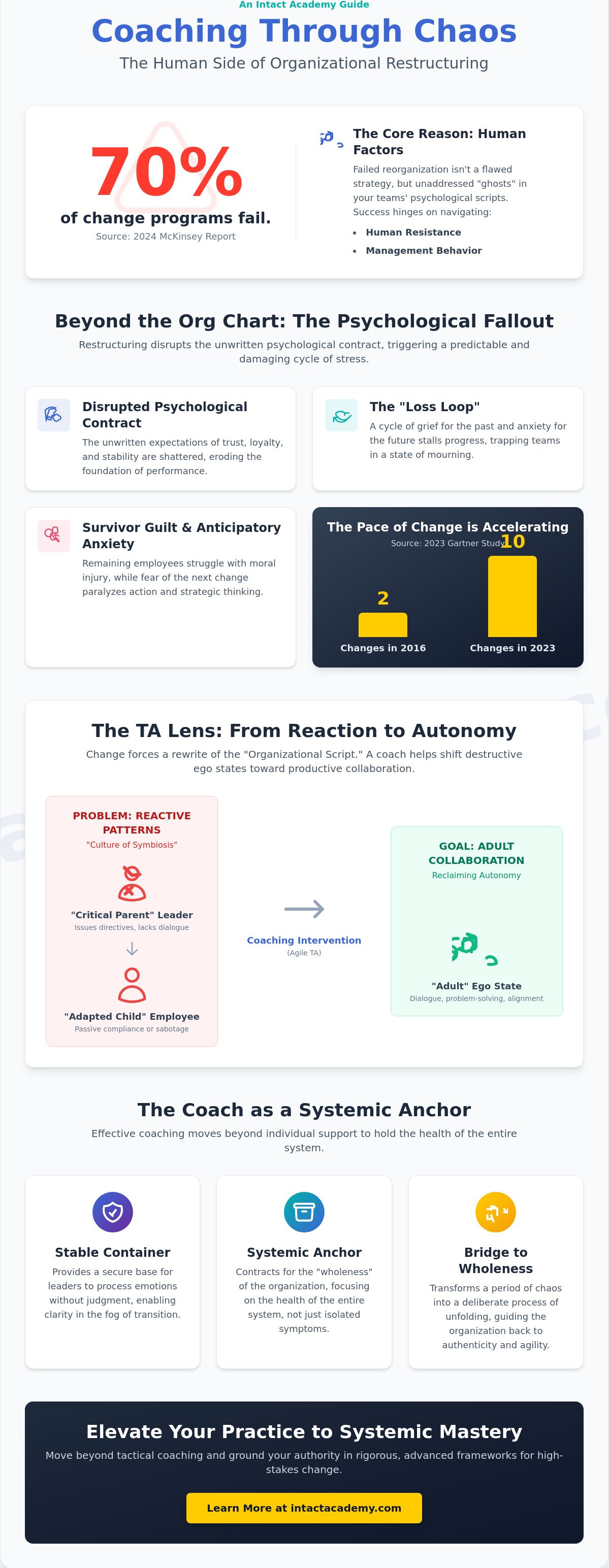
What if the primary cause of a failed reorganization isn't a flawed strategy, but the unaddressed "ghosts" of the old structure still haunting your teams' psychological scripts? When you're coaching through organizational restructuring, the most critical work happens not on the organizational chart, but in the quiet, often turbulent space between an old identity and an unfolding future. You've likely witnessed how a 2024 McKinsey report suggests that 70% of change programs fail due to human resistance and management behavior. It's a reality where survivor guilt and systemic anxiety can stall even the most well-funded initiatives.
You recognize that moving a team beyond reactive ego states requires more than a new set of KPIs; it demands a return to wholeness and a clear map for systemic intervention. This guide provides the psychological and systemic frameworks you need to facilitate a deep, sustainable transformation. We'll explore specific tools to transition your teams from resistance to autonomy, positioning you as a senior practitioner who handles high-stakes change with grounded authority and empathy. It's time to move beyond surface-level fixes and invite a more profound integration of human and organizational success.
Key Takeaways
- Understand how restructuring disrupts the unwritten psychological contract, allowing you to move beyond surface-level change management into the realm of deep systemic transformation.
- Master the art of coaching through organizational restructuring by analyzing the Organizational Script and shifting ego states from reactive patterns to Adult collaboration.
- Explore the essential "Integration Phase" of team coaching to foster the psychological safety necessary for newly formed teams to flourish in their new landscape.
- Identify and resolve the psychological games that hinder progress, using a structured framework to restore autonomy and collective potency.
- Elevate your practice from tactical coaching to systemic mastery, grounding your professional authority in the rigorous standards of advanced practitioner accreditations.
Understanding the Psychological Impact of Organizational Restructuring
Restructuring is often viewed through the narrow lens of mechanical realignment, yet it functions as a profound disruption of the psychological contract. This unwritten set of expectations between the individual and the organization forms the foundation of trust and stability. When an organization shifts its shape, it doesn't just move boxes on an org chart; it severs the invisible threads of loyalty and shared identity. According to a 2023 Gartner study, the average employee experienced 10 planned enterprise changes in the past 12 months, compared to only two in 2016. This constant state of flux erodes the internal script of safety that employees rely on to perform with potency.
Traditional approaches frequently falter because they focus on the "what" while neglecting the "how" of human experience. While understanding change management models provides a necessary structural map, these frameworks often ignore the unconscious emotional weight of transitions. This oversight leads to the "Loss Loop," a cycle where grief for what was and anxiety for what will be prevents the system from moving toward integration. If leadership doesn't address this loop, the organization remains stuck in a state of mourning, unable to find new meaning in the restructured environment. Coaching through organizational restructuring serves as the bridge between these two states, transforming a period of chaos into a deliberate process of unfolding.
The coach functions as a "stable container" during these periods of high organizational flux. By providing a secure base, the coach allows leaders to process their own emotional responses without the fear of judgment or professional repercussions. This containment is essential for maintaining the clarity needed to lead others through the fog of transition.
The Anatomy of Restructuring Stress
Stress in a shifting system manifests through two distinct psychological states. Survivor guilt often plagues those who remain, as they struggle with the moral injury of seeing colleagues depart. Simultaneously, anticipatory anxiety creates a paralysis of action as the workforce waits for the next phase of change. For leadership, these pressures often trigger primitive fight, flight, or freeze responses that compromise strategic thinking. Systemic restructuring is a transition of both form and spirit.
The Coach as a Systemic Anchor
Effective coaching through organizational restructuring requires moving beyond individual support to hold a systemic perspective of the whole organization. This begins with "contracting for wholeness" at the start of the engagement, ensuring that the work focuses on the health of the entire system rather than isolated symptoms. Neutrality is a myth in these scenarios; the coach is always positioned within the changing system. By acknowledging this position, the coach can act as an anchor, helping the organization return to a state of authenticity and collective agility.
The Transactional Analysis Lens: Mapping the Organizational Script
Every organization operates according to a "Script," a pre-conscious life plan that dictates how success is achieved and how failure is managed. When coaching through organizational restructuring, we recognize that a change in hierarchy is actually a forced rewrite of this collective narrative. During the 2023 tech sector volatility, where over 260,000 workers faced displacement, many firms fell back into archaic patterns. Leaders often adopt the "Critical Parent" ego state, issuing directives without dialogue, while employees retreat into the "Adapted Child," manifesting as either passive compliance or subtle sabotage.
The transition isn't just about moving boxes on an org chart; it's about breaking a "Culture of Symbiosis." This occurs when teams become over-dependent on old, rigid structures to define their value. By applying Agile Transactional Analysis, coaches help individuals reclaim their autonomy. This process involves moving away from reactive patterns and toward a state of wholeness where the individual's goals align with the new systemic direction.
Ego States in Transition
Spotting the "Critical Parent" leader or the "Adapted Child" employee is vital during layoffs. These states are often defense mechanisms against the unknown. To facilitate rational decision-making, coaches must invite the "Adult" state, the part of the personality that processes current reality without distortion. You can learn more about these dynamics in our guide on what is transactional analysis. Utilizing research on coaching as a buffer, organizations can reduce the psychological strain of change by approximately 30%, allowing teams to remain grounded in their Adult state even during high-stakes upheaval.
Rewriting the Script for the Future
Identifying "archaic" patterns is the first step in ensuring the new organizational goals take root. These patterns are often remnants of a previous founder's vision or a past crisis that no longer serves the current mission. Coaching leaders to model the new script requires authentic and potent communication that acknowledges the past while firmly pointing toward the future. Potency, permission, and protection create the necessary psychological safety for employees to abandon old survival strategies and embrace new responsibilities. When a leader provides the "permission" to innovate and the "protection" to fail, the organization’s potency increases exponentially. To explore how these systemic shifts can revitalize your leadership team, consider how our professional training programs can support your next transition.
Systemic Team Coaching Strategies for Structural Transition
Restructuring often fails because it treats the organization as a machine rather than a living organism. When you engage in coaching through organizational restructuring, you aren't just adjusting workflows; you're reweaving the social fabric. Team coaching serves as the primary lever for success because it addresses the collective script of the group. According to 2022 research on the psychological costs of changes, the absence of psychological support during transitions can lead to a 35% drop in productivity and a significant rise in employee turnover. By focusing on the team level, coaches bridge the gap between the cold logic of a new org chart and the warm reality of human connection.
Coaching the Newly Formed Team
Rapid trust-building in a new reporting structure requires more than a simple icebreaker; it demands rigorous "contracting." This is the process where members define their new boundaries, mutual expectations, and psychological safety requirements. We often facilitate the "Grave-digging" ritual, a deliberate space for the team to honor their old identity before it's buried. If a team doesn't mourn its previous structure, it can't fully inhabit the new one. This process is a cornerstone of leading organizational change from a psychological perspective, ensuring that the transition is felt and integrated rather than just endured. Effective coaching through organizational restructuring turns these moments of loss into a foundation for future potency.
Addressing the Systemic Shadow
Every restructure creates "systemic holes" where roles, influence, or emotional supports used to exist. These gaps often manifest as "unspoken" loyalties to former leaders or departments, which can quietly sabotage current progress. If 20% of a team remains loyal to a leader who was let go, their commitment to the new vision will be compromised. We use systemic constellations to visualize these hidden power dynamics. This method allows teams to map their relationships in physical space, making the invisible visible. The coach’s role is to facilitate "integration" rather than just "reorganization." By acknowledging these shadows, the team can align its purpose with the new vision, moving from a state of fragmentation back to wholeness. This systemic inquiry ensures that the new structure isn't just a facade, but a functional, thriving reality.
- Systemic Inquiry: Questioning the "why" behind new roles to create shared meaning.
- Contracting: Establishing clear rules for engagement and conflict resolution.
- Ritualizing: Using symbolic acts to mark the end of the old and the start of the new.
Navigating Resistance and Psychological Games During Change
Restructuring triggers deep-seated psychological scripts. It's inevitable. When coaching through organizational restructuring, you'll encounter "Psychological Games," which are repetitive, unconscious patterns that end in a predictable "payoff" of bad feelings. The most common is "Yes, But," where a leader asks for advice only to reject every suggestion. Another is "Look How Hard I Tried," where a manager performs exhaustion to avoid accountability for failed implementation. These games aren't just distractions; they're systemic defense mechanisms against the discomfort of change.
To stop these games, coaches can use this 5-step framework to invite Adult collaboration:
- Identify the Bait: Recognize the repetitive "switch" or the moment the conversation feels circular.
- Refuse the Role: Stay in your Adult ego state. Don't provide the "Yes, But" player with more suggestions to shoot down.
- Address the Discount: Point out what's being ignored, such as the team's actual capacity or the leader's own agency.
- Name the Process: Use radical transparency to describe what's happening in the moment without judgment.
- Re-contract: Shift the focus back to the original goal of the restructuring.
It's vital to distinguish between "Resistance" and "Refusal." Resistance is often a 48-hour emotional reaction to a perceived threat to safety or status. Refusal is different. It's a conscious, Adult decision that the new organizational direction no longer aligns with an individual's values. While resistance requires empathy and stability, refusal requires a dignified exit strategy. Radical transparency in these conversations dissolves the rumors that fuel a 70% failure rate in change initiatives, as reported by McKinsey and Harvard Business Review studies.
Spotting the Drama Triangle
During a restructure, the 1968 Drama Triangle by Stephen Karpman often dominates the narrative. Leaders become Persecutors, employees feel like Victims, and HR or coaches are lured into the Rescuer role. If you find yourself working harder than the client, you've been "hooked." To move toward the Winner’s Triangle, you must trade Rescuing for Caring, Persecution for Assertiveness, and Victimhood for Vulnerability. This shift allows the team to own their transformation rather than waiting to be saved.
Dissolving Resistance through Adult Dialogue
Effective coaching uses active listening as a data-gathering tool for systemic blockages. It's not just about empathy; it's about hearing the unspoken fears of the C-suite. Naming the elephant in the room, such as a CEO's fear of losing control, provides the potency needed for real change. The ultimate goal is Autonomy. By encouraging individuals to operate from their Adult ego state, you ensure the restructured organization is built on authentic commitment rather than compliant scripts.
Cultivating Mastery in Organizational Change Coaching
The evolution from a tactical coach to a systemic change master requires a fundamental shift in perception. You move from fixing visible problems to sensing the underlying currents of an organization's script. When you are coaching through organizational restructuring, your potency as a professional depends on your ability to hold the emotional weight of the system while maintaining strategic clarity. This journey involves integrating Transactional Analysis (TA) with organizational theory to foster true autonomy within the workforce. It's about moving beyond surface-level interventions to reach the psychological depth where real transformation occurs.
High-stakes restructuring demands a level of expertise that basic training cannot provide. Obtaining EMCC Senior Practitioner and Senior Team Coach accreditations is vital for those operating at the executive level. These credentials signal your capacity to manage the complex dynamics of collective grief, power shifts, and systemic realignment. Without this rigorous grounding, a coach risks becoming entangled in the very system they're trying to help. Intact Academy provides the structured methodology needed to maintain professional distance while offering deep, empathetic support.
Professional Standards and Systemic Impact
The executive coaching certification requirements for 2026 emphasize that technical proficiency is no longer enough. Mastery now requires a systemic lens that distinguishes a coach in a crowded global market. Data from industry reports suggests that 70% of organizational transformations fail because of human resistance and cultural misalignment. Systemic mastery allows you to address these psychological roots directly. Ongoing professional development for coaches ensures you remain resilient, particularly through regular supervision. Supervision acts as a mirror; it protects your well-being while you navigate the turbulent energies of a transitioning enterprise, ensuring you don't absorb the system's anxiety as your own.
Joining the Intact Academy Global Community
Intact Academy bridges the gap between sophisticated psychological theory and professional pragmatism. Our methodology integrates Agile Transactional Analysis into a proprietary model that honors both individual wholeness and organizational agility. By joining our community, you learn to weave these concepts into your own proprietary coaching model, creating a unique value proposition for your clients. We invite you to join the TA EMCC Senior Team Coach Academy to refine your practice among a community of wise global mentors. This is where you learn to facilitate coaching through organizational restructuring with precision and grace. Discover how our academies help you facilitate sustainable transformation and lead your clients toward a state of systemic health and authenticity.
From Structural Shift to Systemic Wholeness
Organizational change is rarely about the boxes on a chart; it's about the human scripts that reside within them. By applying the lens of Transactional Analysis, you move beyond surface-level fixes to address the psychological undercurrents that drive resistance. Effective coaching through organizational restructuring demands a shift from managing tasks to facilitating a deep, systemic evolution of the collective identity. When you master these structural transitions, you don't just solve a business problem; you return the organization to a state of potency and integration.
If you're ready to deepen your professional impact, join our global community of practitioners. Master the art of systemic change at Intact Academy. Our EMCC and ICF accredited programs are led by global TA expert Sari van Poelje and attract participants from over 14 countries. It's time to transform your practice into a catalyst for profound human and organizational growth. You possess the capacity to guide others through the complexity toward a more authentic, flourishing future.
Frequently Asked Questions
What is the primary role of a coach during organizational restructuring?
The coach acts as a systemic container for the transition, ensuring that the human element remains integrated while structural shifts occur. Their primary role is to move the organization from a state of reactive survival to proactive autonomy. By facilitating clarity in communication and roles, coaching through organizational restructuring can reduce the 25% productivity dip often seen in unmanaged transitions according to 2022 Gartner research.
How does Transactional Analysis help in managing change resistance?
Transactional Analysis manages change resistance by identifying the Child ego state's fear of loss and addressing it through the Adult's objective reality. When leaders understand the strokes, or recognition, their teams require, they can mitigate the 70% failure rate of change initiatives cited by McKinsey. This psychological framework allows for the renegotiation of psychological contracts, transforming resistance into a collaborative inquiry about future possibilities and shared growth.
What are psychological games in the context of a corporate restructure?
Psychological games are repetitive, unconscious patterns of interaction that lead to negative payoffs like blame or victimization during a restructure. Common examples include "Kick Me" or "Blemish," where employees deflect the discomfort of change onto others to avoid personal accountability. Recognizing these patterns allows a team to move toward authentic intimacy, preventing the erosion of trust that plagues 60% of corporate reorganizations according to 2021 industry reports.
Can team coaching accelerate the ROI of a restructuring process?
Team coaching through organizational restructuring accelerates ROI by reducing the "forming and storming" phases of team development by up to 30% according to International Coaching Federation studies. When a coach facilitates the alignment of new team identities, they prevent the hidden costs of disengagement and role confusion. This systemic intervention ensures that the new structure functions as an integrated whole rather than a collection of siloed, underperforming parts.
Is it better to coach leaders or the entire team during a transition?
A systemic approach requires coaching both leaders and their teams to ensure a unified transformation across the entire hierarchy. If only leaders receive support, a parallel process often occurs where the team remains stuck in old scripts while the leader attempts new behaviors. Data from the 2023 Executive Coaching Survey suggests that 85% of successful transformations involve multi-level coaching interventions that bridge the gap between strategic intent and daily execution.
What accreditation do I need to coach at the C-suite level during change?
C-suite coaching during systemic change requires advanced certification such as the Master Certified Coach (MCC) credential or specialized training in Agile Transactional Analysis. These qualifications demonstrate the potency and ethical grounding needed to handle high-stakes corporate shifts. Leaders at this level benefit most from coaches who have completed at least 200 hours of systemic-specific training to navigate the complex power dynamics inherent in the boardroom.
How do you measure the success of a restructuring coaching engagement?
Success is measured through a blend of quantitative KPIs like employee retention rates and qualitative shifts in the organizational script. For example, a successful engagement might see a 15% increase in Adult-to-Adult transactions during executive meetings within the first six months. Coaches also track the speed to autonomy, observing how quickly teams begin to self-regulate and innovate without external intervention after the formal restructure concludes.
What is an "organizational script" and why does it matter?
An organizational script is the unconscious life plan of a company, often dictated by founding myths and past traumas that influence current decision-making. If this script isn't identified and updated, the organization will likely repeat old failures even under a new structural design. By rewriting this script, companies can achieve true wholeness, moving away from historical limitations toward a future of authentic agility and sustained, systemic growth.


