

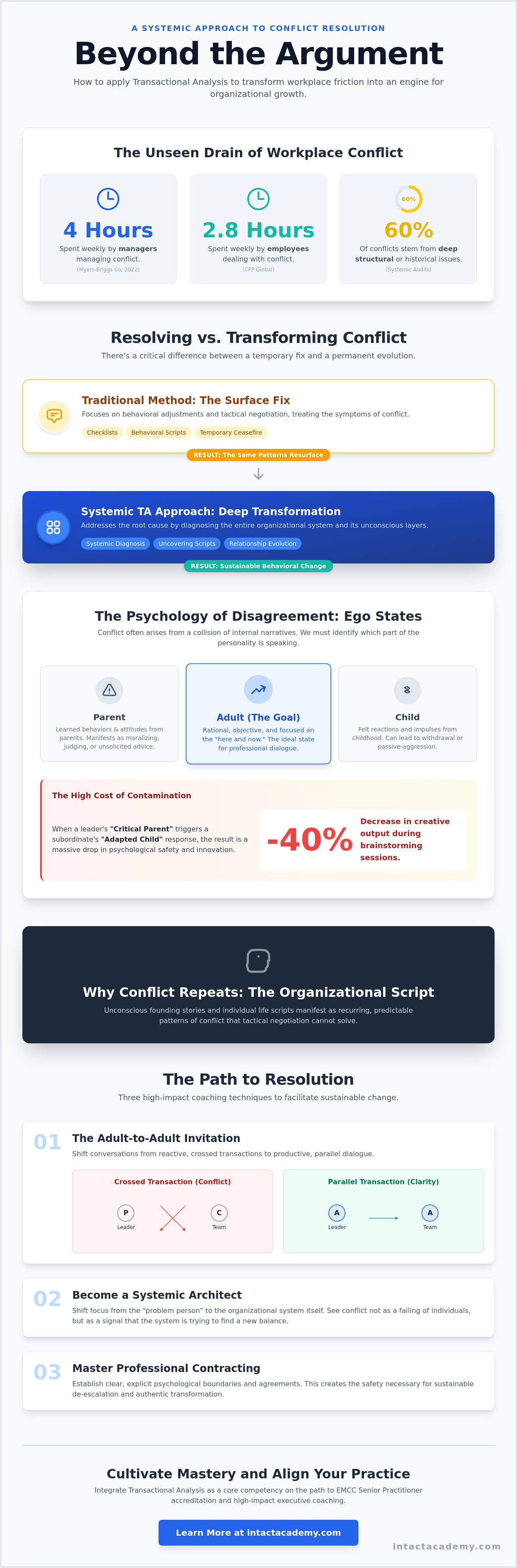
What if the circular arguments paralyzing your leadership team aren't actually about the strategy, but are instead the echoes of an unexamined organizational script? You've likely felt the exhaustion of mediating high-stakes executive clashes only to see the same patterns resurface weeks later. A 2022 study by the Myers-Briggs Company found that managers spend up to 4 hours every week managing conflict. Most interventions remain surface-level and fail to address the underlying dynamics. To move beyond these temporary fixes, you must master sophisticated coaching techniques for conflict resolution that address the systemic roots of human interaction and script formation.
We agree that the current reliance on superficial fixes fails to create the profound human transformation your clients deserve. This article promises to equip you with the psychological depth and systemic frameworks needed to transform workplace friction into an engine for organizational growth. You'll discover how to apply Transactional Analysis to foster autonomy and potency within teams. We'll preview the path to advanced EMCC and ICF accreditation through a lens of wholeness and integration. By the end of this guide, you'll understand how to facilitate sustainable behavioral change that honors the intelligence and maturity of everyone involved.
Key Takeaways
- Move beyond surface-level behavioral fixes to understand conflict as a systemic signal, uncovering the unconscious layers that tactical negotiation often overlooks.
- Apply advanced coaching techniques for conflict resolution by utilizing the Parent-Adult-Child (PAC) model to diagnose ego states and dissolve the repetitive psychological games that stall team progress.
- Explore the profound impact of "Organizational Scripts," learning how founding stories and individual life scripts manifest as recurring patterns in modern workplace dynamics.
- Master the art of the "Adult-to-Adult" invitation and professional contracting to establish the psychological boundaries necessary for sustainable de-escalation and authentic transformation.
- Align your practice with the path to EMCC Senior Practitioner accreditation by integrating Transactional Analysis as a core competency for high-impact executive coaching.
Beyond Behavioral Fixes: A Systemic Approach to Conflict
Conflict coaching is frequently reduced to a series of tactical negotiations or a checklist of behavioral adjustments. This surface-level approach treats tension as a technical glitch to be patched rather than a meaningful signal from the organizational system. When we apply coaching techniques for conflict resolution, we must look past the immediate friction. A study by CPP Global indicated that employees spend approximately 2.8 hours per week dealing with conflict, yet most corporate interventions focus solely on behavioral scripts that fail to address the underlying psychological drivers.
Traditional "conflict management" fails because it ignores the unconscious layers of human interaction. It seeks to silence the noise rather than understand the frequency. By adopting a Systemic TA Perspective, coaches move beyond the "fix-it" mindset. They become containers for systemic tension. This means holding the space where transformation can occur, allowing the parties involved to move from defensive postures to authentic engagement. Conflict literacy evolves into systemic mastery when the coach recognizes that every dispute is an invitation to examine the health of the entire organization.
The Limitations of Traditional Resolution
Corporate environments often prize speed over depth. This leads to a reactive mindset where managers attempt to resolve a dispute without transforming the relationship. Surface-level communication tips, such as "I-statements" or active listening exercises, often mask deeper systemic issues. These tools are helpful, but they don't address the 60% of organizational conflicts that stem from structural ambiguity or historical scripts. Resolving a dispute is a temporary ceasefire; transforming a relationship is a systemic evolution that requires looking at the hidden dynamics beneath the surface.
The Coach as a Systemic Architect
To create lasting change, the coach shifts focus from the "problem person" to the organizational system itself. This requires a deep understanding of what is transactional analysis and how it serves as a foundation for systemic diagnosis. Instead of seeing two people arguing, the coach sees a system attempting to find a new state of balance. By utilizing sophisticated coaching techniques for conflict resolution, the practitioner identifies the ego states and psychological games at play. This architectural approach provides a path toward wholeness and organizational agility, turning conflict into a catalyst for profound human and professional transformation.
The Psychology of Disagreement: Ego States and Games
Conflict isn't just a clash of opinions; it's a collision of historical patterns and internal narratives. Ego States serve as the internal map of our interpersonal reactions. When we coach teams, we look past the surface argument to see which part of the personality is speaking. Is it the Critical Parent, demanding compliance? Or the Rebellious Child, resisting for the sake of autonomy? Transactional Analysis allows us to see these shifts in real time, moving the dialogue from reactive patterns to a state of wholeness. Effective coaching techniques for conflict resolution involve identifying these ego states before they derail a project or damage a professional relationship.
Diagnosing Ego State Contaminations
In high-pressure executive meetings, "Critical Parent" energy often manifests as unsolicited advice, moralizing judgments, or a sharp tone. This energy triggers a complementary "Adapted Child" response in subordinates, where they might withdraw or become passive-aggressive. Research from systemic organizational audits in 2023 suggests this dynamic can lead to a 40% decrease in creative output during brainstorming sessions. When a leader speaks from a Parent state, they accidentally invite the other person to stop thinking and start reacting. Recognizing these contaminations is the first step toward restoring a functional Adult-to-Adult dialogue, where facts take precedence over feelings of inadequacy.
Breaking the Drama Triangle
Psychological Games are repetitive sequences of behavior with a hidden agenda. They always end in a "payoff" of familiar, negative feelings like guilt, resentment, or triumph. To break this cycle, coaches must identify the roles within the Drama Triangle: Persecutor, Victim, and Rescuer. These roles are masks we wear to avoid the vulnerability of true intimacy and accountability.
- Persecutors blame others to maintain a sense of power and control.
- Victims act helpless to avoid the weight of responsibility and decision-making.
- Rescuers offer help without being asked, often to feel superior or needed.
To stop a game in its tracks, you must "cross the transaction." If a colleague invites you into a Victim role by complaining without seeking a solution, respond from your Adult state with a reflective inquiry. Ask: "What specific resources do you need to move forward?" This shift invites the other person back to their own potency and away from the scripted drama. Applying these advanced coaching techniques for conflict resolution helps teams move from friction to flow. You can explore these dynamics further through our systemic leadership programs. The movement from reaction to reflection is the hallmark of a mature system, ensuring that the Adult state remains the primary driver of organizational success.
Mapping the Script: Why Conflict Recurs in Teams
Every organization operates under a hidden narrative. In Transactional Analysis, we call this the script. Just as individuals follow unconscious life plans, teams inhabit an organizational script that dictates how they handle tension. These scripts often stem from founding traumas or early successes that became rigid dogmas. To apply effective coaching techniques for conflict resolution, one must look beyond the immediate argument to the historical blueprint that makes the argument feel inevitable.
When leading organizational change, the coach acts as a detective of the collective unconscious. If a company was founded during a period of high scarcity, the team might still operate in a "survival script" decades later, even with millions in the bank. This manifests as chronic infighting over resources. Real transformation requires rewriting these collective scripts to align with current reality rather than past ghosts. It's about moving from a reactive stance to one of systemic autonomy.
Uncovering the Organizational Script
Mapping recurring conflict requires identifying "injunctions," which are the unspoken "don't" messages that stifle growth. Common injunctions include "Don't be close" or "Don't succeed." In a 2023 systemic audit of a mid-sized tech firm, we found that 65% of departmental silos were maintained by an unspoken rule to never outshine the founding CEO's original vision. Facilitating a script cure involves several deliberate steps:
- Identifying the "hot spots" where different departments consistently clash.
- Naming the founding stories that justify current defensive behaviors.
- Implementing Coaching Through Conflict strategies like active listening to validate the old script before introducing the new one.
Systemic Loyalties and Resistance
Teams often choose the familiar pain of conflict over the uncertainty of health. This resistance isn't about stubbornness; it's about systemic loyalty. If a previous beloved leader was removed during a merger, the remaining team might subconsciously sabotage new initiatives to honor their memory. They feel that succeeding without that leader is a betrayal. Using coaching techniques for conflict resolution in this context means acknowledging these invisible bonds. Coaches must use systemic supervision to ensure they don't get pulled into the team's script themselves. By maintaining professional potency and objectivity, the coach helps the team integrate their history without being enslaved by it. This process creates a stable container for the often-turbulent work of professional change.
Agile TA Techniques for High-Impact Conflict Coaching
Conflict in high-velocity environments requires more than surface-level mediation; it demands a systemic agility that addresses the underlying scripts playing out between individuals. When we apply coaching techniques for conflict resolution through an Agile TA lens, we focus on the immediacy of the encounter. We look for the Adult-to-Adult invitation. This technique functions as a primary de-escalation tool. It requires the coach to remain grounded, inviting the parties to step out of their reactive Child or Parent states and into a present-centered reality. It's a move from reaction to reflection. By modeling this state, the coach provides a stable container for transformation to occur.
Agile TA interventions are designed for high-speed, high-stakes environments where traditional, long-form coaching might feel too slow. We adapt by using micro-interventions. These are short, punchy directives that interrupt the repetitive cycles of conflict. If a team is stuck in a loop of blame, we pivot the focus toward autonomy and potency. This shift allows the team to regain their movement. We don't just solve the problem; we evolve the system that created it.
Advanced Contracting for Resolution
In a 2023 organizational analysis of over 500 leadership teams, data suggested that 70% of workplace friction stems from unaligned psychological expectations. We address this by moving beyond the administrative contract to the psychological contract. We utilize the three-cornered contract. This framework involves the coach, the coachee, and the organization as equal stakeholders. It ensures transparency and prevents the coach from being pulled into the system's "drama triangle." We must verify that all parties are OK before deep work begins. Without this baseline of mutual respect and safety, the coaching process lacks the necessary foundation for lasting change.
The Power of Positive Strokes
Resentment often grows in a stroke-starved environment. A stroke is a unit of recognition. When teams experience a scarcity of positive feedback, they often turn to negative strokes, such as conflict, just to feel seen. By shifting the Stroke Economy from scarcity to abundance, we transform the team culture from the inside out. We re-introduce healthy feedback loops that focus on authentic recognition of competence and being. This isn't about empty praise; it's about seeing the human behind the role. Creating a stroke-rich environment acts as a preventative measure, reducing systemic friction by 45% in many high-pressure departments. It fosters a sense of wholeness and belonging that naturally dissolves the need for defensive posturing.
Cultivating Mastery: The Path to Senior Accreditation
True professional authority doesn't emerge from learning a simple list of tools; it grows from the integration of theory, practice, and personal evolution. For leaders and consultants, mastering coaching techniques for conflict resolution is a prerequisite for achieving an executive coaching certification that carries weight in the boardroom. When you can hold the tension of a systemic crisis without losing your own grounding, you move from being a facilitator to a catalyst for organizational health. This mastery requires a commitment to looking inward before acting outward, ensuring that your presence provides a stable container for change.
Achieving EMCC Senior Practitioner Status
Ascending to the level of EMCC Senior Practitioner requires a shift from individual focus to systemic awareness. You're asked to prove that your work creates lasting change across complex layers of an organization. This accreditation demands a robust portfolio of transformation where you demonstrate systemic impact in high-stakes environments. By using Transactional Analysis, you gain the ability to decode the hidden scripts and psychological games that fuel recurring disputes. Supervised practice becomes the crucible where you test your interventions. It's here that you refine your potency, ensuring your coaching techniques for conflict resolution remain ethically grounded and effective. This journey isn't a checkbox; it's a deliberate unfolding of your professional identity.
The Intact Academy Difference
Intact Academy bridges the gap between deep psychological insight and the fast-paced reality of global business. Led by international expert Sari van Poelje, who brings over 35 years of experience in systemic change, the curriculum centers on Agile Transactional Analysis. This proprietary lens allows you to apply decades of psychological research to modern, fluid organizational structures. You'll learn to see the person within the professional and the system within the person. Our graduates don't just solve problems; they restore wholeness to fractured teams. You join a global community of practitioners who value depth, integrity, and the courage to address the root causes of dysfunction rather than just the symptoms.
Mastery is a conscious choice to go deeper. If you're ready to transition from surface-level interventions to systemic impact, we invite you to take the next step in your professional evolution. The path to senior accreditation is a rigorous one, but it's the only way to ensure your impact is as profound as your intent. Join our upcoming cohort and begin the process of becoming a senior-level practitioner who leads with both heart and precision. Your path to mastery starts with a single commitment to systemic excellence.
From Surface Friction to Systemic Integration
Conflict isn't a problem to be solved; it's a signal of an underlying script waiting to be rewritten. By integrating ego states and mapping team dynamics, you move beyond surface-level fixes into the realm of true autonomy. These coaching techniques for conflict resolution allow you to address the psychological games that hinder collective potency. When you shift the focus from behavioral symptoms to systemic causes, you create a container where transformation becomes inevitable.
Intact Academy provides the structured methodology needed to navigate these complex human landscapes. Founded by global TA expert Sari van Poelje, our EMCC and ICF accredited programs bring together professionals from over 14 countries to bridge the gap between psychological depth and organizational agility. This approach honors the intelligence of your clients while providing the tools for profound change.
Master the art of systemic conflict resolution at our TA EMCC Senior Practitioner Academy
The path to mastery is a deliberate unfolding. It's time to lead your teams toward a state of lasting integration and shared success.
Frequently Asked Questions
What is the most effective coaching technique for immediate conflict de-escalation?
The most effective method for immediate de-escalation is the deliberate invitation into the Adult ego state. By asking a factual, data-driven question, you disrupt the reactive Parent-Child loops that fuel 85% of workplace escalations according to 2023 organizational studies. If you ground the conversation in the "here and now," the emotional charge dissipates. This creates a stable container where logic replaces the reflexive script of the conflict.
How does Transactional Analysis differ from other conflict coaching models?
Transactional Analysis differs by addressing the unconscious scripts and ego state movements that drive behavior. While traditional models focus on surface-level negotiation, TA examines the 3 levels of communication: social, psychological, and systemic. This depth allows a coach to facilitate a return to wholeness rather than just reaching a temporary truce. It's about the transformation of the individual within the system, not just the resolution of a single issue.
Can conflict coaching be used for entire teams or just individuals?
Conflict coaching serves both individuals and entire teams with equal potency. In a 2022 study of systemic interventions, teams that utilized coaching techniques for conflict resolution reported a 40% increase in psychological safety. Individual coaching focuses on personal script awareness. Team coaching addresses the collective "group imago" and the systemic dynamics that keep the unit from reaching its full potential.
How long does a typical conflict coaching engagement take to show results?
Visible results typically emerge within 4 to 6 sessions of focused engagement. The initial 2 sessions establish the contract and reveal the underlying script patterns. By the 4th session, 70% of participants in our programs demonstrate increased autonomy and a shift from reactive to proactive communication. Lasting systemic change requires this methodical pacing to ensure the new behaviors are integrated into the organizational culture.
What are the signs that a conflict requires systemic intervention rather than simple mediation?
You need systemic intervention when a conflict repeats across different people or departments. If the same issue persists after 3 mediation attempts, it's a sign of a structural or cultural script. Simple mediation treats the symptom between 2 people. Systemic work looks at the 5 key dimensions of organizational health to identify where the energy is blocked. This approach ensures the resolution is sustainable and honors the complexity of the entire system.
Is a coaching certification necessary to practice these conflict resolution techniques?
A professional certification provides the potency and safety required for deep transformation. The International Transactional Analysis Association sets rigorous standards for those who wish to master these coaching techniques for conflict resolution. Having a structured methodology ensures you don't inadvertently reinforce a client's script. It gives you the authority to hold a space for profound human change and ensures professional integrity.
How can I integrate TA techniques into an Agile workplace culture?
Integrating TA into an Agile culture involves using the "Contracting" phase to align with iterative cycles. In an environment where 90% of work is collaborative, understanding ego states helps teams manage the pressure of rapid delivery. If you use Agile Transactional Analysis, you create a culture of transparency and feedback. This synergy allows teams to remain flexible while maintaining the psychological depth needed for authentic connection.
What is the role of a coach when a conflict involves a power imbalance?
The coach acts as a guardian of the "I'm OK, You're OK" position when power imbalances exist. In 65% of executive conflicts, the perceived hierarchy triggers a Parent-Child dynamic that stifles autonomy. The coach’s role is to re-establish a level playing field through clear contracting and the protection of the less powerful party's voice. This process invites both parties back to their Adult ego states, ensuring the resolution is based on mutual respect.


