

What if the very advice you offer is the invisible anchor holding your team back from true autonomy? You might feel like a perpetual firefighter, extinguishing 12 minor crises a day while your high-performing team waits for your permission to move. It's exhausting to carry the systemic weight of an organization that seems to resist every effort at change. To evolve, you must cultivate a specific set of coaching skills for senior managers that move beyond the surface of business tasks and into the psychological scripts that drive behavior. Research from the International Coaching Federation suggests that by 2026, the integration of systemic awareness will be the primary differentiator for top executive performance.
We understand that you're seeking more than just another management tool; you're looking for a return to wholeness and potency in your leadership. This article will guide you through the transition from a director who solves to a leader who transforms. You'll learn to master the deep frameworks necessary to empower your direct reports and decode the hidden psychological drivers within your team. We will explore five essential skills that bridge the gap between individual growth and organizational success, ensuring your presence becomes a catalyst for profound human transformation.
Key Takeaways
- Shift from directive oversight to systemic facilitation, learning how to lead with a reflective presence that fosters organizational agility in a complex landscape.
- Discover how Transactional Analysis allows you to cultivate Adult-to-Adult dynamics, ensuring your coaching skills for senior managers create a space for autonomy and potency.
- Uncover the hidden "scripts" that drive recurring stagnation and learn the methodology to rewrite these organizational patterns for lasting transformation.
- Master the art of the systemic contract to define clear boundaries and observe deep-seated patterns rather than reacting to isolated incidents.
- Explore how professional supervision and a community of mastery can help you integrate these profound concepts into a state of authentic leadership wholeness.
Redefining the Senior Manager as a Systemic Coach
By 2026, the traditional image of the executive as a decisive "answer-giver" has become a liability. In a landscape defined by rapid volatility, the most effective coaching skills for senior managers center on systemic facilitation rather than tactical oversight. This shift requires moving from a directive style, where the leader dictates the "what" and "how," to a reflective style that invites the team to discover their own solutions. While mentoring relies on sharing past expertise and performance coaching targets immediate KPIs, transformational coaching addresses the underlying psychological scripts that drive behavior. It's about looking beneath the surface of daily tasks to understand the patterns that either hinder or help growth.
True Coaching at the senior level creates a culture where psychological safety isn't just a buzzword; it's a strategic asset. A 2023 study by the McKinsey Global Institute highlighted that organizations with high levels of psychological safety are 76% more likely to adapt quickly to market disruptions. When a leader listens without judgment, they create a stable environment for the team's collective intelligence to emerge. If a manager can step back from the need to be right, then the team gains the autonomy to be innovative.
The Evolution of Management: From Doing to Being
Most leaders fall into the "Expert-Achiever" trap. They've spent decades being rewarded for their technical proficiency and individual output. However, at the senior level, this reliance on "doing" creates a bottleneck. Transitioning to a coaching stance allows for the sustainable scaling of impact. As Sari van Poelje observes, "Leadership is an invitation to wholeness; when we bring our full selves to the role, we grant others the permission to do the same." This evolution from an expert to a catalyst increases the potency of the entire department. It requires a fundamental shift in identity, moving from the one who has the answers to the one who asks the questions that matter.
The Systemic Impact of the Coaching Stance
A single coaching conversation doesn't end when the door closes. It ripples through the entire organizational culture. By acting as a "container" for tension, the senior manager allows the team to process anxiety without it turning into dysfunction. This approach is a core pillar of leading organizational change. It ensures that agility is built into the fabric of the team rather than being forced through top-down mandates. If you change the way you interact with one direct report, you change the system they inhabit. This systemic awareness is what separates a good manager from a transformational leader. Master these coaching skills for senior managers to ensure your influence extends far beyond your direct presence.
The Psychological Foundations: Ego States and Adult-to-Adult Dynamics
Senior leadership in 2026 requires more than tactical agility; it demands a profound psychological depth. At the heart of this evolution lies Transactional Analysis (TA), a social psychology framework pioneered by Eric Berne in the 1950s. Transactional analysis is a map for human interaction. By refining Coaching Skills For Managers, leaders can move beyond surface-level advice into the realm of human transformation.
Every interaction happens from one of three ego states: Parent, Adult, or Child. The Parent state echoes the behaviors and attitudes we observed in authority figures. The Child represents the feelings and reactions we experienced in our early years. The Adult is the only state capable of processing the present moment with logic, empathy, and presence. Most friction in the C-suite isn't about the strategy itself. It's about the "games" played when a manager adopts a Critical Parent stance and the direct report responds from an Adapted Child position. This dynamic kills accountability and halts progress.
Spotting Unproductive Transactions in High-Stakes Meetings
In a 2023 study of executive teams, 64% of communication breakdowns were traced to misaligned ego states. A manager operating as a "Critical Parent" uses "should" and "must," which often triggers a defensive "Adapted Child" response where innovation dies in favor of compliance. Conversely, a "Nurturing Parent" might over-protect a team, preventing them from experiencing the necessary friction of growth. True systemic transformation begins when we recognize these scripts as they unfold in real-time. When you see a direct report becoming overly apologetic or unusually rebellious, you're witnessing an Adapted Child response that stifles risk-taking.
Maintaining the Adult Stance Under Pressure
Staying in the Adult state requires deliberate grounding. Before a coaching session, pause to identify your current physiological state. If you feel the urge to rescue or the urge to blame, you aren't in your Adult. Use "Adult-to-Adult" contracting to set clear boundaries for the conversation. This process clarifies the goal, the time, and the mutual responsibilities, ensuring both parties remain in a state of autonomy.
To deepen your understanding of these dynamics, you can explore what is transactional analysis and how it applies to professional growth. By consciously inviting the Adult in others, you foster a culture of potency and resilience. This shift from "telling" to "contracting" is what distinguishes a manager from a true coach. It creates a space where complex systemic issues feel manageable through insight and structured methodology, allowing the intelligence of the team to flourish without the weight of outdated psychological scripts.
Navigating the Script: Coaching Beyond Surface-Level Performance
Most leadership interventions fail because they address the symptoms rather than the source. In Transactional Analysis, we define a "Life Script" as an unconscious life plan made in childhood, reinforced by early experiences, and justified by later events. When individuals bring these patterns into the workplace, they create "Organizational Scripts." These are the invisible rules that dictate how a team reacts to stress, success, or change. According to data from the McKinsey Global Institute, approximately 70% of organizational transformations fail due to cultural and behavioral challenges. These failures are rarely about a lack of skill. They're about the Script.
Effective coaching skills for senior managers involve identifying these recurring patterns of stagnation. If a team consistently misses deadlines despite having the resources, the problem isn't time management. It's likely a systemic pattern. You must move the conversation from "What are you doing?" to "What is happening here?". This inquiry shifts the focus from individual blame to the systemic field. It allows you to see the "Psychological Games" at play, which are repetitive sequences of interactions that lead to a predictable, often negative, emotional payoff. These games act as a substitute for real intimacy and progress.
Identifying Organizational Scripts and Cultural Patterns
Organizations often adopt restrictive scripts such as "Don't Succeed" or "Don't Be Important." In a "Don't Succeed" culture, teams might sabotage a project just as it nears completion to avoid the pressure of higher expectations. You can rewrite these narratives by using systemic questions. Ask: "Who are we being loyal to when we fail?". This uncovers hidden organizational loyalties that keep the team stuck in old, unproductive ways of being. By naming the script, you give the team the potency to change it.
Breaking the Drama Triangle: Victim, Rescuer, Persecutor
Senior managers frequently fall into the "Rescuer" role. You might think you're helping by solving every problem, but you're actually creating dependency and reinforcing a "Victim" mindset in your team. This dynamic, known as the Drama Triangle, prevents true accountability. To shift the team into an "Agentic" mode, you must step out of the triangle. Stop providing answers and start demanding autonomy.
Reflecting on the professional development for coaches shows that the path to mastery involves a profound personal transformation. It's about developing the internal stability to stay grounded when the team tries to pull you back into the Rescuer role. When you refine these coaching skills for senior managers, you move from managing tasks to facilitating the unfolding of human potential. You become a catalyst for wholeness, helping your team return to a state of authenticity where they no longer need the script to survive.
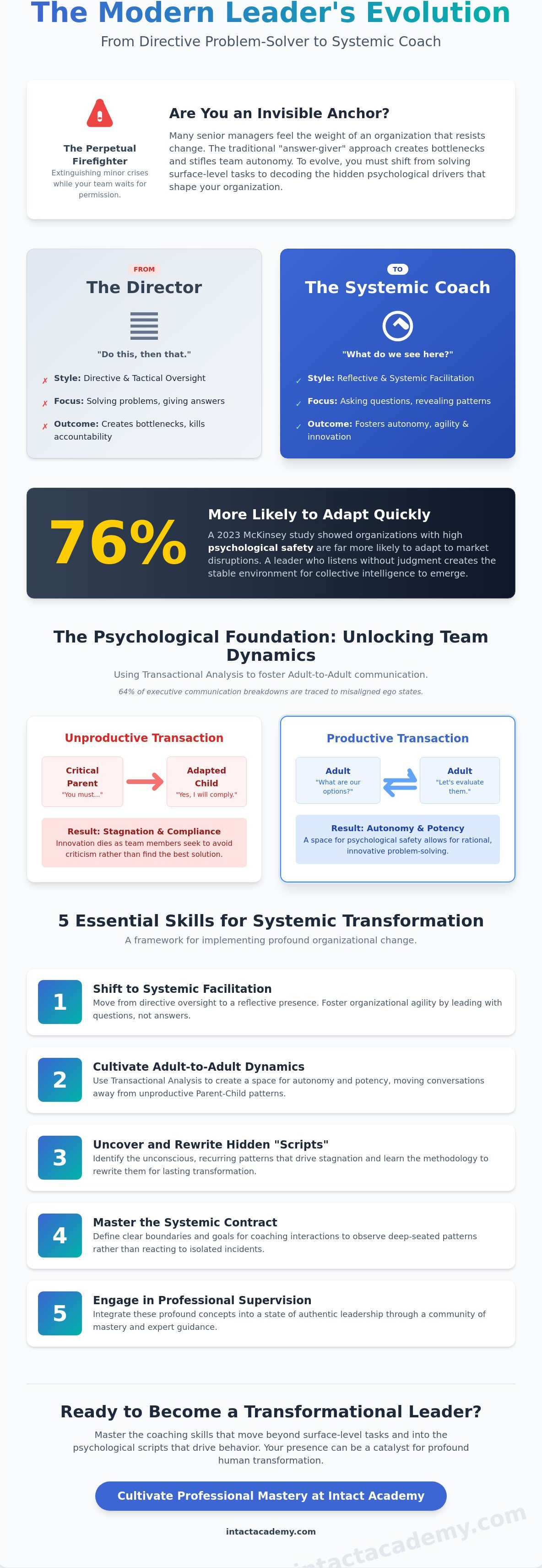
5 Steps to Implementing a Systemic Coaching Framework
Systemic coaching shifts the focus from the individual to the entire organizational field. It's a method that requires a senior leader to act as a catalyst for awareness. To master coaching skills for senior managers, you must follow a disciplined sequence that honors both the person and the system. This process ensures that change isn't just a temporary adjustment but a fundamental evolution in how the team functions.
The journey begins with observation. You don't look for isolated incidents; you look for the underlying script that governs the team's behavior. When a direct report struggles with a deadline, the systemic manager doesn't just ask why they're late. They ask how the delay serves the current organizational dynamic. By addressing the resistance, or the "psychological no," you help the leader move through their script toward a state of autonomy. This isn't about forced compliance. It's about inviting a shift in the internal landscape that leads to sustainable outward action.
Contracting for Professional Transformation
Clear contracting is the primary predictor of coaching success. Without it, the relationship often collapses into a Parent-Child dynamic where the manager rescues and the direct report remains dependent. A 2023 study by the International Coaching Federation suggests that robust contracting improves engagement by 60% because it aligns expectations across three distinct levels.
- The Administrative Contract: Logistics, frequency of meetings, and reporting lines.
- The Professional Contract: Tangible goals, such as a 15% improvement in cross-departmental collaboration.
- The Psychological Contract: The unspoken expectations regarding trust, feedback, and emotional safety.
To begin, use this Discovery Session Checklist with your senior reports:
- Define what success looks like in six months for both the individual and the system.
- Establish how you'll handle "the psychological no" when change feels threatening.
- Agree on the level of radical candor required to break through old patterns.
- Identify which organizational boundaries must be respected or challenged.
Powerful Inquiry: Shifting the Focus to Insight
Inquiry is the engine of the Adult ego state. It's not about gathering information; it's about provoking a new level of consciousness. Silence is your most potent tool here. When you allow a silence to stretch for 10 seconds or more in the boardroom, you create a vacuum that the other person's insight must fill. It forces them to look inward rather than looking to you for the answer.
Potency in a coaching context is the leader's capacity to remain grounded and influential while inviting the client to step out of their script into a state of wholeness. Use these five systemic questions to trigger that shift:
- What part of this problem belongs to you?
- If this team were a living organism, what would this conflict be trying to tell us?
- What are you protecting by staying in this current pattern?
- How does your current reaction mirror the history of this department?
- What would happen if you chose to act from your Adult state right now?
To deepen your ability to hold these transformative spaces, explore our specialized programs on coaching skills for senior managers at Intact Academy.
Cultivating Professional Mastery at Intact Academy
Acquiring a toolkit of coaching skills for senior managers marks only the beginning of a leader's evolution. While techniques provide a temporary structure, they often crumble under the weight of complex organizational crises if they aren't anchored in professional mastery. True leadership potency requires more than a workshop; it demands a dedicated community of practice and the rigorous mirror of systemic supervision. At Intact Academy, we understand that the person of the coach is the most powerful tool in the room. We don't just teach you how to coach; we facilitate the integration of your professional identity with your human wholeness.
The TA EMCC Senior Practitioner Academy serves as a crucible for this transformation. By bridging the profound insights of Transactional Analysis with business pragmatism, we help leaders decode the "script" of their organizations. This approach ensures that your interventions aren't just surface-level fixes but systemic shifts that stick. In the competitive landscape of 2026, holding an international accreditation from the EMCC or ICF is no longer optional. It's a hallmark of credibility that signals a commitment to ethical standards and a deep understanding of human dynamics, providing a significant advantage in global executive careers.
The Path to Senior Practitioner Level
If you seek to move from tactical advice to systemic influence, then you must engage with advanced frameworks that look beyond the individual to the entire organizational field. Stepping into a high-level certification program involves a shift in perspective where you learn to hold the space for others' growth while managing your own internal state. A cornerstone of this journey is systemic supervision. This process allows you to examine your leadership presence and the subtle "parallel processes" that occur between you and your team. For a detailed roadmap on this professional evolution, consult our executive coaching certification guide, which outlines the requirements for mastery in the coming years.
Join a Global Network of Transformational Leaders
Growth happens best in the company of peers who challenge and inspire. Our programs bring together professionals from 14+ countries, creating a rich tapestry of cultural and organizational perspectives. This diversity is essential for developing the global citizenship required of modern executives. Central to our methodology is Sari van Poelje’s Agile TA framework. This proprietary lens accelerates leadership growth by combining the psychological depth of Transactional Analysis with the speed and flexibility of Agile principles. It's a methodology designed for the volatility of 2026, ensuring you remain grounded while the world shifts around you.
Ready to move beyond basic coaching skills for senior managers? Explore our upcoming Senior Practitioner programs and begin your journey toward systemic impact and professional wholeness.
Stepping Into Your Systemic Power
The transition toward 2026 requires more than a tactical shift; it demands a psychological evolution. You've seen how moving from advice-giving to Adult-to-Adult dynamics creates a culture of autonomy rather than dependency. When you address the organizational script instead of reacting to surface symptoms, you unlock a new level of systemic potency. These advanced coaching skills for senior managers bridge the gap between individual growth and lasting organizational agility.
Mastery isn't found in a textbook; it's forged through deep practice and reflection. Our EMCC and ICF accredited programs offer a structured path to this integration. Led by international expert Sari van Poelje, the academy brings together leaders from over 14 countries to explore the intersection of Transactional Analysis and business excellence. It's a space where you can shed old patterns and step into a more authentic, impactful version of yourself.
Master Systemic Impact: Join the TA EMCC Senior Practitioner Academy
The path to wholeness is open, and the world is waiting for your most potent leadership.
Frequently Asked Questions
What is the difference between coaching and mentoring for senior managers?
Mentoring involves a senior leader sharing their established professional script to guide a junior's career path through direct advice. Coaching, specifically the coaching skills for senior managers we cultivate, focuses on unlocking the coachee's internal potency and autonomy. While 70% of Fortune 500 companies use mentoring for knowledge transfer, coaching is a systemic intervention that fosters a leader's own problem-solving capacity without the coach providing the answers.
How does Transactional Analysis apply to executive coaching?
Transactional Analysis provides a psychological map for understanding the communication "games" played within the boardroom. It allows an executive coach to identify if a leader is operating from a Controlling Parent ego state or a functional Adult state. By using Agile Transactional Analysis, managers can shift from reactive patterns to intentional leadership. This methodology helps leaders rewrite their organizational scripts to achieve 100% autonomy in their decision-making processes.
How much time should a senior manager spend on coaching per week?
Senior managers should dedicate 20% of their weekly schedule to developmental coaching conversations with their direct reports. Research from the Harvard Business Review indicates that leaders who spend at least 6 hours per week on coaching see a 25% increase in team productivity. It's not about adding more meetings to a calendar. It's about integrating these skills into existing 1-on-1 sessions to ensure every interaction serves the goal of human transformation.
Can coaching skills help in managing conflict within the C-suite?
Coaching skills are vital for de-escalating C-suite conflicts by uncovering the underlying psychological "rackets" that drive executive friction. When a manager uses these techniques, they can move a team from a Drama Triangle of Victim, Rescuer, and Persecutor into a state of professional intimacy. A 2023 study by the International Coaching Federation found that 70% of leaders improved their conflict management through professional coaching interventions that prioritized systemic health.
Is professional coaching accreditation necessary for a corporate career?
While a corporate contract doesn't legally require accreditation, 82% of organizations now prioritize leaders with formal coaching credentials for senior roles. Accreditation ensures you possess the systemic depth and ethical boundaries required to handle complex human transformations safely. It moves your practice from intuitive advice-giving to a structured methodology. This professional rigor respects the psychological safety of your team and prevents the reinforcement of unhealthy organizational scripts.
How do I start a coaching conversation with a high-performing but defensive leader?
Start the conversation by establishing a clear psychological contract that focuses on shared goals rather than perceived failures. Use a "strokes" approach, acknowledging their 95% success rate before inviting them to explore the 5% that feels stuck. If you approach them from an Adult ego state, you bypass their defensive Parent or Child responses. This creates a safe container for them to examine their resistance without feeling their professional identity is under threat.
What are the most effective coaching questions for senior leaders?
The most effective coaching skills for senior managers center on questions that invite the "Adult" ego state to lead the conversation. Ask, "What is the systemic impact if we maintain this current pattern?" or "How does this choice align with your desired leadership script for 2026?" These inquiries move beyond tactical fixes. They prompt a leader to look at the broader organizational field, encouraging a shift from immediate reaction to long-term strategic integration and wholeness.
How do I measure the ROI of my coaching efforts as a manager?
Measure ROI by tracking the reduction in turnover rates and the acceleration of succession readiness within your specific department. A 2022 study by MetrixGlobal found that coaching produced a 529% return on investment for large enterprises. You can also quantify success through "Time to Autonomy," measuring how quickly your direct reports move from needing 100% supervision to making independent, high-stakes decisions. This data reflects the true transformation of your leadership style.


