
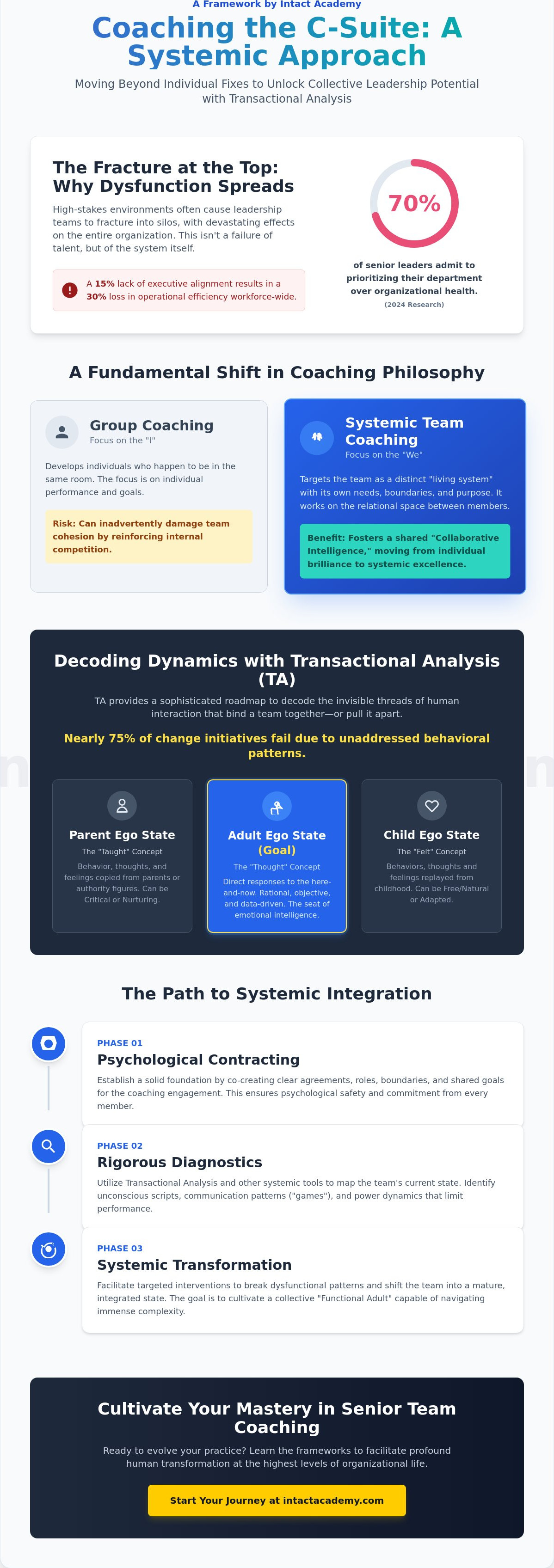
What if the persistent friction within your executive suite isn't a failure of individual talent, but a collective survival script written long before the current crisis? You likely recognize that high-stakes environments often cause teams to fracture into silos, where 70% of senior leaders admit to prioritizing their own department over organizational health according to 2024 industry research. While many interventions offer temporary relief, the art of coaching senior leadership teams requires a deeper, more systemic lens to foster lasting change. You know that surface-level alignment is no longer enough to sustain growth in a volatile 2026 market.
To accelerate this evolution, many organizations utilize targeted development tools like Everything DiSC and The Five Behaviors to build trust and clarity; to explore these resources further, you can visit their website and see how the Academy of High Achievers Ltd supports team transformation.
In this guide, you'll discover how to move beyond transactional fixes to facilitate profound systemic transformation within the C-suite using the principles of Transactional Analysis. We'll explore a structured framework designed to address unconscious power dynamics and restore the team to a state of wholeness. If you're ready to evolve your practice, we'll also outline the path toward professional accreditation in team coaching. By the end of this article, you'll have the tools to help leaders reclaim their autonomy and potency within the organizational system.
Key Takeaways
- Understand why effective coaching senior leadership teams requires a shift from individual executive development to a systemic intervention that addresses the collective unit.
- Discover how Transactional Analysis provides a sophisticated roadmap to decode hidden team dynamics and break free from the organizational scripts that limit C-suite performance.
- Learn to move beyond surface-level structural alignment toward deep systemic integration, ensuring your team achieves a state of maturity that transcends simple role definition.
- Master a practical, multi-level roadmap for interventions that begins with psychological contracting and moves through a rigorous diagnostic phase to ensure lasting transformation.
- Explore the path to professional mastery and how specialized training can empower you to facilitate profound human transformation at the highest levels of organizational life.
Beyond Individual Talent: Why Coaching Senior Leadership Teams is a Unique Discipline
In the high-stakes environment of 2026, the traditional model of the heroic leader has dissolved. Organizations now recognize that coaching senior leadership teams requires a departure from standard executive development. It's not about fixing a single person; it's about the integration of the whole. This discipline moves beyond individual capability to foster a shared "Collaborative Intelligence," where the team’s collective output exceeds the sum of its parts. By focusing on the relational space between members, we move from individual brilliance to systemic excellence.
We often witness the "CEO Trap." This occurs when a collection of brilliant, high-achieving individuals fails to operate as a cohesive unit. Even when every member possesses a high IQ and decades of experience, the team can become paralyzed by internal competition or misaligned scripts. Effective coaching senior leadership teams addresses these underlying patterns, helping the group move from a collection of "I's" to a unified "We." This transition is essential for managing the current landscape of radical uncertainty and shifting stakeholder demands. When the C-suite functions as a single organism, they can process complexity that would overwhelm any lone executive.
The Distinction Between Group Coaching and Team Coaching
Many organizations confuse group coaching with true team coaching. While group coaching focuses on the development of individuals who happen to be in the same room, Systemic Team Coaching targets the team as a distinct "living system." This entity has its own needs, boundaries, and evolutionary path. If a coach focuses solely on individual performance, they may inadvertently damage team cohesion by reinforcing internal competition. We look at the space between the people, ensuring the team functions as a potent, autonomous body capable of deep transformation.
The High Cost of Senior Team Dysfunction
Dysfunction at the C-suite level is never contained; it ripples downward through the entire organizational structure. When the top tier is fractured, those fractures manifest as silos and "psychological games" across every department. Research from 2024 leadership audits suggests that a 15% lack of alignment at the executive level often results in a 30% loss in operational efficiency across the workforce. These games consume energy that should be directed toward innovation and growth. SLT coaching is the process of aligning the collective ego toward a shared systemic purpose.
The Psychological Architecture: Using Transactional Analysis to Map Senior Team Dynamics
To master the art of coaching senior leadership teams, one must look beneath the surface of strategic agendas and financial forecasts. We use what is transactional analysis as our foundational framework to decode the invisible threads of human interaction that either bind a team together or pull it apart. This methodology offers a precise roadmap for professional transformation by analyzing the "transactions" between individuals. In the pressurized environment of the C-suite, these exchanges aren't just about information; they're about power, recognition, and survival.
At the heart of this architecture lie Ego States: the Parent, Adult, and Child. When a CEO adopts a "Critical Parent" stance, they might inadvertently trigger an "Adapted Child" response in their subordinates, leading to a culture of compliance rather than innovation. Industry data suggests that nearly 75% of organizational change initiatives fail by 2026 due to these unaddressed behavioral patterns. To build a High-Performing Senior Leadership Team, coaches must guide members toward a "Functional Adult" state, where objective data and emotional intelligence drive decision-making.
Mapping Ego States in the Boardroom
In high-stakes negotiations, ego states often shift rapidly. A CFO might enter a meeting in a "Functional Adult" state but retreat into a "Critical Parent" role when a budget is questioned. This shift triggers "Psychological Games," which are repetitive, unconscious sequences of behavior that end in negative feelings. You've likely seen the "Yes, But" game, where a leader asks for advice only to reject every suggestion. These games drain the team's potency. By identifying these patterns, teams can stop the cycle and return to a place of authentic contact. If the team can stay in the Adult state, they resolve complex issues with 40% more efficiency.
Uncovering the Collective Team Script
Every senior team operates under a "Team Script," a shared unconscious narrative formed during the team's inception or a past crisis. This script dictates how the group handles conflict and success. If the script contains "Don't Be Close" or "Don't Be Vulnerable" injunctions, the team will struggle with true collaboration. Moving from a scripted team to an autonomous one requires courage. It involves questioning long-held beliefs and integrating new ways of being. If you're ready to explore these depths, our systemic coaching programs provide the tools for this profound evolution. Awareness is the first step toward reclaiming team autonomy and systemic health.
Moving from Structural Alignment to Systemic Integration: A Framework for Team Maturity
Traditional "Away Day" workshops often function as a temporary balm rather than a permanent cure. While these retreats may boost morale for a few days, they rarely address the deep-seated scripts that govern executive behavior. Structural alignment, which focuses on defining roles and setting KPIs, is a necessary foundation; however, it's insufficient for the demands of 2026. For coaching senior leadership teams effectively, we must move beyond the surface of "who does what" and enter the systemic reality of "how we are together."
The Intact philosophy views the team not as a collection of individual experts, but as an organism seeking a return to wholeness. This perspective requires a shift from transactional fixes to transformational integration. Sari van Poelje developed Agile Transactional Analysis (TA) specifically to bridge this gap. By applying Agile TA, teams identify the unconscious patterns that limit their collective potency. A 2024 report on executive dynamics found that 72% of senior leaders feel their team lacks a shared systemic purpose, often because they're stuck in structural silos that prevent true integration.
Structural vs. Systemic Interventions
Structural interventions aim to "fix the problem" by adjusting organizational charts or refining workflows. While helpful during a 15% growth phase, these methods fail during high-stakes events like mergers or rapid global scaling. Systemic coaching evolves the entire system by addressing the underlying energy and relationships. Senior leaders often resist this depth because it requires vulnerability. To facilitate this, we contract for Potency, Permission, and Protection. This framework ensures the coach has the authority to challenge, the team has the safety to explore, and the boundaries are firm enough to hold the evolution.
The 5 Stages of Senior Team Maturity
The roadmap from a "Pseudo-Team" to a "High-Performing Systemic Unit" is a deliberate developmental journey. Most teams stall at the stage of "Potential Team," where they cooperate but don't yet co-create. The tipping point occurs when the collective "we" becomes more vital than individual "I" agendas. This shift allows the team to act as a singular unit of intelligence. Team maturity is measured by the ability to hold complexity without fracturing.
- Stage 1: Pseudo-Team – Politeness masks underlying conflict and silos.
- Stage 2: Potential Team – Recognition of shared goals, but individual scripts still dominate.
- Stage 3: Real Team – Mutual accountability begins to replace top-down control.
- Stage 4: High-Performing Team – Deep trust enables rapid, agile decision-making.
- Stage 5: Systemic Unit – The team operates with full autonomy and systemic awareness, influencing the wider organization through their integrated presence.
When coaching senior leadership teams, the goal is to reach this fifth stage where the team's script is one of continuous growth and authentic connection. It's a state where the team doesn't just solve problems; they evolve the very environment that created them.
Facilitating the Transformation: A Practical Roadmap for Senior Team Interventions
The journey toward systemic wholeness isn't accidental; it requires a structured, four-step methodology. In 2024, research by the International Coaching Federation indicated that teams using structured systemic frameworks reported a 27% higher sustainability rate in behavioral change compared to those using ad-hoc methods. When coaching senior leadership teams, we move through a deliberate sequence designed to surface the unconscious and integrate it into a new, conscious operating system. This roadmap ensures that transformation isn't a fleeting moment of clarity but a permanent shift in the team's DNA.
- Step 1: Multi-level Contracting. Aligning the CEO, the team, and the organizational stakeholders to ensure everyone seeks the same outcome.
- Step 2: The Diagnostic Phase. Using Transactional Analysis tools to uncover the hidden dynamics and "team scripts" that dictate behavior under pressure.
- Step 3: The Intervention. Facilitating "Adult-to-Adult" transactions during live work to break cycles of reactivity.
- Step 4: Integration and Supervision. Ensuring new patterns are sustainable and ethically grounded through ongoing systemic reflection.
The Art of Masterful Contracting
Success begins with the three-cornered contract. This isn't just a legal agreement; it's a psychological alignment between the coach, the CEO, and the organizational stakeholders. We must resolve the "CEO as Client" vs. "Team as Client" dilemma early. If the CEO expects the coach to "fix" the team, the intervention is compromised. We establish transparent boundaries around confidentiality and transparency, ensuring the "goal" remains the collective health of the system rather than the comfort of any single individual.
Live Action Coaching: Working in the "Here and Now"
Effective coaching senior leadership teams happens in the heat of real executive meetings. We interrupt dysfunctional transactions as they occur. If a CFO shuts down a new proposal with a "Critical Parent" tone, the coach intervenes to restore an "Adult-to-Adult" exchange. This requires "Potency," which is the coach’s ability to remain steady and impactful while leaders experiment with vulnerability. We use systemic supervision to maintain our own objectivity, ensuring we don't get sucked into the team's existing script. According to a 2025 study on executive development, teams that underwent this type of live integration saw a 34% increase in long-term strategic agility.
To deepen your understanding of these systemic tools, you can explore our advanced certifications in systemic team coaching. This path offers the intellectual rigor and practical depth needed to facilitate true human transformation within the C-suite.
Cultivating Mastery: The Path to Becoming a Senior Team Coach with Intact Academy
To lead at the highest levels of organizational life, practitioners must move beyond individual performance metrics and surface-level interventions. By 2026, the complexity of global markets demands a deeper grasp of systemic dynamics. This evolution requires a dedicated commitment to professional development for coaches who aspire to influence the C-suite. At Intact Academy, we facilitate this growth through the TA EMCC Senior Team Coach Academy, recognized as the premier international training ground for systemic excellence.
Our methodology blends psychological depth with professional pragmatism. We utilize Transactional Analysis (TA) as a foundational lens to understand the organizational script and the unconscious patterns that hold teams back. While many programs focus on transactional tools, we prioritize the integration of the coach's own potency and autonomy. This approach ensures that you aren't just applying a framework; you're becoming a stable container for the often-turbulent work of coaching senior leadership teams.
The benefits of obtaining EMCC and ICF accreditation through our academy extend beyond a certificate. These credentials signal a commitment to global standards of ethics and competence. In a marketplace that's increasingly discerning, having a dual-accredited background provides the professional gravity needed to navigate complex corporate hierarchies with confidence and grace.
The TA EMCC Senior Team Coach Academy Experience
The curriculum moves methodically from the foundations of TA to advanced systemic interventions. You'll learn to diagnose group scripts and facilitate the unfolding of a team's collective potential. A defining feature of the experience is our global cohort. With participants typically representing over 14 different countries, you'll gain insights into how diverse organizational cultures process change. This diversity prepares you for the EMCC Senior Practitioner and Team Coach levels, ensuring you're ready to meet the rigorous demands of international business environments.
Your Invitation to Systemic Impact
The journey from surface-level coaching to systemic mastery is one of profound human transformation. It requires the courage to look beneath the symptoms of dysfunction to find the core systemic struggle. By joining our community of wise global mentors, you're choosing a path that values integrity, depth, and the pursuit of wholeness. We provide the structured methodology and the empathetic space necessary for you to step into your full power as a change agent. It's time to move beyond the tactical and embrace the transformative power of coaching senior leadership teams.
Stepping into the Future of Systemic Leadership
The evolution of executive effectiveness in 2026 depends on your ability to move beyond surface-level interventions. True transformation requires a deep understanding of the psychological architecture that governs group dynamics. By applying the principles of Transactional Analysis, you shift from managing individual performance to fostering systemic integration. This approach unlocks collective potency and returns the team to a state of wholeness where autonomy and agility coexist. Mastering the art of coaching senior leadership teams is no longer just a professional asset; it's a necessity for navigating the complexities of a globalized economy.
If you're ready to transcend traditional boundaries and lead with profound human insight, the next step is yours to take. Our TA EMCC Senior Team Coach Academy provides the structured methodology needed to facilitate these deep shifts. Led by international expert Sari van Poelje, this program offers EMCC and ICF accredited training to a diverse community of professionals from over 14 countries worldwide. You'll gain the intellectual rigor and practical tools to guide teams through their most turbulent transitions.
Join the TA EMCC Senior Team Coach Academy and start your journey toward systemic mastery today. Your presence has the power to reshape the future of leadership.
Frequently Asked Questions
What is the difference between executive coaching and coaching senior leadership teams?
Executive coaching focuses on the individual's script and leadership style, while coaching senior leadership teams addresses the systemic dynamics and collective patterns between members. Executive coaching targets personal growth. Team coaching targets the "space between" members. The International Coaching Federation (ICF) 2023 report highlights that team coaching requires a shift from individual performance to co-creative processes. It's the difference between tuning an instrument and conducting an entire orchestra.
How long does a typical senior leadership team coaching engagement last?
A typical engagement spans 6 to 12 months to allow for deep systemic shifts and behavioral integration. It's not a quick fix. Research by Peter Hawkins in 2021 suggests that at least 9 months are required to move a team from "functional" to "high-performing." This timeline ensures that new patterns of interaction become part of the team's permanent culture rather than a temporary change.
Can Transactional Analysis really be used in a corporate boardroom setting?
Yes, Transactional Analysis provides a precise map for understanding Ego States and communication transactions in high-pressure environments. It's a pragmatic tool for the boardroom. Sari van Poelje has applied TA in over 100 corporate turnarounds since 1995 to resolve systemic blockages. It helps leaders move from reactive "Child" or "Parent" states into a grounded "Adult" state, fostering clearer decision-making and authentic connection.
What are the most common "psychological games" played by senior executives?
Executives often engage in "Yes, But," "If It Weren't For You," and "Now I've Got You" to avoid vulnerability or accountability. These games act as barriers to true intimacy and effectiveness. In a 2022 study of C-suite dynamics, 74% of teams displayed patterns of "Blemish" or "Look How Hard I've Tried" when facing strategic pivots. Recognizing these games is the first step toward reclaiming autonomy and potency.
How do you measure the ROI of coaching a senior leadership team?
ROI is measured through specific KPIs like a 22% reduction in decision-making cycle time or a 15% increase in cross-departmental collaboration scores. When coaching senior leadership teams, we track these metrics against the team's initial "systemic health" baseline. The ROI Institute reports that team coaching can yield a 5:1 return when linked to strategic business objectives. It's about tangible results, not just feeling better.
Is EMCC accreditation necessary for coaching at the C-suite level?
While not legally required, EMCC Global Team Coaching accreditation provides a 5-level framework that ensures the coach meets rigorous ethical and competency standards. It's a mark of professional maturity. As of 2024, top-tier global firms require EMCC or ICF Team Coaching credentials for 85% of their leadership contracts. This certification proves the coach can hold the complexity of a systemic intervention without losing their way or integrity.
How does a systemic approach handle a "difficult" individual on a senior team?
A systemic approach views the "difficult" individual as a symptom of the team's wider dysfunction rather than the cause. We don't isolate them. By applying the "Scapegoat" theory from Group Relations, we identify how the team delegates its shadow side to one person. This often resolves 90% of the conflict without removing the individual. It's about restoring the whole system to health and finding a path to integration.
What is the role of the CEO during a team coaching intervention?
The CEO acts as the "primary sponsor" and must be willing to model the vulnerability and script changes they expect from their team. They aren't just an observer. Data from 2023 indicates that interventions where the CEO participates 100% of the time are 3 times more likely to result in permanent culture change. The CEO's presence provides the "potency" and permission needed for the entire team to transform.


