

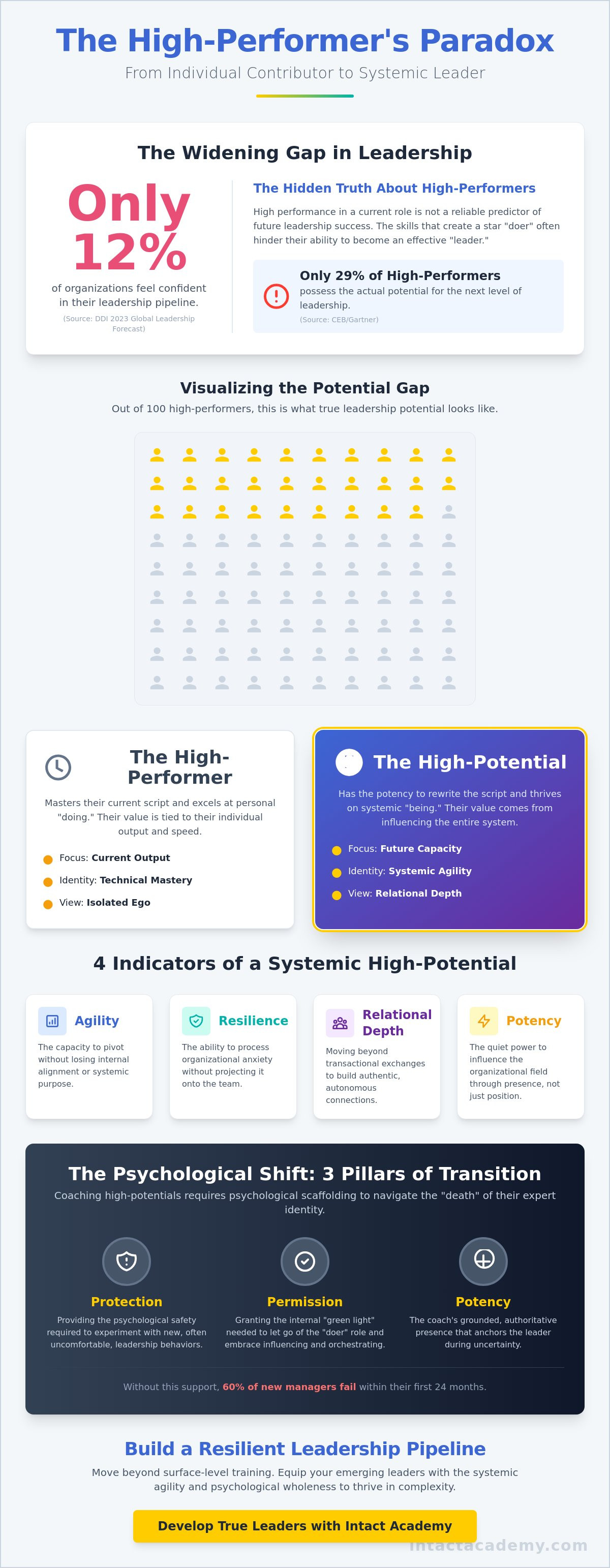
What if the drive that propelled your top performer to success is the exact mechanism that causes them to fail once they reach the executive suite? You likely recognize the pattern: a brilliant individual contributor is promoted, only to struggle with the psychological weight of the shift from doing to leading. This transition often feels like a loss of professional identity rather than a gain in status. In fact, DDI’s 2023 Global Leadership Forecast revealed that only 12% of organizations feel confident in the strength of their leadership pipeline. You understand that talent alone isn't enough. It requires a structural and emotional evolution to handle the weight of systemic responsibility.
Effective coaching high potential employees for leadership requires us to look beneath the surface of professional competencies and into the scripts that govern human behavior. By applying the principles of Transactional Analysis, we can transform high-potential talent into leaders who possess the autonomy and potency to navigate organizational complexity without succumbing to burnout. This article explores how to facilitate this deep internal transition, ensuring your most valued people feel seen and truly developed. We'll examine the path toward building a sustainable pipeline where leaders don't just occupy a role, but embody a new state of wholeness and systemic agility.
Key Takeaways
- Distinguish between current performance and future capacity to ensure your talent strategy honors the systemic impact of every emerging leader.
- Navigate the profound psychological transition from individual contributor to leader by applying Transactional Analysis to map ego state shifts.
- Move beyond surface-level workshops by prioritizing vertical development, which expands the internal capacity required for coaching high potential employees for leadership.
- Utilize a structured 5-step framework to identify and rewrite the internal scripts that often limit a high-potential’s professional potency and agility.
- Build a resilient leadership pipeline by integrating the Intact philosophy of wholeness as the foundation for authentic, systemic influence.
Defining High Potentials through a Systemic Lens
Organizations often mistake individual speed for organizational depth. Traditional talent management focuses on the "star player," yet this narrow view ignores how an individual interacts with the wider organizational field. When we begin coaching high potential employees for leadership, we must look beyond the isolated ego. We must see the person as a node within a complex web of relationships and systemic pressures. High potential is the capacity to integrate personal autonomy with systemic responsibility.
The distinction between current output and future capacity is vital. Research from the CEB (now Gartner) indicates that while nearly all high potentials are high performers, only 29% of high performers actually possess high potential for the next level. High performance is a reflection of how well an individual masters their current script. High potential represents the potency to rewrite that script as the complexity of their environment increases. A systemic high potential doesn't just deliver results; they influence the health and agility of the entire organizational field.
The Hidden Risks of Misidentifying Talent
The Peter Principle, first identified by Dr. Laurence J. Peter in 1969, remains a persistent shadow in modern corporate structures. It suggests that individuals are promoted until they reach their level of incompetence. In agile environments, this risk is amplified by unconscious bias. Managers often select "mini-me" candidates who reflect their own biases rather than those who possess true systemic agility. This creates a fragile Leadership development pipeline that lacks diversity of thought and emotional resilience. True potential reveals itself through relational depth and the ability to remain grounded during systemic turbulence.
Moving Beyond Performance Metrics
Top individual contributors often struggle when transitioning to leadership because their success was built on personal "doing" rather than systemic "being." Effective coaching high potential employees for leadership requires a shift from individual emotional intelligence to systemic intelligence. This involves evaluating a candidate's ability to operate from an "Adult" ego state. In high-pressure environments, many leaders regress into Child or Parent states, seeking approval or demanding compliance. A true high potential demonstrates the following systemic indicators:
- Agility: The capacity to pivot without losing internal alignment or systemic purpose.
- Resilience: The ability to process organizational anxiety without projecting it onto the team.
- Relational Depth: Moving beyond transactional exchanges to build authentic, autonomous connections.
- Potency: The quiet power to influence the organizational field through presence rather than just position.
By shifting our focus from what a candidate produces to how they integrate within the system, we ensure that the leaders of tomorrow are not just functional, but transformative.
The Psychology of Transition: From Contributor to Leader
The journey from individual contributor to leader is not a simple step up a corporate ladder; it's a profound transformation of the self. This shift marks the psychological "death" of the expert identity and the birth of a systemic orchestrator. For many high potentials, their self-worth has been anchored in personal output and technical mastery for years. When coaching high potential employees for leadership, we must acknowledge the grief that often accompanies this loss. If the new leader doesn't let go of the "doer" role, they risk becoming a functional bottleneck for the entire organization.
We use the framework of Transactional Analysis to map this movement through three pillars: Potency, Permission, and Protection. Potency refers to the coach’s grounded, authoritative presence that anchors the leader during times of uncertainty. Permission is the internal "green light" the leader needs to stop producing and start influencing. Protection provides the psychological safety required to experiment with new, often uncomfortable behaviors. Data from the Corporate Executive Board indicates that 60% of new managers fail within their first 24 months. This failure usually stems from a lack of psychological scaffolding, causing them to default to old patterns that no longer serve the systemic context.
Ego States in the Boardroom
When high potentials feel the pressure of a new role, they often slip into the "Adapted Child" ego state. This manifests as a desperate need for perfection or a fear of making the wrong move, which inevitably leads to micromanagement and burnout. To succeed, the leader must cultivate their "Adult" state for objective problem-solving and their "Nurturing Parent" state to provide the support their team requires. Recognizing the "Psychological Games" played during moments of insecurity is vital. If a leader understands why they feel the need to "rescue" their team, they can return to a state of professional autonomy and effectiveness.
Identifying the Leadership Life Script
Every leader operates from a "Life Script," which is an unconscious narrative formed early in life that defines their limits and successes. To Develop High-Potential Employees, we must look at the drivers that push them toward specific behaviors. Scripts like "Be Perfect" or "Hurry Up" create invisible ceilings that prevent true agility. Understanding what is transactional analysis helps coaches and leaders uncover these scripts, allowing for a more authentic leadership style to emerge. This level of coaching high potential employees for leadership moves beyond surface-level skills into the realm of true human unfolding. If you feel called to deepen your impact, you might explore our systemic coaching methodologies to facilitate this profound change.
Skill-Based Training vs. Systemic Coaching for Leadership
Traditional leadership development often focuses on the horizontal acquisition of skills. While learning to give feedback or manage a budget is necessary, these "tips and tricks" frequently dissolve when they meet the cold reality of systemic resistance. Research from the 2023 Training Industry Report indicates that while organizations spend billions on workshops, only about 10% of that learning results in long-term behavioral change. This gap exists because skill-based training addresses the tools a leader uses, whereas coaching high potential employees for leadership addresses the person who uses them.
The Limits of Transactional Development
Transactional workshops offer the illusion of progress through short-term masterclasses. They provide a temporary boost in motivation but fail to address the underlying psychological script that governs a leader's reactions. If a HiPo struggles with a "Be Perfect" or "Please Others" driver, no amount of time-management training will solve their burnout. The common objection that coaching is too slow ignores the reality of stability. While a three-day retreat is fast, it's also fragile. Systemic coaching facilitates vertical development, expanding the leader's internal capacity to hold complexity and ambiguity. This shift isn't about adding more apps to the operating system; it's about upgrading the operating system itself.
The Power of Systemic Intervention
A leader never exists in a vacuum. When we engage in coaching high potential employees for leadership, we aren't just working with an individual; we're influencing the entire organizational field. The coach serves as a systemic mirror, helping the leader see how their presence affects the team's autonomy and potency. By using the principles of leading organizational change, the HiPo learns to recognize the invisible threads of culture and hierarchy that dictate team behavior.
- Individual Output: Traditional metrics focus on the leader's personal KPIs and task completion.
- Systemic Health: True ROI is found in reduced team conflict, higher retention rates, and the unfolding of collective intelligence.
- Identity Shifts: Coaching moves the leader from "doing" leadership to "being" a leader, ensuring that changes are permanent and integrated.
If a leader changes their internal state, the system around them must adapt. This is the essence of systemic intervention. It moves beyond the surface, creating a ripple effect that improves the health of the entire organization. We measure success by the leader's ability to remain grounded and authentic, even when the system tries to pull them back into old, dysfunctional patterns. This process requires patience, but it delivers a level of agility that transactional training simply cannot match.
A 5-Step Framework for Coaching High Potentials
Effective coaching high potential employees for leadership requires more than a checklist of skills; it demands a psychological evolution. We've developed a rigorous 5-step framework that moves the individual from surface-level performance to deep systemic potency. This methodology ensures that growth isn't just a temporary peak, but a sustainable transformation that resonates throughout the entire organization. A 2023 analysis of leadership development programs suggests that organizations utilizing a structured psychological framework see a 31% higher retention rate among their top talent.
- Step 1: Contracting for Growth. We establish clear, multi-level boundaries to ensure the coaching engagement remains focused, safe, and aligned with organizational needs.
- Step 2: Script Analysis. We identify the internal narratives, often formed early in life, that limit a leader's current capacity for risk, innovation, and decision-making.
- Step 3: Decontamination of the Adult. This step involves separating objective leadership facts from reactive 'Parent' or 'Child' ego states that cloud professional judgment.
- Step 4: Systemic Integration. The leader practices new behaviors within the actual organizational field, testing their impact in real-time within their specific team dynamics.
- Step 5: Supervision and Reflection. We provide ongoing professional oversight to ensure that the growth is integrated and sustainable, preventing a slide back into old patterns.
Contracting: The Foundation of Success
Contracting is the mutual agreement on the goal, process, and outcome of change. It's the container that holds the entire coaching relationship together. We distinguish between the administrative contract, covering logistics; the professional contract, focusing on measurable goals; and the psychological contract, which addresses the hidden expectations between the high potential and the organization. Research from the Corporate Executive Board indicates that 46% of leadership programs fail specifically because of misaligned expectations during the initial phases of engagement.
Developing Executive Presence through TA
Executive presence emerges when a leader operates from the 'Ok-Ok' matrix, a state of mutual respect and psychological safety. This shift allows them to move from transactional interactions, which focus on immediate task completion, to truly transformational leadership. It's about presence and authenticity, not just authority. An executive coaching certification prepares coaches to guide leaders through these high-level transitions, helping them find their authentic voice within the system. When a leader's internal script aligns with their external goals, their influence becomes both potent and inclusive.
To master coaching high potential employees for leadership, one must look beyond the individual and see the system as a whole. Reflection and supervision are not optional; they're the bedrock of professional integrity. By slowing down to observe the patterns of the organizational field, we create the space for genuine agility and wholeness to emerge.
Building a Sustainable Leadership Pipeline with Intact Academy
Leadership isn't a set of skills you wear like a suit; it's an internal state of being. At Intact Academy, we believe returning to wholeness is the primary requirement for anyone tasked with guiding others. When coaching high potential employees for leadership, we don't just focus on KPIs. We look at the script they carry. If an executive operates from an unconscious script of perfectionism, they'll inevitably create a culture of anxiety. Our systemic approach ensures that the next generation of global leaders understands how their internal world mirrors the organizational system.
The TA Foundation Year serves as the bedrock for this transformation. It provides the foundational coaching competencies needed to navigate complex human dynamics. Participants learn to move beyond surface-level management. They gain the potency to address the root causes of systemic stagnation. This isn't a quick fix; it's a journey toward professional mastery that honors the intelligence of the practitioner and the complexity of the global market.
The Path to Mastery: Accreditation and Supervision
Quality in coaching isn't optional. We align our programs with EMCC and ICF standards because accreditation provides a necessary framework for ethical practice. However, accreditation alone isn't enough. Systemic supervision is vital to prevent coach burnout. It ensures that the coach remains a clean instrument for change. Sari van Poelje’s methodology, built over 35 years of international consultancy, bridges the gap between deep psychology and practical business agility. This approach allows leaders to integrate their personal growth with organizational strategy.
Next Steps: Embarking on the Journey
Organizations that integrate Transactional Analysis into their L&D strategy see a marked shift in psychological safety and autonomy. By joining our global community, you connect with systemic practitioners across 15 different countries. This network provides the support needed for long-term cultural change. If you're ready to evolve your approach to coaching high potential employees for leadership, the next step is clear. Explore our upcoming Senior Practitioner programs to begin your own transformation.
Cultivating the Next Generation of Systemic Leaders
Leadership isn't merely a collection of new tasks; it's a profound evolution of a professional's internal script. When organizations prioritize coaching high potential employees for leadership, they're investing in a psychological transition that moves the individual from a solo contributor to a systemic steward. This process requires a structured framework to bridge the gap between individual talent and organizational health. By focusing on autonomy and potency, you ensure your future leaders don't just occupy roles; they transform them.
True leadership development demands a balance of intellectual rigor and human empathy. Our EMCC and ICF accredited programs provide this stability by honoring the intelligence and maturity of every learner. Led by international expert Sari van Poelje, the academy has mentored participants from over 14 countries to achieve lasting change through our unique Agile Transactional Analysis lens. Transform your leadership pipeline with our TA EMCC Senior Practitioner Academy and begin the work of systemic integration. The future of your organization depends on the depth of the growth you foster today.
Frequently Asked Questions
How do you identify a high-potential employee for leadership coaching?
Identify high-potential employees by using the 9-box grid to locate the 5 percent of staff who demonstrate both consistent high performance and leadership agility. Research from Korn Ferry indicates that true high potentials possess a 71 percent higher probability of success in senior roles than their peers. We look for those who move beyond technical mastery to exhibit the systemic awareness required for complex organizational navigation.
What is the difference between coaching and mentoring for high potentials?
Coaching focuses on psychological transformation and autonomy, while mentoring relies on the transfer of specific industry knowledge from a senior figure. In our practice, coaching high potential employees for leadership involves using Transactional Analysis to explore the individual's script and internal drivers. While a mentor says "here is what I did," a coach asks "who are you becoming within this system?"
How long does a typical leadership coaching engagement for HiPos last?
A typical leadership coaching engagement for HiPos lasts between 6 and 12 months to allow for deep behavioral integration. According to the 2023 ICF Global Coaching Study, engagements of this length provide the necessary holding environment for sustainable change. This timeframe ensures that the leader doesn't just learn new habits but actually shifts their internal state of being to reflect their new responsibilities.
Can Transactional Analysis really be applied in a corporate business setting?
Transactional Analysis is highly effective in corporate settings, particularly for resolving the 60 percent of workplace conflicts that stem from poor communication patterns. Leaders use the Adult Ego State to maintain composure under pressure and the Drama Triangle to identify and stop unproductive office politics. It transforms the workplace from a series of reactive games into a space of clear, contractual agreements and psychological safety.
What are the common pitfalls when coaching high-potential employees?
The most common pitfall when coaching high potential employees for leadership is ignoring the systemic context, which causes 40 percent of newly promoted leaders to fail within their first 18 months. Another trap is focusing solely on skills while neglecting the leader's underlying psychological script. If the organization doesn't support the individual's growth, the newly empowered leader often chooses to leave for a more aligned environment.
How do you measure the success of a leadership coaching program?
We measure success through a combination of 360-degree feedback scores and the Phillips ROI Methodology, which often shows a 5x return on the initial investment. Tracking the retention rate of coached HiPos compared to the general 13 percent turnover rate in corporate sectors provides a clear metric of program health. Success is visible when the leader moves from reactive firefighting to proactive systemic stewardship.
Is systemic coaching better than traditional leadership training?
Systemic coaching is superior to traditional training because it addresses the 85 percent of performance issues that reside in the organizational structure rather than the individual. While training offers a temporary knowledge hit, systemic coaching creates a permanent shift in how the leader interacts with their environment. It treats the organization as a living organism rather than a machine with replaceable parts that need fixing.
Why is psychological safety important when coaching emerging leaders?
Psychological safety is the foundation of growth, as Amy Edmondson's research at Harvard shows it's the number one predictor of team success. When emerging leaders feel safe, they can move out of survival scripts and into a state of creative potency. Without this safety, the coaching process remains a superficial exercise in mask-wearing rather than a true unfolding of the leader's authentic potential and wholeness.


