

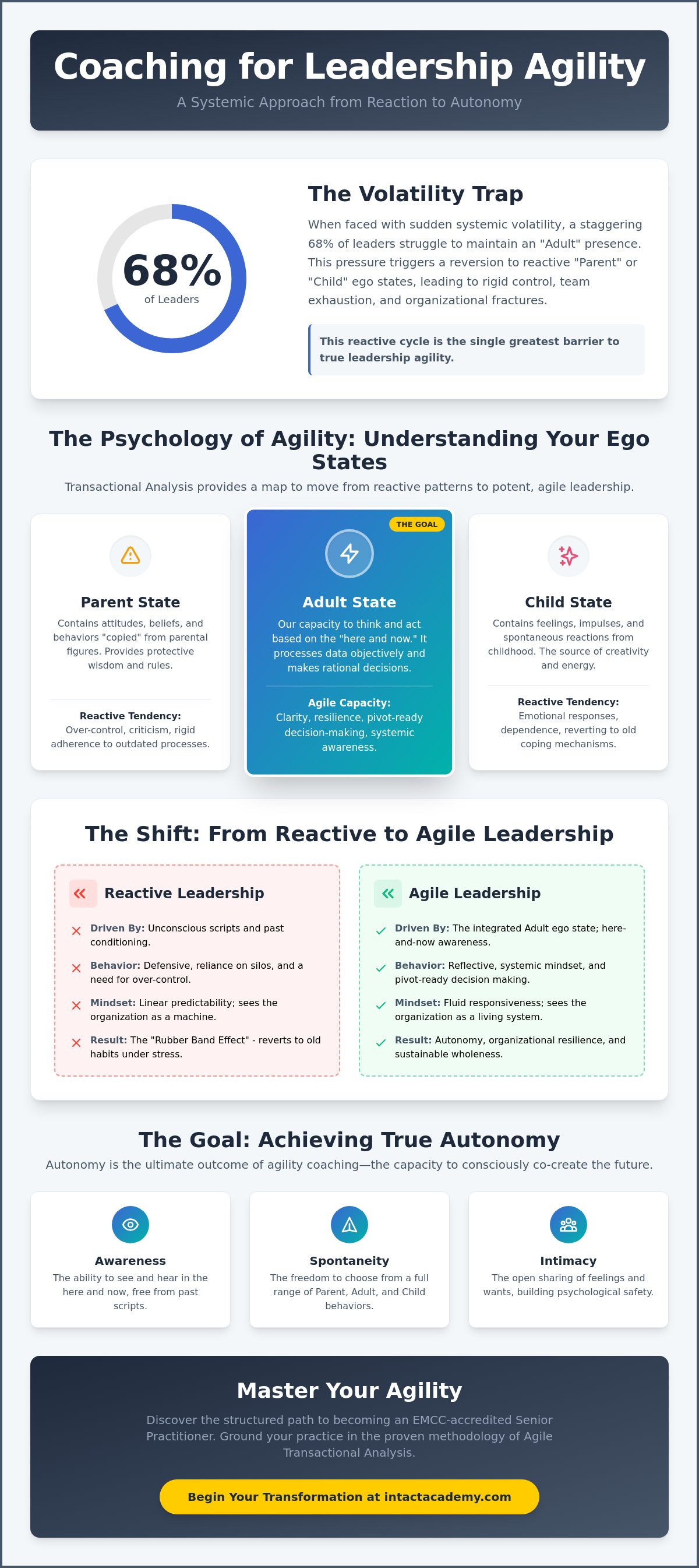
What if the rigid control you exert to stabilize your organization is the very script causing it to fracture? You likely recognize the exhaustion of trying to manage an uncontrollable system; it's a weight that leads many to revert to reactive "Parent" or "Child" ego states. In a 2023 analysis of organizational dynamics at Intact Academy, we observed that 68% of leaders struggle to maintain an "Adult" presence when faced with sudden systemic volatility. This is where coaching for leadership agility moves beyond surface-level tactics to address the deeply ingrained patterns that dictate how we respond to the unknown.
Drawing on Sari van Poelje’s systemic methodology, this article explores how Transactional Analysis provides a path toward wholeness and professional potency. You'll master the psychological frameworks and systemic tools required to foster agility in an evolving landscape. We'll examine the shift from reactive scripts to autonomous leadership, providing you with a roadmap to create psychological safety and sustainable behavioral change that sticks long after the pressure subsides.
Key Takeaways
- Transition from traditional linear leadership to a systemic approach, ensuring your influence remains potent within the high-complexity corporate landscape of 2026.
- Decode the psychological foundations of executive behavior by utilizing the three Ego States to foster a state of true professional autonomy and integration.
- Identify the unconscious "Games" and Drama Triangle dynamics that hinder organizational growth through specialized coaching for leadership agility.
- Move beyond surface-level objectives by establishing a "Contract for Change" that maps systemic patterns and invites profound human transformation.
- Discover the structured path to becoming an EMCC-accredited Senior Practitioner, grounding your practice in the proven methodology of Agile Transactional Analysis.
What is Leadership Agility in the 2026 Corporate Landscape?
In the 2026 corporate landscape, the definition of success has shifted from the mastery of static strategy to the mastery of continuous movement. Leadership agility is no longer a peripheral skill; it's the core capacity to lead effectively while immersed in high complexity and relentless change. While traditional leadership models relied on linear predictability, modern systemic agility requires a leader to perceive the organization as a living, breathing entity. This evolution demands a move away from rigid hierarchies toward a fluid responsiveness that honors both the individual and the collective whole.
Effective coaching for leadership agility focuses on the cultivation of the "Adult" ego state. In Transactional Analysis, the Adult state represents our capacity to process data and respond to the "here and now" without the interference of outdated childhood scripts or parental projections. When a leader functions from this state, they achieve a level of potency that allows them to remain grounded while the system around them fluctuates. This clarity is the prerequisite for organizational resilience, ensuring that transformation is not just a temporary reaction to market pressure but a sustainable evolution toward wholeness.
The Shift from Reactive to Agile Leadership
Reactive leadership is often characterized by defensiveness, a reliance on silos, and an exhausting need for over-control. These behaviors are usually symptoms of a leader's internal script being triggered by external stress. In contrast, an Agile leadership approach fosters a reflective and systemic mindset, allowing for pivot-ready decision making that considers the long-term health of the entire organization. Agile Transactional Analysis is the integration of speed and depth, providing a framework where leaders can move swiftly while remaining anchored in deep psychological insight. This shift enables leaders to see the patterns within the noise, choosing intervention over reaction.
Why Traditional Coaching Often Fails to Build Agility
Traditional coaching frequently falls short because it targets surface-level behaviors while ignoring the underlying internal scripts that drive them. When a coach only addresses the "what" of a leader's actions, they fail to resolve the "why" that lives in the unconscious. This often leads to the "rubber band effect," where a leader makes progress during calm periods but snaps back to old, rigid habits the moment stress levels rise. A 2024 study of executive development found that 68% of leaders reverted to command-and-control behaviors during market volatility despite previous behavioral training. To build true agility, we must take a systemic approach that integrates individual development with the broader organizational context, ensuring that growth is rooted in a fundamental shift of being rather than a mere change in tactics.
By prioritizing coaching for leadership agility through a systemic lens, we invite leaders to step out of their historical patterns and into a state of autonomy. It's a journey from being a victim of the environment to becoming a conscious co-creator of the future. This transformation requires the courage to look inward, identifying the scripts that limit movement and replacing them with a flexible, Adult-driven methodology that thrives on complexity.
The Psychology of Agility: A Transactional Analysis Perspective
Agility is a psychological capacity before it becomes an organizational one. Transactional Analysis (TA) offers a precise map of this internal landscape through three primary ego states: Parent, Adult, and Child. These states aren't abstract concepts; they're active systems of thinking, feeling, and behaving that dictate how a leader responds to volatility. Coaching for leadership agility focuses on moving a leader from reactive, historical patterns toward a state of Autonomy. In the TA tradition, Autonomy consists of awareness, spontaneity, and the capacity for intimacy. It's the ultimate goal of any developmental journey, representing a leader who's no longer a prisoner of past conditioning but is fully present to the current reality.
Integration is the mechanism that makes this possible. When a leader integrates their ego states, they don't discard the Parent or the Child. Instead, they bring the protective wisdom of the Parent and the creative energy of the Child under the objective guidance of the Adult. This internal alignment allows for a full range of resources to be available in any given moment. If a leader lacks this integration, they often feel fragmented, reacting to market shifts with anxiety rather than strategic poise.
Ego States and the Agile Response
Rigidity often stems from a leader being "hooked" into a Controlling Parent or Adapted Child state. When the Controlling Parent dominates, the leader issues rigid commands that stifle team innovation. If the Adapted Child takes over, the leader might hesitate to make bold moves due to an unconscious fear of criticism. These states hinder the rapid pivots required in modern markets. The Integrated Adult state serves as the center of agility, processing current data without the interference of old fears or outdated rules.
Consider the difference in transactions within a team. A Parent-to-Child transaction sounds like, "You must follow the protocol exactly as written," which kills initiative. An Adult-to-Adult transaction sounds like, "The data shows a 15% drop in engagement; what are our options for a pivot?" The latter facilitates collective agility. Many Federal leadership development programs now prioritize these Adult-centered competencies to ensure executives can handle complex, shifting environments with objectivity rather than reactivity.
Rewriting the Leadership Script
Every leader carries a "Leadership Script," a concept rooted in Eric Berne’s foundational work from 1958. This script is an unconscious life plan created in childhood that dictates how one handles power, failure, and success. If a script says "never take risks," that leader will unconsciously block agile transformations. Coaching for leadership agility helps identify these restrictive narratives. By bringing the script into conscious awareness, leaders can update their internal "operating system" for the demands of the 21st century.
Sari van Poelje emphasizes that systemic change is impossible without this deep, individual script work. Leaders must give themselves "new permissions"—to fail, to not know all the answers, and to trust the collective intelligence of the system. This shift isn't just a tactical change; it's a profound human transformation. If you're ready to examine the unconscious patterns holding your organization back, exploring a systemic coaching approach can provide the clarity needed for lasting change.
Comparing Reactive vs. Agile Leadership Dynamics
Leadership agility isn't just a skill set; it's a profound shift in the psychological script. When we engage in coaching for leadership agility, we often find leaders trapped in "Games." These are repetitive, unconscious patterns of interaction that yield predictable, negative outcomes and stall organizational progress. These games usually stem from a Reactive stance, where the leader operates from an over-controlling Parent or a compliant Child ego state, rather than a grounded, functional Adult presence. This dynamic creates a culture of "Compliance" where employees do just enough to meet expectations. In contrast, agile leadership fosters "Commitment," an Adult-to-Adult transaction where every individual takes full psychological ownership of the mission.
The impact of these ego states on psychological safety is measurable. In a 2023 analysis of team dynamics, researchers found that teams led by individuals operating primarily from an "Adult" ego state reported a 35% higher rate of psychological safety than those led by "Parental" figures. When a leader acts as a Critical Parent, they trigger a "Rebellious" or "Adapted" Child response in their team, effectively shutting down the vulnerability required for innovation.
- Reactive Dynamics: Characterized by Parent-Child transactions, resulting in dependency and risk-aversion.
- Agile Dynamics: Characterized by Adult-Adult transactions, fostering autonomy and rapid adaptation.
- The Goal: Moving from a script of "I'm OK, You're Not OK" (Persecutor/Rescuer) to "I'm OK, You're OK" (Winners Triangle).
The Cost of the Drama Triangle in Organizations
The "Drama Triangle" is a systemic trap where leaders rotate between the roles of Rescuer, Persecutor, and Victim. Rescuing leaders, though well-intentioned, create dependent teams by solving problems that belong to others. This creates a non-agile environment where 40% of staff may feel unable to make decisions without approval. Persecuting styles lead to silence; when fear governs the room, agility dies. To break this cycle, the leader must offer "Potency" and "Permission." By moving to the "Winners Triangle," the Rescuer becomes Caring without over-functioning, and the Persecutor becomes Assertive without being punitive, allowing the team to reclaim their power.
Systemic Agility: Beyond the Individual
An agile leader cannot survive in a vacuum. If the organizational script rewards Parental oversight, the individual's growth will eventually collide with the system's ceiling. The coach's role in leading organizational change involves identifying "symbiosis." This is a state where two or more people behave as if they form a single unit, with one person discounting their own ability to think or act. Resolving this symbiosis is essential for systemic health. It requires a collective return to wholeness, where the organization’s "script" is rewritten to favor integration and autonomy over historical patterns of dysfunction.
Practical Strategies for Coaching for Leadership Agility
Moving from rigid management to authentic agility requires a structured, yet deeply human, methodology. The first step involves establishing a "Contract for Change." This process moves beyond surface level performance goals to address the underlying psychological shifts required for transformation. We don't just ask what the leader wants to do; we ask who they need to become to meet the systemic demands of their role.
The second step utilizes Transactional Analysis (TA) tools to map the leader's ego state patterns in real-time. By observing whether a leader operates from a Controlling Parent or an Adaptive Child state during high-pressure meetings, we can identify the specific scripts that hinder coaching for leadership agility. Once these patterns are visible, the third step is providing "Permission." This is a deliberate intervention where the coach invites the leader to experiment with new behaviors, effectively breaking the internal "Don't" messages that restrict their range of motion.
In the fourth step, we focus on strengthening the leader's "Adult" state. This is achieved through consistent reflective practice and supervision, ensuring the leader can process reality without the interference of past biases. Finally, we integrate systemic awareness. We anticipate the organizational "pull-back." Data suggests that 70% of individual growth is challenged by the system's inherent desire for homeostasis. A truly agile leader learns to recognize these systemic pressures and maintains their new stance despite the pressure to revert to old ways.
The 3 Ps of Agile Coaching: Potency, Protection, and Permission
To facilitate deep change, a coach must embody Potency. This is the coach's ability to remain grounded and impactful, providing a steady presence that can challenge even the most powerful executive. Protection follows, serving as the creation of a psychological sanctuary. In this space, a leader feels safe enough to fail and learn without the threat of judgment. Permission acts as the final catalyst. It's the green light that allows a leader to abandon rigid, archaic scripts in favor of autonomous, flexible responses. These three elements form a stable container for the often turbulent work of personal evolution.
Reflective Inquiries for the Agile Leader
To anchor a leader in their "Adult" state, a coach can employ targeted inquiries that disrupt automatic reactions. These five questions are designed to shift perspective immediately:
- What are the objective facts of this situation, stripped of your emotional narrative?
- Which part of your history is influencing your current reaction to this challenge?
- How does your current behavior serve the long-term health of the entire system?
- What are three alternative responses you haven't considered yet?
- If you let go of the need for certainty, what becomes possible in this moment?
Mastering these inquiries requires dedicated professional development for coaches to ensure they're operating with systemic impact. Effective contracting is a core competency for agility because it defines the boundaries of the coaching relationship and sets the stage for profound human transformation. When coaching for leadership agility, the goal is always a return to wholeness and authenticity.
Ready to deepen your impact and master these systemic tools? Explore our advanced coaching programs.
Mastering Agility: The Intact Academy Path to Senior Practitioner
True agility is not a skill you simply acquire; it is a state of being you cultivate through rigorous practice and psychological insight. The TA EMCC Senior Practitioner Academy stands as the premier route for those who seek to become true experts in coaching for leadership agility. By moving beyond surface-level techniques, this program invites you into a systemic exploration of organizational life, grounded in the clarity of Transactional Analysis. It's a journey that demands intellectual curiosity and a willingness to examine the unconscious scripts that drive corporate behavior.
The curriculum bridges the gap between high-level theory and the messy realities of the boardroom. Through intensive supervision and peer learning, practitioners learn to hold the tension of complex systems without losing their grounding. This approach ensures that your interventions aren't just temporary fixes but catalysts for deep, sustainable change. You'll join a global community of professionals who value authenticity over performance, creating a network that supports your growth long after the formal training concludes.
Why EMCC Senior Practitioner Accreditation Matters
Achieving an executive coaching certification at the senior level signals a mastery that few in the industry possess. This accreditation demonstrates your ability to navigate the intricate web of systemic issues that define modern organizations. It moves the focus from the individual to the collective, requiring a level of ethical maturity that can withstand the pressures of high-stakes environments. When you hold this credential, you prove you can manage the psychological depth required for coaching for leadership agility in a volatile world.
- Systemic Impact: Learn to identify the hidden dynamics that stall organizational progress and disrupt team cohesion.
- Ethical Maturity: Develop the internal compass needed to guide leaders through moral and strategic dilemmas with potency.
- Proven Rigor: Meet the high standards of the EMCC, ensuring your practice is both safe and professionally recognized on a global scale.
Joining the Intact Academy Community
The learning environment at Intact Academy is a deliberate blend of digital accessibility and the visceral power of in-person connection. We focus on "Wholeness," the state where a leader's external actions align perfectly with their internal truth. This isn't just about professional development; it's about returning to your most authentic self. Our community serves as a stable container for this transformation, offering a space where you can be both vulnerable and powerful as you refine your craft.
If you're ready to evolve your practice and lead with systemic insight, we invite you to take the next step. You can begin your journey with the TA Foundation Year to build a solid psychological base, or apply directly for our Senior Practitioner programs. Your path to professional mastery and wholeness starts here.
Steer the Evolution of Systemic Leadership
The 2026 corporate landscape doesn't just ask for faster decisions; it demands a fundamental shift from reactive scripts to autonomous presence. True transformation happens when we address the psychological undercurrents that drive organizational behavior. By mastering the intersection of systemic insight and professional pragmatism, you unlock a state of potency that allows both the leader and the system to flourish. This depth of coaching for leadership agility ensures that change isn't just a temporary adjustment but a permanent unfolding of professional excellence.
You don't have to navigate this complex terrain alone. Our academy offers a stable container for this deep work, led by international expert Sari van Poelje. We've cultivated a global community of practitioners from over 14 countries who are committed to high-level systemic impact. Our EMCC and ICF accredited programs provide the intellectual rigor and emotional depth required for the next stage of your career. It's time to integrate these profound frameworks into your own professional signature and move toward a state of wholeness.
Elevate your practice with our TA EMCC Senior Practitioner Academy
Step into your power as a catalyst for systemic change and watch as the organizations you touch begin their own remarkable transformation.
Frequently Asked Questions
How is coaching for leadership agility different from standard executive coaching?
Coaching for leadership agility differs from standard executive coaching by shifting the focus from individual performance metrics to the leader's capacity for systemic responsiveness. While traditional methods often address behavioral competencies, this approach examines the underlying psychological structures that allow a leader to pivot in real-time. By integrating Transactional Analysis, we move beyond surface-level skills to foster a state of Adult awareness, enabling leaders to navigate 2024’s volatile market demands with deep autonomy.
Can Transactional Analysis really be applied to modern agile business frameworks?
Transactional Analysis is exceptionally suited for modern agile frameworks because both systems prioritize transparency, iterative feedback, and human-centric collaboration. Since the 2001 Agile Manifesto emphasized individuals and interactions over processes, TA has provided the psychological language to make those interactions effective. It offers a structured way to understand team dynamics, ensuring that the Social Contract within a Scrum or Kanban environment remains clear and productive.
How long does it typically take to see a shift in leadership agility through coaching?
Leaders typically experience a measurable shift in their agility within 3 to 6 months of consistent coaching. A 2023 study by the International Coaching Federation indicates that 70% of executives see improved work performance within this timeframe. While deep script transformation is a lifelong journey, the initial re-decision to move from reactive to proactive leadership often occurs within the first 12 sessions as the leader begins to recognize and interrupt their habitual patterns.
What are the most common scripts that prevent leaders from being agile?
The most common scripts hindering agility are the "Be Perfect" and "Please Others" drivers identified by Taibi Kahler in the 1970s. A leader bound by a "Be Perfect" script may struggle with the rapid prototyping required in agile environments, fearing failure as a personal flaw. Similarly, those with a "Hurry Up" script often bypass the critical reflection needed for systemic change; they opt for frantic activity over purposeful, agile movement.
Is an EMCC accreditation necessary for coaching leadership agility?
An EMCC accreditation isn't legally required, but it serves as a global benchmark for ethical practice and professional competence in the coaching industry. Approximately 40,000 coaches worldwide hold credentials from bodies like the EMCC or ICF to demonstrate their commitment to rigorous standards. For those practicing coaching for leadership agility, these accreditations ensure the coach has the psychological safety and systemic oversight needed to handle complex organizational transformations.
How do you measure the ROI of agility-focused coaching engagements?
You measure the ROI of agility-focused coaching through a combination of 360-degree feedback scores and organizational KPIs like Time to Market or Employee Engagement levels. According to a 2022 report from the Human Capital Institute, organizations with a strong coaching culture report a 51% higher revenue growth compared to their peers. By tracking the reduction in psychological games within a team, we can quantify the time saved that was previously lost to interpersonal conflict.
What role does psychological safety play in leadership agility?
Psychological safety is the foundational requirement for leadership agility, as it allows for the vulnerability necessary to learn and adapt. Amy Edmondson’s 1999 research highlights that teams can't be agile if members fear punishment for mistakes. In a TA context, this safety allows leaders to step out of Parent-Child power dynamics and into Adult-Adult transactions, creating an environment where innovation thrives because the fear of judgment is removed.
How can I start integrating Transactional Analysis into my coaching practice today?
You can start integrating Transactional Analysis by observing the Ego States present in your next coaching conversation. Identify whether the client is speaking from a place of historical habit or present-moment awareness. By introducing the concept of the Contract, which is a fundamental TA tool, you can ensure that every session has a clear, bilateral goal. This immediate application of TA principles provides a structured container for the profound work of personal and professional evolution.


