

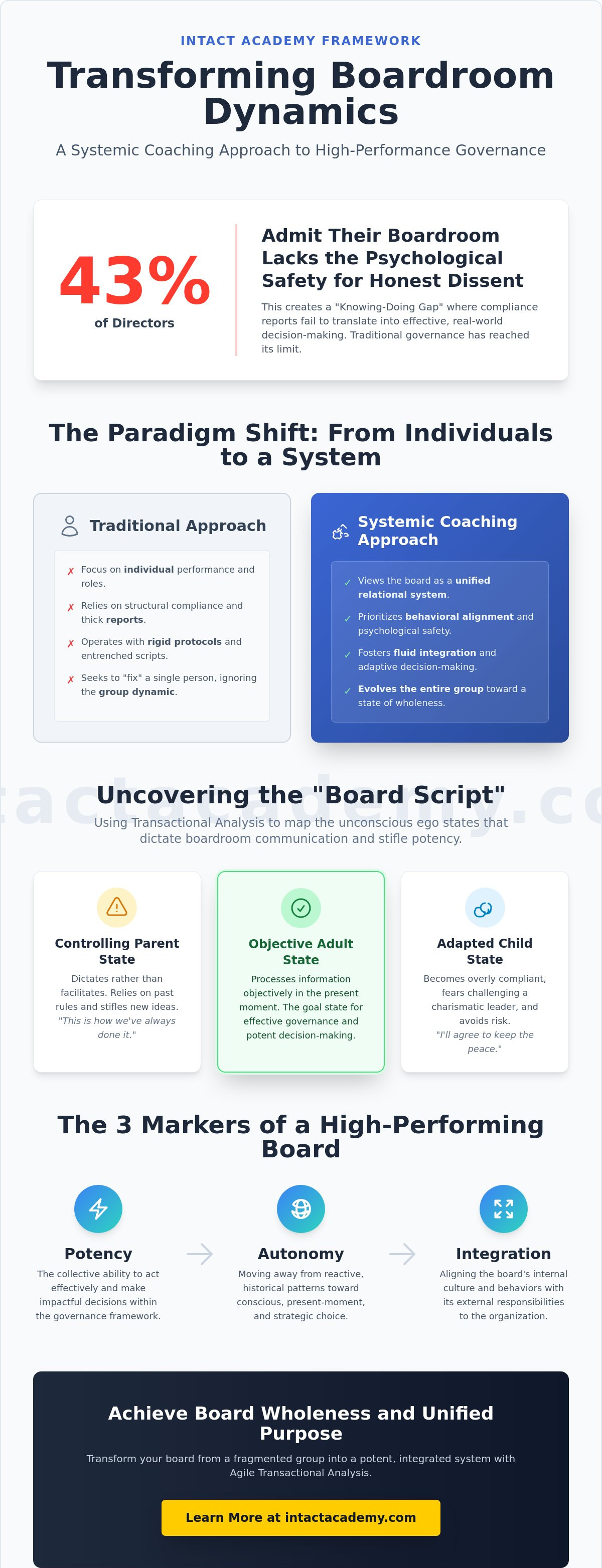
If 43% of directors admit their boardroom lacks the psychological safety required for honest dissent, then the traditional approach to governance has reached its limit. You've likely felt that palpable friction when a Board Chair and CEO lose alignment, or watched as entrenched behavioral scripts stall a decision that should've taken minutes. While most organizations focus on structural compliance, the true work of high performance happens beneath the surface. Mastering coaching a board of directors best practices isn't about ticking boxes; it's about shifting the systemic energy of the collective unit.
You recognize that for a board to truly flourish, it must move from a state of rigid protocol to one of fluid integration. This article reveals how to navigate those deep psychological undercurrents to foster sustainable behavioral change. We'll examine a framework for governance mastery that prioritizes individual autonomy and collective potency, providing you with the tools to transform the boardroom into a site of profound human and organizational evolution.
Key Takeaways
- Shift your perspective from individual performance to the board as a unified relational system, ensuring that your interventions address the root of collective dynamics.
- Decode the "Board Script" through the lens of Transactional Analysis to uncover the unconscious patterns and communication flows that silently dictate decision-making.
- Resolve the "Knowing-Doing Gap" by prioritizing deep behavioral alignment and psychological safety over the mere accumulation of governance data and reports.
- Discover essential coaching a board of directors best practices, including how to navigate complex three-way contracting and utilize systemic 360-degree feedback for lasting impact.
- Integrate the Intact philosophy of wholeness to return your board to a state of authenticity, fostering rapid evolution through the principles of Agile Transactional Analysis.
Defining Board Coaching: A Systemic Intervention for Governance
Effective governance requires more than a checklist of compliance requirements. While many organizations rely on traditional audits to assess performance, these reviews often fail to capture the behavioral undercurrents that dictate how decisions are actually made. Coaching a board of directors best practices involves a shift from viewing the board as a collection of experts to treating it as a single, relational system. This systemic intervention moves beyond the surface level of fiduciary duty. It invites the board to achieve a state of Systemic Wholeness, where technical compliance and human psychological integration work in tandem rather than in conflict.
A fundamental step in understanding the board of directors is recognizing that their formal roles are often shadowed by invisible dynamics. While individual executive coaching focuses on a leader's personal autonomy and script, board coaching addresses the collective script of the group. This journey isn't about fixing a single person; it's about evolving the way the entire group interacts with risk, power, and strategy. When a board achieves this level of integration, they stop merely surviving quarterly cycles and begin to lead with true potency. They move from a state of fragmentation to one of unified purpose.
Coaching vs. Consulting: The Behavioral Gap
Consultants typically arrive with a diagnostic lens, delivering thick reports that detail what's wrong. They provide the "what," yet they rarely stay to address the "how" of behavioral change. Knowledge of fiduciary duty doesn't automatically translate to effective decision-making under pressure. A coach acts as a mirror for the board's collective blind spots. Instead of handing over a solution, the coach facilitates a transformation in how the board processes information. This distinction is vital; while a consultant might suggest a new structure, a coach ensures the board has the psychological safety to use that structure effectively. It's the difference between receiving a map and learning how to navigate the terrain together.
The Board as a Relational System
Every boardroom is populated by more than just the people in the chairs. Invisible stakeholders, from past founders to future investors, influence the current dynamic. Applying systemic team coaching principles means identifying these influences and establishing the board's Primary Task. This task is the essential reason for the board's existence, transcending mere survival or profit. By focusing on this core purpose, the board can navigate high-stakes governance with a shared sense of mission. Coaching a board of directors best practices requires this deep dive into the relational field to ensure that the board's energy is directed toward growth rather than internal friction. Success is measured by three key systemic markers:
- Potency: The collective ability to act effectively within the governance framework.
- Autonomy: Moving away from reactive historical patterns toward conscious, present-moment choice.
- Integration: Aligning the board's internal culture with its external responsibilities to the organization.
Uncovering the Board Script: TA Frameworks for Directors
Every board room has a ghost in the machine. We call this the Board Script, which is an unconscious blueprint that governs how directors interact, compete, and decide. This script isn't found in the bylaws or the annual report; it lives in the repetitive patterns of communication that either propel a company forward or keep it tethered to past failures. When applying coaching a board of directors best practices, the first step involves making these invisible scripts visible. By using Transactional Analysis (TA), we can map the energy in the room to understand why a group of brilliant individuals often produces a mediocre collective result.
Ego States in the Boardroom
Governance often falters when directors slip out of their Adult state. You might see a Controlling Parent ego state dominate the table, manifesting as a Chairperson who dictates rather than facilitates. Conversely, an Adapted Child state appears when board members become overly compliant, fearing to challenge a charismatic CEO. These dynamics stifle innovation and create a culture of silence. To restore potency, the coach must facilitate a return to the Adult state where objective strategic analysis can flourish.
Mapping Boardroom Transactions
Communication is rarely as simple as it appears on the surface. In many high-stakes environments, ulterior transactions take root. This happens when a director says something that sounds professional but carries a hidden psychological message. For instance, a 2022 survey of 150 global directors indicated that 38% felt hidden agendas were the primary barrier to board effectiveness. These Psychological Games, such as the classic "Yes, But" dynamic, allow the board to avoid the discomfort of real change by dismissing every viable solution offered.
- Crossed Transactions: These occur when an Adult inquiry is met with a Parent rebuke, causing the flow of information to stop abruptly.
- Stalemate: Continuous crossed transactions lead to the governance deadlocks that cost organizations significant market agility.
- Integration: Moving toward Adult-Adult communication fosters psychological safety and trust.
Understanding what is transactional analysis allows directors to recognize these patterns in real-time. By shifting away from Parent-Child dynamics, the board moves from a state of reactive script-following to proactive, systemic mastery. If you're ready to deepen your impact, you might consider how systemic coaching can transform your board's culture from the inside out.
Behavioral Alignment vs. Governance Reports: Why Knowledge Isn't Impact
Many boards operate under the illusion that a 20% increase in data reporting or a more robust compliance manual will resolve underlying friction. It's a common fallacy that ignores the systemic reality of human interaction. Knowledge is the map, but behavior is the terrain. This disconnect is the "Knowing-Doing Gap" in corporate governance. While directors understand their fiduciary duties intellectually, their collective script often prevents them from acting on that knowledge during high-stakes moments. When implementing coaching a board of directors best practices, the focus shifts from auditing what directors know to observing how they interact. The coach functions as a systemic architect, moving the board from the safety of theoretical compliance to the potency of authentic action.
The Illusion of Consensus
False harmony is a silent killer of board effectiveness. When every member nods in agreement, it's rarely a sign of true alignment; it's often a sign of a groupthink script. High-performing boards require a "Safe Container" where dissent is invited as a form of loyalty to the organization's mission. To surface healthy conflict, coaches use techniques like circular questioning or the "Devil’s Advocate" rotation. These methods allow directors to express minority views without damaging interpersonal relationships. By surfacing resistance early, the board gains the agility to pivot before a crisis occurs, ensuring that consensus is earned rather than performed.
Addressing the #1 Objection: The ROI of 'Soft' Skills
Critics often dismiss behavioral work as "soft," yet the financial implications are stark. According to a 2023 analysis by the Harvard Business Review, poor board dynamics are a primary driver in the 70% failure rate of M&A transactions. When a board is misaligned, strategic execution stalls and costs mount. CEO turnover, often a byproduct of board dysfunction, costs organizations an average of $1.5 million in recruitment fees and lost productivity per instance.
Integrating coaching a board of directors best practices allows the chair to position behavioral alignment as a tactical hunt for organizational efficiency. This isn't about "feeling better" in the boardroom. It's about reducing the friction that slows down multi-million dollar decisions. Boards that master these dynamics see a measurable acceleration in strategic execution because they've removed the psychological blocks that lead to hesitation. We focus on:
- Reducing Decision Latency: Cutting the time between identifying a problem and taking corrective action.
- Stabilizing Leadership: Lowering the 15% average annual turnover rate for high-level executives.
- Enhancing Strategic Potency: Ensuring that the board's collective intelligence is fully utilized rather than suppressed by social pressure.
Best Practices for Coaching a Board of Directors: A Strategic Roadmap
Effective coaching a board of directors best practices begins with a diagnostic that looks beyond surface level interactions. According to PwC’s 2023 Annual Corporate Directors Survey, 45 percent of directors believe at least one member of their board should be replaced. This statistic highlights the necessity of a rigorous diagnostic phase. By using 360 degree feedback and systemic mapping, a coach can identify the hidden scripts and power dynamics that hinder collective potency. This phase isn't about individual performance alone; it's about how the parts interact to create a functional or dysfunctional whole.
Integration is the final, vital step in this roadmap. The insights gained in a coaching session must survive the transition back to the boardroom floor. This requires the coach to observe live meetings, providing real time feedback on how the board handles high pressure decisions. When the coach works with the Board Chair dyad, they focus on the Chair’s role as a facilitator of psychological safety. The goal is to move the board from a collection of experts to a cohesive, systemic entity capable of profound transformation.
Contracting for Success in High-Stakes Environments
In high stakes governance, clear contracting is the foundation of autonomy. The coach must establish a three way contract between themselves, the CEO, and the Board to ensure all parties are aligned on the desired outcomes. This process involves defining a Psychological Contract that goes deeper than a standard service agreement. It addresses the emotional expectations and unspoken fears of the group. Understanding the boundaries between coaching, supervision, and consultancy is essential to maintain professional integrity. Those seeking to master these complexities often pursue an executive coaching certification to refine their systemic impact.
Facilitating the Board-CEO Relationship
The relationship between the CEO and the board is often defined by a complex Power Script. Coaching this dyad requires a delicate balance between supporting the executive’s leadership and honoring the board’s oversight responsibility. Best practices focus on creating alignment between strategic vision and operational execution. When radical transparency becomes the norm, the board can move away from micromanagement and toward mutual accountability. This shift allows the CEO to lead with confidence while the board provides the necessary systemic guardrails.
Sustaining Change Through Supervision
Board coaches often encounter Parallel Processes, where they unconsciously mirror the very dysfunctions they're trying to solve. This is why systemic supervision is non negotiable for practitioners. It provides a reflective space to process the emotional weight of the boardroom and ensures the coach remains a grounded, objective presence. Establishing a regular rhythm for ongoing board development, rather than relying on one off retreats, ensures that growth becomes a permanent part of the organizational DNA. This commitment to wholeness is what separates transactional coaching from true governance mastery.
Ready to deepen your systemic impact and lead boards toward authentic transformation? Explore our systemic coaching programs at Intact Academy.
Moving Toward Board Wholeness with Intact Academy
The Intact philosophy operates on a singular, powerful premise: organizations and their leaders aren't broken, they're simply stuck in scripts that no longer serve their purpose. When we talk about coaching a board of directors best practices, we aren't just discussing governance protocols or meeting efficiency. We're inviting a return to authenticity. This process of returning to wholeness requires a methodology that's as fluid as the markets these boards navigate. This is where Agile Transactional Analysis (ATA) becomes indispensable. It allows a board to evolve rapidly by identifying the underlying psychological transactions that stall decision-making and stifle innovation.
At the heart of this work is Sari van Poelje, who has spent over 35 years pioneering systemic change across the globe. Her approach doesn't just address the surface level symptoms of board dysfunction. Instead, she guides practitioners to see the board as a living organism. If a board can recognize its own patterns of communication and ego states, it gains the potency to change its entire organizational culture from the top down. Mastery in this field isn't about having all the answers. It's about having the systemic tools to ask the right questions at the right time.
The TA EMCC Senior Team Coach Academy
Professional mastery in board coaching requires a rigorous framework that balances psychological depth with executive pragmatism. The TA EMCC Senior Team Coach Academy provides this through a curriculum specifically designed for high-level interventions. While individual coaching focuses on the person, systemic board coaching focuses on the "space between" the directors. Transitioning to this level of work means moving from the role of a confidant to that of a systemic mirror. This EMCC-accredited training ensures that coaches possess the credibility and the structured methodology needed to handle the intense power dynamics found in the boardroom.
Your Journey to Professional Impact
The landscape of leadership is shifting, and the demand for deep, systemic intervention has never been higher. Engaging in continuous professional development for coaches is the only way to remain relevant in a world that's increasingly volatile. By joining our global community, you aren't just signing up for a course; you're entering a collective of practitioners dedicated to human flourishing. True transformation requires the courage to look at the shadows within a system. If you're ready to move beyond transactional coaching and into the realm of systemic mastery, the path is open. The evolution of governance starts with the evolution of the coach.
From Governance Compliance to Systemic Mastery
Effective governance requires more than reviewing quarterly reports; it demands a deep understanding of the hidden scripts that drive board behavior. You've seen how moving beyond surface-level knowledge toward behavioral alignment creates a more potent leadership environment. By integrating Sari van Poelje’s 35 years of expertise in systemic transformation, boards can shift from reactive patterns to a state of collective autonomy. Implementing these coaching a board of directors best practices allows the system to breathe and evolve with genuine agility.
Real change happens when we address the systemic roots of performance rather than just the symptoms. If you're ready to facilitate this profound human transformation, join a global community of practitioners committed to professional wholeness. You can deepen your impact with the TA EMCC Senior Team Coach Academy, where our EMCC and ICF accredited programs focus on advanced Systemic Transactional Analysis. It's time to bring a new level of depth and integrity to the boardroom. Your journey toward mastery starts with the courage to look beneath the surface.
Frequently Asked Questions
What is the difference between board coaching and board training?
Board training focuses on the transfer of knowledge regarding compliance, financial oversight, and legal duties. Coaching addresses the systemic behavior and psychological dynamics of the group to improve collective decision-making. A 2022 study by the International Coaching Federation shows that while training increases productivity by 22%, coaching combined with training boosts it by 88%. It's the difference between learning the rules and mastering the internal agility to play the game well.
Is board coaching effective for nonprofit boards as well as corporate boards?
Systemic coaching is vital for nonprofit boards because they often navigate complex stakeholder scripts and emotional missions. The 2021 BoardSource "Leading with Intent" report found that 49% of nonprofit CEOs believe their boards lack the tools to support them effectively. Coaching provides a stable container for these leaders to align their personal values with the organization's systemic purpose. It helps them move from a state of survival into one of authentic flourishing.
How long does a typical board coaching engagement last?
A typical engagement lasts between 6 and 18 months to ensure that new behavioral patterns become permanent. Research from the Harvard Business Review in 2020 suggests that deep cultural shifts in leadership teams require at least 12 months of consistent intervention. This timeframe allows the board to move through the stages of awareness and integration without rushing the process. It ensures the transformation is rooted in the board's daily operations rather than being a temporary fix.
Can a coach help with a board that is experiencing extreme conflict?
Coaches resolve extreme conflict by identifying the underlying psychological games and systemic scripts that drive the friction. By using Agile Transactional Analysis, a coach helps members look past surface arguments to find the root causes of dysfunction. This process transforms destructive energy into creative potency and collective autonomy. It allows the board to stop repeating old patterns and start building a future based on mutual respect and clarity.
Who should initiate the request for board coaching?
The Board Chair or the Governance Committee typically initiates the request for external coaching support. According to the 2023 Spencer Stuart Board Index, 70% of high-performing boards now include formal coaching in their annual development plans. Sometimes a CEO suggests coaching during a period of rapid growth or structural change. It's a sign of professional maturity to seek a mirror for the board's behavior before systemic issues turn into a crisis.
What are the common signs that a board of directors needs coaching?
Common signs include persistent silos, a lack of healthy dissent, or a feeling that the board is stuck in a repetitive loop. When applying coaching a board of directors best practices, we often look for the "80/20 rule" where 20% of members dominate 80% of the conversation. If your meetings feel drained of energy or if decisions are made outside the boardroom, the systemic health of the group is likely compromised.
How much does board of directors coaching typically cost?
Costs for board coaching vary based on the scope of the intervention and the expertise of the coach. The 2023 Sherpa Executive Coaching Survey reports that professional rates for board-level coaching generally range from $350 to over $1,000 per hour. These figures reflect the specialized nature of systemic work and the high stakes involved in board performance. Investing in coaching is a way to protect the organization's long-term value and integrity.
What qualifications should I look for in a board coach?
Look for a coach with systemic certification, such as those from the International Transactional Analysis Association or the International Coaching Federation. They should possess a blend of psychological depth and practical governance experience to handle complex boardroom dynamics. A qualified coach acts as a wise mentor who understands how to bridge the gap between individual growth and organizational success. They should offer a clear methodology that honors the intelligence of the board.


