
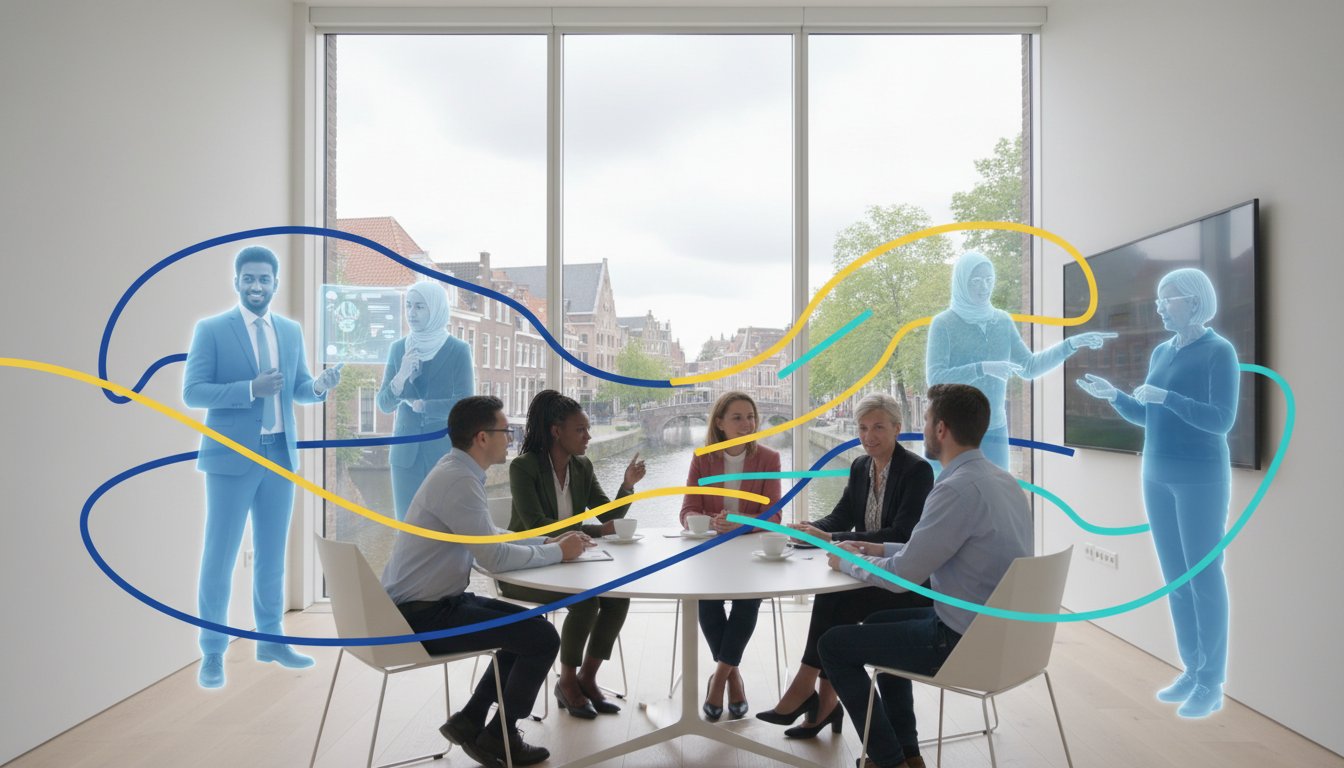
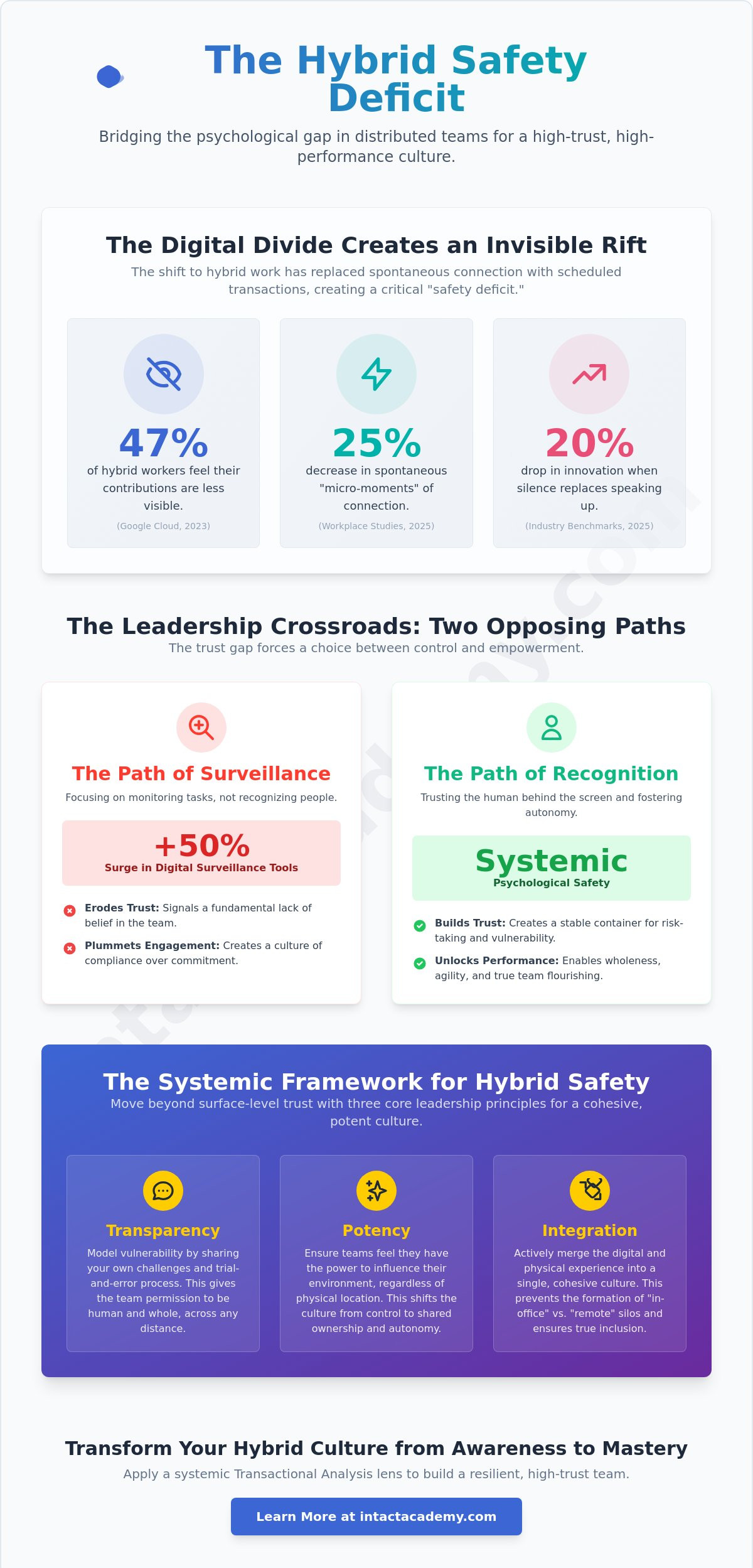
Most leaders mistakenly believe that the absence of conflict signifies the presence of safety. According to a 2023 Google Cloud study, 47% of hybrid workers feel their contributions are less visible than those of their in-office peers, creating a silent rift in organizational trust. Building psychological safety in hybrid teams isn't achieved through more meetings; it's found in the quality of the transactions between those meetings. You’ve likely felt the weight of this distance as spontaneous Adult-to-Adult dialogue fades, often replaced by the rigid, unconscious scripts that emerge when people feel unseen.
It’s exhausting to manage a team where invisible silos dictate the flow of information. You want a culture where every member feels the potency to speak up, yet the digital divide often invites subtle psychological games that drain collective energy. In this guide, we'll move beyond surface-level rapport to apply a systemic Transactional Analysis lens to your leadership. You'll discover how to identify toxic team scripts early and gain the tools to foster a high-trust environment where human wholeness and performance are no longer at odds.
Key Takeaways
- Uncover the systemic "safety deficit" in distributed environments and learn how to identify the invisible barriers that prevent genuine interpersonal risk-taking.
- Apply the framework of Ego States to digital communication, allowing your team to move beyond reactive patterns toward a state of conscious, professional potency.
- Discover how building psychological safety in hybrid teams requires rewriting unconscious "Distance Scripts" that often lead to exclusion and fragmented cultures.
- Learn to use Psychological Contracting and the "Equal Voice" protocol to create explicit boundaries that foster deep inclusion across all physical and digital spaces.
- Transition from surface-level trust to a continuous systemic practice, integrating Agile Transactional Analysis to sustain long-term cultural transformation.
The Evolution of Psychological Safety in the Hybrid Era
The concept of psychological safety, once a niche academic term, has become the bedrock of organizational health. It represents the shared belief that a team is safe for interpersonal risk-taking, where individuals feel they won't be punished for making mistakes or asking questions. In 2015, Google's Project Aristotle famously revealed it as the primary driver of team success. Fast forward to 2026, and the hybrid era has introduced a profound safety deficit. The traditional office provided a physical container where trust was built through proximity and spontaneous interaction. Today, the digital veil often obscures these human connections. It creates a psychological distance that makes vulnerability feel like a liability rather than an asset. Building psychological safety in hybrid teams is no longer a soft skill; it's a systemic requirement for survival in a fragmented work world.
The shift to hybrid work has replaced consistent face-to-face contact with scheduled, transactional meetings. This change has led to a 25% decrease in "micro-moments" of connection, according to 2025 workplace studies. Without these moments, the emotional weight of a team's culture begins to thin. We see a move from surface-level trust, which relies on politeness, to a need for systemic psychological safety that can withstand the pressures of distributed work. This evolution requires us to look deeper than just team building exercises; we must examine the underlying structures that allow a human being to feel seen even when they are not physically present.
Beyond Amy Edmondson: Safety as a Systemic Necessity
While Amy Edmondson’s work remains foundational, the hybrid reality requires a more robust update. We must move beyond individual interactions to look at the organizational script. In distributed teams, the cost of silence is high. When employees feel they can't challenge the status quo, innovation drops by 20% according to 2025 industry benchmarks. This silence also masks the early signs of burnout, which often goes undetected until it results in turnover. We must view safety not as a feeling, but as a structural property of the team system. Hybrid psychological safety is the stable container for distributed autonomy.
The Trust Gap: Recognition vs. Surveillance
There is a critical distinction between knowing what people are doing and trusting who they are. Since 2024, the adoption of digital surveillance tools has surged by 50% in remote-heavy sectors, yet employee engagement in those same companies has plummeted. These tools actively erode the foundation of safety. They signal a lack of systemic potency and an over-reliance on control. Authentic safety requires a shift from monitoring tasks to recognizing the human behind the screen.
- Transparency: Leaders must model vulnerability across the physical-digital divide by sharing their own challenges.
- Potency: Teams need to feel they have the power to influence their environment, regardless of their location.
- Integration: Building psychological safety in hybrid teams requires merging the digital and physical experience into a single, cohesive culture.
When a leader shares their own process of trial and error, they give the team permission to be whole. This integration of the self into the digital workspace is the first step toward a high-performing, autonomous system. It moves the team from a state of mere survival into a state of flourishing and agility.
Mapping the Invisible: A Systemic View of Hybrid Team Dynamics
To understand building psychological safety in hybrid teams, we must look beneath the surface of the digital interface. Communication in a distributed environment isn't just about the words exchanged; it's about the psychological positions we occupy. Transactional Analysis (TA) provides a sophisticated lens for this mapping, allowing us to see the invisible threads of the "Ego States" that define our interactions. When we interact, we do so from one of three states: Parent, Adult, or Child. In a physical office, subtle physical cues often keep us grounded in an Adult-Adult state. In the vacuum of hybrid work, these cues vanish, often causing teams to regress into outdated systemic scripts.
Every organization operates under a systemic script, an unconscious plan created by its history and leadership. If the script emphasizes control over autonomy, hybrid work will trigger defensive behaviors. Instead of open collaboration, teams might find themselves trapped in a cycle of micro-management and withdrawal. Breaking this cycle requires a conscious return to the "Adult" state, where we respond to the present reality rather than past fears.
Ego States in Slack and Zoom
The "Critical Parent" tone is a frequent intruder in asynchronous messaging. A short, context-free message like "Update?" can be perceived as an authoritative reprimand. This often triggers an "Adapted Child" response, where the employee feels a need to comply or hide, effectively withholding the critical feedback or creative risks essential for building psychological safety in hybrid teams. To maintain an "Adult" state in high-pressure virtual meetings, participants should practice "pausing." This moment of reflection allows you to ask if your response is based on the current facts or an old emotional habit. It's about staying present when the screen makes it easy to drift into the past.
Agile TA: A Framework for Distributed Wholeness
Agile principles and Transactional Analysis intersect to create a framework for rapid team evolution. This approach focuses on "Integration," the process of aligning the individual's internal world with the collective goals of the team. Sari van Poelje, a leading voice in systemic change, uses these insights to heal the fragmentation that often occurs when teams are physically separated. Her methodology emphasizes that wholeness isn't a destination but a continuous practice of awareness.
By applying Agile TA, teams can move beyond rigid hierarchies and foster true potency. This involves:
- Recognizing when the team script has become "stuck" in a repetitive, unproductive loop.
- Encouraging "Adult" contracts for how and when communication happens.
- Using systemic mapping to identify where trust has been fractured in the digital space.
Identifying the 'Distance Scripts' that Erase Safety
In Transactional Analysis, a script is an unconscious life plan created in childhood as a survival strategy. Within an organizational context, these scripts transform into collective patterns that dictate how a group reacts to stress or change. When we transition to hybrid models, these scripts don't disappear; they adapt to the digital divide. Building psychological safety in hybrid teams requires us to name these patterns before they become the default operating system. Without intervention, teams often fall into the "Office Elite" versus "The Invisible Employee" dynamic, a systemic split that creates a two-tier hierarchy of belonging.
Psychological games thrive in the low-context environment of Slack messages and brief Zoom calls. One prevalent game is "Now I've Got You" (NIGYSO). In this scenario, a team member withholds feedback or remains silent during a project's development, only to point out a critical flaw once the work is public. This behavior is rarely about the work itself. It's a systemic defense mechanism used to maintain a position of "I'm OK, You're Not OK." According to a 2023 report from the MITSloan Management Review, toxic culture remains the strongest predictor of turnover, often fueled by these unaddressed interpersonal games that erode the "Adult" ego state of the collective.
- Withholding: Using information as a currency of power or a shield against perceived threats.
- Discounting: Ignoring the presence, feelings, or problems of a colleague to avoid the effort of engagement.
- The Script Loop: A repetitive cycle where the team experiences the same failure because they haven't addressed the underlying psychological payoff.
The 'Invisible Employee' Script
The "Invisible Employee" script is a product of proximity bias. When leaders fail to intentionally include remote participants, they're practicing "discounting." This isn't just a lack of politeness; it's a psychological erasure of the person's potency. A 2023 Pew Research study found that 71% of remote workers feel they are less likely to be considered for promotions. To break this cycle, leaders must provide consistent "strokes," which are units of recognition. A stroke can be as simple as acknowledging a remote worker's insight by name during a physical boardroom meeting, ensuring their presence carries weight regardless of their location.
Digital Games: 'Yes, But' in Virtual Facilitation
During virtual brainstorming, the "Yes, But" game often emerges as a barrier to innovation. A team member appears to agree with a proposal but immediately follows with a reason why it won't work. This cycle prevents the team from moving into authentic problem-solving. To pivot, the facilitator must move the group into an "Adult-to-Adult" transaction. You can do this by creating a "contract for safety" at the start of every session. This contract is a clear, explicit agreement on how the team will handle dissent and provide feedback. It replaces the hidden agendas of psychological games with a shared commitment to transparency and mutual respect, which is the cornerstone of building psychological safety in hybrid teams.
Practical Interventions: Building Safety through Agile TA
Building psychological safety in hybrid teams isn't an organic byproduct of good intentions; it's a deliberate systemic construction. In Agile Transactional Analysis (TA), we recognize that the physical distance between home offices and headquarters often triggers a "script" of isolation or exclusion. To counter this, leaders must move from implicit assumptions to explicit agreements. This transition begins with vulnerability modeling. When a leader safely "unmasks" by admitting a mistake or acknowledging the difficulty of the hybrid setup, they invite team autonomy. They signal that the environment is safe enough for others to stop performing and start contributing. This vulnerability isn't a sign of weakness but an act of potency that dismantles the hierarchy of perfection.
Contracting for Hybrid Success
Implicit expectations are the silent killers of trust. When team members guess at response times or "online" etiquette, they experience a constant state of low-level anxiety. You can resolve this by facilitating a social contract that defines the team's operational reality. Follow these steps:
- Define "Availability Windows" to protect deep work.
- Select specific channels for different types of communication (e.g., Slack for speed, Email for depth).
- Establish a "Right to Disconnect" to prevent digital burnout.
The Power of Recognition (Stroking)
In TA, a "stroke" is a unit of recognition. Remote work often creates a stroke deficit, leading to what Claude Steiner described in 1971 as a "Stroke Economy" based on scarcity. To maintain psychological safety, leaders must prioritize positive conditional strokes, which are specific recognitions of a person's work or behavior. Instead of a vague "good job," try "I appreciated the clarity of your data in the third slide." This specific feedback bridges the physical gap, ensuring team members feel seen and valued despite the screen. Mapping a "Stroking Profile" for your team reveals who needs public praise and who prefers a private note, preventing the disengagement that follows when effort goes unnoticed.
Systemic Facilitation Techniques
Ensuring systemic inclusion requires the "Equal Voice" protocol. In hybrid meetings, remote participants should always speak first to counteract the natural "proximity bias" of those in the room. You can also use the "Empty Chair" technique in a virtual setting. By dedicating a digital tile or a physical chair in the office to represent an absent stakeholder or a missing perspective, you keep the system's integrity intact. These interventions are essential for leading organizational change effectively, as they allow for "Crucial Conversations" even when the team is physically separated. By facilitating these moments with psychological depth, you ensure that every voice contributes to the collective intelligence of the organization.
To deepen your understanding of these systemic tools, explore how our methodology supports profound human transformation in your leadership journey.
From Awareness to Mastery: Transforming Your Hybrid Culture
Safety isn't a static achievement or a box to check during an annual retreat. It's a continuous systemic practice that requires constant recalibration as team members move between physical and digital spaces. When we focus on building psychological safety in hybrid teams, we're committing to a relational quality that transcends the limitations of a screen. A 2022 Gartner report revealed that only 25% of remote or hybrid workers feel a strong sense of belonging to their organization's culture. This gap exists because many leaders focus on the mechanics of work rather than the systemic health of the group.
The role of a Senior Team Coach is to facilitate a long-term cultural unfolding. This goes beyond "doing" coaching as a scheduled task. It's about "being" a safe presence. When a leader embodies potency and protection, the team feels a sense of permission to innovate and fail. You move from fixing surface-level conflicts to addressing the underlying script of the organization. This shift creates a container where autonomy isn't just encouraged; it's the natural state of being.
Developing the 'Coach Approach' in Leadership
Most leaders operate from a "Manager" script rooted in historical Parent-Child dynamics. This often leads to micro-management in remote settings or a lack of boundaries in the office. Transitioning to a "Coach" script requires staying in a consistent Adult state. A 2023 study found that teams utilizing systemic coaching frameworks saw a 15% increase in collaborative efficiency because they stopped wasting energy on defensive maneuvers.
- Maintain the Adult State: Use professional supervision to process your own triggers and avoid the drama triangle.
- Operational Integration: Embed reflective inquiries into daily stand-ups. Ask "What are we not saying?" instead of just "What is the status?"
- Systemic Awareness: Recognize that a hybrid team is a single organism with different nodes of connection.
Join the TA EMCC Senior Team Coach Academy
The journey toward professional mastery requires a structured methodology and a supportive community. Our academy provides a deep dive into systemic transformation through the lens of Agile Transactional Analysis. We help you move past transactional interactions to reach a state of wholeness and authenticity. For international leaders, the EMCC accreditation serves as a global benchmark of excellence, ensuring you have the tools to handle complex, multi-layered organizational dynamics.
By building psychological safety in hybrid teams through our specialized training, you gain the agility to lead in an uncertain world. We focus on the integration of individual growth and organizational success, providing a stable path for those ready to lead with depth and integrity. Explore our Team Coach Academy to master hybrid dynamics and begin your own transformation from a manager to a systemic architect of human flourishing.
Mastering the Systemic Pulse of Your Hybrid Team
True transformation begins when we stop viewing physical distance as a barrier and start seeing it as a systemic field of scripts and dynamics. By identifying the hidden patterns that erode trust, leaders can move from reactive management to a state of collective potency. Building psychological safety in hybrid teams isn't about more meetings; it's about applying Agile Transactional Analysis to create a container where every voice feels heard and every contribution counts. You've explored how to map these invisible forces and move toward a culture of authentic integration. This shift requires courage. It demands a commitment to returning to wholeness through structured methodology and deep insight.
If you're ready to bridge the gap between theory and profound organizational change, our programs offer the stable container you need. Join a global community of practitioners from 14+ countries in our EMCC and ICF accredited programs. Led by Sari van Poelje and our world-class faculty, we provide the tools to foster resilience in any environment. Elevate your leadership with our TA EMCC Senior Team Coach Academy and begin your journey toward systemic mastery. The path to a flourishing, integrated workplace is yours to shape.
Frequently Asked Questions
What is the first sign that psychological safety is lacking in a hybrid team?
The most immediate sign is a decline in conversational turn-taking, a metric identified in Google’s 2012 Project Aristotle study. When team members stop offering dissenting opinions or wait for the leader to speak first, they've entered a state of survival adaptation. You'll notice Slack channels becoming purely transactional, with 0% of messages challenging the status quo. This silence signals that the perceived risk of interpersonal vulnerability has outweighed the benefit of innovation.
How can I encourage quiet remote employees to speak up without putting them on the spot?
Shift from real-time interrogation to asynchronous brainwriting to invite the Adult ego state without triggering a fear response. Research by Professor Leigh Thompson at Kellogg School of Management shows that brainwriting generates 2.5 times more ideas than traditional brainstorming. Provide a shared document 24 hours before the meeting. This allows remote employees to contribute their insights in a low-pressure environment, ensuring their potency is recognized without the anxiety of an immediate spotlight.
Can psychological safety be built entirely through virtual communication?
You can succeed at building psychological safety in hybrid teams using virtual platforms if you prioritize relational strokes over task completion. A 2021 study by Microsoft found that digital exhaustion occurs after 30 minutes of video conferencing, so keep sessions short. Use breakout rooms for groups of three or four to foster intimacy. These smaller clusters allow for the authentic exchange of script stories, which builds the foundational trust necessary for a high-performing systemic culture.
What is the difference between trust and psychological safety in a hybrid context?
Trust is a bilateral contract between two people, whereas psychological safety is a systemic property of the entire team. Amy Edmondson’s 1999 research clarifies that while I may trust my manager, I might still fear the group's reaction to my mistakes. In a hybrid setting, you might trust a colleague to finish a report by 5:00 PM but still feel unsafe admitting a technical error during a Zoom call with 12 participants.
How do I handle a 'Critical Parent' dynamic in a team Slack channel?
Address a Critical Parent dynamic by naming the behavior and returning the conversation to an Adult-to-Adult transaction. If a senior developer uses judgmental language in Slack, respond with a neutral, fact-based inquiry. Refer to the team’s social contract, a document 85% of high-performing teams use to define acceptable communication. This intervention stops the Drama Triangle and refocuses the energy on the problem rather than the person, maintaining the team's professional integrity.
What role does the 'Physical' office play in building safety for a hybrid team?
The physical office acts as a touchstone for high-bandwidth social bonding that 60% of remote workers find difficult to replicate digitally. Use in-person time specifically for relational anchoring rather than routine tasks. According to the 2023 WFH Research group, teams that meet in person at least one day a month report higher levels of belonging. These physical encounters reinforce the systemic boundaries and provide the sensory strokes that sustain psychological safety during remote periods.
How does Transactional Analysis help in identifying team dysfunctions?
Transactional Analysis identifies dysfunctions by mapping the transactions between team members to reveal hidden systemic scripts. By analyzing whether communication is crossed or ulterior, a leader can see why a project stalled in June 2023 despite clear instructions. This framework provides a structured methodology to move from reactive Rebellious Child behaviors to proactive Adult problem-solving. It allows for a precise diagnosis of the team's psychological architecture, leading to more sustainable transformations.
Is psychological safety the same as being 'nice' to employees?
No, being nice often masks the polite avoidance that hinders building psychological safety in hybrid teams. True safety is about creating a container for radical candor and high accountability. A 2017 study in the Harvard Business Review notes that teams with high safety actually have more frequent, albeit productive, disagreements. It's the difference between a Nurturing Parent who overprotects and an Adult who provides the necessary structure for growth and honest feedback.


