

What if the resistance you encounter isn't a sign of employee defiance, but a natural systemic response to a "Parental" communication style that strips adults of their autonomy? Research from 2024 shows that 70% of organizational transformations stall because leadership fails to account for the psychological safety of the collective. To bridge this gap, you need more than just a schedule of emails; you need a change management communication plan template that honors the unique script of your organization. By shifting from top-down directives to an Adult-to-Adult dialogue, you can ensure that 2026 becomes a year of genuine integration rather than mere compliance.
You've likely felt the frustration of sending frequent updates only to be met with silence or friction. It's exhausting to lead when the messaging from the boardroom feels worlds away from the reality on the shop floor. This guide promises to equip you with a systemic framework to align these two realities and restore organizational potency. We'll explore how to use our specialized change management communication plan template to foster wholeness and reduce transition friction. We'll also examine the nuances of Agile Transactional Analysis to build a communication strategy that honors the maturity of your people.
Key Takeaways
- Move beyond transactional messaging by viewing change as a systemic intervention that addresses the deep-seated psychological scripts hindering organizational evolution.
- Discover how to utilize a change management communication plan template centered on the "Dialogue Loop" to minimize resistance and invite collective participation.
- Transition from top-down directives to professional autonomy by applying Transactional Analysis to shift ego states from reactive resistance to proactive integration.
- Implement the "Three-Contract" method to align administrative goals with psychological safety, ensuring your communication culture supports agile and sustainable transformation.
- Learn to conduct a systemic audit of your current culture to identify hidden barriers to wholeness and unlock the true potency of your leadership team.
Beyond Information: The Psychology of a Change Management Communication Plan
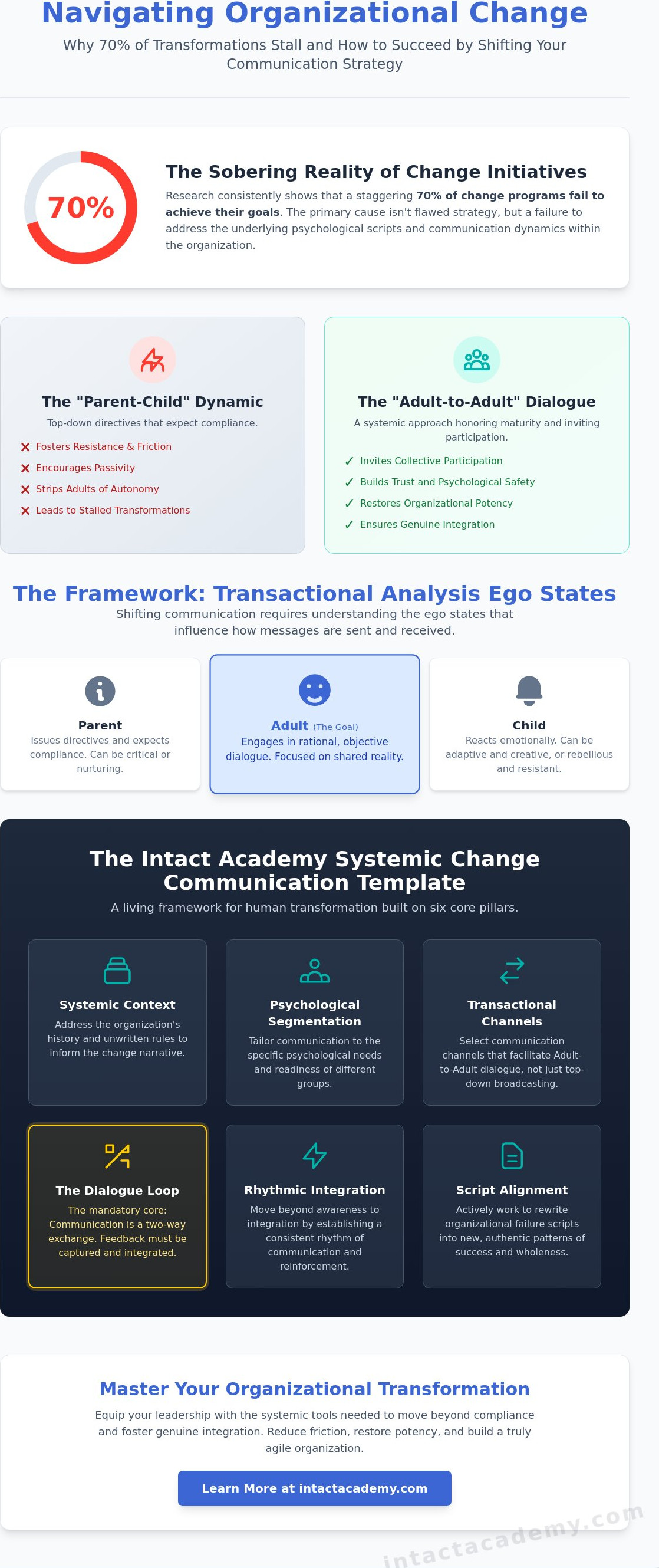
A robust change management communication plan template is more than a schedule of newsletters and town halls. It represents a deliberate systemic intervention designed to shift the collective consciousness of an organization. Research from McKinsey and Company indicates that 70% of change programs fail to achieve their goals. This high rate of attrition often occurs because leaders focus on the mechanics of the shift while ignoring the underlying psychological scripts that dictate how people actually behave. When we treat communication as a mere data transfer, we neglect the psychological contract. This is the unspoken set of expectations and obligations that bind an employee to their company. Effective transformation requires us to honor this contract through transparency and mutual respect.
By integrating fundamental change management principles, we move away from traditional Parent-Child messaging. In many corporate environments, leaders adopt a "Parent" ego state, issuing directives and expecting "Child" compliance. This dynamic breeds resentment and passivity. A systemic approach favors Adult-Adult communication, where the organization invites employees into a shared reality of autonomy and potency. If a message acknowledges the complexity of the transition rather than sugarcoating it, it builds the trust necessary for true integration.
The Role of Transactional Analysis in Change
Transactional Analysis (TA) provides the framework for understanding these interpersonal dynamics. Within the system, three Ego States (Parent, Adult, and Child) influence how every message is processed. If a message feels patronizing, employees often engage in "Discounting." This is a psychological mechanism where individuals minimize or ignore positive change indicators because they feel unsafe or undervalued. You can explore a deeper foundation in what is transactional analysis to see how these states impact professional growth. When people feel seen and heard, they stop discounting the future and begin to invest in the present.
Shifting the Organizational Script
Every organization operates under a "script," a repetitive pattern of behavior that dictates its destiny. Common failure scripts like "we always start things but never finish" act as invisible barriers to progress. Communication serves as the primary tool for re-scripting the entire system. Through the lens of Sari van Poelje’s Agile TA, we view communication as a way to build agility and wholeness. If a leader uses a change management communication plan template to acknowledge past failures and propose a new, authentic path, they begin the work of systemic healing. This process moves the organization toward a state of integration where individual purpose aligns with the collective mission. It's about returning to a state of wholeness where every member of the system feels empowered to contribute to the unfolding transformation.
The Intact Academy Systemic Change Communication Template
Our change management communication plan template moves beyond the superficial checklists of traditional corporate messaging. It functions as a living document that facilitates human transformation across six core pillars: Systemic Context, Psychological Segmentation, Transactional Channels, the Dialogue Loop, Rhythmic Integration, and Script Alignment. In this framework, the "Dialogue Loop" is a mandatory field. Communication isn't a one-way broadcast; it's a systemic exchange that requires a response to be complete. If the feedback isn't captured and integrated, the system remains in a state of unresolved tension.
Setting systemic objectives requires a shift from "awareness" to "integration." While 85% of leaders focus on whether employees heard the news, our template measures whether the new reality is being lived. We look for evidence that the change has moved from an external directive to an internal standard. Research from The Conference Board on best practices in change communication suggests that messaging must be deeply rooted in the organizational culture to stick. We achieve this by ensuring every objective anchors the change in the collective autonomy of the team.
Component 1: The Situation Statement and Systemic Context
Drafting the "Why Now?" requires an Adult ego state: objective, factual, and grounded in current reality. You must honor the old system before introducing the new. If you don't acknowledge the 12 years of stability the legacy processes provided, the organization will perceive the change as an act of disrespect toward its history. Current Reality vs. Desired Future State: "While our current decentralized model supported our growth to 400 employees, our desired future state requires a unified digital infrastructure to support 1,200 global partners by December 2026."
Component 2: Audience Segmentation and Psychological Readiness
Standard mapping identifies job titles, but systemic mapping identifies psychological readiness. We categorize stakeholders by their ego state reactions to the unknown. Early Adopters often lead with a "Natural Child" state of curiosity, whereas Protectors of the Status Quo may operate from a "Parental" state, seeking to shield the system from perceived harm. Every stakeholder needs three questions answered before they can commit to the journey: 1. How does this change affect my daily autonomy? 2. What is the specific timeline for my role's transition? 3. How will my past contributions be valued in this new structure?
Component 3: Channels, Frequency, and the Feedback Loop
We choose channels that foster "transactions" rather than "strokes." A mass email is a stroke; it acknowledges the audience but doesn't invite engagement. Interactive workshops and town halls are transactions that allow for a genuine exchange of energy. We follow the "Rule of 7," which recognizes that a message must be processed through different psychological states at least seven times before it's fully integrated into an individual's professional script. Our Adult-Adult feedback mechanism captures systemic resistance early, treating it as vital data for the project's evolution. To master these high-stakes interactions, consider how our systemic leadership training can refine your approach to organizational health.
Transitioning from Resistance to Autonomy: Communicating through Ego States
The most frequent frustration in executive suites is a sense of bewilderment: "We shared the vision, we held the town halls, and we followed the change management communication plan template, but people are still pushing back." This resistance isn't a failure of logic. It's a psychological response to a perceived shift in the systemic balance. When leadership issues directives from a "Controlling Parent" ego state, they inadvertently trigger the "Adapted Child" in their employees. This leads to the 70% failure rate often cited in change initiatives due to cultural friction. To break this cycle, you must shift your linguistic patterns to invite the "Adult" ego state, fostering a space where autonomy can flourish. Understanding this psychological shift is central to leading organizational change from a place of depth and presence.
Identifying and Handling "Games" in Change Comms
In many feedback sessions, you'll encounter the "Yes, But" game. A manager offers a solution, and the employee provides a reason why it won't work. This isn't a search for information; it's a structural maneuver to maintain the status quo. If your executive announcements rely on a "Controlling Parent" voice, focusing solely on compliance, you invite this rebellion. Instead, adopt a "Nourishing Parent" tone that acknowledges the difficulty while maintaining clear boundaries. If you find yourself in a "Why Don't You... Yes, But" loop, stop offering solutions. Ask, "What do you propose?" This pivot forces an Adult-to-Adult transaction, moving the conversation from a script of helplessness to one of shared responsibility.
The Power of Potency, Protection, and Permission
To move beyond a static change management communication plan template, leaders must embody three systemic qualities that create a container for transformation:
- Permission: This involves explicitly telling teams it's okay to feel uncertain or to grieve the old way of working. It's the "okayness" required for the Adult state to stay online.
- Protection: You must create a space of psychological safety where the "Adult" can function without fear of reprisal. A 2023 study on organizational culture found that teams with high protection levels are 47% more likely to adopt new workflows successfully.
- Potency: This is the leader's own presence and authority. It's the quiet power that signals stability amidst chaos. Potency ensures your communication carries the emotional weight needed to lead through a transition.
When you integrate these three elements, you aren't just moving boxes on an org chart. You're facilitating a profound human transformation. By providing permission to feel and protection to act, you give your team the potency they need to step into their own autonomy. This is how a change management communication plan template becomes a living strategy for wholeness rather than a mere document of directives.
Implementing the Plan: Agile Feedback Loops and Systemic Integration
Transformation isn't a destination; it's a continuous unfolding of organizational potential. To move your change management communication plan template from a static document into a living reality, you must follow a disciplined, systemic sequence. This process ensures that your message doesn't just reach the inbox but resonates within the collective psyche of the organization. Implementation requires a delicate balance between structure and spontaneity.
- Step 1: Conduct a Systemic Audit. Evaluate your current communication culture to see where energy is blocked. A 2024 Gartner study revealed that 73% of employees suffer from change fatigue. You must identify the existing "organizational script" before attempting to rewrite it.
- Step 2: Apply the Three-Contract Method. Define the Administrative contract (logistics and timelines), the Professional contract (tasks and competencies), and the Psychological contract (unspoken needs and emotional safety). If these three layers aren't aligned, the message will feel hollow.
- Step 3: Pilot with a Shadow Board. Test your messaging with a diverse group of internal influencers to identify "ego-state triggers." Does your tone invite an Adult-to-Adult dialogue, or does it accidentally trigger a rebellious Child response from your staff?
- Step 4: Execute in Agile Sprints. Release information in two-week cycles. Use the "Dialogue Loop" to gather real-time data and adjust the next wave of messaging based on what the system actually needs.
Agile TA: Iterative Communication in 2026
Static 12-month plans belong to a predictable past that no longer exists. In a VUCA world, your communication must be as fluid as the market itself. Retrospectives shouldn't be reserved for IT teams; they're essential for the whole organization to reflect on how information is being digested. Micro-messaging, consisting of brief, punchy updates, maintains momentum without overwhelming the system's capacity for integration. It's about keeping the pulse steady rather than delivering occasional, massive shocks to the system.
Measuring Success Beyond Open Rates
True success is measured by "Systemic Health." This means tracking the reduction of "Psychological Games" like "Yes, But" or "Blame" in stakeholder meetings. When you see a 40% shift from passive resistance to active co-creation, you know the change management communication plan template is functioning as intended. Use qualitative data from these interactions to refine your next script, ensuring it remains grounded in reality. To deepen your understanding of these systemic dynamics, explore our organizational development certifications.
Mastering Organizational Transformation with Intact Academy
A change management communication plan template is a necessary starting point, yet it remains a static artifact without the internal alignment of the leader. True transformation requires more than ticking boxes on a spreadsheet. It demands a level of systemic awareness that allows you to see the invisible patterns holding a team back. At Intact Academy, we view these templates as the initial 10% of the work. The remaining 90% is found in the potency of your presence and your ability to navigate the psychological scripts of the organization. If you find that your communication plans fail to land, then the issue likely resides in the systemic undercurrents that a simple document cannot reach.
The Journey from Template to Mastery
Mastering the human side of change is an unfolding process rather than a destination. While a change management communication plan template offers a vital structure, our Executive Coaching and Organizational Change programs provide the necessary depth to make that structure breathe. Through the lens of Sari van Poelje’s systemic approach, leaders learn to apply Agile Transactional Analysis to complex global challenges. This methodology has reshaped international organizations by moving them from rigid, reactive hierarchies to fluid, autonomous systems. You can join our global cohort of professionals in Utrecht or through our digital campus to begin your own integration of theory and practice. We focus on the leader as the primary instrument of change, ensuring your presence is as refined as your strategy.
Accreditation and Professional Growth
In the 2026 job market, the demand for certified expertise is a baseline requirement for high-level consulting and leadership roles. Holding EMCC and ICF recognized certifications signals a commitment to ethical, high-impact transformation. Our TA EMCC Senior Practitioner academy bridges the gap between tactical management and deep human evolution. We incorporate systemic supervision into every stage, ensuring your change initiatives are grounded in professional integrity and psychological safety. This rigorous approach provides the stability needed when navigating the turbulent waters of organizational restructuring. It's the definitive path for those ready to move beyond surface-level fixes and into the realm of lasting impact. Take the first step toward becoming a master of systemic transformation today.
- Develop the psychological literacy to read organizational scripts.
- Gain globally recognized credentials that validate your expertise.
- Access a network of international practitioners dedicated to systemic health.
- Learn to use Agile Transactional Analysis as a tool for rapid, sustainable growth.
Leading Your Organization’s Systemic Evolution
Effective transformation requires you to look beyond the surface of tactical updates. By integrating Transactional Analysis ego states into your strategy, you move teams from defensive scripts toward true autonomy. This approach ensures your change management communication plan template isn't just a document; it's a living framework for psychological safety and systemic integration. You've learned how agile feedback loops ground these shifts, turning potential resistance into a collective unfolding of potency and purpose.
Real change demands a depth of expertise that spans borders and disciplines. Sari van Poelje’s systemic methodology has already empowered leaders across 14+ countries to navigate complex organizational scripts with clarity. When you choose programs accredited by both the EMCC and ICF, you aren't just gaining a certification. You're entering a global community dedicated to professional mastery and human wholeness. It's time to step into your role as a catalyst for profound transformation.
Download our Systemic Change Guide and Explore the TA EMCC Senior Practitioner Academy
Your capacity to lead with wisdom and empathy starts with this single, intentional step.
Frequently Asked Questions
What is the most important element of a change management communication plan?
The most important element is the alignment between the organizational narrative and the individual's psychological script. According to the 2023 Prosci Benchmarking Report, 73% of employees identify the "why" behind the change as their primary need. Without this systemic clarity, even the most detailed change management communication plan template fails to resonate. You're not just moving tasks; you're facilitating a transition of identity and purpose across the entire workforce.
How do you handle employees who refuse to engage with change communications?
You handle resistance by identifying the underlying "racket" or defensive pattern rather than applying more pressure. Gartner research from 2022 indicates that 50% of change resistance is rooted in a lack of psychological safety. Instead of lecturing, invite these individuals into an Adult-to-Adult dialogue. This approach honors their autonomy while addressing the systemic fears that prevent them from integrating the new reality and moving toward wholeness.
How often should you update your change communication plan?
You should update your communication strategy every 30 days to stay aligned with the evolving organizational pulse. Agile methodologies suggest a 4 week sprint cycle for these adjustments to ensure the message remains relevant. Use your change management communication plan template as a living document that breathes with the project. This cadence allows you to pivot when the 15% of early adopters identify unforeseen systemic friction points.
What is the difference between a project plan and a change communication plan?
A project plan manages the technical "what" and "when," while a change communication plan manages the human "how" and "who." The project plan tracks the 100% completion of technical milestones. The communication plan focuses on the emotional integration of those milestones. It addresses the systemic impact of the transition, ensuring the human spirit isn't crushed by the weight of the technical requirements during the unfolding process.
Can Transactional Analysis really be applied to corporate communication?
Transactional Analysis is a powerful tool for corporate communication because it fosters Adult-to-Adult interactions that eliminate unproductive organizational "games." Sari van Poelje’s systemic approach applies these psychological principles to ensure leaders speak from a place of potency and presence. When you communicate through this lens, you reduce the 40% of time typically wasted on office politics and misaligned expectations. It transforms the culture from the inside out.
How do I measure the ROI of my change management communication?
You measure the ROI by tracking the reduction in the "productivity dip" and the acceleration of the adoption curve. McKinsey research shows that companies with effective communication are 3.5 times more likely to outperform their competitors. Monitor the 20% increase in employee retention rates following a major shift. These metrics reflect the systemic health of your organization and the tangible value of a well-executed human transition.
What are the best channels for communicating sensitive organizational changes?
The best channels for sensitive changes are synchronous, high-touch environments like face-to-face meetings or direct video calls. Albert Mehrabian’s 7-38-55 rule reminds us that 93% of communication is non-verbal. For the 65% of employees who feel anxious during restructuring, seeing a leader’s calm, empathetic presence is vital. It provides the grounding necessary for them to process the information without falling into a state of panic or withdrawal.
How can I adapt this template for a remote or hybrid workforce?
Adapt your approach by increasing the frequency of asynchronous video updates and digital town halls to maintain a sense of systemic belonging. Buffer’s 2023 State of Remote Work report found that 20% of remote employees struggle with loneliness. To counter this, schedule 15% more touchpoints than you would in a physical office. This ensures the systemic connection remains intact, even when the workforce is distributed across different time zones.


