

What if the very tools you use to unlock potential in others are the ones keeping you trapped in an invisible organizational script? While many practitioners view coaching supervision as a mere checklist for accreditation, it's actually the difference between reactive performance and true professional potency. You likely recognize the weight of professional isolation, especially when you're caught in the unconscious biases of high-stakes engagements. It's a heavy burden to carry alone. A 2023 study by the International Coaching Federation revealed that 33% of practitioners find maintaining a sense of professional belonging their greatest challenge. This isolation often stifles the very transformation you seek to facilitate.
This article promises to show you how systemic coaching supervision transcends simple quality control to become a catalyst for your personal growth and organizational impact. By integrating the principles of Agile Transactional Analysis, we'll explore how you can regain your autonomy and navigate complex client systems with renewed clarity. We will examine the path toward professional wholeness, ensuring your career remains sustainable, grounded, and profoundly impactful for years to come.
Key Takeaways
- Shift from monitoring to mastery by understanding how coaching supervision serves as a collaborative, systemic inquiry into your internal state and professional impact.
- Master the architectural depth of the 7-Eyed Model and Transactional Analysis to navigate the psychological games and ego states that shape organizational dynamics.
- Distinguish between the technical focus of mentoring and the psychological rigor of supervision to align your professional growth with your deeper purpose.
- Identify the essential criteria for selecting a systemic supervisor who offers the psychological safety and insight required for profound human transformation.
- Explore how the integration of Sari van Poelje’s Agile Transactional Analysis can help you reclaim your autonomy and return to a state of professional wholeness.
Beyond Reflection: Defining Coaching Supervision in 2026
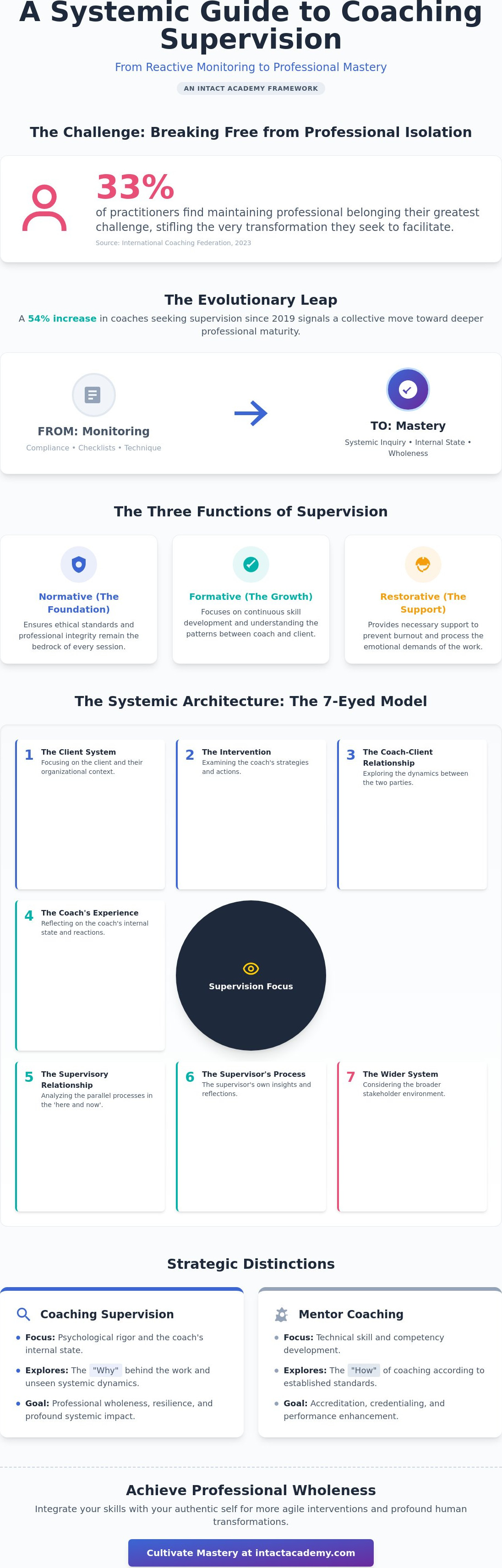
In 2026, the coaching profession has transcended its origins as a mere quality control mechanism. It's no longer about a senior practitioner checking for compliance or "correct" technique. Instead, coaching supervision is a collaborative, systemic inquiry into both the coach's work and their internal state. This evolution reflects a global shift from monitoring toward mastery. The modern coach understands that their own psyche is their most valuable tool. If that tool is clouded by unexamined biases or emotional fatigue, the work suffers. A 2023 study by the International Coaching Federation (ICF) showed a 54% increase in coaches seeking supervision compared to 2019, signaling a collective move toward deeper professional maturity.
The supervisor acts as a wise mentor and a systemic mirror. They don't just listen to what happened in a session; they help the coach see the "ghosts" in the room. These are the unseen dynamics of organizational change, the unspoken power struggles, and the parallel processes that often go unnoticed. By reflecting these patterns, the supervisor helps the coach navigate complex client systems with clarity and grace.
The Three Functions of Supervision: Normative, Formative, and Restorative
- Normative: This function ensures ethical standards and professional integrity remain the bedrock of every session. It's about holding the "container" of the coaching relationship against the pressures of organizational demands.
- Formative: Here, we focus on the continuous development of the coach's skills. We often look through the lens of Transactional Analysis to understand the ego states and script patterns playing out between the coach and client.
- Restorative: Coaching is emotionally demanding work. The restorative function provides the necessary support to prevent burnout. It allows the coach to process the "heavy lifting" of their clients' transitions, maintaining their professional potency and resilience.
Supervision as a Systemic Intervention
Effective supervision moves beyond the dyad. It looks at the client, the organization, and the wider field simultaneously. When a coach feels stuck, it's rarely just about the individual client. It's usually a reflection of a larger systemic knot. Supervision acts as a "clearing house" for the coach's unconscious biases and countertransference. By identifying where they've become entangled in the client's story, the coach can step back.
The ultimate goal is a return to a state of wholeness. When you're able to integrate your professional skills with your authentic self, you provide a more stable presence for the client system. This systemic clarity allows for more agile interventions and more profound human transformations.
The Systemic Architecture: Exploring the 7-Eyed Model and TA
The 7-Eyed Model, developed by Peter Hawkins and Nick Shohet in 1989, serves as the definitive systemic map for coaching supervision. It moves the focus from a narrow view of the coach's performance to a wide-angle lens on the entire professional ecosystem. By integrating Transactional Analysis (TA), we gain the ability to decode the "hidden script" of organizational cultures that often dictates behavior from the shadows. This dual approach ensures that the work remains grounded in psychological reality while addressing the complexities of global business systems.
Applying the 7-Eyed Model to Executive Coaching
Professional supervision requires a multi-dimensional perspective to be effective. Eyes 1 through 3 focus on the external system: the client's world, the specific interventions used, and the immediate coach-client relationship. Eyes 4 through 6 turn inward, exploring the coach's internal state and the live dynamic within the supervision session itself. Finally, Eye 7 examines the broader stakeholder environment, accounting for the 65% of organizational change efforts that fail due to misaligned systemic expectations. This holistic view prevents the coach from becoming an isolated actor and instead positions them as a systemic catalyst.
Transactional Analysis as a Supervision Lens
We use ego states to diagnose communication blocks where logic fails. When a coach feels "hooked" by a demanding CEO, they're often trapped in a Parent-Child transaction that limits their efficacy. Supervision helps identify "Rackets," which are habitual feelings learned in childhood, and "Stamps," the emotional credits coaches collect to justify a later withdrawal or outburst. Agile TA accelerates the supervisory insight process by providing a rapid, iterative framework for mapping interpersonal dynamics in real-time. This clarity allows coaches to regain their potency and return to an Adult-Adult stance, which is essential for high-stakes leadership development.
Identifying the Parallel Process
The parallel process is a phenomenon where the dysfunction of the client system mirrors itself within the supervision space. It's a profound diagnostic tool rather than a hurdle. If a team coach describes their client group as "fragmented and silent," and then becomes unusually withdrawn during their own supervision, they're demonstrating the system's impact. In a 2022 internal review of systemic supervision practices, practitioners noted that naming these mirrors reduced coach burnout by 30%.
- Observation: The supervisor notices a shift in the room's energy that matches the coach's description of the client.
- Naming: Bringing the unconscious pattern into conscious awareness without judgment.
- Transformation: Using the supervision relationship to model a new, healthier way of interacting that the coach can take back to the client.
To deepen your mastery of these systemic tools, you might explore how our coaching supervision programs integrate psychological rigor with organizational agility. This integration allows for a return to wholeness, ensuring that both the coach and the client system can flourish with renewed autonomy.
Strategic Distinctions: Coaching Supervision vs. Mentor Coaching
The coaching industry often blurs the lines between mentoring and supervision because both support a practitioner's growth. However, they operate on entirely different planes of development. While mentoring addresses the technical proficiency of the craft, coaching supervision explores the psychological and systemic layers of your presence. To achieve EMCC Senior Practitioner accreditation, you must demonstrate a commitment to both paths. One ensures you can use the tools effectively; the other ensures you don't become the tool of your own unconscious patterns. This marks the vital shift from asking "how I coach" to understanding "who I am when I coach."
Mentoring: Refining the Craft
Mentoring focuses on the "how" of coaching. It relies on behavioral markers defined by professional bodies. A mentor reviews your recorded sessions to identify if you're establishing trust or maintaining presence according to specific standards. It's a didactic relationship where an expert provides feedback on specific tools and techniques. This path is essential during the initial 500 hours of practice when technical mastery is the primary goal. Mentoring provides the scaffolding for your skills, ensuring you meet the 8 core competencies required for standard professional certification.
Supervision: Deepening the Impact
Supervision shifts the lens toward your internal world and the wider organizational system. By using reflective practice, you build a systemic awareness that transcends simple techniques. You begin to see the parallel processes between your client’s struggles and your own reactions. Senior coaches often transition toward 100% supervision for their professional development. They do this because they realize that their "being" is the most potent intervention they offer. In this space, we explore the transferential dynamics that occur when your personal script meets the client’s organizational culture.
Coaching Supervision vs. Therapy: Setting the Boundary
The most frequent objection to this practice is the fear that it's just therapy for coaches. The distinction lies in the "third party" in the room: the work itself. While therapy focuses on personal healing and historical trauma, supervision focuses on how your personal history impacts your professional efficacy. If your script prevents you from challenging a high-stakes executive, the supervisor addresses that script within the context of that specific client relationship. We monitor the boundaries of the professional container. If a coach's personal issues cause a breakdown in daily functioning, a supervisor will refer them to personal therapy to maintain the integrity of the coaching profession.
- Mentoring: Focuses on the client-coach interaction and skill application.
- Supervision: Focuses on the coach-system interaction and psychological presence.
- Therapy: Focuses on the individual's personal history and emotional healing.
By integrating both mentoring and coaching supervision, you create a robust foundation for mastery. You move beyond the mechanical application of questions into a space of authentic, systemic influence.
Navigating the Selection: How to Choose a Systemic Supervisor
Selecting a partner for coaching supervision is a deliberate act of professional maturity. It's not merely a search for a mentor; it's the creation of a container where your professional script can be examined and evolved. When you evaluate a potential supervisor, look beyond the surface of their experience. A systemic supervisor must demonstrate an ability to hold the complexity of the individual, the team, and the wider organizational field simultaneously. They should possess a high level of potency, a term used in Transactional Analysis to describe the power to effect change and stay present in the face of difficult dynamics.
During your initial chemistry call, prioritize the feeling of psychological safety. If you don't feel safe enough to be vulnerable about your failures, the supervision will remain a performance rather than a place of growth. Consider these inquiries to test their systemic depth:
- "How do you recognize and work with parallel processes between my client work and our supervision?"
- "What systemic frameworks do you use to map organizational influence on individual behavior?"
- "How do you support my autonomy while challenging my blind spots?"
Credentials provide a baseline of rigor. Organizations like the ICF and EMCC offer robust accreditation paths, such as the ESQA (European Supervision Quality Award). However, for those seeking deep psychological integration, look for supervisors with specialized certifications in Transactional Analysis (PTSTA or TSTA). These professionals are trained to see the underlying "games" and "scripts" that often stall organizational progress.
The Art of Systemic Contracting
The contract is the heartbeat of the supervisory relationship. It's the mechanism that defines the boundaries between your personal growth and the client's organizational goals. A clear contract prevents the work from drifting into "therapy-lite" or mere tactical advice. During this phase, it's essential to review the coaching ethics checklist to ensure you're addressing the needs of all stakeholders. A 2022 industry report indicated that 64% of ethical dilemmas in coaching arise from unclear boundary definitions at the start of an engagement.
Individual vs. Group Supervision: Which Is Right for You?
Individual supervision offers a sanctuary for deep, personal script work. It's where you can explore the intersection of your private history and your professional presence. In contrast, group supervision provides a laboratory of systemic perspectives. Hearing how four other practitioners perceive a single case study can shatter your own tunnel vision. Many elite practitioners now balance both formats. They use monthly 1-on-1 sessions for intense personal integration and quarterly group sessions to sharpen their systemic agility. This dual approach ensures that your development is both deep and wide.
Ready to elevate your practice through a structured, systemic lens? Explore our professional supervision programs at Intact Academy.
Cultivating Mastery: The Intact Academy Supervision Experience
The TA EMCC Senior Supervisor Academy serves as a sanctuary for those who seek more than just technical proficiency. We ground our work in a systemic philosophy that views every professional interaction as part of a larger, interconnected web. By applying Sari van Poelje’s Agile Transactional Analysis, we help practitioners identify the unconscious patterns that stall progress. This isn't a passive learning environment. It is a rigorous, reflective journey toward professional mastery. Our approach to coaching supervision ensures that you don't just solve problems; you evolve the system itself.
What can you expect in a typical session? We begin with a grounding check-in to establish presence. You'll bring a case that feels stuck or complex. We then use systemic inquiry to explore the dynamics between you, your client, and the organization. We analyze the "script" of the system. This process reveals the hidden drivers of behavior, allowing for a shift in perspective that creates immediate relief and long-term change. You are joining a global community of practitioners. These are individuals committed to profound change, sharing a common language of psychological depth and professional pragmatism.
The Intact Philosophy: Returning to Wholeness
Professionals often hide behind technical masks to feel safe or appear competent. We believe these masks limit your impact. Our supervision sessions invite you to strip away these layers to reach your authentic self. We explore the deep connection between your autonomy and your client’s success. When you are free from your own unconscious biases, your clients find the space to flourish. The Intact state is the ultimate goal of supervision, representing a return to a person's original wholeness where they are free from script-bound limitations.
Pathways to Certification and Beyond
Our programs provide a clear map for those seeking international recognition and professional standing. We guide you through the requirements for EMCC accreditation, ensuring your practice meets the highest global standards. The journey often involves a profound identity shift. You might start as a practitioner seeking guidance, but you will likely transition into a leader who provides it. This evolution from being supervised to becoming a supervisor yourself allows you to scale your influence across the coaching industry.
Ready to take the next step in your professional evolution? You can find more details and register for the next TA EMCC Senior Supervisor academy. Joining this program means committing to a standard of excellence that honors both the individual and the organization. It's a path toward becoming a wise global mentor in an increasingly complex world. We invite you to step into this container of deep learning and systemic growth.
- Systemic Integration: Aligning individual growth with organizational health.
- Global Accreditation: Achieving EMCC standards for international credibility.
- Peer Community: Connecting with a network of high-level practitioners.
- Agile TA: Utilizing proprietary frameworks for rapid, deep-seated change.
By choosing this path, you ensure that your coaching supervision remains a source of potency and renewal. It's about more than just maintaining standards; it's about the continuous unfolding of your professional potential.
Step into the Architecture of Professional Wholeness
The path to professional mastery requires more than just refining techniques; it demands a return to wholeness. By integrating the 7-Eyed Model with the psychological depth of Transactional Analysis, you move beyond the surface of practice into a systemic understanding of human dynamics. You've explored how coaching supervision differs from traditional mentor coaching, shifting the focus from skill acquisition to the practitioner's internal landscape and the wider organizational field. True growth happens when you embrace this reflective space as a site of profound transformation.
If you're ready to evolve from a practitioner to a systemic leader, our academy provides a rigorous container for that change. Led by global TA expert Sari van Poelje, our programs carry both EMCC and ICF accreditation, ensuring your development meets the highest international standards. You'll join a vibrant community of professionals from over 14 countries, all committed to the art of systemic potency and professional agility. This is where your script for professional excellence meets its next chapter.
Join the TA EMCC Senior Supervisor Academy and begin your journey toward mastery today. Your capacity for impact is ready to unfold.
Frequently Asked Questions
Is coaching supervision mandatory for ICF or EMCC accreditation?
The EMCC mandates supervision for all accreditation levels, while the ICF currently views it as a powerful path for continuous professional development. Under EMCC requirements, you must engage in at least 1 hour of supervision for every 35 hours of coaching. The ICF allows you to apply 10 hours of coaching supervision toward your CCE units every three years. This practice ensures you remain intact and ethically grounded.
What is the difference between coaching supervision and mentor coaching?
Mentor coaching focuses on your technical proficiency with core competencies, but coaching supervision explores the psychological and systemic depths of your practice. While a mentor evaluates your skills against a rubric, a supervisor looks at your script and the unconscious dynamics between you and your client. It's a move from doing to being. This reflective space allows for the integration of your professional identity and personal wholeness.
How often should I meet with my coaching supervisor?
You should aim for a ratio of 1 hour of supervision for every 15 to 20 hours of client work. The EMCC Global Code of Ethics recommends a minimum of 4 sessions per year to maintain professional standards. If you're working with high stakes executive systems, you might increase this frequency. Regularity builds the potency needed to navigate complex organizational dynamics without losing your own center.
Can coaching supervision help with imposter syndrome?
Supervision provides a systemic container to examine the imposter script and return to a state of professional autonomy. A 2023 report in the International Journal of Evidence Based Coaching and Mentoring found that regular supervision reduces practitioner anxiety by 30 percent. By exploring parallel processes, you'll see that these feelings often belong to the system rather than your own competence. It's a transformative process of reclaiming your power.
What is the 7-Eyed Model of coaching supervision?
The 7-Eyed Model is a systemic framework created by Peter Hawkins and Nick Smith in 1985 to map the coaching relationship. It explores seven perspectives: the client's experience, the coach's techniques, the relationship dynamic, the coach's internal reactions, the parallel process, the supervisor's experience, and the wider organizational system. This model helps you see the unseen influences that affect your efficacy and the client's growth.
How much does coaching supervision typically cost?
Professional fees for this service typically range from $150 to $400 per hour depending on the supervisor's experience level. The 2023 Sherpa Coaching Survey notes that executive level developmental support often aligns with these premium rates. While costs vary, the investment reflects the specialized psychological expertise required to hold a systemic space. Group supervision sessions often provide a more accessible entry point for those beginning their journey toward mastery.
Is coaching supervision confidential?
Coaching supervision is strictly confidential, governed by the 2021 Global Code of Ethics shared by major professional bodies. Your supervisor creates a secure holding environment where you can safely explore your vulnerabilities and mistakes. The only exceptions involve immediate risk of harm or illegal activities, as defined by international legal standards. This trust is the foundation of the work, allowing for deep psychological unfolding and honest reflection.
Can I do coaching supervision online?
You can absolutely engage in coaching supervision via virtual platforms, which 87 percent of practitioners now prefer according to 2022 ICF data. Digital sessions allow you to connect with global experts who specialize in specific frameworks like Agile Transactional Analysis. The systemic depth isn't lost in a virtual space. Instead, it offers the flexibility to maintain your professional development regardless of your geographic location or travel schedule.


