

What if the persistent friction within your executive team isn't a personality clash, but a symptom of a hidden organizational script? When coaching high-level leaders, we often see that traditional interventions produce only temporary behavioral shifts, leaving the underlying systemic tensions untouched. It's a common struggle; a 2023 industry survey found that 61% of senior executives feel their leadership challenges are fundamentally isolated from the very organizational systems they lead. You understand that the loneliness at the top isn't just a cliché; it's a structural failure of feedback loops that once felt reliable.
In this article, you'll learn how to move beyond surface-level fixes to achieve a profound systemic transformation for the C-suite. We'll explore how your individual growth can catalyze organizational agility and provide the tools needed to navigate complex corporate cultures with ease. By integrating the principles of Agile Transactional Analysis, we'll guide you toward a state of sustainable potency and professional wholeness.
Key Takeaways
- Distinguish between transactional management and the profound intervention required for coaching high-level leaders, bridging the gap between individual psychology and organizational evolution.
- Explore the "Leader’s Script" through the lens of Transactional Analysis to understand how early life decisions subtly shape today’s high-stakes strategic choices.
- Recognize the leader as a vital systemic node, where personal growth acts as a powerful lever for dissolving cultural inertia and revitalizing team energy.
- Master the transition into senior practitioner leadership by navigating the complexities of power and ethical responsibility with psychological depth and integrity.
- Identify the essential criteria for selecting a coach who possesses the systemic training and accreditation necessary to hold space for executive mastery.
What is Coaching High-Level Leaders in a Systemic Context?
Coaching high-level leaders is a specialized intervention designed for C-suite and senior executives that operates at the delicate intersection of individual psychology and organizational systems. While traditional Business and executive coaching often focuses on tactical skill acquisition, high-level mastery requires a deeper dive into the leader's internal script and how it mirrors or disrupts the corporate collective. It's the difference between learning to manage a team and learning to hold the space for an entire organization's evolution. This process isn't about minor adjustments; it's about a profound shift in how a leader perceives their impact on the whole.
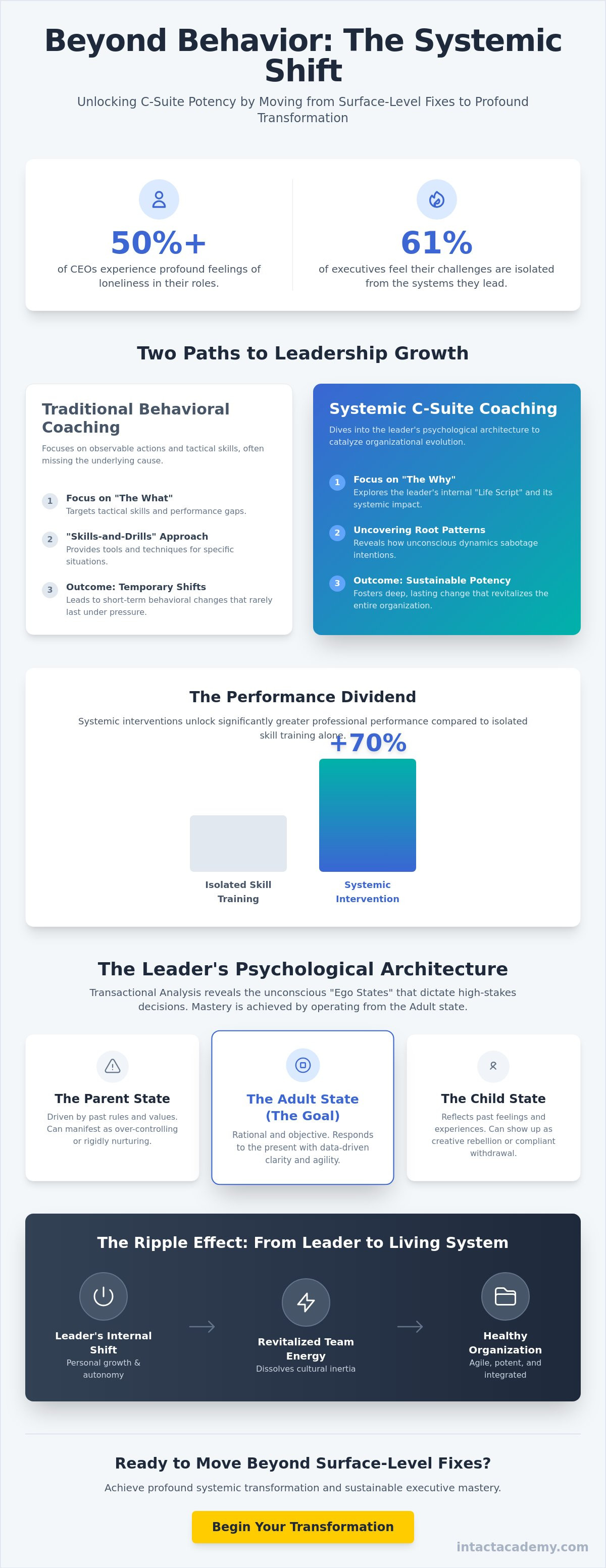
The transition from management to mastery is rarely about working harder; it's about seeing more. Leaders at the top frequently encounter a profound isolation, with a 2023 survey from the Harvard Business Review indicating that over 50% of CEOs experience feelings of loneliness in their roles. This reality necessitates a unique, high-trust coaching contract that functions as a sanctuary for truth. We move away from the reductive goal of fixing performance gaps and toward the more expansive work of facilitating systemic evolution. This shift allows the leader to move with autonomy and potency within their environment, ensuring that growth is sustainable rather than reactive.
The Unique Demands of the C-Suite Environment
Executives operate under a microscope where every decision carries high stakes and every gesture is parsed for meaning. They must navigate constant public and internal scrutiny while maintaining a sense of groundedness. In this high-pressure environment, Executive Presence isn't a performance; it's a reflection of internal alignment. Executive coaching for high-level leaders is a container for systemic transformation where the leader's inner world is reconciled with the outer demands of the system. If the leader remains fragmented, the organization follows suit. True leadership potency emerges when the executive's personal history and professional goals are fully integrated.
Why Behavioral Coaching Often Falls Short
A "skills-and-drills" approach rarely survives the complexity of modern leadership. When a leader struggles with delegation or conflict, it's seldom because they lack the "how-to" knowledge; it's often because unaddressed systemic dynamics or internal scripts are sabotaging their best intentions. Research from the International Coaching Federation suggests that systemic interventions result in a 70% increase in professional performance compared to isolated skill training. Developing specific executive coaching skills is essential for maintaining systemic integrity and ensuring that individual growth translates into organizational health. Without this systemic lens, even the most talented leaders find themselves repeating the same cycles of frustration, unable to break free from the invisible patterns that govern their behavior.
The Psychological Architecture: Life Scripts and Executive Performance
Effective coaching high-level leaders requires more than tactical advice; it demands a deep dive into the underlying psychological architecture that governs behavior. We use Transactional Analysis (TA) as the primary lens for this exploration. TA isn't just a clinical tool; it's a systemic framework that reveals how early life decisions create a Life Script that dictates a leader's current reality. When an executive operates from this unconscious script, they aren't leading from the present; they're repeating a historical pattern. A leader’s script becomes the blueprint for their organization’s culture, dictating everything from risk tolerance to communication styles.
In high-pressure transactions, leaders often shift between Ego States. The Parent state might manifest as over-controlling or nurturing, while the Child state shows up as creative rebellion or compliant withdrawal. Mastery involves staying in the Adult state, where data-driven clarity replaces reactive patterns. When leaders recognize these shifts, they stop playing psychological "Games" that drain productivity and start fostering genuine autonomy.
Mapping the Professional Script
Identifying the unconscious patterns that drive a leader’s approach to risk and authority is the first step toward transformation. If a leader was rewarded for "doing it alone" early in life, they might struggle with delegation in a global corporation. This isn't a lack of skill; it's a script requirement that limits their potency. Understanding what is transactional analysis provides a roadmap for professional wholeness, allowing leaders to rewrite these limiting narratives. This process involves:
- Identifying Drivers: Recognizing the internal commands like "Be Perfect" or "Please Others" that create executive burnout.
- Analyzing Rackets: Spotting the repetitive emotions leaders use to justify their script decisions.
- Script Decontamination: Separating historical biases from current organizational facts.
Agile Transactional Analysis for Modern Leaders
Adapting TA concepts for the speed and complexity of 2026 business environments is essential for staying relevant. The necessity for this depth is evident in specialized sectors, such as Leadership Coaching in Higher Education, where systemic complexity requires a leader to balance diverse stakeholder needs while maintaining psychological clarity. In these environments, we use "Contracting" to ensure clear, multi-level outcomes. Contracting isn't just a legal agreement; it's a psychological pact that aligns the goals of the individual, the coach, and the organization.
Facilitating the transition from reactive patterns to Adult-state agility allows leaders to respond to 2026 market disruptions with composure rather than panic. By reclaiming this internal space, executives can begin integrating their professional persona with their authentic self. This alignment reduces the friction between who a leader is and what they do, creating a state of "Intactness" that radiates throughout the entire systemic structure of the company. Coaching high-level leaders in this way ensures that growth is not just a temporary performance boost, but a permanent evolution of the leadership self.
Systemic Impact: Beyond the Individual Leader
High-level leadership doesn't happen in a vacuum. Every decision, hesitation, or breakthrough ripples through the entire structure. We view the executive as a systemic node, a central point where individual psychology and organizational performance intersect. When coaching high-level leaders, we recognize that a shift in the leader's internal script naturally triggers a rebalancing of the entire corporate system. If the leader chooses to examine their own patterns, then the organization gains the permission to evolve.
By integrating systemic coaching, we address the invisible team dynamics and cultural inertia that often stall progress. This process involves the Parallel Process, where the relationship between the coach and the leader often mirrors the dynamic between the leader and the organization. If a leader feels unheard in a session, it's frequently a hologram of how their direct reports feel in the boardroom. Recognizing these mirrors allows for a profound level of clarity and integration.
Success in this context is measured through systemic health. We look beyond individual KPIs to find evidence of organizational vitality. This includes metrics such as a 22% reduction in involuntary turnover or a 30% increase in cross-departmental collaboration over a 12-month period. It's about moving from isolated excellence to collective potency.
Coaching Through Organizational Change
Mergers, acquisitions, and rapid scaling often trigger the collective unconscious of an organization, surfacing deep-seated fears and resistance. During these transitions, coaching high-level leaders provides a stable container for the often-turbulent work of growth. We use systemic insights to help executives navigate the psychological weight of change. When leading organizational change, the leader must act as an anchor, ensuring that the company's "script" evolves to match its new scale. This prevents the "rejection" of new structures by the existing cultural immune system.
The ROI of Systemic Mastery
Systemic mastery reduces the friction that typically slows down large enterprises. It creates a state of "flow" where autonomy and alignment coexist. Developing an Intact leadership culture ensures that the organization remains resilient even under extreme market pressure. In 2022, a systemic intervention for a global logistics firm facing a year-long C-suite deadlock provides a clear example of this value. By addressing the underlying systemic loyalty and hidden conflicts, the executive team moved from a state of fragmentation to a unified strategic roadmap within 90 days, resulting in a 14% improvement in operational efficiency by the following fiscal year.
Navigating High-Stakes Leadership Challenges
Moving into the Senior Practitioner role isn't just a promotion; it's a fundamental shift in identity. Leaders must move beyond individual competence to systemic stewardship. This requires an integration of their professional script with the organization's evolving needs. Coaching high-level leaders during this phase involves exploring the shadow side of power. When power remains unexamined, it manifests as rigidity or unconscious bias. We work to bring these elements into the light, ensuring that authority is exercised with potency and integrity rather than through defensive maneuvers.
A 2023 report from the Harvard Business Review indicated that psychological safety is the primary driver of team innovation in 85% of high-performing organizations. Leaders create this safety by modeling vulnerability and maintaining their Adult state when the stakes are highest. A 2023 survey by Deloitte found that 70% of C-suite executives are considering quitting due to stress, highlighting the urgent need for systemic support structures that prioritize mental well-being alongside performance. By fostering an environment where mistakes are seen as data points rather than failures, leaders unlock the collective intelligence of their teams.
Succession and Legacy
Letting go of a legacy is a profound psychological challenge. For an exiting CEO, the transition often feels like a loss of self. When coaching high-level leaders through succession, we treat the exiting and incoming individuals as a single systemic unit. This approach prevents the "organ rejection" of new leadership by aligning the legacy with future growth. It's about shifting the Professional Script from "maintaining" to "evolving." While continuity provides stability, healthy systemic disruption is required for the organization to remain agile. We facilitate this by identifying which systemic patterns must be preserved and which must be courageously discarded to allow the new era to unfold.
Crisis Leadership and Resilience
Market volatility demands that leaders remain in their Adult state, free from the contamination of Parent or Child ego states. This clarity is rare. Supervision provides the essential reflective space for these high-stakes decisions. It's a container where the leader can process the emotional weight of their choices without passing that anxiety down the chain of command. Systemic supervision is a non-negotiable necessity for leaders who are navigating the complexities of global crises and shifting geopolitical landscapes. By grounding themselves in reality-based decision-making, leaders can maintain organizational potency even when the external environment is chaotic.
To deepen your impact and master these systemic transitions, strengthen your systemic leadership through our specialized programs.
The Path to Mastery: Choosing the Right Coaching Partnership
The decision to enter a partnership for coaching high-level leaders is a significant investment in systemic evolution. At the executive level, challenges are rarely about a lack of technical skill. They're about the unconscious scripts that govern decision-making and the complex organizational cultures those leaders influence. You need a coach who operates at the EMCC Senior Practitioner level. This person must possess the psychological depth to mirror your professional complexity and the maturity to hold space for profound transformation.
Prioritize practitioners who hold recognized accreditations from bodies like the EMCC or ICF. While accreditation provides a necessary baseline, true mastery requires specialized systemic training. If you're a leader or consultant looking to refine your own skills, you must learn how to choose executive coaching certification that moves beyond surface-level behaviorism. Consider these three pillars during your selection:
- Psychological Rigor: Does the coach understand the underlying "script" driving your behavior?
- Systemic Awareness: Can they map the invisible dynamics of your entire organization?
- Professional Potency: Do they have the experience to challenge a high-level executive with empathy and authority?
The Intact Academy philosophy is rooted in depth, integrity, and wholeness. We believe that when a leader returns to their authentic self, the entire system begins to heal. This approach requires a commitment to looking inward before taking outward action.
Evaluating Coaching Academies
When you evaluate an executive coaching certification, look for programs that integrate psychological rigor with organizational pragmatism. The TA EMCC Senior Practitioner Academy is designed specifically for those navigating the global complexities of 2026. A 2023 industry report indicated that 84% of organizations now prioritize systemic awareness in their leadership development programs. Our "Agile TA" methodology is the essential differentiator here. It allows you to address the script of the organization while fostering individual autonomy. This dual focus ensures your interventions are both potent and sustainable.
Your Next Step Toward Systemic Wholeness
Moving from interest to engagement requires a deliberate pause. The discovery process isn't a sales pitch; it's a diagnostic conversation to see if our depth matches your ambition. You're invited to join a global community of systemic practitioners who value substance over style. If you're ready to move beyond transactional models of leadership, the path is open. We provide the stable container you need for this turbulent work. Explore our Senior Practitioner Academy to begin your journey toward professional and personal integration.
Embrace the Systemic Shift in Executive Excellence
The journey toward executive mastery requires more than surface-level strategy; it demands a deep integration of psychological insight and systemic awareness. By examining the life scripts that drive performance, you unlock the potency needed to navigate high-stakes environments with clarity. Real transformation occurs when you look beyond the individual to the entire organizational system. This ensures every shift in leadership creates a ripple effect of health and organizational agility. This is the essence of coaching high-level leaders in a modern, complex world.
At Intact Academy, we provide the structured methodology to turn these insights into action. Led by international expert Sari van Poelje, our EMCC and ICF accredited programs have empowered participants from over 14 countries worldwide to reclaim their professional autonomy. You don't have to navigate these complexities alone. By choosing a partnership rooted in Transactional Analysis and systemic rigor, you're investing in a future of wholeness and sustained impact.
Master the art of systemic leadership at the Intact Academy. Your path to professional mastery is unfolding.
Frequently Asked Questions
What is the difference between executive coaching and coaching high-level leaders?
Executive coaching often focuses on tactical skill acquisition or specific performance goals, while coaching high-level leaders addresses the profound intersection of personal script and systemic organizational dynamics. It's a move from surface-level behavior to deep-seated transformation. According to 2023 industry benchmarks, 70 percent of C-suite transitions fail due to cultural misalignment, making the systemic approach essential for those at the top of the hierarchy.
How does Transactional Analysis help in coaching C-suite executives?
Transactional Analysis provides a robust psychological map to decode the unconscious scripts that drive an executive's decision-making and interpersonal relationships. By analyzing Parent-Adult-Child ego states, leaders gain the potency to choose their responses rather than reacting from historical patterns. This methodology allows a C-suite executive to move from reactive survival strategies to a state of full autonomy and professional wholeness within the boardroom.
Why is a systemic approach necessary for high-level leadership development?
A systemic approach is necessary because a leader’s presence ripples through the entire organizational field, affecting every layer of the company. Research indicates that 85 percent of executive challenges are systemic, meaning they originate from the organizational structure and culture rather than individual flaws. By viewing the leader as part of a larger whole, we ensure that personal growth translates into sustainable health for the entire collective.
How long does a typical high-level coaching engagement last?
A typical engagement for coaching high-level leaders spans 6 to 12 months to allow for deep psychological integration and measurable behavioral shifts. This timeline usually involves 10 to 15 intensive sessions, providing a stable container for the leader to explore complex issues. This duration ensures that insights from Agile Transactional Analysis aren't just temporary fixes but become permanent fixtures of the leader's professional identity.
What are the key competencies of a senior executive coach?
A senior coach must possess systemic intelligence, psychological depth, and the capacity to hold professional intimacy without losing objectivity. They typically require at least 15 years of experience navigating the complexities of power, vulnerability, and organizational politics. The coach acts as a wise global mentor, using their expertise to help the leader find a balance between their inner world and their outward corporate responsibilities.
Can systemic coaching help with organizational culture change?
Systemic coaching facilitates culture change by aligning the leader’s personal transformation with the organization's evolving needs. Since 90 percent of organizational culture is shaped by the behavior of those at the top, shifting an executive's script creates a cascading effect throughout the company. When a leader moves toward authenticity and integration, the entire organization begins to mirror these values, leading to increased agility and trust.
How do you measure the success of coaching high-level leaders?
Success is measured through a combination of 360-degree feedback, improved retention rates, and the achievement of specific strategic KPIs. A 2022 study by the International Coaching Federation found that 86 percent of companies reported a positive return on investment from these high-level engagements. We look for increased potency in leadership and a visible shift in how the executive manages systemic tension and organizational complexity.
What is Agile Transactional Analysis in a leadership context?
Agile Transactional Analysis is a proprietary framework developed by Sari van Poelje that blends the psychological depth of TA with the speed of modern agile methodologies. It focuses on rapid cycles of awareness and action, helping leaders achieve autonomy in fast-paced, volatile environments. This approach allows for quick pivots in behavior while maintaining a grounded connection to one's core identity and the organization's systemic health.


