

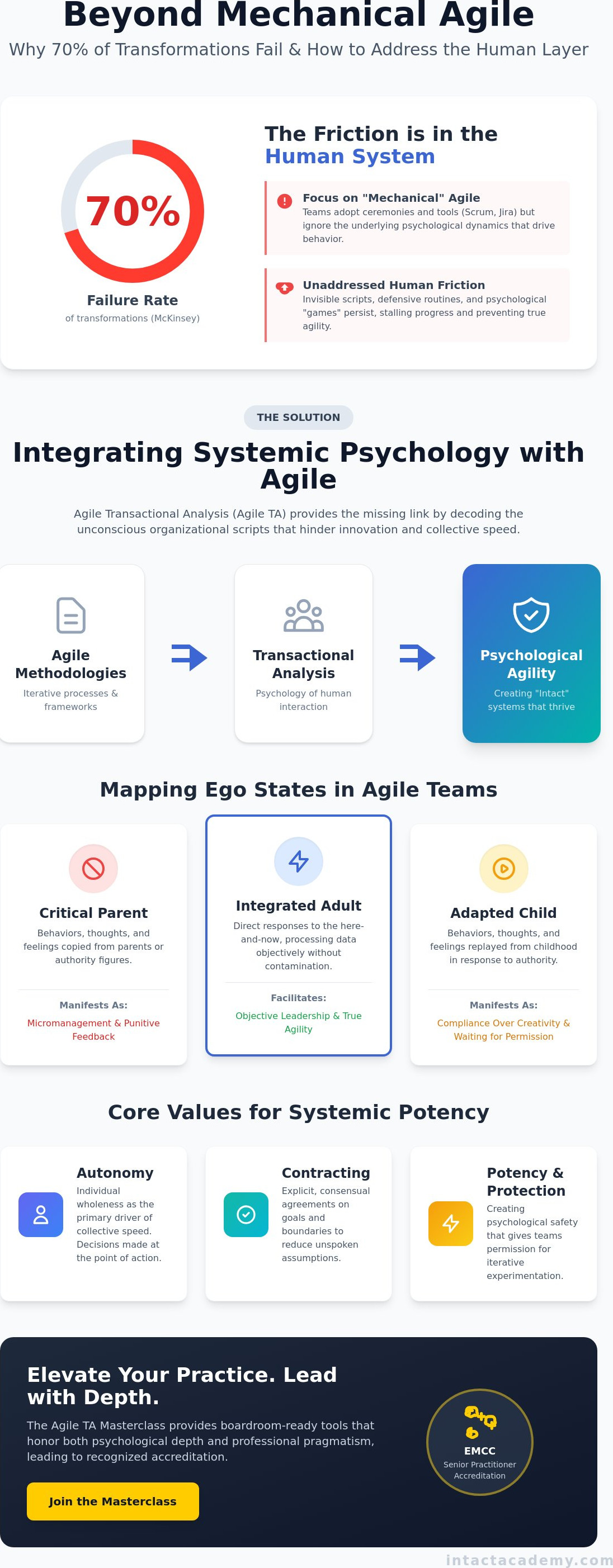
Why do we continue to treat organizational change as a mechanical puzzle when the friction is almost always found in the invisible scripts of human interaction? You've likely seen it happen; a team adopts every ceremony of Scrum, yet the same 70 percent failure rate for transformations reported by McKinsey persists because the underlying psychological dynamics remain unaddressed. If you've felt the limits of surface-level coaching, the agile ta masterclass offers a path toward systemic potency. It's a space where we move beyond the mechanical and into the realm of profound human transformation.
We understand that true agility isn't about faster delivery; it's about the autonomy and integration of every individual within the system. You already know that technical frameworks are only as effective as the people who inhabit them. By joining this masterclass, you'll gain a proprietary toolset to decode organizational scripts and facilitate lasting change. We'll guide you through the integration of Transactional Analysis and Agile methodologies, preparing you for EMCC-recognized accreditation while returning your practice to a state of wholeness and professional excellence.
Key Takeaways
- Discover why traditional Agile often fails at the human layer and how the integration of systemic psychology provides the missing link for profound organizational transformation.
- Master the proprietary frameworks taught in the agile ta masterclass to diagnose the unconscious organizational scripts that currently hinder innovation and collective speed.
- Learn to identify and resolve the "psychological games" within Scrum ceremonies, shifting team dynamics from reactive patterns toward a state of autonomy and wholeness.
- Explore the path to EMCC Senior Practitioner accreditation, equipping yourself with boardroom-ready tools that honor both psychological depth and professional pragmatism.
Redefining Agility: Why Transactional Analysis is the Missing Link
Agile TA represents a profound integration of systemic psychology and iterative organizational change. It moves beyond the surface level of process improvement to address the underlying structures of human interaction. While the 17th State of Agile Report (2023) indicates that 71% of organizations use Agile for software development, many struggle to see meaningful cultural results. This failure occurs at the human layer. We often see mechanical agility, where teams use tools like Jira or Kanban, yet remain stuck in rigid, defensive behaviors. True psychological agility requires an understanding of ego states and the underlying scripts that dictate how people interact under pressure.
In this agile ta masterclass, we explore how to create "Intact" systems. These are environments where individual autonomy isn't sacrificed for the sake of the collective. Instead, it becomes the primary driver of speed. When individuals operate from a place of wholeness, the organization moves with a natural, unforced momentum. If we ignore the psychological underpinnings of our teams, we're simply rearranging the furniture in a burning house. Success requires us to look inward before we attempt to scale outward.
The Evolution of Organizational Change
Transformation has shifted from the linear Waterfall models of the 1990s to systemic, iterative models. This evolution requires more than a new project management framework; it demands a map for the unconscious patterns in corporate culture. By using Transactional Analysis, leaders can identify the repetitive "games" that stall progress. The coach functions as a systemic facilitator. They don't just fix problems; they help the system see itself. This visibility allows for a genuine unfolding of potential rather than a forced march toward a KPI.
Core Values of Agile Transactional Analysis
The engine of any agile ta masterclass is the Adult ego state. This is the part of our personality that processes data in the here and now, free from the prejudices of the Parent or the archaic fears of the Child. Autonomy must always take precedence over protocol. We also apply TA contracting to every feedback loop. This ensures that expectations are clear and consensual, reducing the noise of unspoken assumptions. Finally, we prioritize potency and protection. By creating psychological safety, we give teams the permission they need for iterative experimentation. Without protection, innovation is just a dangerous word. With it, it becomes a predictable outcome of a healthy system.
- Autonomy: Decisions made at the point of action.
- Contracting: Explicit agreements on goals and boundaries.
- Potency: The power to effect change without fear of reprisal.
The Psychological Architecture of an Agile TA Masterclass
An agile ta masterclass functions as a systemic intervention into the collective psyche of an organization. At Intact Academy, we utilize proprietary frameworks to move beyond surface-level ceremonies, focusing instead on the underlying currents that dictate how people relate to power, change, and one another. This masterclass provides the tools to diagnose the invisible structures that either facilitate or stifle systemic agility. By integrating high-level theoretical frameworks with direct, actionable directives, leaders learn to observe the organization as a living, breathing entity that requires psychological safety to thrive. When a leader recognizes the connection between individual autonomy and organizational potency, the path to transformation becomes clear.
Mapping Ego States in Agile Teams
In rigid hierarchies, the "Critical Parent" ego state often dominates, manifesting as micromanagement and punitive feedback loops that stifle innovation. Conversely, teams under extreme pressure may retreat into the "Adapted Child" state, where compliance replaces creativity and up to 70% of team members might wait for permission before taking any initiative. By applying the rigorous standards of the International Transactional Analysis Association, practitioners learn to facilitate a shift toward an integrated state. This involves balancing the protective qualities of the Parent with the spontaneous, creative energy of the Child. The Integrated Adult is the primary state for Agile leaders, acting as the objective processing center that integrates historical experience with present-moment reality. Moving a team into this state requires a deliberate focus on transparency and shared responsibility.
Breaking the Organizational Script
Organizations often operate under unconscious "scripts," which are repetitive patterns or life plans formed early in a company's history. Scripts such as "Don’t Succeed" or "Don’t Be Important" frequently manifest as project bottlenecks or a sudden loss of momentum just before a major release. When you understand what is transactional analysis in a systemic context, you gain the potency to rewrite these narratives. In our agile ta masterclass, we provide the methodology to identify these scripts during the diagnostic phase of a transformation. If a leadership team recognizes a "Don't Be Important" script, they can intentionally shift toward a culture of visibility and radical autonomy. This process of unfolding allows the organization to return to a state of wholeness and authenticity. You may find that engaging with our professional development curriculum provides the necessary container for this deep, reflective work.
Beyond Scrum: Solving the "Human Bug" in Agile Transformations
Standard Agile certifications often treat organizations like machines, focusing on the mechanics of Jira boards or the cadence of ceremonies. They assume that if you fix the process, the people will follow. Yet, data from the 15th State of Agile Report suggests that 46% of organizations struggle with culture as a barrier to success. When a transformation stalls, it isn't usually because the Scrum Master forgot the 15-minute rule; it's because the underlying psychological script remains unchanged. This agile ta masterclass moves beyond surface-level tweaks. It targets the "human bug", those unconscious patterns that bypass even the most rigorous frameworks.
Identifying Psychological Games in Agile
During backlog grooming, you might witness the "Yes, But" game. A developer agrees to a user story but immediately lists three reasons why it's impossible. This isn't just technical feedback; it's a move to maintain a passive-aggressive status quo. In the agile ta masterclass, we learn to pivot these transactions back to Adult-Adult communication. We also analyze the "Victim-Rescuer-Persecutor" triad that plagues many teams. In this drama, a Product Owner might "rescue" a team from a heavy load, only to "persecute" them later for missed deadlines. Breaking this cycle requires a clear contract. Coaches must stop the game by naming the dynamic and returning to the professional boundaries established in the initial agreement.
- The "Yes, But" Pivot: Acknowledge the "Yes" and ask for the specific Adult-level resource needed to eliminate the "But".
- Triad Awareness: Identify when a team member is inviting you into a Rescuer role and decline the invitation to maintain their autonomy.
- Contractual Return: Use the Retrospective to revisit the "Social Contract" of the team, ensuring all transactions remain overt and professional.
Leading Through Systemic Resistance
Resistance isn't a sign of failure. It's a protective mechanism for the organizational system. Sari van Poelje’s systemic lens teaches us that when we push for change, we often trigger the system's survival instinct. If we ignore this, we risk creating systemic trauma that lingers for years. Mastery involves leading organizational change by acknowledging the past before demanding the future.
Leaders must "hold the space" during the messy middle of a transition. This means staying present and grounded while the team's old identities dissolve. It isn't about rushing to the next Sprint; it's about ensuring the team feels safe enough to be vulnerable and, eventually, truly agile. Deep systemic intervention requires us to look at the "script" of the entire department. If the organization has a history of punishing failure, no amount of Scrum ceremonies will create psychological safety. We must address the systemic permission to fail before we can expect the system to innovate.
Curriculum of Mastery: What to Expect from the Masterclass
The journey toward systemic agility requires more than a collection of tools; it demands a fundamental shift in how you perceive organizational life. This agile ta masterclass is structured as a 12-month developmental container. It bridges the gap between sophisticated psychological theory and the pragmatic demands of the executive suite. You won't just learn about systems. You'll learn to feel their pulse and intervene with precision.
The curriculum moves through three distinct phases of evolution. Each phase builds upon the last, ensuring that your growth is both integrated and sustainable. We prioritize depth over speed. We value the "aha" moment that changes a consultant's career forever.
Modules and Learning Outcomes
Module 1: Advanced TA Foundations for Organizational Systems. We begin by deconstructing the organizational script. You'll analyze the unconscious patterns that dictate how a company breathes and reacts. By applying the 10-step developmental model to your current clients, you'll identify where autonomy is blocked and where potency can be restored. This isn't basic theory; it's the surgical application of TA to complex hierarchies.
Module 2: Agile Frameworks through a Psychological Lens. Most Agile transitions fail because they ignore the human script. In this module, we examine Scrum, Kanban, and Holacracy through the lens of ego states and transactions. You'll learn why certain teams resist self-organization and how to resolve the underlying "games" that sabotage 85% of transformation efforts. We focus on creating psychological safety that's rooted in structural clarity.
Module 3: Systemic Intervention and Transformation Design. The final module focuses on the architecture of change. You'll design a comprehensive intervention strategy for a live organizational challenge. We explore how to maintain your own "OK-OK" position while standing in the center of systemic turbulence. You'll leave with a boardroom-ready toolkit for leading 21st-century transformations.
The Intact Academy Learning Experience
We believe that true mastery happens in the presence of others. Our cohorts are strictly limited to 12 senior professionals. This small-group intimacy ensures that every voice is heard and every systemic knot is untangled. You'll benefit from the collective wisdom of peers who face similar high-stakes challenges in global markets.
Central to this experience is the direct mentorship of Sari van Poelje. Her decades of experience as a systemic coach and executive provide a bridge between the classroom and the real world. You won't just study her methodology; you'll see it in action during live supervision sessions. Bring your most difficult consultancy projects. We'll examine them together, applying the agile ta masterclass principles to find the "lever" that moves the entire system.
This program serves as a rigorous foundation for those pursuing the TA Master Practitioner level. It’s designed for the professional who is ready to move beyond transactional coaching into the realm of profound, systemic transformation. You'll emerge with the confidence to lead, the skill to heal, and the vision to see what others miss.
Elevating Your Practice with EMCC Senior Practitioner Accreditation
Professional mastery is not a destination but a continuous unfolding of potency and presence. As you integrate the principles of the agile ta masterclass, your ability to influence organizational scripts moves from tactical intervention to systemic transformation. By 2026, industry projections suggest that 85% of high-level executive contracts will require systemic certification, making this level of expertise the undisputed gold standard for those operating at the board level. This training provides the intellectual rigor and emotional depth needed to meet that demand.
Accreditation and Global Recognition
The curriculum aligns with the rigorous competencies set by the EMCC and ICF, ensuring your development meets the highest international benchmarks. Completing a Sari van Poelje TA training provides more than just theoretical knowledge; it offers a recognized credential that signals your capacity to handle complex human dynamics in high-stakes environments. This path facilitates your transition toward EMCC Senior Practitioner or Senior Team Coach levels by providing the deep reflective practice required for advanced accreditation. To ensure your progress is documented accurately, the academy provides structured guidance on documenting your practice hours and case studies, supporting your portfolio development for formal accreditation.
Joining a Global Community of Systemic Leaders
True autonomy thrives in connection. When you join this program, you enter an international network of alumni spanning over 14 countries, creating a rich tapestry of cultural and organizational insights. This community serves as a stable container for your continued growth, offering a space where the profound concepts of Transactional Analysis remain actionable and relevant. You'll gain access to ongoing supervision and specialized masterclasses that prevent professional stagnation and maintain your edge in a volatile market. The agile ta masterclass is an invitation to return to wholeness while sharpening your professional tools. It's a commitment to your own evolution as a leader and a mentor.
The next cohort represents an opportunity to move beyond surface-level coaching into the realm of profound systemic impact. The journey requires courage, depth, and a willingness to look inward before leading others. Secure your place in the next Agile TA Masterclass and begin your journey toward mastery today.
Stepping into Your Systemic Potency
True organizational agility isn't found in a handbook; it's forged in the psychological scripts that define how we interact. By integrating Transactional Analysis with Agile frameworks, you address the human architecture that either sustains or sabotages change. You've explored how moving beyond surface-level Scrum requires a deep dive into systemic autonomy and the courage to rewrite collective patterns. This journey toward professional wholeness is led by Sari van Poelje, a world-renowned TA expert who has guided leaders across more than 14 countries toward profound transformation. It's a process of returning to authenticity while maintaining rigorous professional standards.
When you choose to enroll in the agile ta masterclass, you're not just attending a workshop. You're entering an EMCC and ICF accredited program designed to elevate your practice to the level of EMCC Senior Practitioner. This curriculum bridges the gap between high-level theory and direct, punchy action. It's time to move past the "human bug" and start fostering a culture where growth feels natural and sustainable. Your evolution from a practitioner to a systemic master begins with a single, intentional step.
Join the Agile TA Masterclass at Intact Academy
The path to authentic leadership is open, and we're ready to walk it with you.
Frequently Asked Questions
What exactly is an Agile TA Masterclass and how does it differ from a Scrum Master course?
An agile ta masterclass differs from a Scrum Master course by focusing on the psychological architecture of systems rather than procedural mechanics. While Scrum optimizes workflows, this masterclass explores the unconscious scripts and ego states that drive human behavior within those workflows. You'll learn to navigate the hidden dynamics that often derail technical agility, moving from surface-level process to deep systemic transformation.
Who is the ideal candidate for this masterclass?
The ideal candidate is a senior leader, organizational consultant, or executive coach with at least 5 years of professional experience. We find that participants who manage complex human systems thrive most in this environment. If you're seeking to move beyond transactional coaching into the realm of systemic potency, this program provides the intellectual rigor and practical tools to facilitate that evolution.
Can I earn EMCC or ICF credits by completing the Agile TA program?
You can earn 40 Continuing Coach Education (CCE) units for ICF or equivalent EMCC credits upon completing the program requirements. These credits reflect the high standard of training and the 60 hours of structured learning you'll undergo. This certification ensures your professional development aligns with global standards while you master the unique lens of systemic Transactional Analysis.
Do I need prior experience in Transactional Analysis to join?
You don't need prior knowledge of Transactional Analysis to join the foundational sessions of the agile ta masterclass. We integrate the essential TA 101 concepts into the curriculum, ensuring every participant builds a solid theoretical base. This approach allows you to apply concepts like the Drama Triangle or life scripts to your professional context immediately, regardless of your previous psychological training.
Is the masterclass delivered online or in person at the Utrecht campus?
Our masterclass is delivered through a sophisticated online learning environment, though we host specific 3-day intensives at our Utrecht campus. This hybrid approach allows 100% of our global cohort to participate in live, interactive sessions while offering the option for deep, in-person integration. You'll engage in real-time supervision and peer practice that mirrors the intimacy of a physical classroom.
How does the Agile TA lens help with organizational culture change?
The Agile TA lens facilitates culture change by identifying the unconscious organizational scripts that prevent 70% of change initiatives from succeeding. By analyzing the transactions between departments and leaders, you'll pinpoint the exact systemic blocks to autonomy and growth. This method replaces vague cultural goals with precise interventions, allowing for a more authentic and sustainable transformation within the collective.
What is the duration and time commitment required for the program?
The program spans 6 months, requiring a commitment of approximately 6 hours per month for live modules and peer coaching. Each of the 12 sessions is designed to be a deep dive into specific systemic issues, balanced with practical application in your current workplace. This steady rhythm ensures you have the space to integrate new insights without overwhelming your existing professional responsibilities.
Are there specific prerequisites for the Senior Practitioner level training?
To enter the Senior Practitioner level, you must have completed the Foundation modules or provide evidence of 100 hours of prior Transactional Analysis training. This ensures all participants share a common vocabulary and a baseline of psychological safety. We've designed this prerequisite to maintain the depth of inquiry necessary for the advanced systemic work we perform at this level.


