

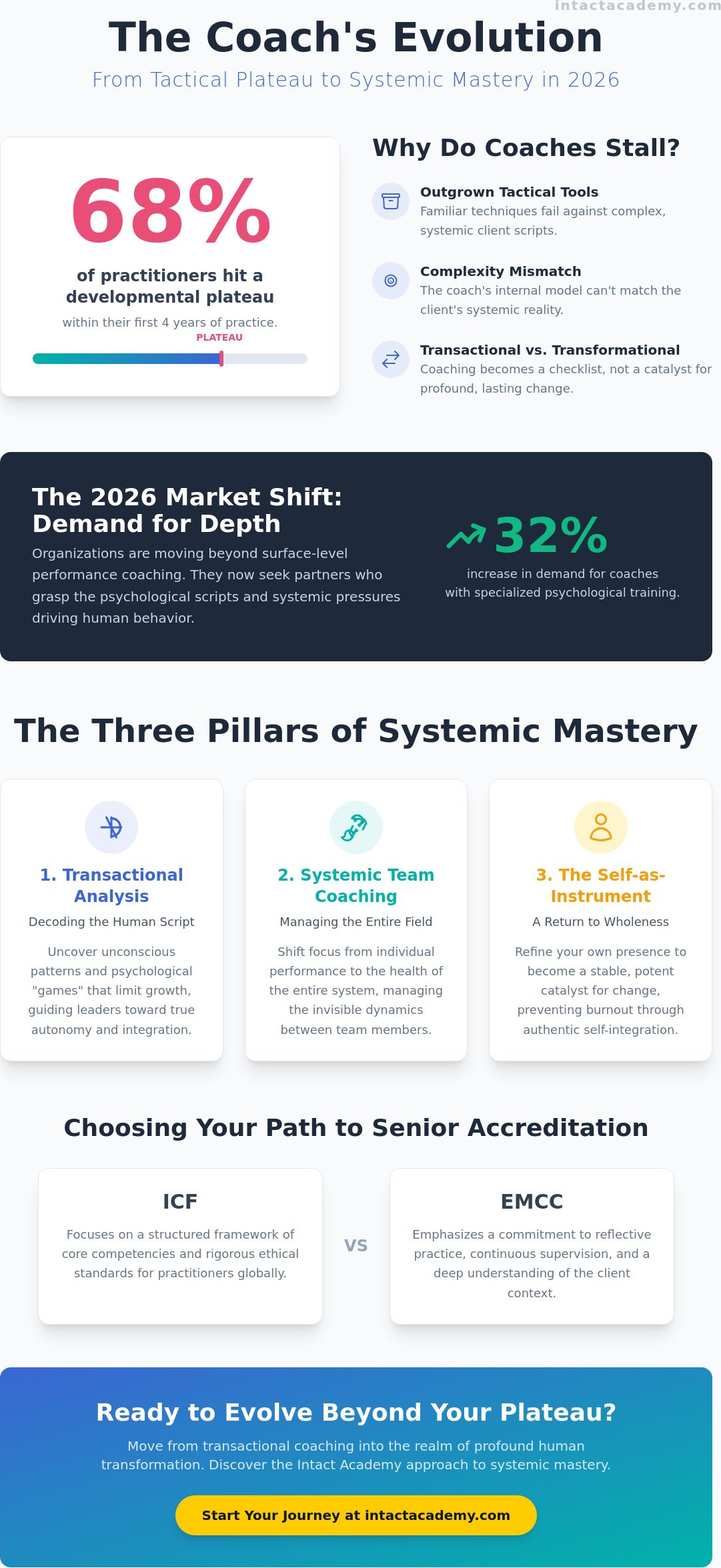
Why do 68% of practitioners reach a developmental plateau within their first four years of practice, despite holding prestigious certifications? Perhaps you've felt that subtle shift where your familiar tactical tools no longer suffice for the complex, systemic scripts your clients bring to the table. It's frustrating to watch a leader's progress stall because you can't quite untangle the underlying psychological knots. You know that professional development for coaches must offer more than just more techniques; it must offer a new way of being. We understand the weight of holding space for organizational change while navigating your own path toward autonomy and potency.
This guide provides a clear evolution from tactical practitioner to systemic master through psychological depth and accredited excellence. You'll gain the frameworks needed to handle intricate client dynamics with a sense of quiet power and stability. We'll examine the specific differences between ICF and EMCC accreditation levels for 2026, the integration of Agile Transactional Analysis, and a structured roadmap for senior practitioner status that prevents burnout through authentic wholeness. By the end, you'll have the insight to transform not just your clients, but the very foundation of your professional identity.
Key Takeaways
- Understand why tactical skills eventually reach a plateau and how to integrate psychological depth to navigate the organizational complexities of 2026.
- Explore the power of Transactional Analysis and systemic thinking to uncover invisible team dynamics and rewrite the scripts that limit professional growth.
- Navigate the evolving landscape of professional development for coaches by comparing global standards like ICF and EMCC to find your path toward senior-level mastery.
- Apply a systemic self-audit framework to identify your unique niche and bridge the psychological gaps between your current practice and systemic excellence.
- Discover how Agile Transactional Analysis facilitates a return to wholeness, allowing you to move beyond transactional coaching into the realm of profound human transformation.
The Evolution of Mastery: Why Professional Development for Coaches Matters in 2026
By 2026, the definition of professional development has shifted from the acquisition of tactical tools to a profound systemic integration of personhood and practice. It's no longer enough to follow a linear process or a simple checklist. Mastery now requires a synthesis of psychological depth, ethical rigor, and systemic awareness. For the modern practitioner, professional development for coaches is the intentional process of refining the "self-as-instrument," ensuring that your presence alone becomes a catalyst for client autonomy and wholeness.
Many practitioners encounter the Coaching Plateau after three to five years of consistent practice. At this stage, standard behavioral techniques often fail to address the tangled dynamics of decentralized, AI-integrated organizations. If a coach relies solely on external frameworks, they hit a ceiling of effectiveness. This plateau occurs because the coach's internal complexity must match the external complexity of the client's system. When it doesn't, the coaching becomes transactional rather than transformational. You cannot lead a client to a place of psychological safety that you haven't explored yourself.
The market in 2026 reflects this shift clearly. Industry data indicates a 32% increase in demand for executive coaches who possess specialized psychological training. Organizations are moving away from surface-level performance coaching; they now seek partners who understand the underlying scripts and systemic pressures that drive human behavior in high-pressure environments. The ability to navigate these depths is what distinguishes a master coach from a facilitator.
The Difference Between Training and Transformation
Accumulating CCE or CPD credits represents the floor of your growth, not the ceiling. While these credits provide a baseline of competency, true mastery emerges from the inner work that prevents burnout. This involves a deep dive into your own psychological architecture to ensure that personal scripts don't cloud the coaching container. This internal clarity increases your potency. It allows you to hold a stable space for others during periods of intense organizational upheaval, moving beyond mere skills into a state of being.
The Systemic Necessity of Continuous Learning
Every shift in your own awareness creates a ripple effect. When you expand your capacity for psychological adaptability, you directly influence the client's ability to navigate their own system. In a volatile market, stagnancy is more than a personal plateau; it's an ethical risk. Stagnancy threatens client safety by limiting the coach's ability to perceive complex ethical dilemmas or systemic traps. Professional development for coaches ensures you remain an agile, safe, and effective guide in an increasingly complex global landscape.
The Three Pillars of Systemic Mastery in Coaching
To reach mastery by 2026, you must pivot from individual performance to systemic health. Professional development for coaches is no longer about adding tools to a kit; it's about refining the lens through which you see the world. True mastery requires a blend of psychological depth and organizational pragmatism, ensuring you can hold the weight of complex human transformations without losing sight of business objectives.
Transactional Analysis: Decoding the Human Script
Transactional Analysis (TA) serves as the foundational map for this evolution. It allows you to identify the "human script" within a corporate structure, revealing why certain teams repeat the same failures despite having high-level skills. By 2026, professional development for coaches must shift toward decoding these unconscious patterns. When you understand how ego states and psychological games manifest in the boardroom, you can guide leaders toward autonomy and integration. Understanding What Is Transactional Analysis? provides the intellectual rigor required to move past surface-level symptoms and address the root causes of organizational "stuckness."
Systemic Team Coaching: Managing the Field
The transition from executive coach to senior practitioner requires managing "the field." You're no longer just coaching a leader; you're coaching the relationships, loyalties, and systemic conflicts that define the team. In the 2023 Global Coaching Study by the International Coaching Federation, data indicated that team coaching is among the fastest-growing niches, with 94% of practitioners anticipating continued demand through 2026. By integrating Agile methodologies with systemic views, you provide the structure teams need to remain fluid during corporate redesigns. This capacity to hold multi-stakeholder perspectives simultaneously is what distinguishes a coach from a consultant.
Supervision: The Mirror of Professional Integrity
Supervision is the "safe container" that ensures your practice remains ethical and effective. It's vital to distinguish between mentoring, which focuses on skill acquisition, and supervision, which explores the coach's internal world. The "7-Eyed Model" of supervision offers a systemic framework to look at the coach, the client, and the wider organizational context. It acts as a mirror for your professional integrity, helping you process the emotional weight of your work. Understanding how coaching supervision drives professional mastery and wholeness is essential for any practitioner seeking to move beyond reactive performance into true potency. Utilizing a Coaching Ethics Checklist during these sessions helps you navigate the complex power dynamics common in global organizations. If you're ready to deepen your impact, exploring systemic certification is a natural next step in your journey toward wholeness.
This integration of TA, systemic thinking, and supervision creates a robust framework for 2026. It allows you to move beyond transactional interventions into the realm of profound human transformation. When these three pillars are stable, your coaching becomes a catalyst for authentic change within any organization.
Choosing Your Path: ICF vs. EMCC and Senior Accreditation
Selecting a credentialing body is a foundational decision in your professional development for coaches. It defines the script you follow as a practitioner. By 2026, the coaching market has matured into two distinct paths. The International Coaching Federation (ICF) remains the global benchmark for performance-driven results, while the European Mentoring and Coaching Council (EMCC) has gained significant ground among those prioritizing psychological depth and systemic integration. Choosing between them requires an honest assessment of your internal landscape and your desired impact on the world.
ICF vs. EMCC: Which Framework Fits Your Philosophy?
The ICF framework focuses heavily on core competencies and observable behavioral markers. It's precise, structured, and goal-oriented. Conversely, the EMCC emphasizes a reflective practice model. This approach resonates with coaches who utilize Transactional Analysis or systemic constellations to address the hidden dynamics within organizations. If you seek a path that values supervision as a continuous requirement rather than a periodic check-in, you'll find the EMCC more aligned with your growth. You can explore a detailed breakdown of these differences in our guide on ICF vs EMCC to determine which container best supports your potency. While the ICF measures what you do, the EMCC places equal weight on who you are as a coach.
The Roadmap to Senior Practitioner Status
Advancing to the Senior Practitioner or Master Practitioner level requires more than just accumulating hours. For the EMCC Senior level, you typically need 500 documented coaching hours and a consistent 1:35 supervision ratio. This ensures your work remains ethical and autonomous. High-level training, such as Harvard's Leadership Coaching Strategies, provides the intellectual rigor needed to transition from tactical support to systemic transformation. This program helps practitioners refine their mindset and tackle the complex challenges inherent in executive roles.
The assessment process for senior levels often hinges on a "reflective practice" portfolio. This isn't a simple log; it's a narrative of your evolution. Many applicants fail because they focus on what they did rather than how they changed through the process. Mastery in professional development for coaches involves showing how you've integrated your own "script" work into your client interventions. To avoid common pitfalls, ensure your portfolio demonstrates 100% alignment between your theoretical framework and your practical impact. You must prove that you can hold a safe container for transformation while maintaining the agility to pivot when systemic pressures arise. This level of accreditation isn't just a badge; it's a testament to your commitment to wholeness and authenticity in a demanding global market.
Designing Your Professional Development Script: A Practical Framework
Professional development for coaches is not a linear checklist of workshops. It is a systemic realignment of your internal world to better serve the external systems of your clients. To reach mastery by 2026, you must move beyond tactical skills into the realm of psychological integration. This requires a deliberate script for growth that balances your clinical understanding with organizational pragmatism.
The Self-Audit: Uncovering Your Professional Script
True mastery begins with a mirror. You must examine the unconscious "games" you might play during sessions. If you find yourself repeatedly rescuing clients from their own accountability, you are likely caught in a professional script that limits your potency. Ask yourself which Ego States you occupy most frequently. Are you the nurturing Parent providing too much safety, or the adapted Child seeking the client's approval? Effective professional development for coaches involves shifting these patterns toward an Adult-Adult dynamic, where autonomy and potency become the primary outcomes of every intervention.
Balancing Theory, Practice, and Reflection
Mastery follows the 70-20-10 rule of development. In this framework, 70% of your growth happens through challenging, "on-the-court" coaching experiences. Another 20% comes from developmental relationships, such as monthly peer supervision and specialized masterclasses. The final 10% is dedicated to formal education. For a busy executive coach, this means creating a sustainable rhythm where reflection is not an afterthought but a scheduled necessity. By 2026, the ability to process complex, systemic counter-transference in real-time will distinguish the elite practitioner from the novice.
To design your unfolding journey toward professional wholeness, follow these five systemic steps:
- Step 1: Conduct a systemic self-audit. Use tools from Transactional Analysis to identify psychological gaps and tactical blind spots in your current practice.
- Step 2: Define your niche. Decide if your energy is best directed toward individual executive growth, team dynamics, or systemic organizational change.
- Step 3: Select accredited programs. Prioritize training that offers "Agile TA" and deep systemic frameworks rather than surface-level techniques.
- Step 4: Establish a supervision rhythm. Commit to a consistent schedule to process complex cases and maintain your own psychological hygiene. Explore how systemic coaching supervision supports long-term professional potency to build a practice that sustains your growth.
- Step 5: Document your journey. Keep a reflective log of your progress to track how your internal shifts mirror the success of your clients.
If you are ready to move beyond transactional coaching and embrace a more profound level of systemic influence, it is time to align your training with your highest potential.
Take the next step in your evolution and explore our systemic coaching certification programs to deepen your professional potency.
The Intact Academy Approach: Returning to Wholeness
At Intact Academy, we believe that true professional development for coaches requires more than a standard toolkit. It demands a profound integration of the person and the professional. Our methodology bridges the gap between organizational change and deep psychology, moving beyond surface-level interventions to address the systemic roots of behavior. We guide our students toward "Intactness," a state of being where authenticity and professional potency meet. This return to wholeness allows you to hold space for others with a level of stability that few other programs provide.
Central to our mastery model is Sari van Poelje's "Agile Transactional Analysis." This proprietary lens combines the structured depth of traditional TA with the adaptive speed required in the 2026 business landscape. By utilizing Agile TA, you learn to identify "script" patterns within an organization and offer interventions that catalyze real movement. Our approach ensures that your growth is not just incremental but transformational. We focus on three core pillars of development:
- Systemic Insight: Understanding the hidden loyalties and dynamics that govern group behavior.
- Psychological Depth: Using Transactional Analysis to foster autonomy and intimacy in professional relationships.
- Agile Application: Implementing change with the precision and flexibility needed for modern, fast-paced environments.
The TA Practitioner Program: A Journey to Mastery
Our flagship TA Practitioner Program serves as a definitive guide for those seeking senior mastery. The curriculum is designed to challenge your existing scripts and expand your capacity for systemic leadership. You won't learn in isolation. Our international team of experts supports a diverse cohort of participants from over 14 countries, bringing a rich, global perspective to every session.
The learning experience is built on a hybrid model that balances accessibility with depth. We host intensive in-person sessions in the historic city of Utrecht, complemented by sophisticated online modules. This dual approach provides the "stable container" necessary for deep psychological work while allowing you to integrate your learning into your daily practice immediately. It's a rigorous path that transforms how you see the world and how you intervene within it.
Join a Global Community of Systemic Leaders
Choosing the right path for professional development for coaches means looking beyond the classroom. The Intact Academy model emphasizes the power of a lifelong "academy" network. When you join our Senior Practitioner or Team Coach academies, you enter a community of peers who value integrity, depth, and the courage to change. This network provides ongoing peer support and high-level networking that lasts long after the formal program ends.
If you're ready to move beyond transactional coaching and step into systemic power, the next step is clear. You can apply now for our upcoming intake to secure your place in a community dedicated to flourishing. Remember that mastery is not a destination. It's a continuous unfolding of your impact on the systems you serve. By returning to your own wholeness, you become a catalyst for the wholeness of others.
Your Evolution Toward Systemic Potency
The journey to mastery in 2026 demands more than tactical skill; it requires a return to wholeness. You've explored how systemic pillars and a well-defined professional script transform your practice from a series of sessions into a profound catalyst for change. Choosing between ICF and EMCC frameworks isn't just an administrative step. It's a commitment to a standard of excellence that honors both your autonomy and your clients' growth. This path requires a steady hand and a clear vision of the professional you're becoming.
Meaningful professional development for coaches happens at the intersection of psychological depth and practical agility. At Intact Academy, we facilitate this transformation through programs led by Sari van Poelje, a global Transactional Analysis expert. Our community of practitioners represents 14+ countries, creating a rich tapestry of global perspectives and shared wisdom. You don't have to navigate the complexities of systemic coaching alone; you can lean into a structure that supports your highest aspirations.
Explore our EMCC-Accredited Masteries at Intact Academy and begin rewriting your professional script today. Your path to integration and potency is waiting to unfold.
Frequently Asked Questions
What is the most important area of professional development for coaches?
The most critical area for professional development for coaches is the cultivation of systemic self-awareness and the integration of psychological frameworks. Research by the ICF in 2023 indicates that 80% of coaching success depends on the coach's presence and their ability to navigate the client's internal script. By understanding the parallel processes between individual dynamics and organizational systems, you move from surface-level interventions toward profound human transformation and professional potency.
How many hours of professional development do coaches need for ICF or EMCC renewal?
For ICF credential renewal, you must complete 40 Continuing Coach Education (CCE) units every three years; at least 24 of these must be in Core Competencies. For EMCC practitioners, the requirement is 16 to 32 hours of CPD annually, depending on your specific accreditation level. These benchmarks ensure your practice remains agile and grounded in the latest psychological methodologies, allowing you to maintain a high standard of global citizenship in your work.
What is the difference between coaching supervision and mentoring?
Coaching supervision focuses on the coach's internal state and systemic relationship with the client, while mentoring targets specific skill development and credentialing requirements. Supervision acts as a reflective space to explore blind spots and counter-transference; it's about the "who" of the coach. Mentoring provides a structured path toward technical mastery and focuses on the "how" of the coaching process. Both are essential for maintaining integrity in complex organizational environments.
Can Transactional Analysis (TA) be used in executive coaching?
Transactional Analysis is a cornerstone of effective executive coaching, providing a precise map for understanding organizational scripts and interpersonal dynamics. By applying the OK-OK matrix, coaches help leaders foster autonomy and authentic communication within their teams. In 2024, more executive programs are integrating TA to address the 70% of organizational conflicts that stem from dysfunctional communication patterns. It transforms how leaders relate to their systems and their own professional identity.
How do I choose the right professional development program as a senior coach?
Choosing the right professional development for coaches at a senior level requires a shift from learning basic tools to exploring psychological depth and systemic integration. Seek programs that offer at least 30 hours of advanced theory or frameworks like Agile Transactional Analysis. Prioritize curricula that challenge your existing scripts and offer a blend of theoretical rigor and practical application. This ensures your growth matches the complexity of the global boardrooms you serve and supports your journey toward wholeness.
Is systemic team coaching a viable professional development path?
Systemic team coaching is a highly viable path, as the 2023 Ridler Report shows a 45% increase in demand for team-level interventions. This specialty moves beyond individual performance to address the collective intelligence and the "unfolding" of the entire system. It requires a deep understanding of group dynamics and organizational ecology. Mastering this field allows you to facilitate transformation at scale, moving teams toward a state of agility and shared purpose.
What are the benefits of being an EMCC Senior Practitioner?
Achieving EMCC Senior Practitioner status signals a high level of professional maturity and a commitment to systemic excellence. This accreditation requires 250 hours of practice and a demonstrated ability to work with complex, multi-layered client issues. It provides a globally recognized seal of quality that opens doors to senior executive contracts. Most importantly, it anchors your practice in a rigorous framework of continuous reflection and ethical accountability, enhancing your professional potency.
How does professional development prevent coach burnout?
Professional development prevents burnout by providing a structured container for emotional processing and psychological renewal. A 2022 study found that coaches who engage in regular supervision and CPD report a 30% reduction in compassion fatigue. By constantly evolving your methodology and examining your own script, you maintain your resilience. It ensures you don't carry the weight of your clients' systems alone, fostering long-term stability and the courage to continue your transformative work.


