

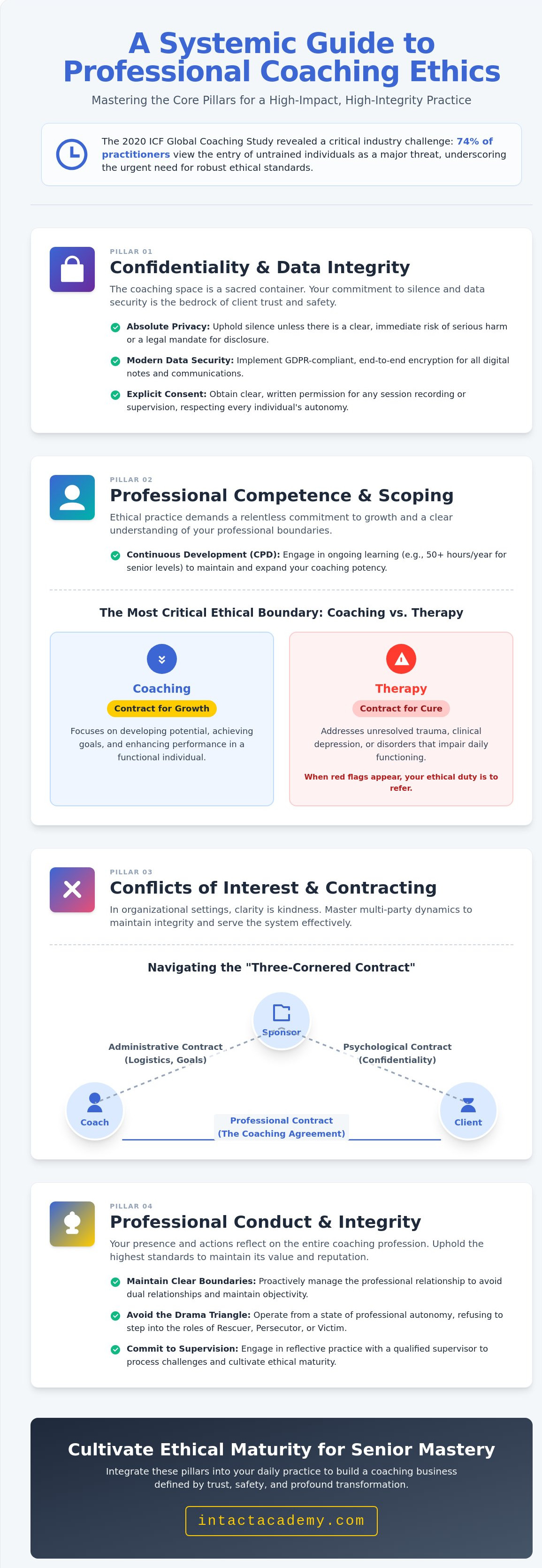
What if the very empathy that makes you a gifted coach is also the greatest risk to your professional integrity? In the 2020 ICF Global Coaching Study, 74% of practitioners identified the entry of untrained individuals as a major hurdle, highlighting the urgent need for defined professional standards. Mastering coaching ethics isn't merely a box-ticking exercise for accreditation. It's a commitment to developing the systemic maturity required to hold space for an individual's script while respecting the organizational context.
You already know that the most profound human transformations happen within a container of absolute safety and clarity. It's the foundation of your potency as a leader and a mentor. This article provides the structural methodology you need to master essential ethical standards and psychological boundaries for a high-impact practice. We'll walk through a clear, systemic framework for navigating "grey area" dilemmas, ensuring you meet the rigorous requirements of the EMCC and ICF with unwavering confidence.
Key Takeaways
- Establish a foundation of professional integrity by applying a systemic 10-point checklist that transcends mere rules to ensure deep client safety.
- Uncover the psychological scripts that lead to boundary crossing, learning to navigate the Drama Triangle to maintain a state of professional autonomy.
- Integrate the essential pillars of coaching ethics into your daily practice, ensuring your work remains a potent container for human transformation.
- Resolve the inherent tensions of multi-party contracting by mastering the "Three-Cornered Contract" between the sponsor, the client, and the coach.
- Cultivate the ethical maturity required for senior mastery through the reflective practice of professional supervision and systemic integration.
What is Coaching Ethics? Beyond the Code of Conduct
Coaching ethics represents more than a static list of rules pinned to a digital wall; it's the living application of moral principles within a professional relationship. At its core, coaching ethics ensures the safety of the client while maintaining the integrity of the coach. When we operate with ethical potency, we create a secure container where transformation becomes possible. This isn't just about avoiding malpractice. It's about honoring the autonomy of the individual and the health of the systemic script they inhabit. When we examine the foundational Coaching Ethics and Standards, we see that integrity is the bedrock of professional efficacy.
Ethics matter because they protect three distinct entities: the client, the coach, and the broader coaching industry. A single breach doesn't just harm one person; it ripples through the organizational system, reinforcing unhealthy patterns and diminishing the collective reputation of our craft. We must distinguish between ethics and professional standards. Standards focus on competence and "how" we work. Ethics focus on the "why" and the values that guide our presence. If a coach is competent but unethical, they possess power without conscience, which is a dangerous combination for human development.
From a systemic perspective, your ethical behavior impacts the entire organizational "script." If you collude with a leader's avoidant behavior, you aren't just failing a session; you're validating a culture of bypass. Authentic coaching requires the courage to maintain boundaries even when it's uncomfortable. This commitment to wholeness is what allows a coach to remain a "clear mirror" for the client's unfolding potential.
The Evolution of Ethical Standards in 2026
By 2026, the integration of AI into coaching has fundamentally shifted the landscape of confidentiality. Coaches now manage complex data ethics, ensuring that digital "shadows" of sessions don't compromise client privacy. Simultaneously, diversity, equity, and inclusion (DEI) have moved from optional frameworks to core ethical mandates. We're also seeing a significant move toward global alignment. Major bodies like the ICF and EMCC are converging on a unified framework to provide a consistent experience for global citizens navigating professional change.
Coaching vs. Therapy: The Most Important Ethical Boundary
The most critical coaching ethics challenge is recognizing the boundary between developmental coaching and clinical therapy. We must identify "red flags" such as clinical depression, unresolved trauma, or personality disorders that require a "Contract for Cure" rather than our "Contract for Growth." If a client's struggle prevents them from functioning in their daily life, the ethical responsibility is clear: a professional referral is required. Safely transitioning a client to a therapist isn't a sign of failure; it's an act of deep empathy and professional maturity that honors the client's path to wholeness.
The Professional Coaching Ethics Checklist
Ethical coaching isn't just about avoiding harm. It's about creating a professional container where transformation can safely unfold. For practitioners pursuing EMCC Senior Practitioner accreditation, ethics move from a passive set of rules to an active, systemic practice. This checklist helps you audit your coaching ethics through the lens of the "Four Pillars": Confidentiality, Competence, Conflicts, and Conduct.
Pillar 1: Confidentiality and Data Integrity
In 2026, the digital footprint of a coaching relationship requires more than a simple password. True integrity means managing data with the same care we manage a client's vulnerability. You're ethically bound to "break the seal" only when there's a clear risk of serious harm to the client or others, or when legal mandates require disclosure. Beyond these rare moments, the silence of the coaching space is absolute.
Modern data management demands GDPR compliance that includes end-to-end encryption for all session notes and recorded materials. When engaging in "shadow coaching" or recording sessions for supervision, you must obtain explicit, written consent from every individual in the room, not just the primary coachee. This honors the systemic field and ensures that the power dynamics of the organization don't override individual autonomy.
Pillar 2: Professional Competence and Scoping
A coach's potency is limited by their commitment to their own growth. Maintaining coaching ethics requires a dedicated mandate for Continuous Professional Development (CPD), often exceeding 50 hours annually for senior practitioners. It's an ethical violation to coach outside your area of expertise; if a client's needs shift from organizational strategy to deep clinical trauma, the ethical move is a referral, not an attempt to "figure it out."
Representing your credentials with radical honesty is the foundation of trust. This means being clear about what you can and cannot do, aligning your practice with the International Coaching Federation Code of Ethics. We don't just sell results; we offer a disciplined, professional relationship built on verified experience.
- Do you have a written contract that explicitly defines the limits of confidentiality?
- Is your data storage for 2026 fully encrypted and separate from personal files?
- Have you scheduled at least four supervision sessions for the coming year?
- Can you clearly articulate the boundary between your coaching and therapy?
- Do you disclose all potential conflicts of interest to the client and the sponsor?
- Is your marketing material 100% free of exaggerated claims or unverified outcomes?
- Do you have a pre-vetted list of mental health professionals for referrals?
- Are you honest about your specific training hours and accreditation level?
- Do you seek feedback from clients on the "psychological safety" of the sessions?
- Do you have a formal process for closing or transitioning a relationship that is no longer productive?
If you're ready to move toward a more integrated, systemic approach to your practice, consider how EMCC Senior Practitioner accreditation can provide the structure your professional evolution requires.
Navigating Complex Ethical Dilemmas with Transactional Analysis
Ethical breaches rarely happen in a vacuum. They often emerge from the hidden psychological undercurrents that influence our daily interactions. By applying a Transactional Analysis lens, we can see how unconscious patterns compromise the professional relationship. One significant risk involves the Drama Triangle, a model developed by Stephen Karpman in 1968. In this dynamic, a coach might slip into a "Rescue" behavior. While it feels helpful, this behavior creates dependency and crosses the boundaries of professional coaching ethics. When we rescue, we inadvertently treat the client as though they're not capable, stripping them of their autonomy.
To maintain a clean contract, coaches must also identify "Psychological Games." Drawing from Eric Berne's 1964 research, these are repetitive sequences of transactions that lead to a predictable, negative emotional payoff. If a coach finds themselves in a cycle of "Yes, But" with a client, the ethical path is to name the dynamic rather than offering more advice. This transparency preserves the integrity of the work. At its core, maintaining an "I'm OK, You're OK" stance serves as the ethical foundation for autonomy. It ensures that both coach and client are viewed as whole, potent, and responsible for their own change.
The Ethics of Power and Influence
The coaching relationship contains an inherent power imbalance that requires constant monitoring. Coaches must stay vigilant about when their guidance shifts from support to an imposition of personal values. Using TA "Ego States" helps maintain a professional Adult-to-Adult relationship. If a coach operates from a "Nurturing Parent" or "Controlling Parent" state, they risk inviting the client into a "Child" state. This stifles growth. Staying aligned with the ICF Code of Ethics ensures that the coach respects the client's right to self-determination. Key practices include:
- Monitoring the "Parent" ego state to avoid moralizing.
- Inviting the client's "Adult" to lead the decision-making process.
- Recognizing when your personal "Script" demands that you be the expert.
Transference and Counter-Transference
Clients often project past "scripts" onto their coaches, a process known as transference. An ethical coach recognizes these projections without becoming entangled in them. Equally important is managing counter-transference, which involves the coach's own emotional triggers in response to the client. The 2021 update to global ethical standards emphasizes that self-awareness is the ultimate tool for the systemic coach. It allows you to discern between your own history and the client's current needs. When you manage your internal triggers, you provide a stable container for the client's transformation. This level of self-regulation is what distinguishes a professional practitioner from an amateur. It ensures that coaching ethics remain a lived practice rather than a static list of rules.
The Ethics of Multi-Party Contracting in Organizations
Navigating the "Three-Cornered Contract" requires a high degree of systemic awareness. In this triad, the coach, the individual client, and the sponsoring organization form a complex web of expectations. Maintaining coaching ethics in this space means ensuring every party understands their role before the first session begins. A 2022 study by the International Coaching Federation indicated that 28% of practitioners find multi-party contracting to be their most frequent ethical hurdle. To manage this, you must establish a clear "Contract for Change" that defines success for both the system and the individual.
- The Administrative Contract: Discuss logistics, fees, and boundaries with the organizational sponsor.
- The Professional Contract: Define the psychological boundaries and goals with the client.
- The Psychological Contract: Address the unspoken expectations and hidden agendas between all three parties.
Ethical reporting is the most common point of friction. You can share process data, such as attendance or high-level progress toward predefined milestones. You can't share the specific content of sessions. If a sponsor demands details that infringe on the client's autonomy, your loyalty must remain with the psychological safety of the coaching space. Transparency is your primary tool for resolving the tension between organizational goals and individual needs. It's about creating a container where transformation can happen without the fear of surveillance.
Transparency in Corporate Engagements
Defining "who is the client" is often the first test of your professional integrity. While the organization pays the invoice, the individual sitting across from you is the primary focus of transformation. If a sponsor's agenda seeks to "fix" a person rather than support their growth, it compromises their potency. You must act as a systemic neutral, holding the tension of the organization's needs without sacrificing the client's right to their own script. This balance ensures the engagement leads to authentic wholeness rather than mere compliance.
Conflict of Interest: Spotting and Resolving
Conflicts often emerge in subtle ways. You might find yourself coaching two executives who are competing for the same C-suite role. In a 2021 survey of executive coaches, 15% reported stepping away from contracts due to such overlaps. If you feel your neutrality is compromised, you have an ethical obligation to disclose the conflict. Developing a formal Conflict of Interest Policy helps you decide when to decline a lucrative engagement. Protecting the integrity of the work is always more valuable than the fee itself. It's a matter of maintaining your professional standing and the trust of the system.
Integrating Ethics into Your Path to Coaching Mastery
Ethical maturity is the true marker of a senior practitioner. It moves beyond checking boxes or following a static code of conduct; it becomes a lived experience of integrity. This deep integration of values is why ethical development sits at the heart of the TA Practitioner Program. We don't just ask what you do. We ask who you are becoming as you hold space for others. This evolution requires a shift from following external rules to cultivating an internal compass that can withstand the pressures of complex organizational systems.
The Importance of Supervision
Supervision is a non-negotiable ethical requirement for any serious professional. It serves as a mirror, reflecting the unconscious biases and "grey area" dilemmas that inevitably arise in coaching ethics. You don't have to carry the weight of complex human dynamics alone. Coaching supervision provides the psychological safety to explore these moments without judgment. It also protects you from the silent creep of burnout. By processing the emotional residue of your clients' scripts, you maintain the potency required for long-term impact. Industry surveys from 2023 indicate that 85% of coaches who engage in regular supervision report increased confidence and significantly better client outcomes.
Handling an ethical breach requires a disciplined protocol of reflection, repair, and reporting. If a boundary is crossed, you must first look inward to understand the systemic pressure that led to the lapse. Repair involves an honest, transparent dialogue with the client to restore the contract and the trust. If the situation warrants, reporting to professional bodies ensures the safety of the wider community. This practice builds a "systemic conscience." You start to see how your presence influences the entire field, allowing you to lead with a clear vision of your long-term impact as a mentor and guide.
Committing to Wholeness and Autonomy
At Intact Academy, we link coaching ethics directly to our core philosophy of returning to a state of wholeness. An ethical coach doesn't impose their will or try to "fix" the client. Instead, they facilitate the client's journey toward autonomy and authenticity. You serve as a model of ethical behavior within a systemic organizational context, showing others that it's possible to be both powerful and principled. This isn't a surface-level fix; it's a deep transformation that ripples through every level of an organization.
Your path to mastery is an unfolding process of integration and agility. By committing to these standards, you ensure that your practice remains a safe container for profound human change. Join the academy to deepen your ethical and systemic impact. Let's work together to create a more conscious world where every individual has the space to flourish.
Cultivate Your Systemic Ethical Presence
Professional integrity isn't a static destination; it's a continuous unfolding of awareness. By moving beyond a basic code of conduct and applying Transactional Analysis to multi-party contracting, you protect the autonomy of every individual within the system. This systemic framework ensures your coaching ethics remain robust, even when organizational scripts create pressure to compromise. True potency comes from your ability to stay grounded while navigating these complex human dynamics. You've now seen how a structured checklist transforms abstract values into actionable professional boundaries.
Mastery requires a container that honors both psychological depth and professional pragmatism. Our curriculum, led by Sari van Poelje, integrates 35 years of systemic expertise into a program accredited by both the EMCC and ICF. If you're ready to evolve your practice and embrace the courage to change, we invite you to take the next step in your professional journey. Deepen your ethical mastery in our TA EMCC Senior Practitioner Academy and return to a state of professional wholeness. Your path toward profound transformation starts with a single, conscious choice.
Frequently Asked Questions
What are the 4 main ethical principles of coaching?
The 4 main ethical principles of coaching are autonomy, beneficence, non-maleficence, and justice. These pillars ensure you respect the client's agency while striving to do good and avoid harm. In professional coaching ethics, justice requires you to treat all individuals with fairness and impartiality. By following the 2021 Global Code of Ethics standards, you maintain a systemic balance that supports the client's journey toward wholeness and psychological autonomy.
How do you handle an ethical dilemma in a coaching session?
You handle an ethical dilemma by pausing the session to reflect on the conflict through the lens of your professional code. First, identify the specific ethical boundary being crossed. Then, consult the 4 step ethical decision making model which includes identifying the problem, reviewing relevant codes, seeking supervision, and documenting the outcome. This structured methodology prevents reactive decisions. It allows you to maintain your potency as a coach while navigating complex systemic issues with clarity.
Is coaching ethics the same as legal requirements?
Coaching ethics aren't the same as legal requirements; they represent a higher standard of professional conduct. While laws are mandatory rules enforced by 195 different national governments, ethical codes are voluntary commitments to excellence. For example, the GDPR 2018 regulations mandate data privacy, but ethical standards require you to hold the emotional script of the client with a deeper level of sanctity that transcends mere legal compliance.
What is a conflict of interest in coaching?
A conflict of interest occurs when your personal, financial, or professional relationships interfere with your objectivity toward a client. This often arises in tripartite contracts where the 1 organization paying for the coaching has goals that clash with the individual's autonomy. To maintain integrity, you must disclose any potential 100 percent overlap of interests immediately. This transparency ensures the coaching relationship remains a clean space for transformation without hidden agendas.
When should a coach break confidentiality?
You should break confidentiality only when there's a clear risk of imminent harm to the client or others, or when required by a court of law. Most professional bodies, like the ICF, specify that illegal activity or threats of self harm necessitate this breach. In these 2 specific scenarios, your duty of care shifts from the individual's privacy to the safety of the systemic whole. Always outline these 3 exceptions in your initial contract to ensure transparency.
How does the EMCC Code of Ethics differ from the ICF?
The EMCC Global Code of Ethics differs from the ICF Code by placing a stronger emphasis on mandatory supervision and reflective practice. While the ICF 2021 update focuses heavily on 8 core competencies, the EMCC requires coaches to engage in regular supervision to maintain their accreditation. This difference reflects a European tradition of psychological depth. Both organizations aim for the same 100 percent commitment to coaching ethics but utilize different structural pathways.
Why is contracting considered an ethical competency in TA?
Contracting is an ethical competency in Transactional Analysis because it establishes a clear, Adult to Adult agreement that prevents psychological games. By defining the 3 levels of a contract, administrative, professional, and psychological, you ensure the coaching process is transparent and consensual. This methodology, championed by Sari van Poelje, fosters autonomy. It allows the client to move away from their script and toward a state of wholeness through a mutually agreed upon systemic framework.
What is the role of a coaching supervisor in ethics?
The role of a coaching supervisor is to act as a reflective partner who helps you navigate the blind spots in your practice. Systemic coaching supervision provides a safe container to explore the 7 eyed model of supervision, which looks at the systemic dynamics between coach, client, and organization. By reviewing your work with a supervisor at least once every 20 coaching hours, you ensure your practice remains grounded in integrity. This process supports your ongoing professional unfolding and potency.


