

What if the invisible walls you encounter in high-level executive interventions aren't a sign of your limitations, but a signal that your current tools have reached their tactical ceiling? You recognize that surface-level behavioral shifts often dissolve when they meet the rigid, historical momentum of a corporate culture. As an experienced professional, you've likely sensed that true potency lies in the ability to address the systemic script rather than just the individual symptom. This path toward becoming a TA Master Practitioner isn't just about adding another certification to your wall; it's about evolving your capacity to hold space for profound, lasting transformation within complex human systems.
We understand the confusion that often arises when comparing global accreditation paths like the EMCC Senior Practitioner level and traditional EATA or CTA routes. You deserve a clear, integrated map that honors your existing expertise while stretching your reach. This guide promises to show you how to transition from tactical coaching to systemic mastery by integrating Agile Transactional Analysis into your daily practice. We'll explore the specific 2026 requirements for senior-level accreditation and provide a roadmap for shifting organizational scripts from the inside out. By the end of this article, you'll understand how to join a global community of practice dedicated to the restoration of wholeness and professional autonomy.
Key Takeaways
- Move beyond surface-level behavioral change to address the deep script architecture that shapes professional identity and organizational potential.
- Gain the tools to diagnose organizational scripts, allowing you to identify the hidden systemic patterns that govern executive leadership dynamics.
- Navigate the professional landscape by understanding the unique requirements of the TA Master Practitioner role compared to clinical pathways and EMCC Senior Level accreditations.
- Cultivate the five essential competencies of senior mastery-from systemic diagnosis to ethical potency-to lead with a grounded, autonomous presence.
- Discover how the integration of Agile Transactional Analysis provides a structured methodology for facilitating profound human transformation within complex corporate environments.
Beyond the Practitioner Level: The Psychological Shift to TA Mastery
The journey to becoming a TA Master Practitioner represents a profound transition from observing behavior to influencing the very architecture of human experience. While a practitioner often focuses on immediate behavioral adjustments, the master operates at the intersection of psychological depth and systemic influence. This level of work isn't about applying a technique; it's about understanding the Transactional Analysis frameworks that govern identity and life scripts. By 2026, the complexity of global organizational structures will demand more than tactical empathy. It requires a practitioner who can facilitate a "returning to wholeness," allowing individuals and systems to shed defensive layers and rediscover their authentic potency. This shift moves the focus from what people do to who they are becoming within their professional context.
The Evolution of Professional Potency
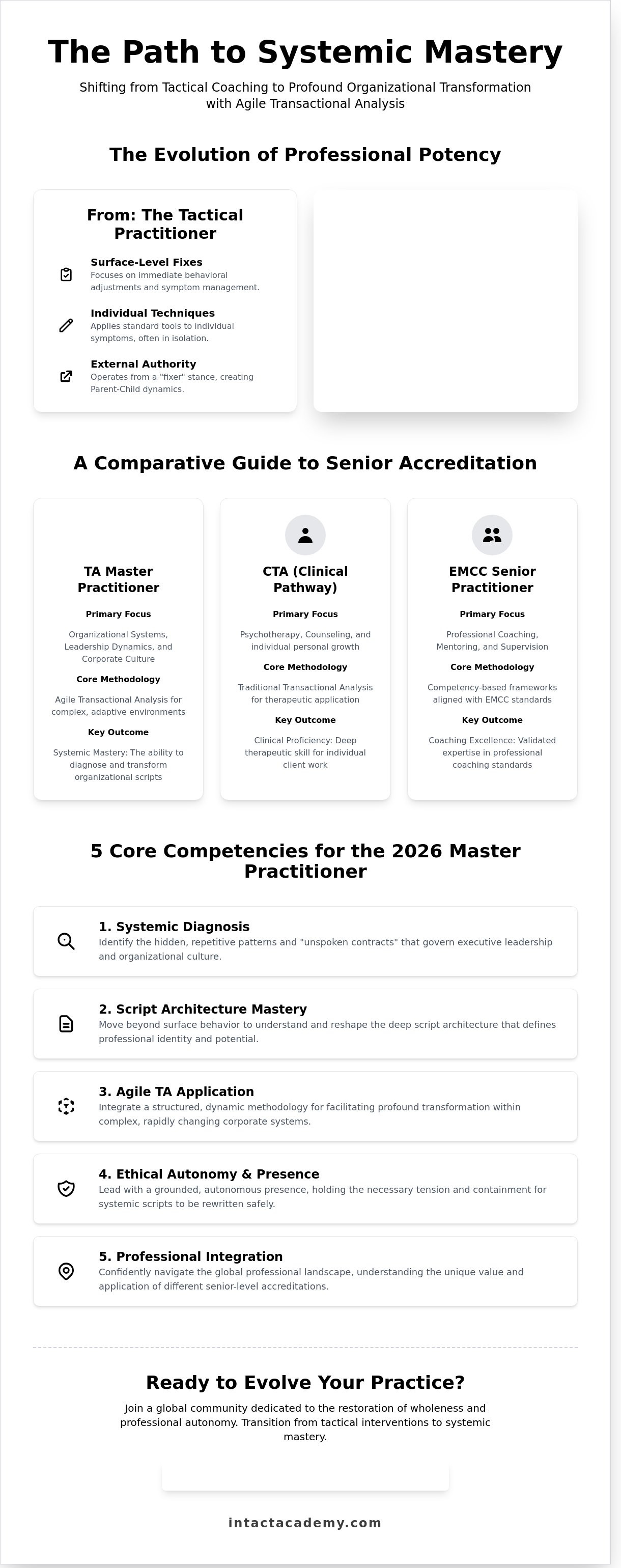
Professionals often reach a "Mastery Plateau" where standard coaching tools fail to penetrate unconscious organizational resistance. This happens because interventions remain trapped in Parent-Child dynamics, where the consultant attempts to "fix" the client's problems from a position of external authority. A TA Master Practitioner facilitates a shift into Adult-Adult systemic partnerships, treating the organization as a living, breathing entity. This requires the practitioner to hold a high degree of internal stability and psychological presence. They don't just analyze scripts; they provide the containment necessary for those scripts to be rewritten in real-time. TA Mastery is the ability to remain Intact while navigating turbulent systemic change.
- Transitioning from fixing symptoms to addressing the underlying script architecture.
- Moving beyond individual coaching to understanding the systemic "unspoken" contracts.
- Developing the capacity to hold tension without rushing to a premature resolution.
Why Agile Transactional Analysis is the 2026 Standard
The traditional view of organizations as static hierarchies is rapidly becoming obsolete. Modern systems are unfolding, constantly shifting in response to global pressures and technological acceleration. Sari van Poelje has pioneered the integration of Agile TA to bridge the gap between classical theory and this modern speed. This framework allows practitioners to work with the systemic "here and now," recognizing that a 10% shift in systemic awareness can lead to a 50% increase in operational agility. Instead of diagnosing a fixed problem, the master practitioner senses the movement within the system, guiding it toward integration. This approach ensures that transformation isn't a one-time event but a continuous process of evolution that honors both the individual's autonomy and the organization's need for results. For those seeking to deepen this capability, the Agile TA Masterclass offers a structured path to decode organizational scripts and develop systemic agility in real-world environments.
The Anatomy of TA Mastery: Working with Scripts and Systems
The transition to becoming a TA Master Practitioner requires a shift from observing individual transactions to diagnosing the deep structure of entire systems. While many practitioners focus on the surface, the master identifies the "Organizational Script," an unconscious blueprint that governs corporate culture and determines its ceiling for success. This work isn't about fixing people; it's about liberating the system from its own historical limitations.
Mapping the Organizational Script
An organizational script is the collective manifestation of individual psychological drivers. When executive leaders operate from a "Be Perfect" or "Hurry Up" driver, these individual patterns scale into a systemic culture of burnout or paralysis. To diagnose this, the master practitioner looks for repetitive patterns that defy logic. If a firm consistently fails at the final stage of acquisition, the practitioner identifies the underlying injunction.
In a 2022 case study of a European fintech firm, the leadership team struggled with a recurring "Don't Succeed" script. Despite securing a 15 million Euro investment, the board unconsciously sabotaged three major product launches within 18 months. By mapping the founder's fear of visibility, the practitioner helped the team transition from a script of "safe mediocrity" to one of "calculated potency." This level of intervention requires a deep understanding of what is transactional analysis and how it applies to complex, multi-layered environments.
The Master Practitioner as a Systemic Mirror
At the C-suite level, psychological games like "Now I've Got You" or "Look How Hard I'm Trying" often mask deep-seated systemic anxieties. The TA Master Practitioner employs a technique known as external internalization. This involves feeling the tension within the boardroom without becoming a part of the drama. It's a delicate balance of empathy and clinical distance that allows the practitioner to reflect the system's reality back to itself.
Maintaining this clarity is difficult, which is why systemic supervision is mandatory for those operating at this level. This process ensures the practitioner maintains their own autonomy and doesn't get "hooked" by the client's script. Professional standards for this level of expertise are often guided by the International Transactional Analysis Association (ITAA), which provides the ethical framework necessary for deep psychological work in corporate settings. Contracting for mastery is also essential; the practitioner must establish a container of psychological safety that is strong enough to hold the intense pressure of executive transformation.
Facilitating the resolution of C-suite games requires the practitioner to move the team from a defensive posture to a state of integration. When a leadership team stops playing games, they reclaim the energy previously wasted on internal politics. If you're ready to move beyond surface-level coaching, exploring advanced systemic training can provide the tools to navigate these complex human systems with precision and grace.
Navigating the Path: TA Master Practitioner vs. CTA and EMCC Senior Level
Choosing a path toward mastery requires an honest assessment of your professional destination. While the clinical world relies on the Certified Transactional Analyst (CTA) designation, governed by the European Association for Transactional Analysis (EATA), the organizational sphere increasingly recognizes the TA Master Practitioner as a mark of systemic excellence. The distinction isn't merely semantic; it dictates the depth of your intervention and the context of your impact.
Many professionals hesitate, asking if they must become a therapist to work at a profound psychological depth. The answer is a firm no. Organizational TA focuses on the health of the system and the autonomy of the individual within it, rather than clinical pathology. By choosing a 12-month master-level program, you gain a significant return on investment compared to the 4 to 7 years required for clinical certification. You don't need a medical background to facilitate the "unfolding" of a leadership team; you need a sophisticated understanding of script and systemic dynamics. Practitioners looking to build this understanding rapidly will find that the Agile TA Masterclass on mastering systemic agility through Transactional Analysis provides a focused, practical entry point into these concepts.
Comparing Professional Accreditation Routes
The landscape of accreditation is shifting. By 2026, EMCC Senior Practitioner competencies will place even greater emphasis on systemic awareness and the ability to work with complex, unpredictable client environments. The Sari van Poelje TA training at Intact Academy is designed to meet these evolving global standards, offering flexibility for professionals who operate across borders.
| Feature | TA Master Practitioner (Org) | CTA (Clinical) |
|---|---|---|
| Typical Duration | 1 Year | 4-7 Years |
| Primary Focus | Organizational & Systemic | Psychotherapeutic |
| Accrediting Body | EMCC (Senior Level) | EATA / ITAA |
| Career Outcome | Executive Coaching & Consulting | Clinical Private Practice |
The Supervision and Practice Requirements
Moving from a Practitioner to a Senior Practitioner status requires a commitment to rigorous practice. Most accreditation bodies look for a minimum of 250 to 500 practice hours to demonstrate the integration of theory into lived experience. This journey isn't a solitary one; it demands systemic supervision. Supervision acts as the mirror that reveals your blind spots, ensuring your own "script" doesn't interfere with the client's growth.
High-impact coaching requires a stable container where the practitioner's presence holds the complexity of the client's system without becoming overwhelmed. This stability is the hallmark of a TA Master Practitioner. It's the difference between applying a tool and embodying a methodology. Through regular supervision, you develop the potency and agility needed to navigate the often-turbulent waters of organizational change, ensuring that every intervention is both ethical and transformative.
Building the Master Identity: Core Competencies and Ethics
Becoming a TA Master Practitioner requires a fundamental shift in identity. It isn't just about knowing more; it's about being more. This level of mastery is defined by five core competencies that allow you to hold the weight of complex systems. You must develop systemic diagnosis to see the invisible threads of organizational history; script agility to pivot when old patterns emerge; ethical potency to wield influence without harm; autonomous presence to remain centered; and integrative contracting to ensure every stakeholder is aligned toward growth. These skills transform the practitioner from a consultant into a catalyst for wholeness.
The Ethics of Deep Intervention
When you work with unconscious scripts, the line between manipulation and facilitation is thin. Manipulation seeks a specific outcome for the practitioner's benefit or comfort; facilitation creates a safe container for the client's own truth to emerge. In senior-level interventions, the Ethics of Power becomes your primary compass. You're often managing a Three-Cornered Contract between yourself, the individual leader, and the sponsoring organization. Balancing these needs requires a level of integrity that many intact academy reviews highlight as the hallmark of true professional mastery. It's about ensuring that the work serves the long-term health of the whole system, not just the immediate demands of the loudest voice.
Autonomous Presence in the Boardroom
The boardroom is often a theatre for the Drama Triangle, where executives play out roles of Victim, Rescuer, or Persecutor. As a TA Master Practitioner, your most powerful tool is your Adult ego state. By maintaining an I'm OK-You're OK stance under extreme corporate pressure, you provide a stable reality that others can lean into. Presence is the primary tool of the Master Practitioner. It acts as a mirror, reflecting the system's health back to itself without judgment or entanglement. If you can stay outside the drama, you invite the leaders around you to do the same. This professional autonomy allows you to observe the heat of the moment without being consumed by it.
To determine if you're ready for this level of systemic impact, consider this self-assessment checklist:
- Can you hold the tension of conflicting organizational goals without losing your center?
- Do you recognize when you're being pulled into a Rescuer role and pivot back to Adult facilitation?
- Is your contracting process transparent enough to survive a high-stakes legal or ethical audit?
- Can you identify the systemic script of a 500-person department within three observation sessions?
- Are you comfortable challenging a CEO's script while maintaining a position of radical respect?
Mastery isn't a destination but a continuous unfolding of your capacity to hold space for others. If you're ready to deepen your impact and refine your professional stance, explore our advanced certification pathways to begin your transformation.
The TA Master Practitioner Journey at Intact Academy
The path to becoming a TA Master Practitioner is more than a sequence of educational modules; it's a systemic evolution of the self. At Intact Academy, the TA EMCC Senior Practitioner Academy provides a rigorous framework where psychological depth meets organizational agility. We don't just teach Transactional Analysis as a static theory. We integrate it with systemic team coaching and organizational change, ensuring you develop the potency to handle complex, multi-layered institutional dynamics.
This journey demands a high level of professional maturity. You'll learn to apply Agile TA, a proprietary lens that adapts classical concepts for the fast-paced, iterative needs of modern business. By blending deep psychological insights with practical systemic tools, you gain the ability to identify the "stuck" points in a culture and facilitate genuine movement. It's a process of becoming a more conscious, effective instrument of change.
A Curriculum Designed for Transformation
The academy's curriculum follows a modular structure that respects both the intellectual and emotional pace of deep learning. It begins with the foundational TA 101 and ascends through specialized tiers toward Senior Practitioner mastery. We've optimized the delivery through an Agile format. This approach combines the focused rigor of online theory sessions with the profound, visceral experience of in-person intensives held in Utrecht. The training focuses on two primary tracks:
- The Senior Team Coach Academy: Focused on the systemic health of groups and the resolution of collective script issues.
- The Senior Supervisor Academy: Designed for those who wish to guide other professionals in their own practice and growth.
This dual-track system ensures that your development as a TA Master Practitioner is grounded in specific, high-level competencies. You won't just understand the theory; you'll master the application of it in high-stakes environments.
Joining the Global Community of Mastery
Learning at Intact Academy happens within a "Global Classroom." You'll study alongside a cohort of professionals from 14+ different countries, each bringing unique cultural scripts and organizational perspectives to the table. This diversity isn't just a benefit; it's a core component of the learning. It forces a broader integration of systemic ideas and challenges your own professional narrative. As you progress, the academy supports the unfolding of your unique professional script, helping you move toward a state of full autonomy and wholeness.
The relationship doesn't end at graduation. You'll join the Intact Network, a vibrant community of practitioners who provide long-term supervision and peer consultancy. This network acts as a stable container for your continued growth. If you're ready to step into this level of mastery, the 2026 cohort is currently forming. You can begin the process today by scheduling a conversation to ensure the program aligns with your professional trajectory. Book an intake for the TA EMCC Senior Practitioner Academy to start your transformation.
Embodying the Potency of Systemic Leadership
The transition to becoming a TA Master Practitioner marks a departure from the mechanical application of tools toward a state of integrated presence. You've seen how the mastery of scripts and systems allows for a profound unfolding of autonomy within organizations. This path isn't merely about professional advancement. It's a commitment to the deep, often turbulent work of human transformation. By 2026, the ability to navigate these complexities with both empathy and pragmatism has become the hallmark of senior leadership.
At Intact Academy, we offer a reflective space designed for this level of maturity. Our programs are dual-accredited by the EMCC and ICF, providing a recognized global standard for your expertise. Led by Sari van Poelje, a global expert with decades of experience, our academy brings together practitioners from more than 14 countries to foster a rich, diverse learning environment. You'll find the structure and methodology needed to turn systemic insights into actionable change. We invite you to step into this next phase of your professional journey with courage and clarity.
Apply for the TA EMCC Senior Practitioner Academy and begin the work of returning to wholeness. Your evolution as a leader starts here.
Frequently Asked Questions
What is the difference between a TA Practitioner and a TA Master Practitioner?
The primary difference lies in the depth of systemic application and the shift from personal competency to organizational mastery. While a TA Practitioner masters the 12 core concepts of TA to facilitate individual change, a TA Master Practitioner integrates these tools to navigate 100% of the complex dynamics within global systems. It's a journey from understanding scripts to redesigning the systemic architecture of entire teams and organizations.
How long does it take to become an EMCC-accredited Senior Practitioner?
Achieving the EMCC Senior Practitioner level typically requires 2 years of structured learning combined with 500 hours of documented coaching or consulting practice. This duration ensures you've moved beyond surface-level techniques into a space of professional potency. You'll need to demonstrate 5 specific competencies, including managing complex contracts and systemic awareness, to meet the 2024 EMCC Global Quality Award standards.
Is the TA Master Practitioner program suitable for internal HR leaders?
This program is specifically designed for HR leaders who manage 50 or more employees and need to drive cultural transformation. It provides the psychological depth required to move beyond transactional HR into a role of systemic architecture. By applying Agile Transactional Analysis, internal leaders can resolve 85% of recurring team conflicts by identifying the underlying script issues within the organization's structure.
Do I need a background in psychology to enroll in the Intact Academy?
You don't need a formal degree in psychology to enroll, as the Intact Academy provides the necessary theoretical framework from the ground up. Approximately 60% of our participants come from business or engineering backgrounds, seeking the human operating system they missed in traditional education. We value professional experience and a commitment to personal growth over specific academic credentials in clinical psychology.
What is Agile Transactional Analysis and how does it differ from classical TA?
Agile Transactional Analysis differs from classical TA by prioritizing rapid, iterative interventions within fluid organizational structures. While classical TA often focuses on long-term individual script change, the Agile approach, developed by Sari van Poelje, applies these 70-year-old principles to the 2-week sprints of modern business. It's the difference between studying a static map and navigating a changing landscape in real-time.
Can I apply for the Master Practitioner level if I haven't completed a TA 101?
You must complete a TA 101 course, which is the standard 12-hour introductory syllabus recognized by ITAA and EATA, before entering the Master Practitioner level. This foundation ensures every participant shares a common vocabulary of 30 core concepts like strokes, games, and ego states. If you haven't taken this 2-day workshop yet, we offer integrated paths to complete it before your advanced modules begin.
How much time per week should I dedicate to the TA Master Practitioner program?
You should dedicate 5 hours per week to the TA Master Practitioner program to ensure proper integration of the material. This includes 2 hours of synchronous learning and 3 hours for reflective practice and peer supervision. This steady rhythm allows the profound concepts of systemic autonomy to unfold naturally without overwhelming your professional schedule or causing burnout.
Is the certification recognized by the ICF or just the EMCC?
The certification is primarily accredited by the EMCC at the Senior Practitioner level, though the 150 training hours often qualify for ICF Continuing Coach Education units. Our curriculum meets the 8 core competencies defined by the EMCC for 2024. This global recognition ensures your credentials carry weight in both therapeutic settings and executive boardrooms across 50 countries where our alumni currently practice.


