

What if the primary barrier to your client's evolution isn't a lack of strategy, but a hidden systemic script that dictates their every move? You've likely noticed that traditional, tactical interventions often lose their efficacy after the third or fourth session. It's a common plateau; research from the 2023 ICF Global Coaching Study indicates that 86% of organizations now prioritize coaches who can navigate complex organizational dynamics over those who offer simple advice. You understand that to facilitate lasting change, your executive coaching skills must move beyond surface-level behavior and address the underlying psychological architecture of the leader and their system.
We've designed this guide to help you transition from a facilitator of tasks to a master of systemic transformation. You'll gain a clear roadmap for developing the autonomy and potency required to handle deep-seated leadership patterns with precision. We'll explore how to integrate Agile Transactional Analysis into your practice, providing you with a structured path toward senior-level certifications and a measurable impact on organizational wholeness.
Key Takeaways
- Discover the vital distinction between tactical performance fixes and the deep, identity-based work that characterizes true transformational coaching.
- Master the psychological architecture of Transactional Analysis to navigate boardroom dynamics with precision and cultivate a grounded executive presence.
- Develop your systemic potency by learning to address organizational scripts, allowing you to influence the health of the entire collective through the individual.
- Assess your professional growth using a diagnostic checklist designed to sharpen your executive coaching skills across psychological and systemic domains.
- Transition from the mechanical application of tools to a state of integrated coaching presence that invites profound organizational wholeness.
Beyond Active Listening: The Evolution of Executive Coaching Skills
Modern executive coaching skills have evolved into a multi-layered competency framework that transcends simple rapport or active listening. It's no longer enough to offer a mirror; the coach must provide a map. We distinguish between tactical coaching, which focuses on performance metrics and behavioral adjustments, and transformational coaching, which addresses the leader's underlying identity. In the high-pressure environment of the C-suite, leaders don't just need to do things differently. They need to become different people to meet the demands of global complexity.
This specialized approach requires a blend of psychological insight and systemic awareness. We introduce the concept of "Potency" as a core requirement for any top-tier coach. Potency is your ability to hold a stable, grounded space for high-stakes transformation. When a CEO faces a board-level crisis or a merger failure, they don't need a cheerleader. They need a coach with the internal strength to challenge their deepest assumptions without fracturing the professional relationship. This level of presence allows the leader to explore their "script" or the unconscious patterns that dictate their responses to stress and authority.
The Shift from Manager to Systemic Coach
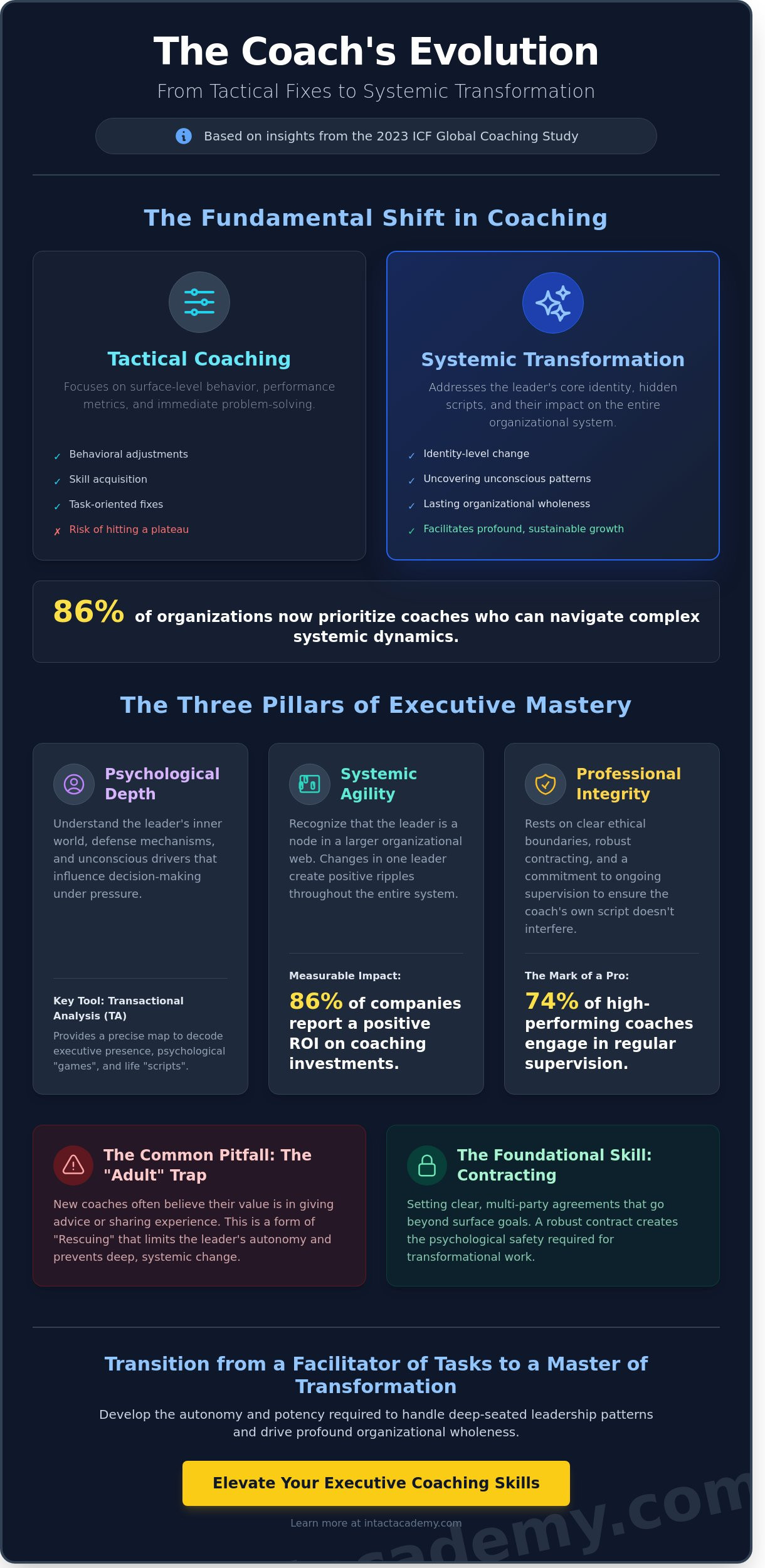
Many new coaches fall into what we call the "Adult" trap. They believe their primary value lies in giving advice or sharing their own executive experience. This is a subtle form of "Rescuing" that inadvertently limits the leader's autonomy. True mastery involves moving from immediate problem-solving to deep pattern-recognition. You aren't just resolving a conflict between a CFO and a COO; you're identifying the systemic "games" that cause these conflicts to recur across the organization.
This shift begins with "Contracting for Change." It's the foundational skill of setting clear, multi-party agreements that go beyond surface-level goals. Without a robust contract, coaching becomes a series of pleasant but ineffective conversations. By establishing a firm psychological and professional contract, you create the safety necessary for the leader to move toward wholeness.
The Three Pillars of Executive Mastery
- Psychological Depth: This involves understanding the leader's inner world. You must recognize the defense mechanisms and drivers that influence their decision-making under pressure.
- Systemic Agility: The leader is a node in a larger organizational web. According to the 2023 ICF Global Coaching Study, 86% of companies report a positive ROI on coaching, largely because changes in the leader trigger positive ripples throughout the entire system.
- Professional Integrity: This pillar rests on supervision and ethical boundaries. The same ICF study indicates that 74% of high-performing coaches now engage in regular supervision. This practice ensures that the coach's own "script" doesn't interfere with the client's growth, maintaining the purity of the coaching container.
By integrating these pillars, you move from being a tactical advisor to a catalyst for profound human and organizational evolution. It's a journey from fixing what's broken to unfolding what's possible.
The Psychological Architecture: Using Transactional Analysis in Coaching
To truly excel, a coach must look beneath the surface of leadership behavior to the underlying structures that drive it. Transactional Analysis (TA), developed by Eric Berne in the late 1950s, serves as a precision instrument for decoding executive presence; it's a framework that transforms vague observations into actionable insights. By integrating TA into your executive coaching skills, you provide leaders with a map of their own internal architecture, allowing them to move from reactive patterns to conscious, autonomous choices. Developing these advanced executive coaching skills requires a commitment to understanding the nuances of the human script and the hidden transactions that occur in every meeting.
Psychological games often stall progress in the boardroom. These are repetitive, unconscious patterns of communication that always end in a predictable "payoff" of negative emotion. A skilled coach recognizes these games, such as "Yes, But" or "Now I've Got You," as they unfold in real time. When a leader understands the games they play with their board, they gain the potency to interrupt the cycle and return to a state of authentic contact.
Mapping Ego States in High-Stakes Leadership
In high-pressure environments, leaders often shift between different Ego States. The "Controlling Parent" manifests as authoritarian commands that stifle innovation, while the "Adapted Child" might emerge as a fear of taking risks or a need for approval. Effective coaching focuses on cultivating the "Integrating Adult," a state where the leader processes reality without the distortion of past biases or childhood defense mechanisms. Individual Ego States act as a mirror for organizational culture, reflecting the psychological health and communication flow of the entire system.
Decontaminating the Professional Script
Every executive operates from a "Life Script," an unconscious plan created in early childhood that dictates how they handle success, failure, and stress. This script is often reinforced by "Drivers" identified by Taibi Kahler in 1975, such as "Be Perfect," "Please Others," or "Be Strong." While these drivers may have propelled them to the C-suite, they eventually become limiters. A leader obsessed with perfection often struggles with delegation, creating bottlenecks that hinder organizational agility. The coach's role is to facilitate a "re-decision," helping the leader discard outdated scripts in favor of new, life-affirming strategies.
This process of individual decontamination isn't isolated. It's the first step toward systemic coaching, where personal growth fuels the evolution of the whole enterprise. If you're seeking to expand your mastery of these dynamics, you might explore how our specialized training can refine your approach to human transformation.
Systemic Potency: Navigating Organizational Scripts and Change
Systemic intelligence is the ability to coach the whole through the part. It recognizes that an executive doesn't operate in a vacuum; they're a node in a complex, living web of relationships and history. When you refine your executive coaching skills, you begin to see that a leader's individual struggle is often a localized symptom of a wider organizational script. This script acts as an unconscious blueprint, dictating how the collective handles power, conflict, and innovation.
A profound tool in this work is the concept of Parallel Processes. This phenomenon occurs when the coaching relationship itself begins to mirror the dynamics of the organization. If a coach feels a sudden sense of urgency or a heavy silence during a session, it's rarely accidental. It's a reflection of the systemic field. By applying Agile Transactional Analysis, coaches provide a framework for organizational agility, allowing leaders to move from rigid, repetitive patterns toward autonomous, responsive action. Statistics from a 2023 industry report suggest that 74% of organizations see higher retention when coaching addresses these systemic cultural layers rather than just individual performance metrics.
Coaching the System, Not Just the Leader
Top coaches identify the "unspoken rules" that govern the executive suite. These are the hidden scripts that tell leaders what's safe to say and what must remain hidden. These scripts often create deep-seated resistance when leading organizational change, as the system's homeostatic drive fights to keep things as they've always been. Mastery in this area requires Systemic Observation. You must learn to read the room beyond the spoken word, noticing who is excluded from the narrative and how historical "ghosts" of past leaders still influence today's strategy.
The Role of the Coach in Systemic Transformation
True transformation involves facilitating wholeness by reintegrating the parts of the system that have been ignored or suppressed. Whether it's a marginalized department or a neglected company value, the coach helps bring these elements back into the light. During periods of high-stakes volatility, the coach acts as a temporary anchor. You provide a stable container for the leader's anxiety, preventing it from cascading through the hierarchy. Your level of self-awareness directly determines your systemic potency, as a coach who isn't grounded will inevitably be swept up in the very organizational drama they're meant to resolve. This depth of presence is what separates standard training from high-level executive coaching skills that actually shift a culture. For a deeper exploration of how these principles apply in practice, our guide on coaching high-level leaders offers a systemic framework for navigating the unique pressures of the C-suite.
The Executive Coaching Skills Checklist: A Framework for Senior Practitioners
Mastery isn't a final destination; it's a continuous process of refinement. To sustain potency in the boardroom, you need a structured way to evaluate your impact. This framework serves as a mirror. It invites you to look beyond surface-level techniques and examine the deeper architecture of your practice. Using this checklist ensures your executive coaching skills remain sharp and relevant in a complex corporate world. This diagnostic tool isn't just for self-reflection; it's a roadmap for lifelong learning and professional supervision.
Domain 1: Psychological & Relational Competencies
Senior practitioners must navigate the intricate dance of human personality. You need the ability to identify and work with Ego State contaminations, recognizing when a client's past scripts interfere with their present leadership. It requires the potency to challenge high-power clients directly without damaging the therapeutic alliance. You must consistently operate from an "I'm OK - You're OK" position, ensuring every transaction fosters autonomy rather than dependency. This psychological depth allows you to hold space for transformation when the pressure of the C-suite becomes overwhelming.
Domain 2: Systemic & Organizational Competencies
An executive doesn't exist in a vacuum. Your skill in mapping organizational scripts and systemic loyalties is what separates a coach from a consultant. You must be able to facilitate team interventions using systemic frameworks that reveal hidden dynamics. This involves a high degree of competence in aligning individual development goals with the broader needs of the organization. According to a 2023 industry survey, 86% of organizations now prioritize coaches who can demonstrate this systemic alignment. You're not just coaching a person; you're influencing an entire ecosystem.
Domain 3: Professional & Ethical Competencies
Ethics in senior coaching go beyond simple confidentiality. It requires regular engagement in systemic supervision to monitor counter-transference and maintain professional clarity. You must master the art of multi-party contracting between the coach, the client, and the corporate sponsor. Data suggests that 74% of coaching engagements face friction due to unclear initial contracts. Commitment to ongoing accreditation, such as the EMCC Senior Practitioner level, ensures your executive coaching skills stay grounded in global standards of excellence and integrity.
The path to becoming a wise global mentor involves a commitment to the unfolding of your own potential. If you're ready to deepen your impact and refine these competencies, explore our executive coaching certification to join a community of practitioners dedicated to profound human transformation. It's time to move beyond the transactional and embrace the systemic.
Integrating Mastery: From Tactical Skill to Systemic Transformation
True mastery in the professional sphere isn't a collection of tools; it's a state of being. You've explored the foundational executive coaching skills required to guide leaders through complexity. Yet, proficiency in active listening or powerful questioning is merely the entry point. The transition from a competent coach to a transformative one requires a shift from tactical application to systemic integration. It's the difference between doing coaching and being a coach who embodies presence, potency, and protection for their clients.
Skills alone often fail when they aren't anchored in the coach's own psychological wholeness. If a coach hasn't examined their own internal script, they risk projecting their biases onto the organizational systems they aim to serve. Research into practitioner efficacy suggests that the coach's internal state accounts for a significant portion of the variance in client outcomes. This internal alignment allows you to hold a stable container for high-stakes leadership transitions, ensuring that your executive coaching skills function as extensions of your intuition rather than rigid protocols.
The Path to Senior Practitioner Accreditation
The journey toward high-level impact requires a rigorous framework that bridges individual psychology and organizational dynamics. The TA EMCC Senior Practitioner academy at Intact Academy integrates these diverse elements into a cohesive, systemic practice. You don't just learn theory; you engage with a global cohort that fosters cross-cultural awareness and challenges your existing perspectives. Under the leadership of Sari van Poelje, participants move beyond surface-level interventions to master the art of systemic change. This program provides the intellectual rigor and emotional depth necessary to navigate the intricate power structures of modern corporations.
- Develop a sophisticated understanding of Agile Transactional Analysis.
- Refine your ability to diagnose and intervene in complex organizational scripts.
- Join a network of practitioners dedicated to ethical, deep-level transformation.
Your Next Step Toward Systemic Impact
Reflect on your current professional script. Are you operating from a place of habit, or are you moving with the autonomy and agility that your clients require? The path to becoming a Senior Practitioner is a commitment to your own evolution as much as it's a professional milestone. If you're ready to move beyond the basics, it's time to evaluate how you choose your path forward. We invite you to explore our choose executive coaching certification guide to find the alignment you need. Stop practicing techniques and start leading through your presence. Join Intact Academy and transform the script of your professional life.
Mastering the Architecture of Human Change
Refining your executive coaching skills requires a transition from tactical interventions to deep, systemic integration. You've explored how Transactional Analysis provides the psychological architecture needed to decode organizational scripts and foster genuine autonomy. This checklist serves as your map; it ensures every session moves beyond simple problem-solving toward lasting transformation. It's about developing the potency to hold space for complex change while maintaining professional pragmatism. When you change the individual script, you change the organizational destiny.
The path to senior practitioner status is both a personal and professional evolution. By applying these systemic frameworks, you join a global community of leaders who prioritize depth over surface-level fixes. Our programs, led by international expert Sari van Poelje, bring this systemic approach to professionals in more than 14 countries. These EMCC and ICF accredited pathways offer the structured methodology needed to facilitate profound growth in high-stakes environments. You'll gain the tools to navigate the most turbulent corporate waters with a sense of quiet power and stability.
Begin your journey to systemic mastery in our TA EMCC Senior Practitioner Academy
Your commitment to this level of mastery is the first step toward reclaiming wholeness for yourself and the organizations you serve. We're ready to support your unfolding brilliance.
Frequently Asked Questions
What are the essential executive coaching skills for C-suite leaders?
Top executive coaching skills for C-suite leaders focus on systemic intelligence, psychological safety, and the ability to deconstruct professional scripts. Leaders often operate within rigid, unconscious patterns. A coach must identify these scripts to foster true autonomy. Statistics show 85% of high-level transitions fail due to a lack of relational awareness rather than technical incompetence. Effective coaching provides the necessary container for this deep, structural growth.
How does Transactional Analysis improve executive coaching outcomes?
Transactional Analysis improves outcomes by offering a clear map of ego states and communication "games" within the boardroom. When a coach uses this framework, they help clients move from reactive Child or Parent states into the functional Adult state. This shift increases organizational agility. Research from the ITAA suggests that TA-based interventions can reduce workplace conflict by 40% through improved interpersonal clarity and emotional regulation.
What is the difference between individual and systemic executive coaching?
Individual coaching focuses on the person's internal script, while systemic coaching addresses the entire organizational web. You aren't just coaching a leader; you're coaching the relationships they represent. Systemic work recognizes that a leader's behavior is often a symptom of the wider culture. By addressing these 360-degree dynamics, the coach ensures that individual changes don't get rejected by the corporate "immune system" during the transformation process.
How can a coach develop systemic intelligence in a corporate setting?
You develop systemic intelligence by mapping the invisible flows of energy and authority within an organization. This requires looking beyond the formal chart to see the underlying, informal structure. Coaches often use the "Three-Cornered Contract" model to clarify expectations between the coach, the leader, and the company. In a 2022 industry study, coaches with systemic training reported a 25% higher success rate in maintaining long-term organizational change.
Why is professional supervision critical for executive coaches?
Professional supervision is critical because it prevents the coach from becoming entangled in the client's script. It acts as a mirror, ensuring the coach remains "Intact" and objective. The EMCC requires at least 1 hour of supervision for every 35 hours of practice to maintain accreditation. Without this external perspective, a coach risks losing their potency and falling into the same blind spots as the executive they're meant to guide.
What is the EMCC Senior Practitioner level, and why does it matter?
The EMCC Senior Practitioner level signifies a coach has completed over 250 hours of practice and demonstrated a deep integration of psychological theory. It matters because it provides a benchmark of quality in a largely unregulated market. Achieving this level shows you can handle complex, multi-layered contracts. It's a mark of maturity that reassures C-suite clients you possess the refined executive coaching skills necessary for high-stakes transformation.
How do you handle ethical dilemmas in executive coaching?
You handle ethical dilemmas by returning to the primary contract and maintaining radical transparency. If a conflict of interest arises between the individual's growth and the company's goals, the coach must address it immediately. Using the Global Code of Ethics, established in 2016, provides a structured path for resolution. Integrity is the foundation of the coaching relationship. It's about choosing the "hard right" over the "easy wrong" to preserve the client's autonomy.
Can executive coaching skills be learned online or do they require in-person training?
You can learn the theoretical frameworks of coaching online, but the profound transformation of your "self as instrument" often benefits from in-person interaction. Digital platforms provide accessibility for the 60% of learners who balance full-time roles. However, the nuances of somatic resonance and systemic energy are best felt in a shared physical space. A hybrid approach ensures you gain both the intellectual rigor and the emotional depth required for this work.


