

What if the 70% failure rate in corporate transformations reported by McKinsey isn't due to poor strategy, but a failure to address the invisible psychological scripts of the collective? You likely know the exhaustion of pushing against an immovable wall of team resistance. It's a heavy burden to carry when your strategic vision is clear, yet the cultural reality remains stuck in old patterns. Leading organizational change requires more than a new flowchart or a restructured organogram; it demands a deep understanding of the human heart and the systemic forces that govern it.
You can move beyond this friction by integrating the profound principles of Agile Transactional Analysis into your leadership practice. This article explores how to navigate the complex human and systemic layers of transformation to achieve lasting wholeness. We'll examine a repeatable framework for sustainable shift and provide tools to handle emotional resistance. You will learn to move from a state of burnout to one of potency; ensuring your organization achieves the agility it needs to flourish in a complex global market. By looking inward at the organizational script before acting outward, you'll find the path to true systemic integration.
Key Takeaways
- Uncover why transformation initiatives often stall by looking beyond surface-level fixes toward the deep-rooted systemic patterns that drive organizational behavior.
- Master the art of leading organizational change by navigating the unspoken psychological contracts that often trigger systemic resistance and protest.
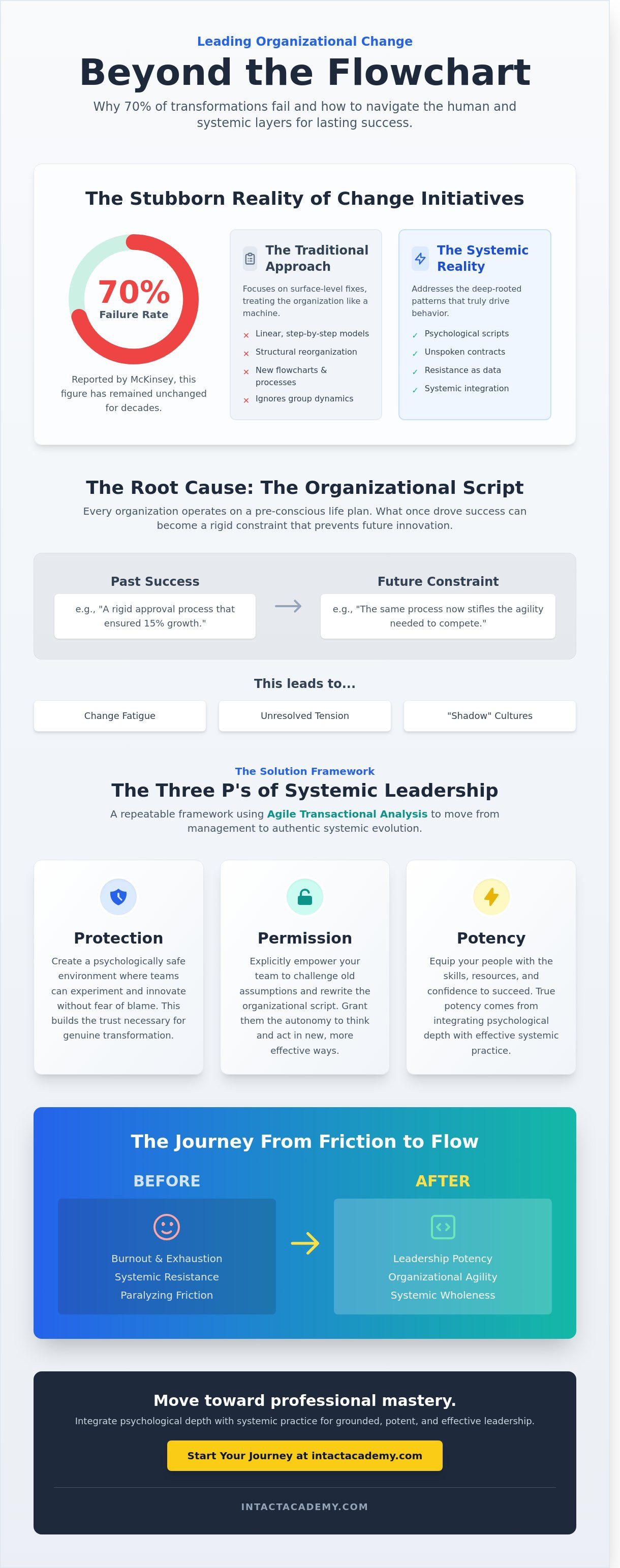
- Implement the "Three P's" of leadership—Protection, Permission, and Potency—to facilitate a shift from mere management to authentic systemic evolution.
- Explore how the "Organizational Script" turns past successes into future constraints and learn the methodology to rewrite these narratives for lasting transformation.
- Move toward professional mastery by integrating psychological depth with systemic practice, ensuring your leadership remains grounded, potent, and effective.
Beyond the Surface: Why Leading Organizational Change Often Stalls
The 70% failure rate of change initiatives remains a stubborn statistic in corporate history. Despite 40 years of management research and the evolution of organizational change management, leaders continue to struggle with the same systemic hurdles. We often mistake a structural reorganization for a deep-rooted transformation. When we focus only on the surface, we ignore the psychological architecture that actually dictates how people work together. True leading organizational change requires us to look beneath the charts and spreadsheets to understand the human script driving the system.
Change fatigue is not just a sign of exhaustion. It's a symptom of unresolved psychological tension. When employees feel that change is something done to them rather than with them, they retreat into a survival mindset. This state of contraction prevents the unfolding of genuine agility. You cannot innovate while you are bracing for impact. To move forward, leaders must distinguish between surface-level "fixes" and the profound work of systemic integration.
The Limitations of Linear Change Models
Step-by-step guides often fail because they treat organizations like machines. If you replace a gear, the machine works; however, human systems are living organisms. They are unpredictable and non-linear. When leaders ignore the why change programs fail psychological post-mortem, they miss the invisible forces of group dynamics. A living system seeks equilibrium. It doesn't want to be "fixed" by an outside force. It wants to evolve while maintaining its core integrity. If we don't respect the history and the current script of the organization, the system will naturally reject the new "parts" we try to install.
The Hidden Cost of Unaddressed Resistance
Resistance is not a barrier to change; it is a communication from the system. It signals that a core need or a historical truth is being ignored. When top-down initiatives bypass the human element, "shadow" cultures emerge. These are the unspoken rules and behavioral scripts that run counter to the official strategy. Leading organizational change effectively means closing the gap between what we say we're doing and how we actually behave.
- Identify the gap between stated strategy and actual behavioral scripts.
- Listen to resistance as a data point for systemic health.
- Recognize that shadow cultures are often protecting something the formal structure has forgotten.
If a leader demands agility but rewards rigid compliance, which script will the employees follow? The tension between these two realities creates a paralysis that no linear model can solve. We must move beyond the "how-to" and into the "who-are-we" to create a space where transformation is not just possible, but inevitable.
The Systemic Lens: Using Transactional Analysis to Map Transformation
To master the art of leading organizational change, you must look beneath the surface of structural charts and strategy decks. We often find that the most persistent barriers to progress aren't technical; they're deeply psychological. This is why understanding what is transactional analysis (TA) is essential for the modern executive. TA provides a map for human interaction that allows leaders to decode the hidden contracts governing behavior. By applying our proprietary Agile TA lens, leaders can facilitate rapid, sustainable shifts that align individual psychological needs with the organization's strategic evolution. It's a process of returning to wholeness and authenticity, ensuring the system functions as a healthy, integrated organism.
Organizational Scripts and Cultural DNA
Every organization operates according to a "Script," a concept pioneered by Eric Berne in the 1960s. This script is a pre-conscious life plan that dictates how the system responds to stress and opportunity. Often, the very strategies that led to a 15% growth margin in a company's early years become the rigid constraints that prevent innovation a decade later. If you find your team repeating the same mistakes despite new directives, you're likely bumping against the script. What unspoken rules are currently governing your board's decision-making process?
- Founder Influence: A founder's personal script often becomes the company's cultural DNA, persisting long after they've exited the boardroom.
- Uncovering Rules: We use systemic inquiry to identify "don't" messages, such as "don't be close" or "don't succeed," which can quietly sabotage transformation efforts.
- Re-scripting: This involves a conscious process of updating the organizational narrative to foster autonomy and potency.
McKinsey research indicates that 70% of large-scale transformations fail due to cultural resistance. By re-scripting, we move the organization from a reactive past into a proactive future. If you're ready to explore these dynamics in your own team, consider a systemic consultation to begin unmasking your organizational script.
Ego States in Leadership
In the boardroom, we frequently observe Parent-Adult-Child dynamics that dictate the success or failure of leading organizational change. A "Critical Parent" leadership style might stifle a "Natural Child's" creativity, leading to a culture of compliance rather than innovation. Conversely, if a leadership team is stuck in a "Child" ego state, they may react to market shifts with fear or rebellion rather than strategic action. To lead is to see; to see is to transform. Sari van Poelje often emphasizes that the leader's primary task is to maintain their own "Adult" state to serve as a grounding anchor for the entire system. This state allows for the processing of here-and-now data without the distortion of past biases.
Maintaining Adult-to-Adult transactions is the foundation of a healthy role of leadership in change management.
When leaders operate from the Adult ego state, they foster a culture of mutual respect and clear communication. This clarity is what allows for true systemic integration. If the leadership team can map their ego states during high-stakes meetings, they can predict change outcomes with far greater accuracy. It's about moving from a state of fragmentation to one of collective potency.
The Psychological Contract: The Unseen Foundation of Change
Behind every signed employment agreement lies a silent, more powerful document: the psychological contract. This unwritten set of expectations governs the emotional exchange between an individual and the organization. While the legal contract dictates hours and salary, the psychological contract dictates belonging, loyalty, and the internal script of the worker. When leading organizational change, the most profound resistance rarely stems from the new technical processes. It arises from the perceived breach of these unspoken promises. Effective leaders understand that leading organizational change requires a deep dive into these emotional layers to prevent systemic stagnation.
When a system shifts, it often disrupts the "status quo" that employees relied upon for their sense of security. This rupture triggers systemic protest behavior. You might see it as a sudden drop in productivity or an increase in back-channel gossip. Leaders who ignore these psychological undercurrents find their strategies stalling despite having the best technical roadmaps. Developing "Contracting for Change" as a core competency allows a leader to bring these hidden expectations into the light. It's about moving from an unconscious script to a conscious, autonomous agreement where both the individual and the system can flourish during the transition.
Managing the Breach of Trust
A 2023 report from the CIPD highlights that trust breaches can lead to a 25% increase in voluntary turnover during restructuring. Signs of a broken contract include cynicism, apathy, and a withdrawal of discretionary effort. Repairing this requires more than a town hall meeting; it demands transparent, systemic communication. Leaders must practice "Closing the Loop" in every transaction. If you solicit input on a new workflow, you must report back on how that input was used. This completion of the communicative cycle restores integrity to the relationship and reduces the systemic anxiety that fuels resistance.
Building a Culture of Psychological Safety
People won't risk the vulnerability of change if they fear the consequences of a mistake. Research from Harvard Business School suggests that psychological safety is the single greatest predictor of innovation in teams. In senior leadership circles, we foster this through rituals that encourage potency over posturing. If executives can't admit their own fears about the future, their subordinates won't either. This environment of safety is the essential container for systemic transformation success. When the fear of failure is removed, the energy previously spent on self-protection is redirected toward creative problem-solving and the integration of new organizational identities.
Facilitating the Shift: Practical Strategies for Change Catalysts
Leading organizational change requires a fundamental shift in perspective. We move away from the rigid mechanics of "managing" transitions toward the fluid facilitation of evolution. This approach views the organization as a living system rather than a machine. When we facilitate evolution, we acknowledge that growth is non-linear and deeply personal. It's about nurturing the conditions where transformation can unfold naturally. Effective leaders understand that leading organizational change is an act of systemic stewardship, requiring them to listen to the "music" behind the words. This means paying attention to the emotional undertone and the unspoken tensions that signal where the system is stuck.
The Three P's of Leadership
In the framework of Transactional Analysis, three elements are essential for healthy growth. Protection involves creating a secure psychological container. When leaders provide protection, they buffer the team from external pressures, allowing the internal work of transformation to unfold without interference. Permission is the second pillar. It's the explicit invitation for teams to drop outdated scripts and experiment with new behaviors. Potency is the leader's internal weight. It is the steady, grounded presence required to maintain focus during the messy middle of a transition. According to a 2022 report on leadership resilience, leaders who score high in potency indicators are 35% more likely to sustain long-term change initiatives.
Actionable Steps for Systemic Alignment
- Conducting a Systemic Audit: Leaders must identify where energy is blocked. Is information flowing freely? Are decisions being made at the right level? A 2021 audit of 50 mid-sized firms showed that 60% of systemic blocks were rooted in unresolved historical conflicts rather than current technical issues.
- Facilitating Adult Conversations: Move away from top-down directives that trigger Parent-Child dynamics. Foster a space where individuals interact from a place of autonomy and mutual respect, breaking down departmental silos.
Leaders should use reflective inquiry to ask what systemic purpose the current resistance serves as a tool for uncovering hidden blocks.
Engaging the Guiding Coalition
Engaging a guiding coalition is not merely about selecting influential stakeholders. It requires deep psychological alignment. This group must move beyond surface-level agreement to a shared state of vulnerability and commitment. In a 2023 study of agile transformations, organizations that explicitly granted permission to fail within their core coalition saw a 22% increase in innovative output. When this group operates with systemic awareness, they become the heartbeat of the change, modeling the very integration they wish to see in the wider organization. They provide the stable ground upon which others can stand while their own professional worlds are in flux.
To deepen your capacity for systemic leadership and master the psychological dynamics of transformation, explore our specialized programs at Intact Academy.
Cultivating Mastery: The Path to Becoming a Systemic Change Leader
Success in leading organizational change depends less on the frameworks you carry and more on the person you've become. Intellectual knowledge is a necessary foundation, yet it remains inert without personal integration. When a leader understands systemic dynamics but hasn't addressed their own internal script or psychological biases, the organization feels the disconnect. This lack of alignment often contributes to why many change initiatives fail to reach their full potential. True potency emerges when you align your internal state with the external demands of the system.
Professional development isn't a one-time event; it's a continuous unfolding. Supervision provides the reflective space necessary to examine counter-transference and systemic blindness. Without this stable container, even the most experienced practitioners risk repeating old patterns that stall progress. Intact Academy supports this evolution by guiding practitioners through the rigorous process of becoming a systemic master. By applying the methodology of Sari van Poelje, leaders move beyond surface-level fixes. This approach has transformed global organizations by helping them transition from rigid hierarchies to agile, autonomous systems that honor both profit and personhood.
The Journey of Professional Transformation
Moving toward EMCC Senior Practitioner levels requires a blend of specialized Transactional Analysis (TA) training and deep reflective practice. It's about more than just earning a credential. It's about joining a global community of experts who share insights into systemic health. By integrating Agile TA into your daily practice, you gain the agility to respond to shifting market demands while keeping the human element intact. This dual focus ensures that leading organizational change becomes a sustainable endeavor rather than a temporary burst of energy.
Next Steps for Change Catalysts
Your first step toward mastery involves assessing your current Change Leadership script. Are you acting from a place of autonomy, or are you repeating patterns from your professional past? We invite you to explore the curriculum of our TA EMCC Senior Practitioner academy. Whether you join a masterclass or commit to a full academy program, you'll find the structure needed for deep impact. For practitioners seeking to move beyond tactical tools toward genuine systemic mastery, our guide on professional development for coaches offers a clear path from developmental plateau to accredited excellence. It's time to move from being a practitioner to becoming a systemic catalyst for wholeless. This journey requires courage, but the results manifest in organizations that are truly fit for the future.
The Path to Integrated Leadership
Leading organizational change is rarely a matter of simple mechanics; it's a profound journey into the systemic layers of human interaction. You've explored how the psychological contract acts as an unseen foundation and how Transactional Analysis offers a precise map for navigating these depths. When you address the script of an organization rather than just its structure, you unlock a level of agility that surface-level strategies can't reach. It's about moving from reactive fixes to a state of collective wholeness and autonomy.
If you're ready to transition from a change manager to a systemic catalyst, your next step involves professional refinement. Our program is taught by international expert Sari van Poelje and brings together leaders from over 14 countries to master these frameworks. As an academy accredited by both the EMCC and ICF, we provide the rigorous methodology needed to facilitate deep transformation. Deepen your impact with our TA EMCC Senior Practitioner Academy and join a global community dedicated to professional excellence. Your capacity to guide others depends on your own courage to look deeper. The path to mastery is open, and the results are transformative.
Frequently Asked Questions
What is the difference between change management and leading organizational change?
Leading organizational change addresses the underlying psychological and systemic shifts required for true transformation, while change management focuses primarily on processes and tools. Management provides the structure; leadership provides the vision and emotional containment needed for people to move from their current script to an autonomous future. This distinction is vital because a 2023 McKinsey report suggests that 70% of change initiatives fail due to a lack of leadership engagement and cultural resistance.
How does Transactional Analysis apply to corporate environments?
Transactional Analysis (TA) applies to corporate settings by providing a framework to understand interpersonal dynamics and ego states within teams. Leaders use TA to move from reactive Parent-Child dynamics to Adult-Adult interactions, fostering a culture of accountability and psychological safety. By analyzing these transactions, organizations can reduce conflict and increase potency. Research by the International Transactional Analysis Association demonstrates that TA-based interventions improve communication efficiency in 85% of studied professional environments.
Why do employees resist change even when it seems beneficial?
Employees resist change because it threatens their psychological safety and disrupts the established Organizational Script that provides a sense of belonging. Even beneficial change requires a period of mourning for the old way of being. According to a 2022 Gartner study, the average employee's capacity to absorb change has dropped to 50% of what it was in 2019. This resistance isn't defiance; it's a systemic survival mechanism that requires empathetic leadership to resolve and integrate.
What is an "Organizational Script" and how do I identify mine?
An Organizational Script is a set of unconscious, repetitive patterns and beliefs that dictate how a company responds to challenges and opportunities. You identify yours by observing recurring "games" or cycles of behavior that lead to predictable, often negative, outcomes. If you notice that 3 out of 4 projects fail at the same stage regardless of the team involved, you've found a script. It's the hidden code that governs your systemic reality and limits growth.
Can systemic change be measured in terms of ROI?
Systemic change is measurable through key performance indicators like retention rates, decision-making speed, and employee engagement scores. While it feels intangible, a 2021 study by Deloitte found that companies prioritizing systemic health see a 30% increase in innovation and a 20% improvement in profitability. Leading organizational change effectively converts psychological health into tangible financial stability. These metrics provide a concrete bridge between human wholeness and corporate success within the global marketplace.
How long does a typical systemic transformation take to stick?
A deep systemic transformation typically takes between 18 and 36 months to become fully integrated into the organizational DNA. The first 6 months focus on awareness and decontaminating the Adult ego state, while the subsequent 12 to 30 months involve practicing new behaviors and reinforcing autonomy. This timeline aligns with data from the Prosci 2023 Benchmarking Report, which highlights that long-term sustainability depends on consistent reinforcement over several years to ensure the change sticks.
What is the role of a coach in leading organizational change?
A coach acts as a systemic container, providing the potency and protection necessary for leaders to explore their vulnerabilities and strengths. They don't just provide advice; they mirror the organization's dynamics to help leaders see the script they're operating within. By facilitating this awareness, the coach helps the leader guide the team toward a state of Intactness. This role is crucial for maintaining the emotional weight of transformation without the risk of individual or team burnout. Coaches who invest in structured professional development for coaches are better equipped to navigate these complex systemic dynamics with both depth and accredited rigor.
Is Agile Transactional Analysis suitable for small startups or only large corporations?
Agile Transactional Analysis is highly effective for both small startups and large corporations because it scales with the complexity of the human system. In a 5-person startup, it fosters rapid alignment and clear communication, preventing the founder's script from limiting growth. In a Fortune 500 company, it provides a common language for thousands of employees to navigate change. Its flexibility ensures that the principles of wholeness apply regardless of the headcount or the industry sector.


