

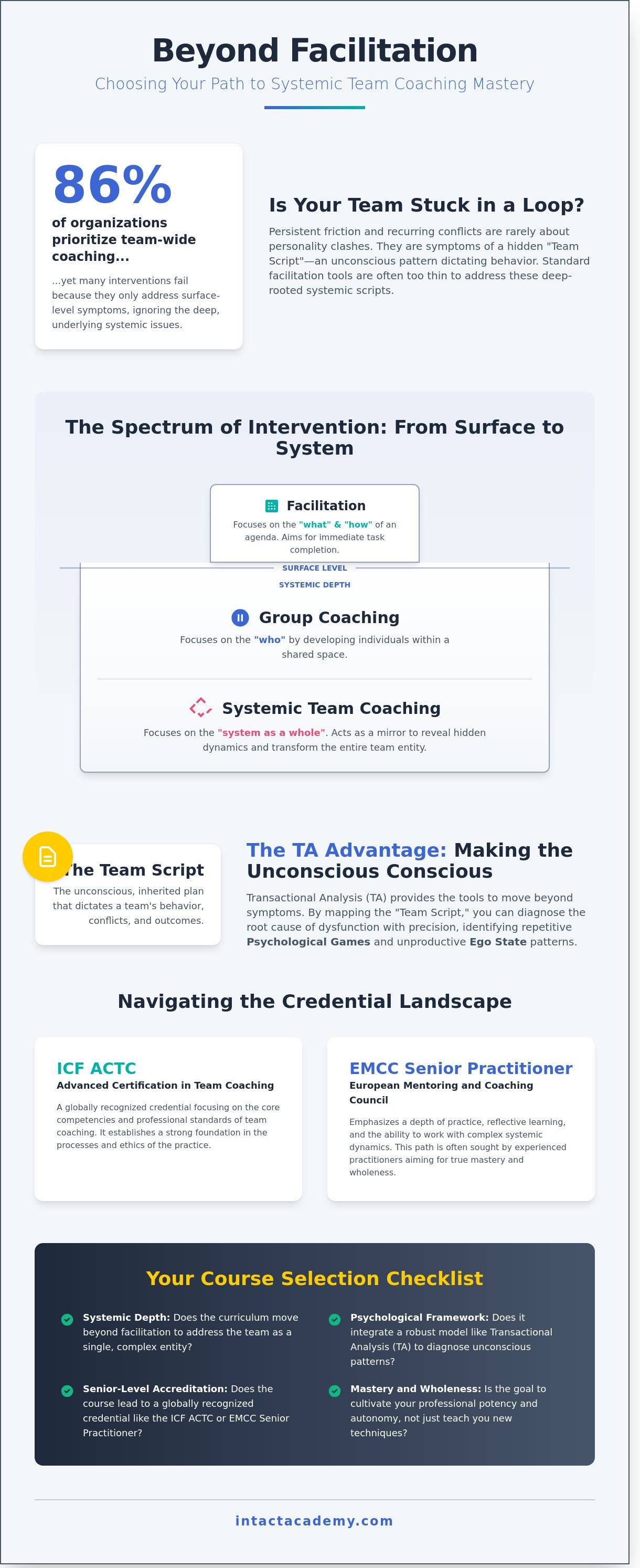
What if the persistent friction in your boardroom isn't a personality clash, but a systemic script playing out on repeat? You've likely stood in a room where standard facilitation tools felt painfully thin against the weight of a team's history. It's a common realization among senior practitioners. A 2023 report from the International Coaching Federation indicates that 86% of organizations now prioritize team-wide coaching, yet many practitioners still struggle when surface-level interventions fail to reach the roots of conflict.
This guide empowers you to select a team coaching course that transcends basic facilitation. You'll learn to evaluate programs that integrate Agile Transactional Analysis, ensuring you gain the potency to navigate unconscious patterns while securing a globally recognized senior-level accreditation. We'll break down the structural differences between ICF and EMCC paths and the specific markers of a curriculum designed for true systemic transformation and wholeness.
Key Takeaways
- Understand the critical distinction between surface-level facilitation and the systemic depth required to resolve recurring organizational dysfunctions.
- Discover how to identify the "Team Script"—the unconscious patterns that dictate behavior—and use Transactional Analysis to facilitate profound transformation.
- Navigate the global credential landscape by comparing the professional impact and requirements of the ICF ACTC and EMCC Senior Practitioner accreditations.
- Apply a rigorous buyer's checklist to evaluate any team coaching course, ensuring the curriculum and faculty provide the necessary psychological and systemic depth.
- Learn how to integrate theory and practice to move beyond transactional interventions toward a state of professional wholeness and mastery.
Beyond Facilitation: Why Your Next Team Coaching Course Must Address Systemic Depth
The landscape of organizational development has fundamentally shifted. By 2026, the traditional boundaries of the corporate office have dissolved into complex hybrid ecosystems. Simply managing a meeting or smoothing over a minor conflict is no longer enough. A modern team coaching course must prepare you for a descent into the systemic architecture of the group. If you treat a team as a mere collection of individuals, you miss the invisible threads that bind their behavior. You're coaching the parts, but the system remains untouched.
Many practitioners fall into the facilitation trap. They focus on agendas, timekeeping, and surface-level engagement while ignoring the deeper signs of a dysfunctional team. When a group exhibits repetitive conflict or chronic stagnation, a simple checklist won't save them. These issues are often symptoms of an underlying unconscious script. To create lasting change, you must adopt a "team as a single entity" mindset. This shift moves the focus from individual performance to the collective energy and patterns that define the whole.
The Evolution of Team Coaching in 2026
Remote work has altered communication rituals. Recent data suggests that 73% of high-performing teams now operate with asynchronous workflows, creating gaps where unspoken assumptions often fester. This organizational complexity requires a coach who can map unconscious patterns in real time. The rising demand is for systemic agility rather than basic soft skills. Leaders don't just need to communicate better; they need the capacity to handle high-stakes systemic pressure without losing their professional potency or authenticity.
Facilitation vs. Group Coaching vs. Systemic Team Coaching
The distinction lies in the intent. Facilitation aims for immediate task completion. Group coaching focuses on individual growth within a shared space. Systemic team coaching, however, targets the transformation of the system itself. Consider this scenario: if you only fix the meeting structure, the original problem usually recurs within six months. If you fix the system, the team evolves autonomously.
- The Facilitator: Focuses on the "what" and the "how" of the agenda.
- The Group Coach: Focuses on the "who" regarding individual development.
- The Systemic Team Coach: Acts as a systemic mirror, reflecting the group's hidden dynamics back to them.
In this advanced team coaching course framework, you aren't a problem solver. You're a catalyst for wholeness. By reflecting the team's reality without judgment, you allow them to see their own patterns. This awareness is the first step toward true integration and sustainable success in a volatile global market.
The TA Advantage: Moving from Surface Dynamics to Team Scripts
Surface-level interventions often fail because they treat symptoms rather than the underlying architecture of a group. A systemic team coaching course based on Transactional Analysis (TA) offers a more profound entry point. At the heart of this approach is the concept of the Team Script. This is an unconscious plan, often established during the team's founding or inherited from the wider organization, that dictates how members behave, compete, and succeed. When a team feels stuck, it's usually following a script that no longer serves the current business reality.
In high-pressure corporate environments, the effectiveness of an intervention depends on the coach's potency and autonomy. Potency isn't about being the loudest voice in the room; it's the professional authority to name the unspoken and hold the system's tension. This allows the coach to remain neutral yet impactful. If a coach lacks this grounded presence, they risk becoming part of the team's existing script rather than the catalyst for its transformation. Structured professional development for coaches that addresses this internal dimension is what separates practitioners who plateau from those who achieve genuine systemic mastery.
Mapping the Unconscious: Ego States and Psychological Games
Understanding what is transactional analysis allows a coach to diagnose conflict with surgical precision. Teams often fall into psychological games, which are repetitive sequences of behavior that end in a familiar bad feeling for everyone involved. These games, like "Yes, But" or "Cornered," are used to avoid the vulnerability of real work and accountability.
- Parent-Child Dynamics: These occur when leaders dictate and members either comply or rebel, stifling innovation.
- Adult-Adult Culture: The goal of any advanced team coaching course is to move the system toward an Adult-Adult state, where communication is clear, respectful, and focused on the present task.
- Systemic Alignment: This shift aligns with the 8 ICF Team Coaching Competencies, which require coaches to facilitate growth while maintaining a systemic focus.
Agile TA: A Proprietary Lens for Modern Business
Agile Transactional Analysis, a framework pioneered by Sari van Poelje, integrates systemic theory with the pragmatism required in today's fast-moving markets. It moves beyond the therapeutic origins of TA from the 1950s into a tool for organizational agility. The process begins with rigorous Contracting. This isn't just a legal agreement; it's a psychological pact that ensures the team is genuinely ready for the discomfort of change. Without a clear contract, interventions remain superficial and results don't last.
The ultimate aim is to achieve wholeness. This means returning a team to its authentic potential by stripping away the defensive layers of the script. It's about helping the group find its own voice and power. If you are seeking to deepen your impact, exploring our systemic training can provide the tools needed to facilitate these profound human transformations.
Navigating the Credential Landscape: ICF ACTC vs. EMCC Senior Practitioner
Entering the professional landscape of systemic work requires a clear map. Accreditation isn't the summit of your career; it's the foundation of your professional house. Without it, you lack the structural integrity to hold the weight of an organization's trauma or its aspirations. In a field where 82 percent of organizations now prioritize accredited coaches, these credentials serve as a vital signal of safety and competence. They represent the floor of your practice, ensuring you operate within ethical boundaries while you strive for the ceiling of true mastery.
ICF ACTC: The Global Standard for Advanced Coaching
The ICF Advanced Certification in Team Coaching (ACTC) serves as a rigorous benchmark for those moving from one-on-one sessions to group dynamics. This path requires a significant investment of time and energy, including 60 hours of specialized education and proof of five distinct team engagements. It also mandates at least five hours of coaching supervision, a practice that ensures you don't become entangled in the team's internal politics.
Transitioning from an Associate or Professional level to the Team specialty requires a shift in focus. You're no longer just listening to one person's narrative; you're tracking the invisible threads between eight or ten people. This team coaching course pathway is ideal for executive coaches who want to differentiate themselves in a crowded market. While it provides high visibility, it's often viewed as a behavioral framework. It gives you the "what" and the "how," but the "why" of deep systemic resistance may require a more psychological lens.
EMCC Senior Practitioner: The Depth-First Alternative
If you seek a more reflective journey, an emcc accredited team coaching course might be your North Star. The EMCC framework prioritizes the coach's internal development and psychological maturity. It focuses on the "self-as-instrument" model, where your own presence becomes the catalyst for change. This approach is essential for driving systemic organizational change because it prepares you to handle the unconscious scripts and power dynamics of a C-suite.
- Reflective Practice: The EMCC requires a portfolio that demonstrates your ability to look inward after every session.
- Psychological Safety: It emphasizes the coach's capacity to hold a "secure base" for teams in crisis.
- C-Suite Validation: Senior Practitioner status signals to top-tier leaders that you possess the gravitas to challenge their existing structures.
Choosing between these two paths depends on your intended impact. The ICF route offers a structured, competency-based ladder that is recognized globally by HR departments. The EMCC route offers a deep dive into the human soul of the organization. Both paths require you to step beyond the role of a facilitator and into the role of a systemic change agent, where your potency is as important as your toolkit.
A Buyer's Checklist: Evaluating Curriculum, Faculty, and Supervision Quality
When you select a team coaching course, you're choosing the container for your professional evolution. It's easy to be swayed by glossy PDFs or high-production marketing videos, yet the true value lies in the unseen infrastructure of the program. You must look beneath the surface to ensure the training offers the psychological depth necessary to handle the volatile dynamics of modern organizational life. A course that focuses only on "tools" without addressing the coach's internal state will leave you ill-equipped for the reality of systemic resistance.
The "Faculty Test" is your first filter. Ask the instructors about their current client load. Practitioners who are active in organizational change bring a potency that theorists cannot replicate. They understand the visceral pressure of a boardroom and the delicate ego-states of leadership. They don't just teach the script; they've lived through the rewrites. If an instructor hasn't been inside a corporate system in the last 24 months, their insights may lack the professional pragmatism you need to succeed.
The Essential Curriculum Components
- Live Field Projects: Avoid programs that rely solely on theoretical case studies. You need a curriculum that requires 100% participation in live projects where you engage with actual teams.
- Measurable Impact: Does the program teach you how to articulate the roi of team coaching? You must be able to link systemic shifts to tangible business outcomes.
- Systemic Tool Integration: Look for the inclusion of mapping, constellations, and script analysis. These tools allow you to see the invisible threads of history that bind a team together.
Supervision: The Secret to Senior-Level Mastery
Supervision is the non-negotiable anchor of high-level mastery. While mentor coaching focuses on the "how" of coaching skills, systemic supervision explores the "who" of the coach in relation to the system. It's the only way to safely navigate the parallel process, where the coach unconsciously mirrors the very dysfunction they're trying to solve. If a team is fragmented, the coach often feels fragmented. Without supervision, you become part of the problem rather than the catalyst for the solution.
Before enrolling in a team coaching course, ask if it includes at least 10 hours of dedicated supervision. Inquire whether the supervisors are trained in systemic work or if they're simply checking off competency boxes. This distinction determines whether you'll develop the autonomy and potency required to hold space for a struggling executive team. High-quality supervision provides the psychological containment that prevents coach burnout and ensures the integrity of the intervention.
If you're ready to move from surface-level facilitation to profound systemic mastery, explore our upcoming certification programs to begin your transformation.
Cultivating Mastery: The TA EMCC Senior Team Coach Academy Experience
The Intact Academy approach isn't just another training program; it's a deep dive into the intersection of Transactional Analysis (TA) and systemic impact. When you choose this team coaching course, you aren't just learning tools. You're entering a rigorous container led by Sari van Poelje, who brings 35 years of experience in systemic change and executive leadership. Whether you join us in the historic city of Utrecht or through our interactive online platform, the focus remains on professional potency. We prepare you for the volatile organizational demands of 2026, where surface-level fixes no longer suffice and teams require leaders who can navigate deep-seated patterns with agility.
The Intact Philosophy: Wholeness and Authenticity
Most programs focus on "fixing" dysfunctional dynamics. We believe in facilitating a team's natural unfolding toward its own inherent health. This shift requires the coach to do their own deep work. You'll join a global cohort of mature professionals from 14+ countries, creating a rich tapestry of cultural and professional perspectives. This certification transforms the coach as much as the client. It moves you from a state of doing to a state of being, where your presence becomes your most powerful intervention tool. The long-term value of this approach includes:
- Developing a keen eye for systemic "scripts" that block organizational progress.
- Cultivating the internal stability needed to hold space for high-conflict teams.
- Integrating Agile Transactional Analysis into your daily practice for immediate, measurable impact.
- Joining a network of practitioners who value depth over superficial metrics.
Your Next Step Toward Systemic Impact
Transitioning to a Senior Practitioner level requires more than just accumulated hours; it requires a fundamental shift in mindset. To apply for the next intake, you'll need a foundational understanding of coaching and a willingness to explore your own professional script. Becoming a Senior Practitioner in the global market signals your ability to handle high-stakes, complex systemic issues. This recognition signifies a level of mastery that sets you apart in a crowded field. If you're ready to move beyond the basics of a standard team coaching course, take the step that leads to true autonomy. Join a community dedicated to the art and science of change. Your journey toward professional wholeness begins with a single, intentional decision to lead from a place of depth.
Step Into Your Role as a Systemic Catalyst
Selecting the right team coaching course is a pivotal moment in your professional evolution. It marks the transition from managing surface dynamics to addressing the deep scripts that govern organizational behavior. You now understand that systemic mastery requires more than just tools; it demands an integration of psychological depth and practical agility. By prioritizing EMCC and ICF accredited programs, you ensure your practice meets the highest global standards of supervision and ethical rigor.
The TA EMCC Senior Team Coach Academy offers a unique space for this unfolding. Led by Sari van Poelje, a global Transactional Analysis expert, the program connects you with a diverse community of practitioners from 14+ countries. This isn't merely training; it's a journey toward greater potency and autonomy in your work. If you're ready to move beyond facilitation and embrace the complexity of human systems, it's time to choose a path that honors your maturity as a leader. Leading organizational change requires this depth of understanding, and enrolling in the TA EMCC Senior Team Coach Academy today will provide you with the framework to navigate these complex transformations. Your path to wholeness and professional excellence is waiting to be written.
Frequently Asked Questions
What is the difference between a team coaching course and a leadership course?
A team coaching course focuses on the collective intelligence of a group system, while leadership courses typically target individual performance and management skills. In a 2023 study by the International Coaching Federation, 68 percent of organizations reported that team coaching improved collective functioning more effectively than individual training. Leadership training builds the person; team coaching builds the invisible dynamics and shared scripts between people.
Do I need an existing coaching certification to enroll in a team coaching course?
You don't always need a prior certification, though 85 percent of senior-level programs require at least 3 years of professional experience in human resources or management. Many practitioners enter with a background in psychology or organizational development. If you start without a foundational credential, you may need to complete a bridge module to master the basic competencies required to hold space for complex systemic transformations.
How long does it typically take to complete a senior-level team coaching certification?
Completing a senior-level team coaching course typically requires 125 to 200 hours of study over a 6 to 12 month period. This duration includes classroom hours, peer practice, and supervised sessions with real clients. According to EMCC Global standards, practitioners must demonstrate at least 50 hours of practical application before achieving Senior Practitioner status. This steady rhythm allows for the deep integration of systemic theories and personal reflection.
Is an online team coaching course as effective as in-person training?
Online training is as effective as in-person sessions when it utilizes synchronous, high-interaction models rather than passive video watching. A 2024 report from the Association for Coaching found that 72 percent of graduates felt equally prepared by virtual programs that included live breakout rooms and real-time supervision. The key isn't the physical location; it's the quality of the relational space created between the participants and the mentor.
What is the average cost of a high-quality team coaching program in 2026?
The average cost for a high-quality professional program in 2026 ranges from 5,000 to 9,000 USD based on current industry inflation rates of 3 percent annually. These figures reflect prices for ICF-accredited Level 2 or Level 3 training programs. While entry-level workshops are more affordable, professional-grade certifications require a larger investment to cover the cost of expert supervision and proprietary curriculum materials developed by master practitioners.
How do I know if a team coaching course is actually accredited by ICF or EMCC?
You can verify accreditation by searching the official ICF Training Program Search Service or the EMCC Global Quality Award directory. Every accredited team coaching course must display a unique provider code that matches these global databases. In 2025, the ICF updated its standards to require specific Team Coaching Competencies, so you should ensure your chosen program aligns with these 8 core pillars of systemic practice.
What role does Transactional Analysis play in modern team coaching?
Transactional Analysis serves as a diagnostic lens to decode the script of a team and its underlying communication patterns. It allows coaches to move beyond surface-level conflicts to address the psychological games that hinder collective productivity. By using this framework, you help teams move from dependency to autonomy. This methodology provides the intellectual rigor needed to handle the turbulent energy of organizational change with calm authority.


