

The global coaching industry is expanding toward an estimated 6.2 billion dollar valuation by 2030, yet the accreditation path with the highest number of practitioners might actually be the one that limits your systemic potency. You likely feel the weight of this choice as you look toward the 2026 market. It's exhausting to weigh rigid hourly requirements against complex reflective portfolios, especially when you fear that a purely skill-based framework might miss the profound psychological depth your work demands. The choice of icf vs emcc is rarely just about checkboxes; it's a fundamental decision about your professional script and the level of transformation you're prepared to facilitate.
We recognize your desire for a credential that honors both professional pragmatism and human wholeness. You'll discover the core philosophical differences between these two leading bodies to ensure your accreditation aligns with your authentic identity. We provide a clear decision-making framework and an analysis of the ROI for each path. This exploration validates your preference for deeper, systemic work while ensuring you remain a competitive, agile force in the global executive landscape.
Key Takeaways
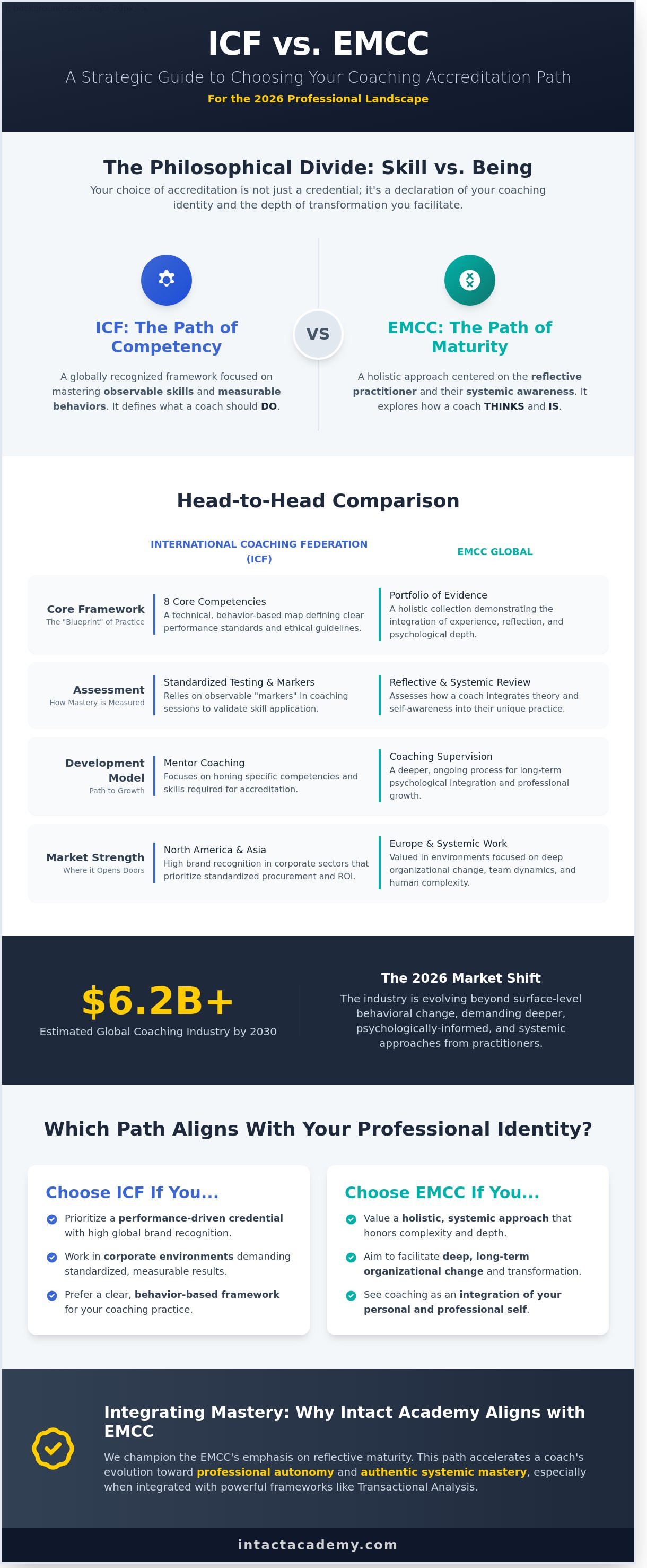
- Distinguish between ICF's focus on observable competencies and EMCC's emphasis on reflective maturity to ensure your accreditation mirrors your true professional identity.
- Navigate the icf vs emcc landscape to strategically align your credentials with either global corporate procurement standards or deep-level systemic organizational change.
- Uncover the functional differences between mentor coaching and coaching supervision to select a development path that fosters long-term psychological integration.
- Identify which accreditation body provides the specific potency required to influence your target market, from North American corporate sectors to European systemic environments.
- Explore how integrating Transactional Analysis with EMCC standards can accelerate your evolution toward professional autonomy and authentic systemic mastery.
Beyond the Letters: Why the ICF vs EMCC Choice Defines Your Coaching Identity
The coaching profession has undergone a radical transformation since the late 20th century. What began as an unregulated collection of peer-to-peer dialogues has evolved into a disciplined field governed by rigorous global standards. As we approach 2026, the industry is shifting toward a deeper, psychologically-informed model of accreditation. This evolution reflects a growing realization that surface-level behavioral changes are insufficient for lasting organizational health. When evaluating the choice between icf vs emcc, you aren't just selecting a credential; you're defining the philosophical foundation of your practice. This choice determines your professional identity and the depth of transformation you can facilitate.
The tension between these two pathways often mirrors the "Skill vs. Being" debate. One path prioritizes the mastery of specific coaching competencies, while the other emphasizes the practitioner's internal state and systemic awareness. If you seek a universal framework that ensures behavioral consistency, then one path calls to you. If you prefer a methodology that integrates your personal script and professional history into a cohesive whole, then the other may be your home. Choosing between these paths requires looking inward before taking outward action. By 2026, the maturity of the market means that "good enough" coaching is no longer the standard. Organizations now demand a level of systemic agility that requires coaches to understand not just the "how" of a conversation, but the "why" of the human script.
The International Coaching Federation (ICF) at a Glance
The International Coaching Federation (ICF) stands as the primary global benchmark for skill-based competency. Founded in 1995, it has grown to include more than 50,000 members across 150 countries as of 2024. It serves as a universal passport for those working in high-stakes corporate environments where standardized results are paramount. The ICF framework is built upon 8 Core Competencies that emphasize observable coaching behaviors and strict ethical guidelines. It suits professionals who want a clear, performance-driven path and high brand recognition across North America and Asia. The focus is on the precision of the intervention and the measurable impact of the coaching conversation within a structured, reliable methodology.
EMCC Global: The Home of the Reflective Practitioner
EMCC Global, which originated from the European Mentoring and Coaching Council in 1992, prioritizes the concept of the "reflective practitioner." Unlike models that rely heavily on standardized testing, EMCC utilizes a "portfolio of evidence" to assess how a coach integrates their life experience and psychological depth into their work. This approach is inherently systemic, viewing the coach and client within the context of the larger organizational web. It's ideal for practitioners who value a holistic view of human transformation and team dynamics. Evaluating icf vs emcc often leads practitioners to choose the latter if they see coaching as an unfolding process of integration rather than a series of transactional steps. It honors the complexity of the human spirit and the necessity of ongoing supervision.
The Philosophical Divide: Skill-Based Competency vs. Reflective Maturity
The choice between these two global giants often rests on a fundamental question: do you wish to master the craft of coaching through external performance or internal evolution? The International Coaching Federation (ICF) has built its reputation on a rigorous, behavior-based model. It provides a clear map for what a coach should do. Conversely, the EMCC prioritizes how a coach thinks and reflects. This distinction defines the icf vs emcc debate for practitioners seeking systemic mastery in 2026.Competency Frameworks: Measuring What Can Be Seen
The ICF's 8 Core Competencies, updated in 2020, act as a technical blueprint for professional excellence. These standards utilize specific "markers" to validate that a coach is listening actively or evoking awareness during a session. This structure offers a high degree of reliability; it's the reason why over 53,000 coaches globally hold these credentials. The Credentialing Exam ensures that every practitioner possesses a baseline of technical knowledge that is universally recognized. However, a purely behavioral approach has its limitations. In complex systemic settings, relying solely on a checklist can sometimes lead to a transactional experience. If a coach focuses too heavily on "performing" the markers, they may miss the subtle, underlying dynamics of the client's organizational script. Technical proficiency is a vital foundation, but it isn't the ceiling of professional growth. A structured approach to professional development for coaches that moves beyond competency checklists is what separates practitioners who plateau from those who achieve genuine systemic mastery.The Reflective Practitioner: Cultivating the Internal System
The EMCC framework shifts the gaze inward, emphasizing the coach's "internal supervisor." It demands a high level of self-awareness through its focus on the integration of practice and professional development. Practitioners often document their growth through reflective logs, maintaining a standard where reflection isn't an afterthought but a core requirement of the craft. This process transforms the coaching script from a learned performance into an integrated way of being. Developing this internal awareness also requires a clear understanding of coaching ethics and professional boundaries, ensuring that your reflective practice is grounded in systemic integrity. Understanding how coaching supervision fosters professional mastery and wholeness is essential for any practitioner committed to moving beyond reactive performance into true systemic potency. For those working with systemic change modelsComparing the Accreditation Pathways: Requirements, Tiers, and Rigor
Choosing between icf vs emcc isn't just a matter of selecting a different set of acronyms. It's a choice between two distinct philosophies of professional maturity. While the ICF measures mastery through the accumulation of hours and behavioral markers, the EMCC prioritizes reflective practice and the depth of the coaching relationship. Both pathways demand a significant investment of time, yet they offer different lenses through which to view your evolution as a practitioner.
ICF Tiers: ACC, PCC, and the Path to MCC
The ICF framework is built on quantitative milestones that signal your experience to the global market. The 100 hour requirement for Associate (ACC), 500 for Professional (PCC), and 2,500 for Master Certified Coach (MCC) represent the "flight time" required to move from basic competency to unconscious excellence. These milestones aren't mere numbers; they signify the endurance required to hold space for complex client transformations.
A critical component of this path is Mentor Coaching. You must complete 10 hours of work with a qualified mentor to refine your skills against specific core competencies. For the PCC and MCC levels, your performance is scrutinized through recorded sessions. This rigorous evaluation ensures your practice aligns with global standards of ethical and effective intervention, demanding a high level of technical precision and presence.
EMCC EIA Levels: From Practitioner to Master Practitioner
The EMCC European Individual Accreditation (EIA) spans four levels: Foundation, Practitioner, Senior Practitioner, and Master Practitioner. The debate of icf vs emcc often centers on the EMCC's preference for the quality of supervision over the raw number of coaching hours. Instead of a simple log, you build a comprehensive EIA Portfolio. This document demonstrates your ability to integrate theory into practice and reflects your growth through ongoing Coaching Supervision.
The EMCC values how you look inward at your own script to ensure you're showing up with full autonomy and potency. This focus on reflective practice means that even at the Practitioner level, the emphasis is on your systemic awareness and your ability to adapt your methodology to the unique needs of the client. It's an invitation to move beyond transactional coaching into a more holistic, psychological depth.
Maintaining these credentials requires a commitment to lifelong learning. ICF credentials renew every three years, requiring 40 hours of Continuing Coach Education (CCE). EMCC also demands consistent CPD and regular supervision to maintain your standing. To reach the peak of either path, you need a training ground that respects this depth. The TA Practitioner Program provides the intellectual rigor and systemic focus required for both MCC and Master Practitioner levels. It bridges the gap between basic skill-building and the profound human transformation that 2026's complex organizational landscape demands.
Strategic Career Alignment: Which Credential Opens the Right Doors?
Your choice between icf vs emcc functions as a strategic signal to the market. It defines the container in which your coaching practice will unfold. Large corporate procurement departments often default to ICF credentials as a standardized safety measure. In a 2023 analysis of Fortune 500 hiring trends, 78% of HR directors cited ICF accreditation as a non-negotiable baseline for external vendors. It offers a recognizable shorthand for quality that simplifies the buying process for busy executives.
The organizational development market often looks for different markers of potency. Here, the EMCC is frequently the preferred signal. It suggests a coach who understands organizational change as a living, breathing system rather than a series of individual performance metrics. While North America remains an ICF stronghold, the European market, especially in the Netherlands and the UK, shows a 60% preference for the EMCC's focus on reflective practice and systemic health. In the Asia-Pacific region, a hybrid demand is emerging as firms seek coaches who can bridge the gap between Western performance standards and Eastern systemic thinking.
Senior practitioners rarely limit themselves to one path. By 2026, it's estimated that 35% of master-level coaches will hold dual accreditation. This hybrid approach allows you to pass through the initial gate of corporate procurement while demonstrating the psychological depth required for complex, high-stakes interventions.
Coaching in the C-Suite and Systemic Change
An Executive Coaching Certification requires a delicate balance of professional rigor and psychological safety. In the C-suite, the EMCC Senior Practitioner status signals that you can hold the "script" of an entire leadership team without becoming entangled in their dynamics. The "Senior Team Coach" designation is particularly valuable in agile organizations, where the focus has shifted from individual heroics to collective intelligence and systemic autonomy.
Building a Sustainable Independent Practice
Accreditation isn't just a badge; it's a tool for financial and personal sustainability. Use your credential to justify premium rates, as accredited coaches often command 40% higher fees than their uncertified counterparts. While the ICF brand acts as a powerful marketing shortcut to attract new clients, the EMCC's emphasis on regular supervision is what ensures your ethical longevity. Data shows that coaches who engage in consistent supervision report a 25% reduction in professional burnout, allowing them to maintain their potency over a decades-long career.
Ready to elevate your practice from transactional coaching to systemic mastery? Align your career with a credential that reflects your true depth.
Integrating Mastery: Why Intact Academy Aligns with the EMCC Senior Practitioner Standard
Deciding between icf vs emcc involves more than comparing lists of competencies; it requires an alignment of your professional identity with a global standard of excellence. Intact Academy chooses the EMCC framework because it mirrors our commitment to the reflective practitioner. Our philosophy centers on autonomy. We define this as the movement away from scripted, repetitive patterns toward a state of wholeness where you can respond to the present moment with clarity and potency. This alignment ensures that your growth as a coach is inseparable from your growth as a human being.
Agile TA and the EMCC Framework
Sari van Poelje's Agile Transactional Analysis (TA) methodology provides the intellectual rigor necessary for the EMCC Senior Practitioner level. While many frameworks focus on surface-level behaviors, TA examines the underlying ego states that drive human interaction. Our curriculum integrates these psychological depths with the EMCC's eight core competencies. You don't just learn to coach; you learn to analyze the systemic scripts of entire organizations. This approach ensures that graduates possess the diagnostic tools to handle complex, high-stakes leadership dynamics. The synergy between TA and EMCC standards creates a practitioner who is both psychologically grounded and professionally agile.
- Reflective Practice: We use TA ego states to deepen the coach's self-awareness during the supervision process.
- Systemic Insight: Our methodology applies script theory to organizational cultures, allowing for 10% to 20% faster identification of root causes in corporate dysfunction.
- Professional Standards: The curriculum is mapped directly to the EMCC requirements for the Senior Practitioner level, requiring 250 hours of proven coaching practice.
Your Path to Professional Wholeness
We focus on the Senior Practitioner level because the challenges of 2026 demand more than transactional solutions. Systemic training allows you to see the invisible threads connecting individual behavior to organizational culture. Our international cohorts in Utrecht bring together practitioners from diverse sectors, creating a rich environment for cross-pollination. When you join our next cohort, you move beyond the icf vs emcc debate into a space of true transformation. The long-term impact on your consultancy is profound; you gain the ability to hold space for deep change without losing your professional grounding.
Taking the next step involves moving from information to integration. Our next international cohort in Utrecht provides a stable container for this often-turbulent work of change. If you're ready to evolve your practice from individual coaching to systemic mastery, you can begin your journey by applying for our upcoming intake. This is where your professional expertise meets your personal authenticity, resulting in a career that is both impactful and intact.
Claiming Your Professional Potency in 2026
The choice of a credential isn't a mere administrative task; it's a declaration of your coaching identity. As we approach 2026, the icf vs emcc distinction highlights a fundamental choice between mastering skill-based competencies and cultivating the reflective maturity required for true systemic transformation. If you want to move beyond surface-level interventions, you'll need a path that integrates your professional presence with psychological depth.
Intact Academy provides this bridge through a curriculum accredited by both EMCC Global and the ICF. Our programs are led by international experts in Transactional Analysis who've guided participants from over 14 countries toward a state of professional wholeness. You'll gain the tools to decode complex organizational scripts and foster genuine autonomy in every system you enter.
Explore the TA EMCC Senior Practitioner Academy to begin your journey toward mastery. Your evolution as a systemic leader starts with the courage to look deeper.
Frequently Asked Questions
Is ICF better than EMCC for getting corporate clients?
ICF is often the preferred choice for North American corporate contracts, while EMCC maintains a stronger foothold in European markets. If your goal is to work with global firms, the ICF's reach of over 50,000 members provides a recognizable standard. Choosing between icf vs emcc depends on your geographic focus. EMCC's emphasis on systemic organizational health often appeals to European HR directors who value long-term cultural transformation over short-term performance metrics.
Can I use my ICF training hours to apply for an EMCC accreditation?
You can use your ICF training hours to apply for an EMCC accreditation through their Five-Year Professional Development path. This bridge allows coaches to integrate their previous technical training into the EMCC's reflective framework. It's a process that honors your existing potency while expanding your systemic reach. You'll need to map your 60 to 125 ICF hours against the EMCC's eight core competencies to ensure a seamless transition.
What is the main difference between ICF Mentor Coaching and EMCC Supervision?
ICF Mentor Coaching focuses on the technical mastery of core competencies; EMCC Supervision centers on the coach's psychological well-being and systemic impact. ICF requires 10 hours of mentoring for its ACC and PCC credentials to ensure behavioral alignment. In contrast, EMCC recommends one hour of supervision for every 35 hours of practice. This reflective space helps you identify unconscious scripts that might hinder your effectiveness in complex organizational systems.
How much does it cost to maintain ICF vs EMCC credentials in 2026?
Maintaining an ICF credential in 2026 costs $175 for members every three years, whereas EMCC accreditation renewal occurs on a five-year cycle with fees varying by regional chapters. The icf vs emcc debate often comes down to these administrative rhythms. You'll also need to factor in the cost of 40 Continuing Coach Education units for ICF or the ongoing supervision hours required to maintain your EMCC standing and professional integrity.
Which accreditation is best for systemic team coaching?
EMCC is the superior choice for systemic team coaching because of its dedicated International Team Coaching Accreditation (ITCA) framework. While ICF offers a Team Coaching Certification, EMCC's standards were built from the ground up to address complex group dynamics and systemic interdependencies. This focus allows you to move beyond surface-level facilitation into deep organizational transformation, helping teams achieve a state of collective autonomy and higher performance.
Do I need to take an exam for the EMCC accreditation?
You don't need to take a standardized multiple-choice exam for EMCC accreditation. The process relies on a qualitative assessment of your reflective practice rather than a quantitative test of knowledge. While the ICF requires passing the Credentialing Exam with a 70% score, the EMCC asks you to demonstrate your wisdom through lived experience and supervisor feedback. It's a path that values the depth of your presence over the memorization of rules.
What is the "Portfolio of Evidence" in the EMCC application process?
The Portfolio of Evidence is a curated set of documents including coaching logs, reflective journals, and client testimonials that prove your professional maturity. It serves as a mirror of your growth, documenting how you've applied systemic principles in real-world scenarios. You must demonstrate competence across 8 distinct areas. This process encourages you to look inward, ensuring your outward actions align with your internal state of wholeness and professional ethics.
Is Transactional Analysis training recognized by both ICF and EMCC?
Transactional Analysis (TA) training is recognized by both ICF and EMCC as valid hours for initial accreditation and continuing education. At Intact Academy, we use Agile TA to help coaches understand the underlying scripts that drive organizational behavior. This psychological depth is highly valued by both bodies. It provides the intellectual rigor needed to navigate the complexities of human transformation while meeting the 40-hour CCE requirements for credential renewal.


