

What if the most powerful tool for systemic transformation is being dismissed by your executive clients as a simple relic of the 1960s? You've likely felt that subtle hesitation when reaching for the Parent-Adult-Child model, fearing it might seem too reductive or "childish" for a high-stakes leadership environment. Mastering how to explain transactional analysis to clients without sounding like a therapist in a boardroom is the bridge between a fleeting insight and a sustained cultural shift. It's about moving beyond the diagram and into the realm of profound human and organizational evolution.
You understand that at the heart of every dysfunctional team is a series of crossed transactions and hidden scripts that drain productivity and morale. This guide will help you master the art of introducing Transactional Analysis through professional, systemic-focused scripts and metaphors that command respect. We'll explore how to frame ego states as functional leadership modes and use narratives that anchor the model in team dynamics. By the end, you'll have a professional framework that ensures your clients see TA not as a psychological curiosity, but as a sophisticated lens for executive presence and long-term systemic success.
Key Takeaways
- Reframe Transactional Analysis as a sophisticated map of social psychology to ensure it resonates with organizational leaders rather than sounding clinical.
- Learn how to explain transactional analysis to clients by introducing ego states as dynamic "Relational Modes" that directly influence executive presence and team cohesion.
- Transform complex concepts like "Psychological Games" into "Repetitive Ineffective Patterns" (RIPs) to bridge the gap between human behavior and systemic business results.
- Gain access to professional scripts and the Iceberg Metaphor to confidently introduce TA concepts in high-stakes environments without losing intellectual rigor.
- Discover why true impact requires moving beyond theoretical understanding toward an embodied mastery supported by systemic supervision.
Beyond the Therapy Room: Framing Transactional Analysis for Professional Impact
To introduce Transactional Analysis in a corporate setting, we must first strip away the clinical veil. We aren't here to diagnose; we're here to decode the social architecture that defines every meeting, every conflict, and every strategic decision. When considering how to explain transactional analysis to clients, it's helpful to present it as a social psychology that maps the architecture of human interaction. It provides a clear, structured framework for understanding how individuals relate to one another within a larger system. This perspective moves the conversation from the individual's history to the system's current effectiveness.
The foundational principles of Transactional Analysis offer a rigorous methodology for observing these interactions without judgment. In a professional context, the focus shifts from fixing an individual to enhancing awareness and systemic effectiveness. It allows leaders to see the invisible threads of communication that either bind a team together or pull it apart. This clarity is why TA remains the gold standard for understanding corporate culture and developing a grounded leadership presence. It offers a mirror for relational dynamics that other models often miss.
Ultimately, this work is about returning to a state of completeness and genuineness. It's about helping the client shed the masks of adaptive behavior to lead from a place of integrity. This isn't a soft skill. It's a pragmatic approach to human transformation that honors the intelligence of the executive mind. By framing TA as a tool for professional evolution, you invite the client into a process of becoming more effective by becoming more themselves.
The Power of the Multi-Level Contract
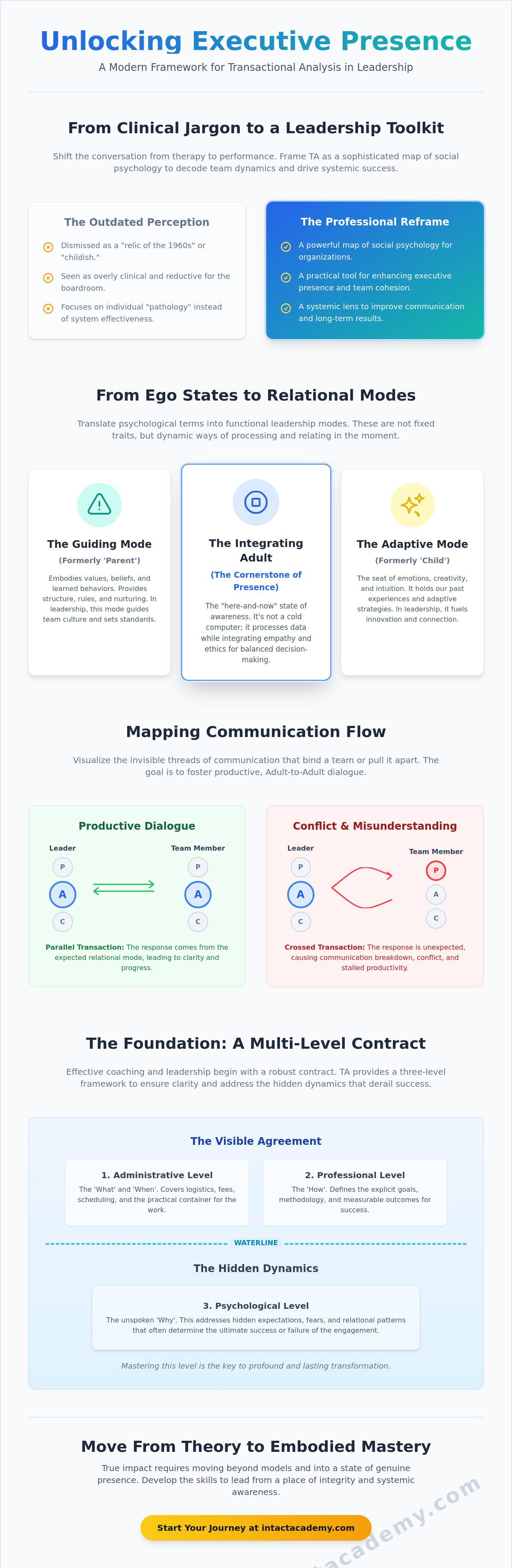
One of the most profound ways to begin is through the contract itself. In TA, we utilize three distinct levels: the Administrative, the Professional, and the Psychological. The Administrative level covers the logistics and fees, while the Professional level defines the goals and methodology. The Psychological level addresses the unspoken expectations and relational dynamics that often derail coaching. A Contract for Change is a mutual agreement for growth where both coach and client are fully committed to the outcome. Using this structure provides a safe container for deep work, demonstrating the model's utility from the very first minute.
Why Professional Pragmatism Matters
Success in the boardroom requires a language for the unsaid. We avoid clinical jargon to ensure the concepts feel accessible and relevant. Instead of discussing pathology, we talk about relational patterns. Instead of ego states, we might use behavioral states or modes of operating. This shift in vocabulary ensures the work remains grounded in professional reality. For those seeking to deepen their impact, the professional development for coaches path offers a structured journey toward systemic mastery. By speaking the language of results, you make the profound depth of TA indispensable to the modern leader.
Demystifying the Three Ego States for the Executive Mindset
When you consider how to explain transactional analysis to clients in a high-stakes environment, the first hurdle is often the terminology itself. Words like "Parent" or "Child" can feel reductive to a seasoned leader. To bridge this gap, we frame these states as Relational Modes. They aren't fixed personality traits; they're dynamic ways of processing information and interacting with the world. This distinction is vital. It shifts the focus from who the leader is to how they're choosing to relate to their team and their challenges in any given moment.
The Adult state is the cornerstone of executive presence. However, we must move beyond the common misconception that the Adult is merely a cold, logical computer. Instead, we present the Integrating Adult. This mode is capable of processing objective data while remaining deeply attuned to empathy and ethical considerations. It's the state of "here-and-now" awareness, where a leader can hold the tension of business requirements alongside the human needs of the organization. Translating TA for professional coaching in this way allows leaders to see the Adult state as a high-functioning integration of their total experience.
The Parent and Child modes are equally essential repositories of data and energy. The Parent state houses the organizational tradition, the "shoulds," and the core values that provide the company's moral compass. Conversely, the Child state is the source of raw data, intuition, and spontaneous energy. By validating these states as functional assets, you help your client move toward a state of wholeness where every part of their experience is available for leadership. If you're looking to deepen your own grasp of these dynamics, exploring a systemic approach to coaching can provide the necessary rigour.
The Parent: Leadership Standards and Cultural Legacy
In management, the Parent mode manifests as either Nurturing or Structuring. A Nurturing Parent provides the psychological safety required for growth, while a Structuring Parent sets the boundaries and standards that ensure excellence. Problems arise when "Critical Parent" energy dominates, as this often stifles innovation and creates a culture of fear. Identifying these nuances is a core component of the TA Foundation Year, where coaches learn to help leaders balance authority with support.
The Child: Innovation, Resilience, and Emotional Intelligence
The Child mode is often the most misunderstood in the boardroom. The "Free Child" is the primary driver of agile transformation, providing the curiosity and creativity needed for breakthrough thinking. In contrast, the "Adapted Child" manifests as either over-compliance or subtle rebellion, both of which can drain organizational momentum. Helping a client access their "Child" intuition allows them to sense market shifts or team tensions before they become visible in the data, making it a critical tool for strategic decision-making.
From 'Games' to 'Systemic Dynamics': Translating TA Concepts for Business
When navigating how to explain transactional analysis to clients, shifting from personal "games" to systemic patterns is essential for professional buy-in. In a clinical setting, we might speak of psychological games as a way to avoid intimacy. In the boardroom, these are more effectively rebranded as Repetitive Ineffective Patterns (RIPs). These are the predictable, recurring sequences of behavior that lead to a "payoff" of frustration, blame, or stagnation. By framing them as patterns rather than personal failings, you allow leaders to analyze the ROI of their interactions with the same rigor they apply to their balance sheets.
Another vital translation involves the concept of "Strokes." We define these as units of recognition. In an organizational context, strokes form the social currency of the culture. A culture starved of positive recognition will inevitably seek out negative strokes because any attention is better than being ignored. This recognition economy dictates everything from employee engagement to retention. Similarly, we introduce Life Scripts not as destiny, but as the Unconscious Strategic Plan. It's the invisible blueprint that guides how an individual, or an entire department, navigates risk and success.
By using these professional metaphors, you help the client see that their relational dynamics are not separate from their business results. They are the engine behind them. This systemic perspective allows for a more profound level of intervention, moving the work from surface-level behavior modification to deep, structural change.
The Drama Triangle in the C-Suite
The Drama Triangle is perhaps the most recognizable TA tool, yet it requires careful handling at the executive level. Consider a manager who constantly "saves" their team by taking over difficult tasks. This Rescuer mode inadvertently creates a Victim workforce that lacks agency. When deadlines are missed, the manager often pivots to Persecutor, blaming the team for the very dependency they fostered. Transitioning to the Winners Triangle or the Empowerment Dynamic requires a shift into the Integrating Adult state. For those looking to facilitate this shift at a high level, an executive coaching certification provides the systemic tools needed to break these cycles and foster true accountability.
Organizational Scripts and Systemic Change
An Organizational Script is the collective "how we do things here." It's the set of hidden rules and permissions that dictate whether a company can truly innovate or if it's bound by the ghosts of past leadership. When leading organizational change, the coach's role is to help the leadership team de-contaminate their Adult state. This means stripping away the outdated beliefs and "scripted" responses that no longer serve the current reality. By rewriting the organizational script, you aren't just changing a process; you're evolving the very DNA of the company.
Practical Scripts and Metaphors for Your First Client Session
The first encounter with a new model often determines its long-term adoption. When considering how to explain transactional analysis to clients, brevity and relevance are your strongest allies. For a CEO, an effective elevator pitch might sound like this: "Transactional Analysis is a framework for mapping the social architecture of your organization. It allows us to observe the invisible relational dynamics that either accelerate your strategic goals or create friction within your leadership team." This positioning moves the conversation away from clinical curiosity and toward operational excellence.
To deepen this understanding, use the Iceberg Metaphor. Explain that observable transactions, the words we speak and the emails we send, are merely the tip. Beneath the surface lies the bulk of the system: the hidden scripts, unspoken rules, and cultural permissions that dictate behavior. When a leader understands the "why" beneath the "what," they gain the power to influence the entire system. This is particularly relevant when discussing the concept of "I'm OK, You're OK." Frame this not as a moral stance, but as the structural basis for psychological safety. You might say, "When we operate from a position where both parties are fundamentally valued and capable, we create a space where truth can be spoken without fear, allowing for faster decision-making and higher accountability."
Finally, introduce the "Discounting" model by linking it to missed market opportunities. Discounting occurs when a team ignores relevant data, minimizes a problem, or overlooks their capacity to solve it. It's the psychological root of strategic blind spots. By identifying where the organization is discounting reality, you provide the client with a tool for reclaiming lost potential and increasing market responsiveness. For those ready to bring this level of insight to their own practice, our Systemic Supervision offers a space to refine these interventions with expert guidance.
The 'Three Circles' Visual Script
In your first session, use a whiteboard to draw three vertically stacked circles. Label them Parent, Adult, and Child. Rather than a lecture, ask a reflective question: "Looking at your most recent board meeting, which circle was leading the conversation?" This visual aid makes the abstract concrete. It allows you to map "crossed transactions," where one person speaks from a Structuring Parent mode and the other responds from an Adapted Child mode, instantly identifying the source of recurring conflict. This simple diagram becomes a shared language for the entire coaching engagement.
The 'Stroke Economy' Metaphor
Social recognition is the currency of your organization. Compare these "strokes" to a wealth-building strategy. A "Wealthy Stroke Economy" is one where positive, specific recognition is abundant, leading to high retention and engagement. Conversely, in a "Poverty Stroke Economy," employees will often subconsciously provoke negative feedback because any attention is more vital for survival than being ignored. Help leaders understand that by consciously directing the flow of recognition, they aren't just being "nice"; they're managing the most volatile and valuable asset in their business.
Cultivating Mastery: The Path to Senior Practitioner and Beyond
Understanding the intellectual framework of how to explain transactional analysis to clients is a vital foundation, yet true mastery lies in the transition from cognitive knowledge to embodied presence. In the high-pressure environment of executive coaching, you are the primary instrument of change. If you aren't operating from a grounded, Integrating Adult state, even the most sophisticated scripts will lose their transformative power. Embodying TA means living the principles of autonomy and awareness, allowing you to hold a stable container for your clients as they navigate their own systemic shifts.
This level of professional maturity requires a commitment to ongoing reflection. Professional supervision is not merely a requirement for accreditation; it's a sanctuary for maintaining Adult clarity. It provides a systemic mirror, ensuring your own unconscious scripts don't become entangled with the relational dynamics of the organizations you serve. By engaging in this process, you ensure that your interventions remain precise, ethical, and deeply impactful. This journey of refinement is what distinguishes a practitioner from a master, leading toward prestigious recognitions such as the EMCC Senior Practitioner level accreditation.
We invite you to join a global community of practitioners who are dedicated to this path of wholeness. It is a space where psychological depth meets professional pragmatism, and where the focus remains steadfastly on the flourishing of individuals and the systems they inhabit. By moving beyond surface-level training, you gain the capacity to facilitate the kind of profound human transformation that modern leadership demands.
Deepening Your Impact with Intact Academy
For those ready to elevate their practice, the TA EMCC Senior Practitioner academy offers a rigorous, systemic journey toward professional excellence. Learning from a master such as Sari van Poelje provides unique insights into the intersection of agile transactional analysis and large-scale organizational change. These programs don't just teach theory; they provide the experiential depth needed to handle the most complex corporate challenges. Targeted workshops also offer opportunities for skill updates, ensuring your methodology remains sharp and relevant.
The Ethical Responsibility of the TA Coach
Working within the social architecture of an organization carries a significant ethical weight. The "Do No Harm" principle is paramount, especially when intervening in entrenched cultural patterns. Systemic supervision plays a critical role here, acting as a safeguard for both the coach and the client system. It ensures that every intervention is designed to return the system to a state of health and genuineness. We encourage you to join the academy today to begin your journey toward facilitating sustainable, systemic transformation that honors the complexity of the human experience.
Empowering Your Systemic Journey Toward Relational Wholeness
The evolution from understanding a model to embodying a methodology defines the path of the senior practitioner. By shifting your language from the clinical to the systemic, you allow your clients to perceive the profound architecture of their own interactions. You've learned to reframe ego states as functional modes and translate complex games into observable patterns. Mastering how to explain transactional analysis to clients ensures that your work remains grounded in professional pragmatism while inviting the human transformation that leads to genuine wholeness.
Your next step is to anchor this knowledge within a supportive, high-level environment. Elevate your coaching with our TA EMCC Senior Practitioner Academy, a rigorous program accredited by both the EMCC and ICF. Led by global expert Sari van Poelje, the academy brings together professionals from 14+ countries to explore the intersection of human behavior and business results. This is your invitation to move beyond surface-level training into a space of deep, systemic mastery. We are honored to walk beside you as you facilitate sustainable change in the world.
Frequently Asked Questions
Is Transactional Analysis too 'simple' for complex corporate problems?
Transactional Analysis is intentionally accessible, yet it possesses a profound depth that allows for the mapping of complex systemic issues. While the visual models are easy to grasp, the underlying theory provides a robust framework for understanding the social architecture of an organization. Leaders often find that this clarity makes the most intricate relational dynamics manageable and actionable during high-stakes strategic shifts.
How do I avoid making my client feel like they are in therapy when using TA?
You avoid the therapeutic tone by focusing strictly on professional effectiveness and organizational outcomes. Reframe clinical terms into business language; use "Relational Modes" instead of ego states and "Repetitive Ineffective Patterns" instead of games. Keep the conversation grounded in how these dynamics influence decision-making, team cohesion, and the overall return on investment for the coaching engagement.
What is the best way to introduce the 'Parent-Adult-Child' model to a CEO?
The most effective approach is to frame the model as a diagnostic tool for leadership presence and executive influence. When considering how to explain transactional analysis to clients at this level, present the three states as different functional modes of operating. This empowers the CEO to see the model as a strategic asset for optimizing their own impact and the team's cultural legacy.
Can I use Transactional Analysis for team coaching as well as 1-on-1 coaching?
Transactional Analysis is exceptionally powerful for team coaching because it maps the collective recognition economy and group scripts. You can use it to identify "crossed transactions" between departments or to decode the hidden rules that dictate how a team handles conflict. It provides a shared language that allows the group to analyze their internal dynamics before taking outward action toward their goals.
How long does it take for a client to start seeing results from TA-based coaching?
Clients typically experience a significant shift in awareness during the very first session as they begin to recognize their own relational patterns. Behavioral changes often become observable within three to six weeks as the client practices moving into an Integrating Adult state. Long-term systemic transformation, such as rewriting a leadership script, usually develops over several months of consistent practice and professional supervision.
What are the common pitfalls when explaining TA to a skeptical client?
The most common pitfall is using clinical jargon that makes the client feel "analyzed" rather than supported in their professional growth. Avoid sounding like a therapist in a boardroom by ensuring every concept is directly linked to a business result. If you over-simplify the model, a sophisticated leader might dismiss it as a psychological curiosity rather than a rigorous tool for professional evolution.
Do I need a specific certification to use TA in my coaching practice?
While there is no legal requirement to use TA concepts, professional mastery and ethical responsibility suggest pursuing advanced training. Learning how to explain transactional analysis to clients effectively requires a depth of knowledge that goes beyond surface-level reading. Programs like the TA EMCC Senior Practitioner Academy provide the systemic rigor and supervision needed to use these tools safely and with confidence in corporate environments.


