

What if the very tactics designed to scale a business are the same ones keeping you locked out of the boardroom? For many seasoned professionals, the standard advice on how to get executive coaching clients feels inherently misaligned with the gravity of the work you actually do. You know that high-level leaders don't respond to aggressive sales funnels or surface-level digital automation. They seek depth, presence, and a partner who understands the intricate, invisible systems they navigate every day.
You likely feel that the closed circles of the C-suite require a different key than a generic marketing pitch. This article shows you how to attract high-level executive clients by shifting from transactional marketing to a depth-oriented, systemic authority model. We will explore how to demonstrate profound impact quickly and build a sustainable practice that honors your professional maturity. You'll learn to move beyond the noise and establish a quiet, authoritative presence that naturally bypasses traditional gatekeepers. By returning to a state of professional wholeness, you can create the resonance required to lead those who lead others.
Key Takeaways
- Learn why traditional digital marketing often fails with the C-suite and how to bridge the "trust gap" through partnership-driven transformation.
- Cultivate a systemic presence to perceive invisible organizational dynamics. This depth allows you to hold space for the most complex executive challenges.
- Discover how to get executive coaching clients by curating systemic intellectual property that resonates with high-level decision-makers.
- Replace standard sales calls with a rigorous contracting session based on Transactional Analysis. This shifts the dynamic to professional partnership from the very first interaction.
- Understand how advanced credentials, such as the EMCC Senior Practitioner academy, act as a professional magnet for global organizations seeking verifiable mastery.
Beyond the Funnel: Why High-Level Executives Seek Depth Over Hype
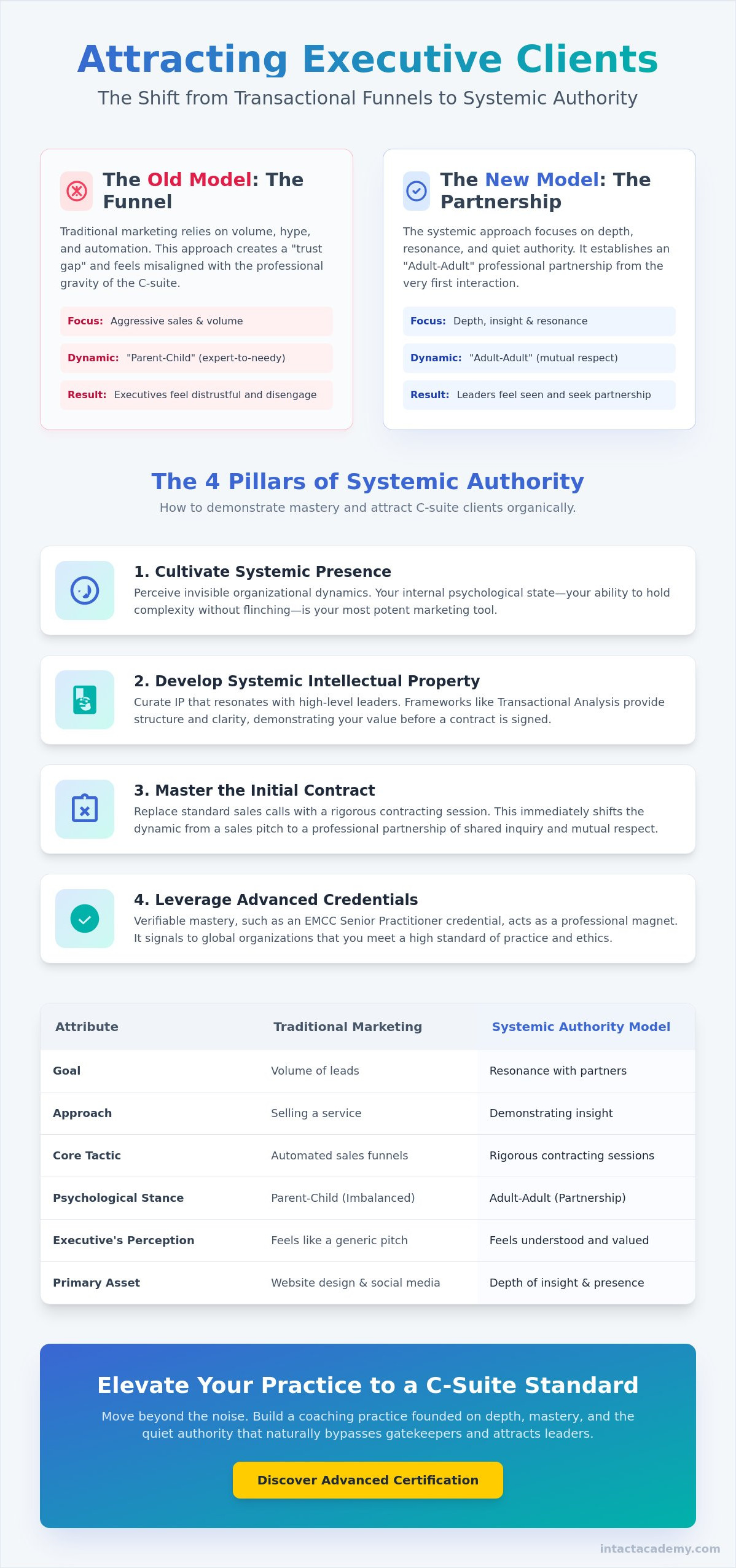
Most marketing strategies for coaches focus on volume. They promise a steady stream of leads through automated funnels and aggressive social media presence. However, high-level leaders don't inhabit these spaces. There is a significant trust gap between the frantic energy of traditional digital marketing and the professional gravity of the C-suite. When you're exploring how to get executive coaching clients, you're not just looking for visibility. You're looking for resonance.
Executives are rarely searching for a service provider. They seek a partner in transformation. They need someone who can step into their world, understand its complexity, and remain unswayed by the power dynamics at play. This shift from "selling" to "demonstrating" is crucial. Your primary marketing asset isn't your website's design; it's the depth of your insight. By showing you can perceive the invisible threads of an organization, you prove your value before a contract is ever signed. Using a what is transactional analysis framework provides the clarity these leaders crave. It offers a structured way to decode human behavior and organizational scripts. This level of psychological rigor separates professional practitioners from those offering surface-level advice.
The Executive Search Pattern
Leaders identify potential partners through the lens of systemic pain points. They don't look for a coach; they look for someone who understands why their executive team is fragmented or why their organizational change initiatives keep stalling. In a loud digital landscape, "Quiet Authority" stands out. It's the ability to speak directly to the core of a problem without hyperbole. Business and executive coaching should be positioned as a high-stakes intervention, not a luxury add-on. Executives prioritize psychological safety over generic leadership tips because the stakes of their vulnerability involve the stability of entire organizational systems.
Transactional vs. Transformational Marketing
Much of today's marketing relies on a "Parent-Child" dynamic. The marketer acts as the all-knowing Parent, while the prospect is treated as the needy Child. This approach is fatal when communicating with executives. To be successful, you must establish an "Adult-Adult" professional connection from the very first touchpoint. This means respecting their autonomy and intelligence. It also requires you to identify the "Psychological Games" often played in the coaching sales process, such as the "Rescue" game where the coach tries too hard to prove their worth. True mastery lies in inviting the client into a space of mutual respect and shared inquiry. This is the most effective way to understand how to get executive coaching clients who are ready for deep, systemic work.
Cultivating Your Systemic Presence: The Psychological Foundations of Attraction
Attraction at the executive level is less about digital visibility and more about the quality of your presence. Systemic presence is the subtle ability to perceive and mirror the invisible dynamics within an organization. It is a state of being that signals to a leader that you are capable of holding the weight of their world. When you understand how to get executive coaching clients, you realize that your internal psychological state is your most potent marketing tool. If your own "Life Script" contains messages of inadequacy or a need to please authority, you will inadvertently signal a lack of the stability required for high-stakes transformation. Adopting the "Wise Mentor" archetype requires a tone that signals global experience and emotional grounding. It invites the client into a space where complex systemic issues feel manageable through insight and structured methodology.
The Coach as a Systemic Mirror
Leaders are often surrounded by people who tell them what they want to hear. They are attracted to the coach who can hold complex, contradictory truths without flinching. This capacity is sharpened through Systemic Supervision, a process that ensures your own biases do not cloud the organizational mirror. Pursuing an executive coaching certification is not just about the credential; it is about the rigorous personal evolution required to meet a CEO as an equal. This level of preparation aligns with the standards found in programs like the Advanced Certification in Executive Coaching at the University of Pennsylvania, which emphasizes the need for evidence-based methodology in professional development. By linking your personal growth to these rigorous standards, you demonstrate a commitment to mastery that gatekeepers respect.
Overcoming the "Imposter" Script
Many coaches struggle to access the C-suite because of unconscious patterns that frame them as "lesser than" the executive. Shifting into a state of "I’m OK, You’re OK"—a core tenet of Transactional Analysis—allows you to enter meetings with a sense of quiet power. Grounding your communication in a steady, rhythmic cadence builds trust more effectively than any sales pitch. It suggests that you are a stable container for change. Presence is the signal. To deepen this internal work, many practitioners find that joining a TA EMCC Senior Practitioner academy provides the psychological framework needed to sustain this presence under pressure. This shift in posture is the most sustainable way to solve the puzzle of how to get executive coaching clients without compromising your professional integrity.
Strategic Authority Building: Demonstrating Mastery in Executive Circles
Authority in high-level coaching is not something you claim; it is something you demonstrate through the clarity and depth of your thinking. When you are considering how to get executive coaching clients, the focus must shift from standard marketing to the curation of unique intellectual property. This involves moving beyond surface-level leadership advice to address the systemic undercurrents that dictate organizational health. By framing your insights through a systemic lens, you signal to the C-suite that you possess the intellectual rigor necessary to handle their most complex challenges.
Strategic speaking also plays a vital role in this process. Choosing stages that signal organizational expertise rather than generic self-help ensures you are seen by decision-makers. It's also helpful to leverage the reputation of established masters like Sari van Poelje. By grounding your practice in proven frameworks like Agile Transactional Analysis, you provide a stable foundation that executives can trust. This alignment transforms your practice from a solo endeavor into a part of a global movement toward professional excellence.
Writing with Psychological Depth
Your written content should reflect the complexity of the executive experience. Instead of "5 Tips for Better Meetings," explore topics like "The Systemic Impact of Unconscious Bias on Boardroom Dynamics." Use anonymized case studies to show your methodology in action. These narratives allow potential clients to see themselves in the struggles you describe and, more importantly, in the solutions you facilitate. By maintaining an Adult-Adult stance in your prose, you invite the reader into a collaborative inquiry rather than a didactic lecture, establishing immediate psychological rapport.
The Power of Systemic Networking
The C-suite operates on a referral engine powered by trust. To tap into this, focus on "Nodes" of influence such as consultants, lawyers, and board members who already hold the trust of your target clients. Practice the art of the "No-Ask" meeting. These are sessions where you build relationships through genuine systemic curiosity rather than a hidden agenda. You can use your ongoing professional development for coaches as a natural talking point. Sharing insights from your latest training demonstrates a commitment to your own growth, which mirrors the evolution you expect from your clients. Ultimately, understanding how to get executive coaching clients is about becoming a visible node within the systems you wish to serve.
The Art of the Initial Contract: Turning Conversations into Engagements
The first meeting with a potential client is often mislabeled as a sales call. In the world of high-stakes leadership, this approach feels invasive and misaligned. If you want to master how to get executive coaching clients, you must shift your perspective from selling a service to facilitating a rigorous contracting session. This process, rooted in Transactional Analysis, establishes your authority and creates a safe container for the work before it even begins. A clear contract reduces the executive's anxiety by providing a structured map of the journey ahead.
A comprehensive agreement involves three distinct layers. The Administrative Contract covers the logistics, boundaries, and financial investment. The Professional Contract defines the specific goals and systemic outcomes the leader hopes to achieve. Finally, the Psychological Contract addresses the unspoken expectations and fears that often derail transformation. By naming these hidden dynamics early, you demonstrate a level of psychological depth that generic coaches simply cannot match. This transparency builds a foundation of trust that transcends the typical vendor relationship.
Mapping the Organizational System
During the contracting phase, your role is to ask the questions that reveal the hidden agendas within the room. Executives rarely operate in a vacuum; they are part of a larger, often turbulent, organizational script. By demonstrating your ability to see the whole system, you position yourself as more than a coach. You become a partner in leading organizational change. This systemic lens allows you to identify where the leader's personal growth intersects with the company's evolution, making your engagement indispensable to the organization's flourishing.
Pricing as a Signal of Depth
In the C-suite, pricing acts as a psychological signal. Underpricing your services is a significant red flag; it suggests a lack of experience or an inability to hold the gravity of executive responsibility. High-level leaders are accustomed to investing in quality. They look for market alignment with established standards, such as those held by an EMCC Senior Practitioner. Instead of focusing on hourly rates, frame your fees around systemic value. When you price based on the magnitude of the transformation you facilitate, you reinforce your position as a master of your craft. To deepen your ability to hold these high-level contracts, consider the specialized training offered in our TA EMCC Senior Practitioner Academy.
Elevating Your Practice: Why Advanced Certification is Your Strongest Magnet
Professionalism in the executive world is often measured by the company you keep and the standards you uphold. While many coaches focus on aggressive sales tactics, the most effective way to understand how to get executive coaching clients is to focus on your own systemic elevation. Advanced accreditation, such as becoming an EMCC Senior Practitioner, serves as a high-level signal to global corporations. It tells them you've moved beyond basic competencies into the realm of professional mastery. This accreditation is more than a badge; it's a commitment to a standard of excellence that global decision-makers recognize and trust.
Expanding your "surface area" through specialized academies in Team Coaching or Systemic Supervision allows you to meet organizational needs at multiple levels. When you offer more than individual interventions, you become a systemic solution provider. There's also a profound psychological safety for an executive in knowing their coach is themselves supervised. It ensures the coach remains a clear, objective mirror, untainted by their own unconscious biases or organizational pressures. Joining a global community of experts further opens doors to international opportunities that are rarely available to solo practitioners.
The TA EMCC Senior Practitioner Academy
Our TA EMCC Senior Practitioner academy is designed to bridge the gap between traditional coaching and systemic consultancy. It provides the psychological frameworks necessary to navigate complex organizational scripts with precision. By joining the Intact Academy international network, you transition from a solo practitioner to a recognized systemic expert. You gain access to a collective wisdom that enhances your ability to hold space for the world's most influential leaders. This shift in identity is often the final piece in the puzzle of how to get executive coaching clients who value depth over hype.
Continuous Mastery as a Client Strategy
Clients are inherently attracted to the "Art of Being a Coach" rather than the "Business of Being a Coach." When you prioritize your own development, you radiate a sense of wholeness that is deeply magnetic. We invite you to explore the TA Foundation Year as a foundational path to this state of professional and personal integration. This journey isn't just about learning new tools; it's about returning to a state of genuineness that resonates with the executives you serve. True authority isn't something you perform. It's something you inhabit. Your clients are waiting for the person you are becoming.
Stepping into Systemic Mastery
True authority in the executive world is not a performance; it's a state of being. By moving beyond the frantic energy of traditional marketing, you create a space for the deep, systemic work that high-level leaders actually require. You've seen how shifting from transactional selling to rigorous contracting establishes immediate trust, and how your own psychological grounding acts as a vital mirror for organizational change. Ultimately, the solution to how to get executive coaching clients lies in the depth of the container you provide for their transformation.
Your evolution as a practitioner is the most sustainable marketing strategy you possess. We invite you to elevate your practice with our TA EMCC Senior Practitioner Academy. Our EMCC and ICF accredited programs are led by global expert Sari van Poelje and attract participants from over 14 countries. This international community offers a stable environment for you to refine your methodology and expand your professional impact. As you return to a state of completeness and professional genuineness, you'll find that the leaders who need your specific depth are already searching for you. The courage to evolve is the same courage you ask of your clients; lead the way by inhabiting your own mastery.
Frequently Asked Questions
How do I reach C-suite executives if I don’t have a massive network?
You reach C-suite executives by positioning yourself as a systemic expert rather than a service provider. Focus on building relationships with nodes of influence, such as board members and legal advisors, who already possess the trust of your target clients. Understanding how to get executive coaching clients without an existing network requires you to demonstrate profound insight into organizational scripts, bypassing traditional gatekeepers through the door of demonstrated authority.
Is it better to focus on a specific niche or be a generalist executive coach?
Focusing on a specific systemic niche is the most effective way to differentiate yourself in a crowded market. While a generalist might handle surface-level leadership tips, a specialist addresses deep-seated organizational patterns or complex leadership transitions. This specialization makes it easier for executives to identify you as the solution to their specific systemic pain points. Mastery in a particular area signals a higher level of professional maturity and intellectual rigor.
Do I really need an EMCC or ICF certification to get high-level clients?
Advanced accreditation acts as a professional magnet and a verifiable standard of quality for global corporations. While the industry remains unregulated, organizations increasingly prioritize coaches with credentials like the EMCC Senior Practitioner. This certification signals that you adhere to a rigorous code of ethics and have undergone deep-dive training. It provides the psychological safety that large organizations require when investing in high-stakes leadership development and organizational change.
How much should I charge for an executive coaching engagement in 2026?
Pricing for executive coaching in 2026 reflects the seniority of the client and the complexity of the intervention. Industry data suggests C-suite hourly rates range from $800 to $3,500 or more. Structured multi-month programs often cost between $5,000 and $30,000, while specialized C-suite level programs can exceed $60,000. Framing fees around systemic value rather than hourly rates ensures your pricing signals the depth and impact of your professional mastery.
What is the most effective way to use LinkedIn for executive client attraction?
The most effective way to use LinkedIn is to share high-level intellectual property that addresses organizational dynamics. Avoid the frantic energy of typical marketing and opt for reflective, Adult-Adult communication. By writing about complex systemic issues, you demonstrate your methodology in action. This approach attracts leaders who are searching for depth and professional pragmatism rather than generic leadership advice, establishing your authority before the first meeting.
How do I handle the "Psychological Games" during the sales process?
You handle psychological games by maintaining an Adult-Adult stance throughout the contracting process. Be aware of the "Rescue" game, where you might feel pressured to over-prove your value or solve problems prematurely. By identifying these unconscious patterns early, you establish a professional boundary that commands respect. This clarity ensures that the engagement begins from a place of mutual autonomy and professional integrity rather than psychological dependency or hidden agendas.
What is the role of coaching supervision in getting more clients?
Coaching supervision plays a critical role in client attraction by ensuring your professional mirror remains clear. It provides a stable container where you can process organizational dynamics and your own psychological responses. When executives know you are supervised, they feel a greater sense of psychological safety. This commitment to your own growth and ethical oversight is a powerful differentiator when discussing how to get executive coaching clients in high-stakes environments.
Can Transactional Analysis really help me in the business world?
Transactional Analysis is an essential framework for decoding the human and organizational scripts that drive business outcomes. It provides a structured methodology for understanding ego states, transactions, and psychological games within a corporate system. By using TA, you offer executives precise insights into why change initiatives stall or why team dynamics fragment. This level of psychological rigor transforms you from a standard coach into a systemic partner in organizational flourishing.


