

Why do so many sophisticated leadership initiatives fail to move the needle on organizational culture? You've likely seen the pattern. A C-suite executive undergoes months of intensive development, only to find their personal growth stifled by the rigid, invisible dynamics of the system they lead. It's a quiet, costly frustration when coaching happens in a vacuum; it remains disconnected from the company's strategic pulse and fails to impact the wider collective. When you're tasked with designing executive coaching programs, the challenge isn't just teaching new skills. It's about ensuring those skills can survive and thrive within the complex architecture of your specific organization.
You already understand that surface-level behavioral changes aren't enough to drive a 700% median ROI or shift a global culture. You're looking for a deeper, more grounded approach. This article provides a framework to master the art of creating programs that align individual psychological evolution with systemic organizational health. We'll explore a methodology for 2026 that moves beyond transactional fixes, showing you how to integrate depth psychology and systemic supervision to turn coaching into a repeatable engine for sustainable, human-centered transformation.
Key Takeaways
- Transition from transactional skill-building to transformational systemic coaching by viewing the executive as an integral part of a larger organizational script.
- Learn a rigorous blueprint for designing executive coaching programs that anchors individual growth in the strategic needs of the entire system.
- Apply Transactional Analysis to decode complex leadership interactions and move toward a more genuine, adult state of professional functioning.
- Shift your evaluation metrics from participant satisfaction to systemic ripple effects that measure the impact on direct reports and cultural health.
- Establish a sustainable foundation for organizational change by integrating deep psychological insights with pragmatic business frameworks.
Beyond Individual Performance: The Systemic Shift in Executive Coaching Design
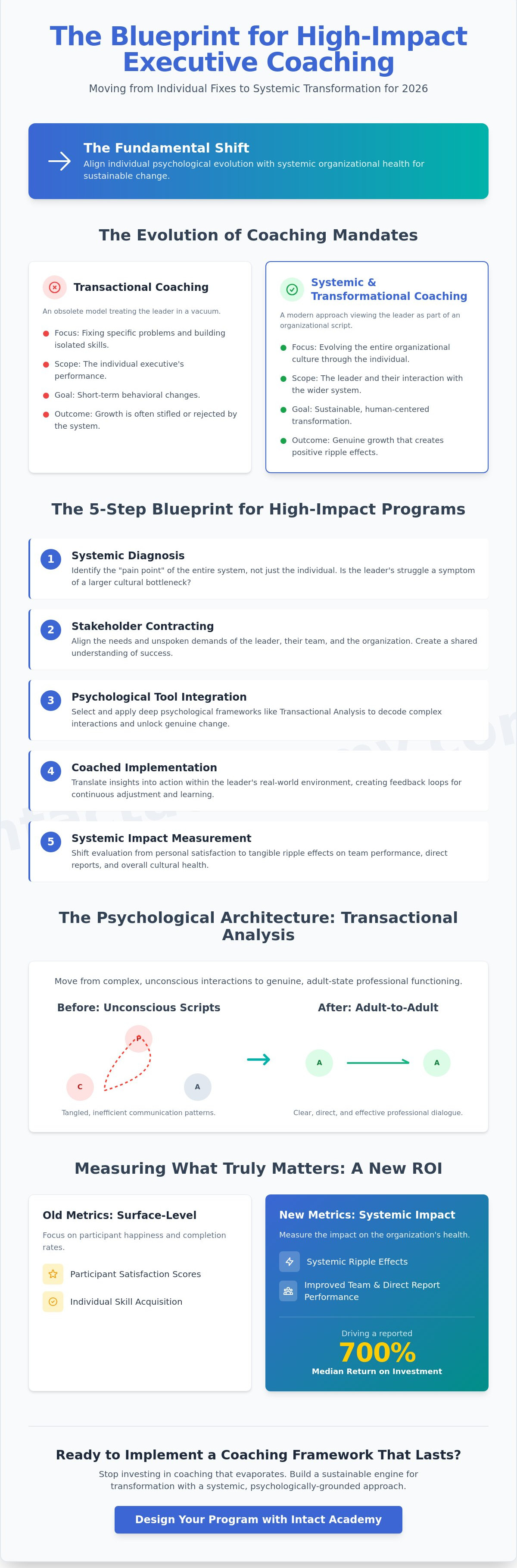
The traditional view of executive coaching often isolates the leader, treating them as a solitary figure whose performance can be optimized in a vacuum. This approach is increasingly obsolete. When designing executive coaching programs for the complexities of 2026, we must recognize that every leader operates within an organizational script. This script is a complex web of history, expectations, and unspoken rules. Systemic executive coaching moves beyond the individual to consider how the leader’s behavior both influences and is influenced by the wider system. It shifts the focus from transactional coaching, which seeks to fix specific problems, toward transformational coaching, which aims to evolve the entire organizational culture through the individual.
Our design goal is wholeness. We aren't just looking for better outputs or more efficient managers. We're looking for leaders who can return to a state of genuineness and completeness. This internal alignment allows them to navigate external volatility with a sense of quiet power. In 2026, the organizations that flourish are those that treat development not as a series of workshops, but as a profound human process that respects the maturity and intelligence of the executive.
The Evolution of the Executive Coaching Mandate
The mandate for coaching has matured significantly. Once viewed as a remedial tool for struggling managers, it has become a vital strategic partnership for high-performing executives. To be effective, the design must ensure that personal development goals are deeply woven into the leading organizational change strategy of the business. By 2026, the focus has moved toward psychological resilience and cognitive agility. Leaders no longer just manage teams; they hold the emotional space for their organizations during periods of rapid transition. This requires a shift from surface-level training to a structured methodology that addresses the person and the professional as one entity.
The Systemic Lens: Seeing the Unseen
A systemic lens allows a coach to identify the unconscious patterns that govern how a company functions. While many people understand what is executive coaching in a general sense, few realize its potential as a lever for cultural change. A single coaching engagement can ripple through an entire department. By mapping power dynamics and influence, the coach helps the executive see the "unseen" forces at play. This awareness is critical when designing executive coaching programs that aim for lasting impact. It ensures that growth is not just a temporary spike in performance, but a fundamental shift in the way the organization breathes and evolves. This process builds a stable container for the often-turbulent work of professional change.
A Strategic Blueprint for Designing High-Impact Executive Coaching Programs
How do we build a program that doesn't just sit on a shelf but lives within the organization? Success isn't found in the sessions themselves; it's found in the quiet, methodical work of aligning the needs of the leader with the unspoken demands of the organization. When designing executive coaching programs, we must move beyond the leader's personal goals and begin with a systemic diagnosis. We identify the "pain point" of the whole system. Is the leader's struggle a reflection of a cultural bottleneck? If we don't address the organizational script, the individual's growth will eventually be rejected by the system, much like a biological graft that doesn't take.
Our methodology follows a five-step arc that ensures depth and durability. While frameworks like Harvard's Executive Coaching Framework emphasize evidence-based methods and neuroscience, our blueprint adds the critical layer of systemic psychology. We move from diagnosis to stakeholder contracting, then to the selection of psychological tools like Transactional Analysis. We then establish a safe container through supervision and, finally, anchor the learning back into daily operations. This structured approach is the core of designing executive coaching programs that endure.
Contracting for Change: The Foundation of Success
The contracting phase is frequently the most overlooked element of professional development for coaches. It's here that we manage the delicate balance between organizational expectations and coachee confidentiality. A solid three-way contract between the coach, the executive, and the organization defines what success looks like before the first session begins. Without clear "success indicators" established at this stage, the ROI remains a vague concept rather than a measurable reality. If you're ready to deepen your own practice, exploring advanced systemic methodologies can offer the clarity needed for this complex work.
Selecting Your Coaching Modality
Choosing the right format is as important as the content itself. You must decide when to employ 1-on-1 sessions and when the situation calls for systemic team coaching. For global executive teams, a blend of virtual and in-person sessions often provides the necessary flexibility without losing the emotional weight of face-to-face interaction. This selection process should always align with the highest executive coaching certification standards, ensuring that the modality supports long-term transformation rather than a quick, temporary fix.
The Psychological Architecture: Integrating Transactional Analysis into Program Design
If the blueprint is the structural design of your intervention, psychology is the living energy that flows through it. Most initiatives fail because they treat the executive as a logical processor rather than a complex human being driven by unconscious patterns. When designing executive coaching programs, we must look beneath the surface of behavior to understand the social and internal dynamics at play. This is where we introduce what is transactional analysis (TA) as a foundational tool. TA provides a precise map for executive interactions, allowing us to see why certain communications flourish while others collapse into conflict or stagnation.
At the heart of this framework are the Three Ego States: Parent, Adult, and Child. In a leadership context, these aren't just theoretical concepts; they are the literal building blocks of executive presence. A leader who operates primarily from a "Critical Parent" state may achieve short-term compliance, but they simultaneously erode the psychological safety of their team. Conversely, a leader trapped in a "Child" state might struggle with accountability or decision-making under pressure. By integrating these concepts into our design, we give leaders the language to recognize their own internal shifts and return to a grounded, "Systemic Adult" state. This state is where genuine leadership resides; it's a place of clarity, responsiveness, and maturity.
Ego States and Executive Presence
Effective program design helps leaders move toward a "Systemic Adult" functioning. This isn't about suppressing emotion; it's about developing the capacity to observe one's own ego state shifts in real-time. We teach executives to identify the physical and linguistic markers of the "Critical Parent" or the "Adapted Child." When a leader can pause and consciously shift back into their Adult state, they transform the quality of the entire room. This shift is a prerequisite for creating a stable container where teams can engage in deep, honest work without the fear of judgment or the need for defensive posturing.
Decoding Organizational Scripts
Every executive carries a "Life Script," a set of unconscious beliefs formed early in life that dictates how they handle success, failure, and risk. When designing executive coaching programs, we must also consider how these individual scripts intertwine with the "Organizational Script." Often, the "Founder’s Script" continues to govern a company long after the founder has departed. If the original narrative was one of "us against the world," the current C-suite may find themselves unconsciously manufacturing crises to maintain that familiar identity. Using TA to rewrite these dysfunctional narratives is the key to systemic transformation. It allows the leadership team to move away from repetitive "Psychological Games" that drain organizational energy and move toward a state of collective wholeness and genuineness.
Measuring the Unmeasurable: Assessing Systemic Transformation and ROI
How do we quantify the evolution of a human system? The traditional reliance on "Happy Sheets"—those end-of-program satisfaction surveys—is a poor metric for true success. While an executive might enjoy the process, the real value lies in the ripple effect. If the coaching doesn't fundamentally change how the executive interacts with their direct reports, the investment has failed to reach its potential. When designing executive coaching programs, we must look beyond individual comfort to find evidence of systemic movement. According to the International Coaching Federation, companies investing in coaching report a median ROI of 700%, but this figure is only achievable when the program design accounts for cultural health and long-term behavioral shifts.
We measure the unmeasurable by shifting from purely quantitative data to a blend of systemic interviews and cultural assessments. We track how the executive’s growth influences the psychological safety of their entire department. Are teams more willing to take calculated risks? Is there a measurable increase in retention among high-potential talent? To ensure this impact remains consistent, we integrate systemic supervision into the framework. This practice acts as a mirror for the coach and the organization, ensuring that the work stays aligned with the strategic goals and doesn't drift into surface-level problem-solving.
The ROI of Psychological Safety
A central goal in designing executive coaching programs is the creation of psychological safety. We use 360-degree Systemic Feedback to track how a leader’s ego state shifts are perceived by those they lead. When a leader moves from a Critical Parent to an Adult state, the team's innovation capacity often expands as the fear of judgment recedes. Eliminating the hidden costs of Psychological Games directly translates to preserved organizational energy and a significant reduction in the expensive turnover of high-performing leaders who value transparency. If you want to build this level of depth into your internal initiatives, you can partner with Intact Academy to master these systemic measurement tools.
Long-term Sustainability and Cultural Integration
The ultimate test of any program is whether it changes the "DNA" of the leadership team. Sustainable transformation requires that the coaching culture outlives the initial intervention. We achieve this by building peer coaching and internal mentoring loops directly into the program architecture. This ensures that the new, healthier narratives developed during the coaching sessions become the standard operating procedure for the firm. By fostering this level of integration, the organization moves toward a state of wholeness where individual growth and strategic success are no longer viewed as separate endeavors, but as two sides of the same coin.
Scaling for Sustainability: Implementing Your Framework with Intact Academy
The transition from a theoretical blueprint to a living, breathing organizational reality requires more than just intent; it requires a specialized mastery of both the human psyche and systemic dynamics. When designing executive coaching programs at scale, the complexity multiplies. You're no longer managing a single relationship, but a network of shifting ego states and organizational scripts. Intact Academy was founded to bridge this specific gap, offering a space where deep psychological insight meets the uncompromising pragmatism of global business. Through the leadership of Sari van Poelje, we guide organizations through the often-turbulent process of systemic change, ensuring that transformation is not just a temporary state but a permanent evolution toward wholeness.
For those responsible for the internal architecture of development, the TA EMCC Senior Practitioner academy provides the rigorous training necessary to lead these initiatives. Accredited programs through bodies like the EMCC and ICF are essential for internal coaching pools. They provide a shared language and a standardized level of ethics and competence. Without this foundation, even the most well-intentioned programs can become fragmented and lose their systemic impact over time. By grounding your internal coaches in these global standards, you ensure that the coaching remains a stable, reliable force for change.
Professional Mastery and Global Standards
The EMCC Senior Practitioner level is widely considered the gold standard for those designing executive coaching programs for complex, multi-layered organizations. This level of certification signifies a move beyond basic competency into the realm of professional mastery. To maintain the integrity of large-scale programs, the TA EMCC Senior Supervisor academy plays a critical role. It provides the necessary oversight and reflective space for coaches to process their work within the system. Joining our global community of practice allows change agents to share insights and refine their methodology alongside other experienced mentors committed to human flourishing.
Next Steps: From Design to Action
The journey toward systemic transformation begins with a quiet, honest audit of your current initiatives. Do your programs truly account for the organizational script, or are they merely treating symptoms? Ask yourself: is your current framework fostering "Adult-Adult" transactions across the hierarchy, or is it inadvertently reinforcing old, Parent-Child dynamics? If you're ready to move beyond transactional fixes, we invite you to explore our professional academies and transform your coaching strategy today. This is your opportunity to build a stable container for genuine growth and lasting cultural change.
The Future of Organizational Flourishing: From Individual Growth to Systemic Wholeness
The landscape of leadership development is moving toward a state of deeper integration and maturity. By 2026, the organizations that thrive will be those that recognize the executive not as an island, but as a catalyst for the entire system. Designing executive coaching programs with this systemic and psychological lens ensures that your investment moves beyond temporary performance spikes to create a culture of genuine, Adult-to-Adult communication. You now have the blueprint to move from diagnosis to integration, using tools like Transactional Analysis to decode the hidden scripts that often hold teams back.
True mastery requires a stable container for learning and a commitment to global standards. Our EMCC and ICF Accredited Programs are led by global expert Sari van Poelje and have welcomed participants from over 14 countries. It's time to join this community of practice and deepen your impact as a change agent. Master Systemic Coaching with the TA EMCC Senior Practitioner Academy. The work of transformation is often turbulent, but with a structured methodology, you can guide your organization toward a state of lasting completeness and flourishing.
Frequently Asked Questions
What are the key elements of an effective executive coaching program design?
Effective design requires systemic diagnosis, clear stakeholder contracting, the selection of appropriate psychological frameworks, and a structured integration phase. These elements ensure that designing executive coaching programs isn't just about the individual; it's about the health of the entire organizational system. By aligning personal growth with strategic goals, the program becomes a stable container for sustainable transformation.
How does Transactional Analysis improve executive coaching outcomes?
Transactional Analysis (TA) improves outcomes by providing a precise map of interpersonal dynamics through the lens of ego states and life scripts. It allows leaders to move from "Critical Parent" or "Adapted Child" states into a grounded "Adult" state. This awareness helps executives stop repetitive psychological games that drain organizational energy, fostering more genuine and productive transactions across the hierarchy.
What is the difference between transactional and systemic executive coaching?
Transactional coaching focuses on fixing specific behavioral problems or acquiring isolated skills to meet immediate targets. In contrast, systemic coaching views the leader as part of an organizational script, aiming to evolve the culture by shifting the leader’s impact on the collective. While transactional work is often remedial, systemic work is transformational, seeking a state of wholeness that benefits the entire firm.
How do you measure the ROI of a large-scale executive coaching initiative?
Measuring ROI requires tracking the "ripple effect" of coaching on an executive's direct reports and the wider cultural health. You should use systemic 360-degree feedback and qualitative interviews to assess increases in psychological safety, team innovation, and talent retention. These metrics move beyond simple participant satisfaction. They show how the intervention has fundamentally changed the organization's behavioral DNA.
Why is contracting so important when designing a coaching program?
Contracting is the most critical phase when designing executive coaching programs because it establishes the boundaries and success indicators for the engagement. It involves a three-way agreement between the coach, the executive, and the organization to ensure alignment on strategic goals while protecting confidentiality. Without a solid contract, the coaching risks happening in a vacuum, disconnected from the very system it intends to change.
How long should an executive coaching program last to ensure sustainable change?
A typical executive coaching program lasts between six and twelve months to ensure that new behaviors are anchored into the organizational script. While short-term interventions can address specific skills, deep psychological shifts and cultural integration require a steady, methodical rhythm. This timeframe allows the leader to navigate various systemic challenges while maintaining the support of a coach and supervisor.
Can executive coaching programs be delivered effectively online?
Online delivery is highly effective for global executive teams, provided the digital space is curated to maintain psychological safety and emotional depth. Virtual sessions offer flexibility and allow for more frequent, bite-sized interactions that can be integrated into the leader's daily operations. The key is to ensure the coach remains a stable, empathetic presence, regardless of the medium used for the session.
What accreditation should I look for when choosing a coaching academy for my team?
You should prioritize academies that offer EMCC or ICF accredited training. Specifically, look for the EMCC Senior Practitioner level for those leading internal program design. These global standards ensure that the training is grounded in rigorous ethics, proven psychological methodologies, and a commitment to professional mastery. This foundation is essential for maintaining the integrity of large-scale systemic initiatives.


