

What if the colleague who consistently hijacks your meetings isn't actually the problem, but rather a symptom of a deeper systemic imbalance? Learning how to handle a dominant team member often feels like an exhausting exercise in conflict management; however, the solution rarely lies in simple behavioral correction. With 85% of employees experiencing workplace conflict, often rooted in personality clashes and ego, the drain on collective energy is immense. You've likely felt the weight of that heavy silence when a strong personality takes over, watching as your team's engagement dissolves into quiet frustration or disengaged compliance.
It's natural to feel "walked over" or drained by these dynamics, but there's a more profound way to reclaim the room. This article promises to transform your perspective, offering a sophisticated framework to move beyond surface-level fixes toward sustainable change. We'll explore how Transactional Analysis and systemic coaching can shift your team from reactive patterns into clear, Adult communication. By understanding the psychological games at play, you can evolve dominance into collaborative power and return your team to a state of genuine, productive wholeness.
Key Takeaways
- Shift your perspective from managing a personality to understanding dominance as a systemic interaction. It's about filling the accountability vacuum that allows one voice to prevail.
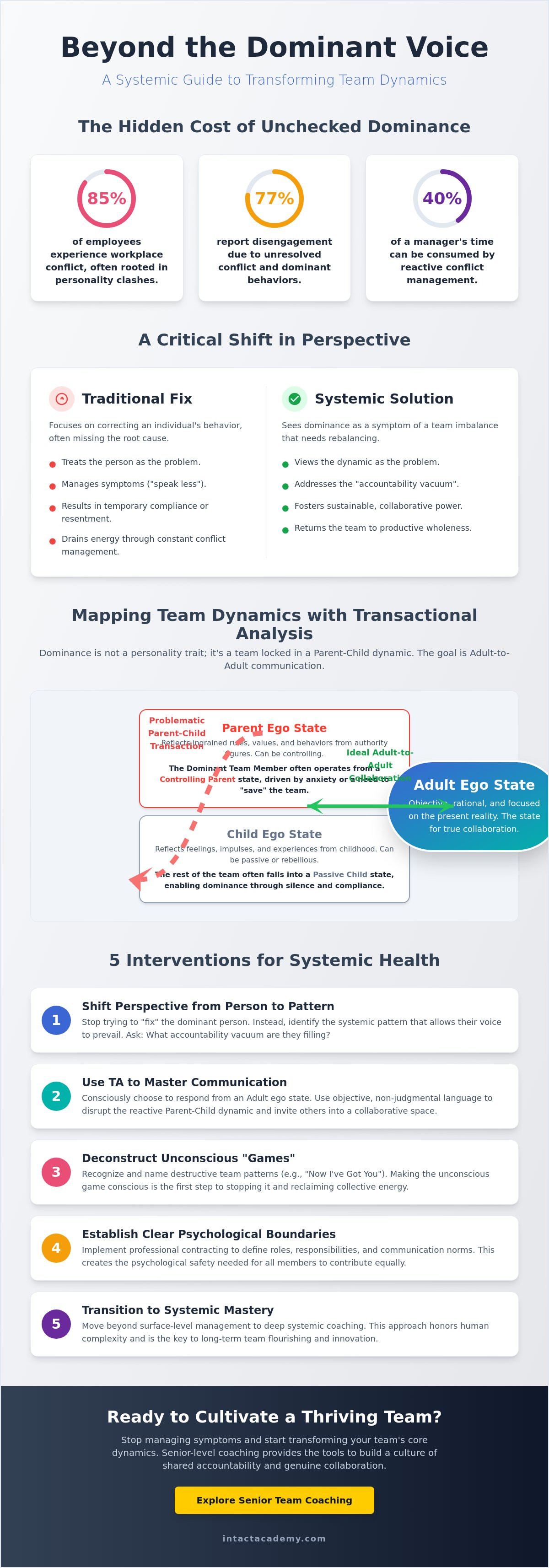
- Use Transactional Analysis to map ego states, helping you master how to handle a dominant team member through Adult-to-Adult communication. This prevents the team from slipping into reactive Parent-Child dynamics.
- Deconstruct the unconscious "games" that keep teams stuck, such as the "Now I've Got You" pattern. Identifying these cycles is key to stopping them before they drain your collective energy.
- Establish clear psychological boundaries through professional contracting and non-judgmental observation. These tools move the group from temporary compliance toward sustainable, collaborative power.
- Transition from surface-level management to systemic transformation by leveraging the depth of senior-level coaching and supervision. This approach honors the complexity of human behavior for long-term flourishing.
Beyond Management: Understanding the Systemic Root of Dominance
Most traditional management advice treats a dominant personality as an isolated behavioral problem to be corrected through discipline or feedback. However, when we consider how to handle a dominant team member from a psychological perspective, we must view the individual as part of a living system. Dominance is rarely a solo performance; it is an interactive process where one person's volume is amplified by the collective silence of the group. When one voice consistently fills the room, it creates a systemic vacuum of accountability where other members subconsciously abdicate their responsibility to contribute, leading to the 77% of employees who report disengagement due to workplace conflict.
Traditional boundary setting often fails with highly dominant individuals because it addresses the "what" rather than the "why." If a leader simply tells a person to "speak less," they are managing a symptom without addressing the underlying script. To achieve sustainable change, we must shift our focus from fixing the person to rebalancing the team system. This requires moving away from reactive conflict management, which already consumes up to 40% of a manager's time, toward a proactive model of systemic health.
The Illusion of the 'Strong Leader'
In many corporate environments, we mistakenly reward dysfunctional dominance as "strong leadership." While healthy assertiveness is rooted in clarity and respect, dominance is often a mask for underlying anxiety or a perceived lack of psychological safety. A team member might dominate because they don't trust the system to hold the weight of a project or because they feel an internal pressure to "save" the team from failure. Dominance is a symptom of systemic imbalance in organizational scripts. By understanding Transactional Analysis ego states, we can see that a dominant member is often stuck in a "Controlling Parent" mode, attempting to manage their own stress by over-functioning for the entire group.
Why Teams Enable Dominance
A dominant voice cannot survive without a "Passive Recipient." When a team falls into a pattern of silence, they are not just being polite; they are participating in a cycle that fuels the very behavior they resent. This dynamic often triggers a "Rescue" cycle, where a manager steps in too late or with excessive force, further destabilizing the team's sense of autonomy. This fragmentation destroys the team's wholeness. When personality clashes and egos drive the narrative, as they do for 49% to 87% of professionals in conflict, the team loses its ability to innovate. True collaboration requires every member to step out of their "Child" or "Passive" roles and into a shared "Adult" responsibility for the group's direction.
The Transactional Analysis Lens: Mapping Ego States in Team Dynamics
To truly understand how to handle a dominant team member, we must look beneath the surface of their behavior and into the psychological architecture of their interactions. Transactional Analysis (TA) offers a precise map for this through the concept of Ego States. These are consistent patterns of feeling and experience directly linked to corresponding patterns of behavior. In a team setting, these states dictate who holds the floor, how they hold it, and the emotional residue they leave behind. When dominance occurs, it isn't just a loud voice; it's a specific ego state attempting to colonize the collective space.
The goal of any high-performing team is to operate from the "Adult" state. This state is characterized by objective, non-judgmental communication that is rooted in the present reality. Unlike the Parent or Child states, which are echoes of past experiences and inherited scripts, the Adult state allows for genuine collaboration and problem-solving. When a team regresses, it loses its ability to innovate, falling instead into predictable and unproductive rituals that drain the organization's vitality.
Identifying the Controlling Parent
The dominant member often operates from the "Controlling Parent" state. While the "Nurturing Parent" provides necessary structure and encouragement, the Controlling Parent seeks to restrict, judge, and direct others through an authoritarian lens. You'll recognize this through specific cues: a tone heavy with "shoulds" and "musts," a tendency to interrupt, or an air of condescension that treats colleagues as subordinates. By understanding what is transactional analysis, leaders can begin to map these transactions in real time, identifying the exact moment a professional discussion shifts into a power struggle. This awareness is the first step toward reclaiming the team's shared authority.
The Transactional Crossing
When one person occupies the Parent role, they subconsciously invite others to respond from an "Adapted Child" state. In this mode, the rest of the team may become overly compliant, hesitant to share dissenting views, or quietly rebellious. This creates a complementary but dysfunctional loop. A dominant transaction requires a submissive counterpart to survive. If the team remains in a "Child" response, the dominance is reinforced. Breaking this cycle requires a "crossed transaction," where the leader or another team member responds from their "Adult" state, refusing to play the counterpart. For those ready to lead this shift, the TA EMCC Senior Team Coach Academy offers a path to mastering these complex human systems. Moving to Adult-to-Adult communication isn't just about politeness; it's about returning the team to a state of psychological wholeness and operational excellence.
Deconstructing the 'Game': Why Teams Enable Dominant Personalities
Dominance isn't a static trait; it's a series of repetitive, unconscious interactions known in Transactional Analysis as "Games." These patterns keep teams stuck in a cycle of frustration and hidden agendas. When you're figuring out how to handle a dominant team member, you're actually looking for a way to stop a game you didn't know you were playing. Every game ends with a "payoff," which is a familiar, though often unpleasant, emotional state that reinforces a person's view of themselves and others. For the dominant member, this payoff is usually a sense of superior control that masks a deeper fragility.
One of the most destructive patterns is the "Now I've Got You" (NIGYSO) game. In this scenario, the dominant individual waits for a colleague to make a minor error, then uses that mistake to assert total authority and moral high ground. The payoff is the feeling of being "I'm OK, You're Not OK." This dynamic creates a culture of fear where innovation dies because the cost of a mistake is systemic humiliation. It's a game that thrives in the absence of clear psychological contracts between team members.
Spotting the Persecutor Role
Within the Drama Triangle, the dominant member usually occupies the Persecutor role. This isn't necessarily because they're "mean," but because their internal script dictates that being a Persecutor is the only way to avoid the vulnerability of the Victim role. Teams often invite this behavior by failing to provide clear structural boundaries or by having members who default to the "Rescuer" or "Victim" positions. As Sari van Poelje emphasizes in her work on agile TA, systemic change requires us to look at the underlying architecture of these invitations rather than just the surface behavior. When the system changes, the individual must either adapt or find that their old scripts no longer work.
Breaking the Script
To break the cycle, you must identify the "Switch," which is the moment the interaction shifts from a professional task to a psychological game. If you cross the transaction by remaining in your Adult state, the game cannot continue. This moves the team toward the Winners Triangle, where Persecution is replaced by healthy Assertiveness. Understanding how to handle a dominant team member involves recognizing their "Life Script," the unconscious plan they've followed since childhood. When you see the script, the behavior becomes manageable data rather than an emotional threat. You're no longer reacting to a "bully"; you're responding to a person stuck in a limiting, repetitive pattern.
Strategic Interventions: Moving from Conflict to Adult-to-Adult Collaboration
Understanding the psychological undercurrents of the system is essential, but the transition to a high-performing culture requires concrete, strategic action. When considering how to handle a dominant team member, we must move beyond surface-level "ice breakers" or soft redirections that are often dismissed in high-stakes executive environments. Instead, we employ the rigorous methodology of Transactional Analysis to re-establish the team's equilibrium. This process isn't about suppression; it's about inviting every individual back into their Adult ego state where true collaboration resides.
Effective intervention follows a structured four-step process designed to break the "Game" and return the group to wholeness:
- Step 1: Naming the dynamic. Make an objective Adult observation. For example, "I notice that we've focused on one perspective for the last twenty minutes, and I'm curious what other voices are present in the room."
- Step 2: Re-contracting. Explicitly redefine the rules of engagement. This might involve setting time limits for contributions or clarifying decision-making rights before the discussion continues.
- Step 3: Offering Strokes. In TA, a "stroke" is a unit of recognition. Offer positive strokes for collaborative behavior rather than dominant behavior. Recognize when the dominant member listens or invites others in.
- Step 4: Using Systemic Questions. Shift the focus from the individual to the group. Ask, "What is the team losing when we don't hear from everyone?" This invites the whole team back into a shared responsibility for the outcome.
Effective Contracting for Team Meetings
The most powerful tool for preventing dominance is the multi-party contract. This involves three distinct layers: the Administrative contract (logistics and timing), the Professional contract (goals and outcomes), and the Psychological contract (how we will be with each other). Explicit contracting prevents the 'Controlling Parent' state from taking over. By making the unspoken rules of the room visible and agreed upon, you remove the "vacuum of accountability" that a dominant voice naturally seeks to fill. For those leading these transitions, our TA EMCC Senior Practitioner academy provides the depth needed to facilitate these complex agreements.
Facilitating the 'Adult' Shift
To pull a dominant member back into their Adult state, use linguistic tools that favor inquiry over advocacy. Instead of countering their Parent-style "shoulds" with your own, ask for data: "What specific evidence leads to that conclusion?" This requires the individual to engage their analytical Adult. You can also employ the "Pause and Reflect" technique, using silence as a systemic intervention. A deliberate five-second pause after a dominant outburst often creates the necessary space for the system to reset. By integrating these leading organizational change principles, you transform a meeting from a power struggle into a sophisticated dialogue between mature professionals.
Cultivating Systemic Mastery: The Path to Senior Team Coaching
Achieving lasting organizational change requires more than just a repertoire of techniques; it demands a profound evolution in the practitioner's own internal state. While we've explored the mechanics of how to handle a dominant team member, the ultimate success of these interventions often hinges on the coach's or leader's ability to remain grounded in their own Adult ego state. Mastery begins within. It's the transition from merely managing surface behaviors to transforming the underlying systemic scripts that define a team's potential for wholeness and innovation.
Transactional Analysis provides more than a temporary fix. It offers a lifelong toolkit for understanding the intricate dance of human behavior within complex systems. As you move beyond the exhaustion of constant conflict management, you begin to see every interaction as an opportunity for growth. This journey toward systemic mastery is what distinguishes a transactional manager from a transformational leader who can return an entire organization to a state of genuineness and collective power.
The Role of Supervision in High-Stakes Coaching
When a coach or leader steps into a room where one voice has long silenced the others, they aren't merely observing a dynamic; they're entering a field of intense psychological pressure. Without a stable container to process this experience, the coach may fall victim to "counter-transference." This occurs when the coach unconsciously reacts to the dominant member's Parent state by slipping into their own Child state, or perhaps by becoming an over-functioning Rescuer. This is why systemic supervision is indispensable. It provides the necessary space to process team toxicity and ensures the practitioner remains an objective, empathetic force for change. Prioritizing professional development for coaches in 2026 means recognizing that your internal stability is your most powerful tool in navigating how to handle a dominant team member.
Mastering the Art of Systemic Impact
The path to the Senior Practitioner level involves a shift from understanding theory to facilitating sustainable transformation. Our approach at the TA EMCC Senior Team Coach Academy focuses on the integration of profound psychological depth with professional pragmatism. We move beyond simple "tips" to explore the very architecture of organizational scripts. This ensures that the behavioral changes you facilitate aren't just temporary compliance but deep-seated evolutions in how the team relates to power and one another. If you're ready to deepen your impact and lead teams toward a state of complete operational and human flourishing, it's time to embrace a higher level of professional rigor. Explore our TA EMCC Senior Team Coach Academy for deeper systemic mastery.
Reclaiming the System: From Dominance to Collective Wholeness
Transitioning from reactive conflict to systemic health requires a fundamental shift in how we perceive power. You've discovered that dominance is often a cry for structure or a symptom of an accountability vacuum rather than a fixed personality trait. By mapping ego states and identifying the underlying psychological games, you can move beyond temporary compliance toward sustainable behavioral change. Mastering how to handle a dominant team member isn't about winning a power struggle; it's about returning the group to a state of Adult autonomy and shared responsibility.
This journey toward profound human transformation is a path we walk together. At Intact Academy, we provide EMCC and ICF accredited programs designed for those ready to move from surface-level management to deep systemic mastery. Led by international expert Sari van Poelje, our training has empowered professionals from over 14 countries to lead with depth, integrity, and insight. Master the art of systemic coaching at Intact Academy and transform the way you facilitate organizational change.
You have the capacity to lead this evolution. By choosing to look beneath the surface of behavior, you're not just solving a workplace problem; you're cultivating a space where every individual can flourish and the whole team can thrive in genuine connection.
Frequently Asked Questions
How do you tell someone they are being too dominant without offending them?
The most effective approach is to offer a neutral, Adult observation regarding the systemic impact of their behavior rather than critiquing their personality. You might say, "I notice our discussion has centered on one perspective for the last fifteen minutes, and I'm curious about the voices we haven't heard yet." This shifts the focus from personal blame to collective responsibility, inviting the individual to reflect on the room's equilibrium without triggering a defensive Parent-Child dynamic.
Can a dominant team member ever become a truly collaborative leader?
Yes, transformation is entirely possible when the individual gains awareness of the unconscious scripts and Ego States driving their need for control. By moving from a Controlling Parent state into a state of Adult awareness, they can learn to repurpose their natural drive for the benefit of the group. This evolution requires a commitment to psychological growth and a shift from seeking individual validation to fostering a culture of collective flourishing.
What is the difference between a 'dominant' and a 'toxic' team member?
Dominance is often a systemic over-functioning where a member fills a structural vacuum, whereas toxicity involves a persistent pattern of undermining the psychological safety of others. A dominant person may still hold the team's goals at heart but lacks the tools for inclusive engagement. Toxicity, however, often stems from deeper scripts that prioritize personal power over organizational health, requiring much firmer systemic boundaries and, occasionally, clinical or disciplinary intervention.
How does Transactional Analysis help in managing team conflicts?
Transactional Analysis provides a precise methodology for mapping the Ego States present during a conflict, allowing you to see exactly where a transaction has "crossed." By identifying these patterns, you can stop the repetitive "Games" that keep teams stuck in unproductive loops. This framework is essential when learning how to handle a dominant team member because it depersonalizes the conflict, turning a heated emotional struggle into a manageable systemic puzzle.
What should I do if the dominant person is my boss?
When the dominance comes from a superior, the strategy must focus on clear psychological contracting and inviting them into an Adult-to-Adult dialogue. You can ask clarifying, data-driven questions that require logical processing, which naturally pulls them out of a Controlling Parent state. Establishing clear boundaries around your own decision-making rights helps rebalance the power dynamic. It provides a stable framework for how to handle a dominant team member in a position of authority.
Why do some teams seem to 'want' a dominant leader to take over?
Teams often subconsciously invite dominance to avoid the collective anxiety that comes with shared accountability and the weight of decision-making. By allowing one person to take over, the group enters a passive "Adapted Child" state, abdicating their own power to avoid the risk of failure. While this creates a temporary and false sense of safety, it ultimately leads to the high rates of disengagement and systemic silence that stifle organizational innovation.
How can I facilitate a meeting where one person does all the talking?
Effective facilitation requires you to fill the structural vacuum before a dominant voice can colonize the shared space. Implementing clear Administrative contracts, such as timed contributions or structured "round-robin" feedback sessions, ensures every voice is heard. If an individual interrupts, a calm but firm Adult intervention can return the focus to the agreed-upon process. This maintains the integrity of the meeting and protects the team's collective intelligence from being overshadowed.
What are the first steps to becoming an EMCC-accredited team coach?
The journey begins with choosing an accredited training path that emphasizes both psychological depth and systemic methodology. Enrolling in a foundational program, such as our TA EMCC Senior Team Coach Academy, provides the rigorous framework needed for professional mastery. You'll move beyond surface-level coaching into the realm of profound human transformation, gaining the credentials and the internal stability required to lead high-stakes organizational change and facilitate complex team dynamics with confidence.


