

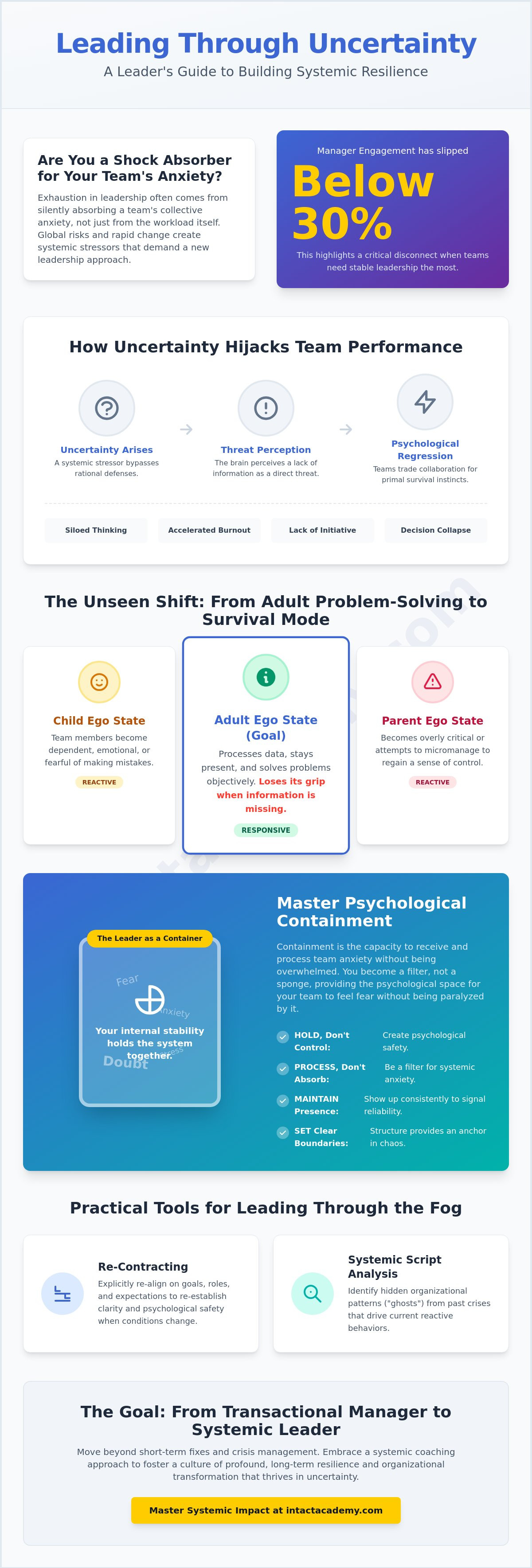
What if the exhaustion you feel isn't from the work itself, but from acting as a silent shock absorber for your team's collective anxiety? With 2026 risks like cyberattacks and economic downturns weighing heavily on every meeting, knowing how to lead a team through uncertainty requires more than just strategic pivots; it demands a shift in your internal posture. It's natural to feel the weight of this responsibility, especially when manager engagement has slipped below 30 percent and the pace of global change seems to outstrip our human ability to adapt.
You don't have to carry the burden of being the sole provider of certainty. This article explores how to move beyond surface-level management to provide deep psychological containment and systemic stability for your people. By understanding the mechanics of collective fear and the importance of maintaining your Adult ego state, you can transform your leadership into a grounding force. We will examine a framework designed to reduce team reactivity and build a culture of systemic resilience that thrives even when the path ahead remains unclear.
Key Takeaways
- Recognize how systemic stressors trigger psychological regression, shifting your team from high-functioning collaboration into primal survival modes.
- Master how to lead a team through uncertainty by adopting the role of a psychological container, where your internal Adult state provides the necessary stability for the entire system.
- Break the cycle of reactivity by identifying the Drama Triangle roles that often emerge during turbulent times, allowing for a shift toward genuine responsiveness.
- Implement structured Transactional Analysis tools, such as re-contracting and script analysis, to establish clear boundaries and identify hidden barriers to success.
- Move beyond transactional management to embrace a systemic coaching approach that fosters long-term resilience and profound organizational transformation.
The Hidden Architecture of Uncertainty: Why Teams Regress
Uncertainty acts as a systemic stressor, one that bypasses our rational defenses and strikes at the heart of our sense of safety. It isn't merely a logistical challenge or a shift in market data; it's a profound psychological event. When the future becomes opaque, the human brain often perceives this lack of information as a direct threat to survival. In these moments, teams don't just feel "stressed." They undergo a process known as psychological regression, where the sophisticated, collaborative behaviors we value in professional settings are traded for primal survival mechanisms. Understanding these invisible patterns is the first step in mastering how to lead a team through uncertainty.
When psychological regression takes hold, the collective maturity of the group begins to thin. You might notice a sudden rise in "siloed" thinking or an uncharacteristic lack of initiative. This happens because the psychological undercurrents of fear are left unaddressed. If a leader fails to recognize this shift, the cost is high. Stagnation sets in, burnout accelerates, and the team’s capacity for decision-making under uncertainty collapses. To restore stability, we must look at what is happening beneath the surface of the organizational chart.
Understanding the Threat to the Adult Ego State
In Transactional Analysis, the Adult ego state functions as our internal reality tester. It's the part of us that processes data, stays in the present moment, and solves problems without the interference of past baggage or future dread. However, the Adult state requires information to function. When uncertainty removes that information, the Adult state often loses its grip, allowing the Child or Parent ego states to take over.
You'll see Child state reactivity when team members become unusually dependent, emotional, or fearful of making mistakes. Conversely, some may retreat into a Parent ego state, becoming overly critical or attempting to micromanage their peers to regain a sense of control. Recognizing these shifts isn't about diagnosis; it’s about noticing when your team has moved from problem-solving to survival.
Uncertainty as a Systemic Trigger
Teams aren't just collections of individuals; they're living systems with their own histories and "scripts." When the environment becomes unstable, old organizational ghosts often reappear. A team that experienced a traumatic restructuring five years ago might react to a minor budget shift as if that past crisis is repeating itself. This is what we call a Systemic Script. It's a repetitive pattern of behavior that the system falls back on during times of pressure.
When you're learning how to lead a team through uncertainty, you must move away from individual blame. Instead of asking why a specific person is underperforming, ask what the system is trying to protect itself from. By viewing team anxiety as a systemic response rather than a personal failing, you create the space necessary for the Adult ego state to re-emerge and for the team to begin moving forward again.
The Leader as a Container: A Systemic Perspective
To understand how to lead a team through uncertainty, we must first view the leader as a psychological container. In systemic coaching and Transactional Analysis, containment is the capacity to receive and process the anxiety of a system without becoming overwhelmed by it. It's a sophisticated psychological act. While many managers attempt to "control" the situation by imposing rigid rules, the systemic leader focuses on "holding" the team. This holding provides a psychological space where people can feel their fear without being paralyzed by it. Your internal stability is the team's most vital asset. If you are grounded, the system has a point of reference; if you are reactive, the system loses its anchor.
Creating a safe container requires more than just a calm demeanor. It demands clear boundaries and a consistent presence that signals reliability. When a leader is physically or emotionally absent during a crisis, the team's anxiety spikes. They begin to fill the silence with their own worst-case scenarios. By showing up consistently, you demonstrate that the system is being held. You aren't promising that nothing will change. You're promising that the team won't face the change alone.
The Art of Psychological Containment
Processing team anxiety doesn't mean absorbing it. It's about being a filter, not a sponge. In moments of crisis, leaders often fall into the "Critical Parent" ego state, using shaming or excessive pressure to drive results. This only deepens the regression we discussed earlier. Instead, moving into a "Nurturing Parent" state provides the firm boundaries and emotional support needed for the team to return to their "Adult" state. Practicing "Reflective Functioning" allows you to observe the team's distress without being swept away by it. You acknowledge the fear, name it, and then redirect the energy toward productive action.
Systemic Stability in a Volatile Field
When the external environment is volatile, clarity becomes the ultimate currency. This is where the concept of "Contracting" is essential. You must establish explicit agreements about what the team can control and what is currently off-limits. By applying principles of leading organisational change, you anchor the team in the present. These "Systemic Anchors" are the values, rituals, or goals that remain unchanged even when the market shifts. These anchors provide a sense of continuity. For those seeking to deepen this capacity, exploring professional team coaching can provide the methodology needed to build these containers. As noted in several Leadership Tips for Navigating Uncertain Times, consistent presence and clear communication are the bedrock of resilience. You don't need all the answers to be an effective leader. You simply need to be a stable enough container to hold the questions.
Bypassing the Drama Triangle: Reactivity vs. Responsiveness
When the systemic container begins to crack under external pressure, interpersonal dynamics often default to a predictable, yet destructive, pattern known as the Karpman Drama Triangle. This psychological model describes how individuals under stress rotate through three specific roles: the Persecutor, the Rescuer, and the Victim. In an environment of instability, these roles act as a defense against the discomfort of the unknown. However, they also drain the team of its collective agency. Learning how to lead a team through uncertainty requires a keen eye to spot these shifts before they become the team's primary mode of operation.
The "Rescuer Leader" trap is perhaps the most seductive pitfall for an empathetic executive. You might feel that by taking on the team's burdens, you're protecting them. In reality, over-functioning for others often keeps them in a "Victim" state, unable to access their own problem-solving capabilities. This creates a cycle of dependency that eventually leads to leadership burnout. For a deeper look at the practicalities of this balance, this guide to managing teams through uncertainty offers valuable perspectives on maintaining resilience without sacrificing your own well-being.
Identifying Crisis-Driven Roles
Spotting the "Persecutor" is often the easiest task; this is the team member who, feeling the weight of the unknown, begins to blame others or the "system" for a lack of clarity. They use criticism as a shield against their own vulnerability. Simultaneously, the "Victim" role becomes incredibly seductive when external factors like market shifts or technological disruption feel overwhelming. It allows a person to wait for a savior rather than taking initiative. The hidden cost for the leader is the "Rescuer" identity. When you step in to fix every conflict or provide every answer, you reinforce the idea that the team is incapable of navigating the fog themselves. This role-play effectively silences the Adult ego state, leaving the system reactive and fragile.
The Adult-to-Adult Communication Strategy
To break the triangle, you must consciously invite others back into their Adult ego state. This is achieved through curiosity and transparency rather than control. Instead of providing the answer, ask questions that require data-driven responses or reflective thought. This shift in communication style signals that you trust their maturity and intelligence. You can also use "Strokes," or units of recognition, to reinforce productive, non-reactive behavior. When you acknowledge a team member's ability to stay grounded during a difficult meeting, you're providing a positive stroke that encourages more of the same. Transactional analysis is the psychological study of social interactions and internal ego states that serves as the essential key to unlocking team potential. By staying in your Adult state, you provide the invitation for the rest of the system to do the same, moving from a culture of blame to one of shared responsibility.
Practical TA Tools for Leading Through the Fog
Moving from theoretical understanding to tangible change requires a specific set of instruments. When you are determining how to lead a team through uncertainty, Transactional Analysis (TA) provides a robust toolkit for restoring Adult-to-Adult functioning. The first step in this process is re-contracting. In stable times, psychological contracts are often implicit. In a crisis, these unspoken agreements fail. You must facilitate an explicit session to establish what the team can and cannot control. By narrowing the focus to immediate, controllable outcomes, you reduce the systemic "noise" and allow the team to regain their footing.
The second step involves script analysis at a systemic level. Teams often follow a "Failure Script," a repetitive pattern of behavior that mirrors past organizational setbacks. If the team believes that "nothing ever goes right during a merger," they will subconsciously invite that reality. Identifying these scripts allows you to challenge them. By modelling decisive action and maintaining your own potency, you signal that the current situation is a new chapter, not a repeat of the past. This level of insight is what distinguishes a manager from a systemic leader.
The Power of Re-Contracting
Yesterday's agreements are rarely sufficient for today's volatility. Re-contracting is the act of making the implicit explicit. It involves asking: "What do we need from each other right now that is different from last month?" This process creates immediate alignment and provides a sense of safety. For leaders who want to explore the foundational theory behind these interactions, understanding what is transactional analysis is essential. It provides the map for navigating the complex ego states that emerge when the path ahead is obscured.
Providing Permission and Protection
In uncertain times, the fear of making a mistake can lead to total paralysis. This is particularly dangerous when 78 percent of organizations are already struggling to restructure workflows around new technologies like AI. To counter this, a leader must provide the "Three Ps": Permission, Protection, and Potency.
- Protection: This is the boundary you create. It is the assurance that as long as the team stays within agreed-upon parameters, they are safe from external "Persecutors."
- Permission: This is the "OK-ness" to experiment. It is the explicit license to try new approaches, even if they don't succeed immediately.
- Potency: This is your presence. It is the calm, authoritative weight you bring to the room that proves the container is strong enough to hold the team's risks.
By balancing these three elements, you foster the agility needed to survive a volatile market. If you are ready to master these systemic dynamics at a professional level, consider joining our TA EMCC Senior Team Coach Academy to deepen your impact. Leading through the fog isn't about having a clearer view of the horizon; it's about being a more reliable guide for those walking beside you.
Mastering the Art of Systemic Impact
When pressure is sustained over months rather than days, the limitations of standard leadership advice become painfully visible. Surface-level tips on transparency or "checking in" are useful tools for a moment, but they cannot sustain a system through prolonged volatility. True mastery in how to lead a team through uncertainty requires a shift from managing tasks to holding the entire system. This is the evolution from being a manager to becoming a systemic team coach. By integrating agile Transactional Analysis, a framework championed by Sari van Poelje, you learn to read the invisible lines of connection between individual behavior and organizational health. This depth of understanding transforms your executive presence from a performance into a grounded, undeniable reality.
This shift isn't merely about learning new techniques. It's about a fundamental restructuring of how you perceive your role within the organization. While a manager seeks to resolve immediate friction, a systemic leader looks for the underlying script that causes the friction to repeat. You begin to see the team not as a group of people to be controlled, but as a living system that requires a stable point of reference to find its own way forward. This internal grounding allows you to remain in your Adult ego state even when the external environment is in a state of collapse.
From Transactional to Transformational Leadership
The journey into the C-suite often rewards transactional excellence, yet staying there requires transformational depth. This is why professional development for coaches and executives has become essential for modern leaders navigating the complexities of 2026. Becoming a systemic practitioner allows you to move beyond the ego’s need for immediate answers. Instead, you facilitate sustainable organizational change by addressing the psychological undercurrents we have explored in this article. You stop being the person who fixes problems and start being the person who enables the system to heal itself.
Next Steps for the Sophisticated Leader
For the leader who feels the weight of these systemic dynamics, the path forward involves formalizing this psychological insight. Exploring our TA EMCC Senior Team Coach Academy offers the methodology needed to turn these concepts into a repeatable leadership practice. Furthermore, the use of systemic supervision ensures that your own "container" remains strong and clear, preventing the burnout that often follows sustained crisis management. Supervision provides the reflective space necessary to ensure the quality and sustainability of your impact on the organization.
The fog of uncertainty does not have to be a source of paralysis. It can be the catalyst for your most profound professional evolution. When you choose to look inward and understand the hidden architecture of your team, you unlock a level of potency that transactional managers simply cannot reach. Discover how our TA EMCC Senior Practitioner academy can ground your leadership in systemic mastery and provide the tools you need to lead with clarity and presence, no matter what the future holds.
Embracing the Evolution of Systemic Leadership
True leadership in volatile times isn't found in having all the answers, but in the capacity to hold the questions. You've explored how psychological regression and the Drama Triangle can stall progress; you've learned that acting as a stable container allows your team to return to their Adult ego state. By implementing re-contracting and providing the three Ps of protection, permission, and potency, you move from reactive management to systemic mastery. This internal grounding is the definitive answer to how to lead a team through uncertainty.
To further your journey into professional excellence, elevate your leadership with the TA EMCC Senior Team Coach Academy. Our program is accredited by the EMCC and ICF, ensuring you receive training that meets the most rigorous global standards. Taught by international expert Sari van Poelje, the academy welcomes participants from over 14 countries, creating a rich environment for profound human transformation. You have the capacity to be the anchor your team needs. As you move toward a state of genuine presence, you don't just survive the fog; you lead others through it with quiet power and enduring clarity.
Frequently Asked Questions
How do I communicate with my team when I don't have all the answers?
You communicate by prioritizing transparency about the process rather than feigning certainty about the final outcome. When how to lead a team through uncertainty becomes a challenge of information gaps, focus on defining the "known unknowns" and the specific timeline for future updates. This approach maintains your Adult ego state and prevents the team from feeling patronized or misled by false promises during a crisis.
What is the most important psychological skill for a leader in a crisis?
The most vital skill is psychological containment, which is the ability to receive and process the system's anxiety without becoming reactive yourself. By staying grounded, you act as a steady point of reference for everyone else. This prevents the "emotional contagion" that often leads to collective panic. It requires a high level of self-awareness to distinguish between your own fears and the anxieties being projected onto you.
How can Transactional Analysis help in managing team conflict during uncertainty?
Transactional Analysis helps by providing a clear map of the ego states and interpersonal games that naturally emerge under systemic pressure. When you identify whether a conflict is driven by "Critical Parent" blame or "Child" rebellion, you can consciously shift the dialogue back to an Adult-to-Adult exchange. This diagnostic tool allows you to address the psychological root of the friction rather than just the surface-level symptoms.
Is it possible to maintain psychological safety when the future of the company is at risk?
It's possible to maintain safety by shifting the focus from long-term job security to immediate interpersonal trust and clear boundaries. While you can't guarantee the external future, you can guarantee how the team will be treated and supported in the present moment. This "Safety in the Process" allows individuals to continue functioning effectively even when the organizational horizon is clouded by significant external threats.
How can I stop my team from regressing into fear-based 'Child' ego states?
You stop regression by consistently inviting team members back into their Adult ego state through curiosity and shared responsibility. Instead of providing directives that trigger "Parent-Child" dynamics, ask for their data-driven insights or collaborative problem-solving. This shift in how to lead a team through uncertainty signals that you view them as capable peers. It effectively disrupts the primitive survival mechanisms that trigger regression.
What is the difference between systemic team coaching and traditional management?
Traditional management focuses on individual performance and task completion, whereas systemic team coaching views the team as a single, interconnected living system. A systemic approach addresses the hidden patterns, scripts, and relational dynamics that influence how the group functions as a whole. This perspective allows you to facilitate deep, sustainable change that persists long after a specific crisis or project has been resolved.
How do I manage my own anxiety while trying to lead others?
You manage your anxiety by practicing reflective functioning and seeking systemic supervision to process the emotional weight of your role. It's essential to have a "container" for yourself so you don't inadvertently leak your stress into the team system. By observing your internal state without judgment, you can maintain the boundaries necessary to lead with clarity and presence during even the most turbulent organizational shifts.
Can deep psychological frameworks really be applied to fast-paced corporate environments?
These frameworks are actually more effective in fast-paced environments because they address the human "operating system" that drives all business decisions. When you understand the psychological undercurrents, you can resolve conflicts and make decisions with much greater speed and precision. Rather than wasting time on surface-level fixes, you apply surgical interventions that align the team's internal state with the organization's strategic goals.


