

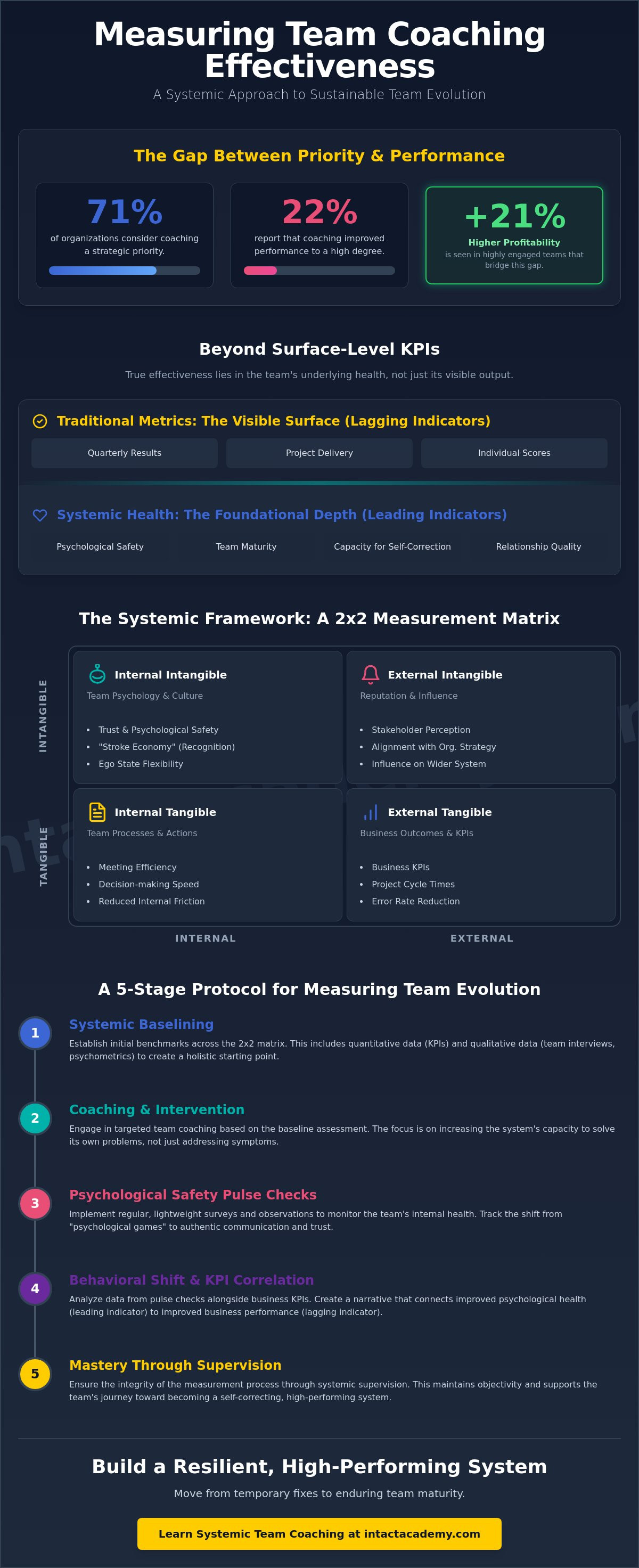
A team's true success isn't defined by the absence of conflict, but by the maturity of the psychological systems it uses to resolve it. While 71% of organizations consider coaching a strategic priority, a mere 22% report that it has improved performance to a high degree. This gap exists because most leaders don't yet know how to measure team coaching effectiveness beyond surface-level KPIs. You've likely felt the frustration of a temporary performance boost that fades once the initial excitement wanes, leaving you to justify the "soft" costs of cultural change to a skeptical board.
We're moving toward a more sophisticated way of tracking growth. This article provides a framework that bridges the gap between psychological safety and business results, such as the 21% higher profitability seen in highly engaged teams. You'll discover how to move beyond anecdotal evidence into a structured methodology of systemic evolution. We'll explore how to track long-term behavioral shifts and present a narrative of maturity that honors both human depth and professional pragmatism. It's a journey from temporary fixes to the enduring process of becoming a high-performing, self-correcting collective.
Key Takeaways
- Learn to distinguish between temporary performance boosts and the sustainable, systemic evolution of a team's collective health.
- Utilize a multidimensional 2x2 matrix to track both tangible business outcomes and the intangible psychological shifts that drive long-term success.
- Master how to measure team coaching effectiveness by applying Transactional Analysis to evaluate ego state flexibility and team maturity.
- Implement a rigorous five-stage protocol that begins with systemic baselining and maintains momentum through psychological safety pulse checks.
- Ensure the integrity of your measurement framework by integrating systemic supervision and the principles of professional mastery.
Beyond the Surface: Why Traditional KPIs Fail Team Coaching
Traditional business metrics often act as a mirror that only reflects the surface. We see the reflection, but we miss the depth of the water beneath. When we consider how to measure team coaching effectiveness, we must look beyond the immediate output of the group and toward the sustainable evolution of the system itself. Performance is a byproduct of health; it's not the health itself. True effectiveness is found in the team's ability to maintain its integrity under pressure, long after the coach has left the room.
Quarterly results and project delivery are lagging indicators. They tell us what happened yesterday, but they reveal nothing about the team's capacity to handle tomorrow's complexity. A team might hit every target while simultaneously eroding its psychological foundation. We focus instead on "Systemic Maturity," a state where the group moves from reactive survival to conscious, collective action. This shift requires a framework that honors the complexity of human systems rather than reducing them to a spreadsheet of completed tasks.
The Limitations of Individual-Centric Metrics
A collection of high-performing individuals isn't necessarily a high-performing team. Aggregating individual competency scores often creates a "False Positive." You might find a team that delivers results through sheer individual brilliance yet remains structurally fragile and toxic. This fragility is often caused by the "Systemic Ghost," those invisible patterns of behavior and unspoken rules that persist even when team members are replaced. We don't measure a team by its parts, but by the quality of the relationships and the strength of the container they create together.
Shifting from Transactional to Transformational Success
Transactional coaching solves a specific problem; transformational coaching increases the system's capacity to solve any problem. Measuring the "invisible" work of psychological safety is essential here. It's about moving toward a state of completeness where every voice is heard and every conflict is used as a catalyst for growth. Engaging in systemic team coaching allows a group to build a reservoir of resilience that outlasts any single project or crisis. We measure success by the degree to which a team can self-correct, demonstrating the maturity to navigate their own psychological games without external intervention. This transformation isn't just about doing better work; it's about becoming a better system.
The Systemic Framework: Measuring Internal and External Impact
To truly understand how to measure team coaching effectiveness, we must acknowledge that a team exists in two worlds simultaneously. There is the internal world of its own psychological dynamics and the external world of organizational expectations. We use a 2x2 matrix to map these dimensions, creating a balance between Tangible and Intangible outcomes across Internal and External axes. This approach ensures that we don't just track what the team does, but who the team is becoming.
The weighting of these quadrants is rarely equal. It depends on the initial contract or the specific focus of the team coaching course the leaders have undertaken. For some, the priority is "External Tangibles" like business KPIs, cycle times, and error rates. For others, the focus lies in "Internal Intangibles" such as trust and psychological safety. A robust measurement framework integrates all four, recognizing that a shift in one quadrant invariably ripples through the others.
Measuring the "External" Collective Impact
A team's effectiveness is often visible in its "boundary management." We look at how the wider organization perceives the team through stakeholder perception mapping. Is the team seen as a silo or a collaborative partner? We track their alignment with organizational strategy and their ability to influence the larger systemic environment. Success here is measured by the team's capacity to navigate corporate politics with integrity, ensuring their collective output serves the broader mission rather than just their own departmental goals.
Measuring the "Internal" Psychological Health
The inner health of a team is quantified through the "Stroke Economy," a concept from Transactional Analysis that measures the quality and frequency of recognition within the group. We look for a measurable shift from "Psychological Games"—those repetitive, unproductive patterns of interaction—toward authentic intimacy and direct communication. One of the most potent indicators of maturity is the reduction in "Drama Triangle" roles. When team members stop rotating between being the Victim, Rescuer, or Persecutor, the system gains the stability required for high-level performance. If you're looking to deepen your own practice in these areas, exploring specialized team coach training can provide the diagnostic tools needed to make these invisible shifts visible.
Transactional Analysis (TA) as a Diagnostic and Measurement Tool
If we view a team's output as the result of its culture, then what is transactional analysis if not the microscope that allows us to see the cellular structure of that culture? TA provides the technical language needed to turn subjective observations into objective data. By using this psychological framework, we move beyond guessing why a team is stuck and begin measuring the specific ego state configurations and unconscious narratives that drive their behavior. This precision is essential when determining how to measure team coaching effectiveness in a way that satisfies both the human heart and the corporate board.
The foundation of this measurement starts with "Contracting." Unlike a simple project brief, a systemic contract establishes a baseline for psychological and behavioral shifts. It asks the team to define not just what they want to achieve, but who they need to become to achieve it. This contract becomes our North Star, allowing us to track progress against the "Group Script," which is the unconscious narrative that often dictates a team's failure or success long before a project begins. When we map this script, we can measure the team’s movement from a story of "not enough" to one of collective potency.
Ego States: Measuring Communication Maturity
A primary indicator of team maturity is "Ego State Flexibility." We track the shift from restrictive Parent-Child transactions, where blame and dependency thrive, to Adult-Adult collaboration characterized by objective reality-testing. We also measure the team's ability to access the "Creative Child" ego state, which is the engine of innovation and spontaneity. By using "Egograms," we can visualize these communication shifts over time, providing a tangible graph of how the team’s energy moves from criticism to curiosity and innovation.
Game Analysis: Reducing Systemic Friction
Systemic friction often manifests as repetitive "Psychological Games" like "Yes, But" or "If It Weren't For You." These games consume vast amounts of organizational energy without producing results. We measure effectiveness by quantifying the reduction in these games and the increase in alignment between the social level (what is said) and the psychological level (what is meant). The ultimate metric here is "Autonomy," which we define through three measurable goals:
- Awareness: The team’s ability to see their own patterns in real-time.
- Spontaneity: The freedom to choose new behaviors instead of falling into old scripts.
- Intimacy: The capacity for direct, game-free communication that fosters true psychological safety.
By focusing on these psychological markers, we ensure that the team isn't just performing better, but is actually evolving into a more mature and integrated system.
A 5-Stage Protocol for Measuring Team Evolution
Measuring the evolution of a team requires more than a simple entry and exit survey. It demands a longitudinal view that captures the shift from the first moment of contact to the enduring habits formed months after the intervention concludes. Understanding how to measure team coaching effectiveness requires a commitment to tracking both the visible performance and the invisible psychological shifts. We utilize a five-stage protocol to ensure that every layer of growth is documented and validated.
- Stage 1: Systemic Baseline. This initial diagnostic uses Transactional Analysis to map the team’s current script and ego state patterns. We establish a clear starting point for both business KPIs and psychological maturity.
- Stage 2: Process Tracking. Real-time pulse checks during the coaching journey monitor psychological safety and the frequency of Adult-Adult transactions. This allows for immediate adjustments to the coaching approach.
- Stage 3: Impact Evaluation. At the end of the engagement, we conduct post-engagement 360s and stakeholder interviews to measure how the team’s external environment perceives their transformation.
- Stage 4: Sustainability Audit. Six months later, we measure the team's ability to self-correct. We look for the "coaching residue," ensuring that the new patterns have become the default systemic behavior.
- Stage 5: ROI and ROE Synthesis. Finally, we combine Return on Investment with Return on Expectation. While 86% of companies report they at least broke even on their coaching investment, the true value often lies in the fulfillment of the qualitative expectations set during contracting.
The Systemic Baseline and Mid-Point Pivot
We begin with "The Three-Cornered Contract," a framework that aligns the expectations of the coach, the team, and the sponsoring organization. This ensures that everyone agrees on what success looks like before the work begins. During the journey, we conduct "Process Reviews" to measure the coaching relationship itself. If the systemic data reveals a deeper, underlying issue, we have the flexibility to pivot our measurement criteria. This ensures our metrics remain relevant to the team's emerging reality rather than being tied to an outdated project plan.
Ensuring Long-Term Sustainability
The ultimate test of effectiveness is what happens when the coach leaves the room. We measure the team's internal capacity for peer coaching and systemic supervision. By creating a "Systemic Dashboard," the team can continue cultural monitoring independently. If you are ready to master these advanced protocols, our TA EMCC Senior Team Coach Academy provides the rigorous training necessary to lead profound systemic transformation.
Mastery Through Supervision: Ensuring Measurement Integrity
The integrity of any measurement framework rests not on the tools themselves, but on the clarity of the person wielding them. We must recognize that the coach is never a neutral observer; they're a temporary, yet influential, part of the team's systemic field. If a coach lacks self-awareness, their data becomes a mirror for their own biases rather than a true diagnostic of the team's health. This is why professional mastery requires a commitment to rigorous self-reflection and the guidance of systemic supervision.
The principles of Sari van Poelje remind us that professional mastery is found at the intersection of agile methodology and deep psychological insight. Without this depth, we risk falling into "Coach-Client Collusion." This occurs when the coach and the team unconsciously agree to report surface-level successes to avoid the discomfort of deeper, systemic failures. Supervision acts as a safeguard, ensuring that when we consider how to measure team coaching effectiveness, we're looking at the raw truth of the system rather than a curated narrative designed to please stakeholders.
The "7-Eyed Model" in Measurement
We utilize the "7-Eyed Model" in supervision to look at the hidden data within the coaching relationship. This model allows us to identify "Parallel Processes," where the team's internal dynamics are unconsciously mirrored in the relationship between the coach and the supervisor. For example, a team that suppresses conflict may lead a coach to become uncharacteristically passive in their reporting. Recognizing these echoes is essential for objective measurement. It turns the coach's own internal reactions into a valuable data point, providing a more complete picture of the team's unconscious state. In high-stakes executive environments, this level of ethical reporting is not just a preference; it's a professional imperative.
The Path to Professional Mastery
True professional development for coaches must include a deep dive into measurement competency. It's not enough to facilitate a good session; you must be able to quantify the evolution of the group's psychological maturity. This involves integrating Transactional Analysis and systemic thinking into your personal toolkit, allowing you to track shifts in ego states and script patterns with clinical precision. High-level accreditation from bodies like the EMCC or ICF serves as a guarantee that your measurement processes are grounded in global ethical standards.
Measurement is a discipline. It's an act of courage that honors the complexity of human transformation. If you're ready to move beyond transactional metrics and master the art of systemic change, we invite you to join our Academy. Together, we can build the frameworks that turn profound psychological growth into measurable business impact, ensuring that every team you touch moves closer to a state of wholeness and high performance.
Cultivating Sustainable Systemic Evolution
The journey of a team is not measured by a single peak in performance, but by the steady evolution of its psychological foundation. You've seen how shifting from individual metrics to systemic health allows for a more profound understanding of team dynamics. By integrating Transactional Analysis and rigorous supervision, you can move beyond the "priority paradox" where coaching is valued but its impact remains elusive. Learning how to measure team coaching effectiveness requires a commitment to seeing the invisible patterns that drive collective behavior.
True professional mastery is a continuous process of becoming. Master the art of systemic team coaching with our EMCC-accredited Academy. Our EMCC and ICF accredited programs offer access to a global faculty of Transactional Analysis experts and specialized training in Systemic Organizational Change. These frameworks provide the stability needed to navigate the turbulent work of cultural transformation and ensure your impact is both deep and enduring.
Embrace the courage to look deeper. When you align psychological safety with business results, you create a space where both the individual and the organization can truly flourish. Your commitment to this depth is the bridge to a more conscious, effective, and human future.
Common Questions on Measuring Team Impact
Is it possible to measure psychological safety quantitatively?
Yes, psychological safety can be quantified using validated assessment tools that measure behaviors like risk-taking, vulnerability, and the absence of blame. By using anonymous pulse surveys, teams can assign a numerical value to their felt sense of safety over time. This data provides a baseline for how to measure team coaching effectiveness by tracking shifts in collective trust and the reduction of defensive behaviors during high-pressure scenarios.
How do you calculate the ROI of team coaching without hard sales data?
You can calculate value by focusing on Return on Expectation (ROE) and cost-avoidance metrics like reduced employee turnover or shortened project cycle times. When sales data is unavailable, look at the efficiency of decision-making and the reduction in "shadow work" caused by systemic friction. These qualitative shifts often translate into significant financial gains by liberating the team's energy for innovation rather than internal conflict.
What are the most common psychological games that hinder team effectiveness?
Common games include "Yes, But," where suggestions are met with immediate dismissal, and "If It Weren't For You," which shifts accountability onto a single scapegoat. Another frequent pattern is "Blemish," where the team focuses on minor flaws to avoid addressing deeper systemic issues. Recognizing these repetitive patterns is a vital part of understanding how to measure team coaching effectiveness, as their reduction signals a move toward authentic collaboration.
How often should a team’s effectiveness be measured during an engagement?
Measurement should occur at four distinct intervals: the initial baseline, a mid-point process review, the post-engagement evaluation, and a six-month sustainability audit. Frequent pulse checks can be integrated into regular team meetings, but formal assessments require space to breathe. This rhythmic approach ensures that the data reflects genuine evolution rather than temporary fluctuations in morale or the honeymoon phase of the coaching relationship.
What is the difference between measuring team performance and team health?
Team performance focuses on external outputs like meeting deadlines and achieving KPIs. In contrast, team health measures the internal resilience and psychological maturity of the system. A team can have high performance but poor health, which leads to inevitable burnout and fragility. Measuring health involves assessing the quality of interactions, the flexibility of ego states, and the team's capacity for self-correction under stress.
Can Transactional Analysis be used by HR professionals to track culture?
HR professionals can use Transactional Analysis as a sophisticated diagnostic tool to map the "Group Script" and track cultural evolution. By identifying dominant ego states within departments, HR can pinpoint where communication is breaking down into Parent-Child dynamics. This systemic lens allows for more targeted interventions that address the root causes of cultural toxicity rather than just treating the surface-level symptoms of low engagement.
How do I handle a team that is resistant to being "measured"?
Resistance often stems from a fear of judgment or a history of measurement being used as a tool for control. Address this by involving the team in the contracting process and ensuring they own the data. When measurement is framed as a tool for their collective flourishing rather than a performance audit, resistance usually dissolves. It's about creating a safe container where data is used for insight, not indictment.
What role does the team leader play in measuring coaching success?
The leader acts as the primary architect of the team's psychological environment and is a key source of stakeholder feedback. Their willingness to model vulnerability and Adult-Adult communication sets the ceiling for the team's evolution. By actively participating in 360-degree feedback and systemic supervision, the leader ensures that the measurement process remains honest and aligned with the organization's broader strategic goals.


