

What if the very expertise that earned you your leadership role is now the primary barrier to your team's success? Understanding how to transition from manager to coach requires more than a simple adjustment in communication; it demands a profound systemic shift in how you relate to those you lead. You likely feel the weight of being the team's bottleneck, exhausted by the relentless cycle of fire-fighting while your people wait for your next directive. It is a wearying state where the desire for control inadvertently stifles the very initiative you wish to see.
This article provides the psychological and systemic framework required to move from directing tasks to developing people through the lens of Transactional Analysis. You will discover how to move from a restrictive Parent-Child hierarchy toward a mature Adult-Adult partnership. We will explore the methodology for fostering a truly autonomous, high-performing team. This shift not only reduces your personal stress but also establishes a clear, professional path toward your own coaching accreditation.
Key Takeaways
- Dismantle the 'Expert Trap' by evolving from a directive answer-giver into a facilitator who holds space for collective intelligence.
- Apply Transactional Analysis to recognize when you're operating from a 'Parent' ego state and how that dynamic limits team autonomy.
- Master the practical conversational tools for how to transition from manager to coach, including the W.A.I.T. rule and the shift to exploratory inquiry.
- Prepare to navigate systemic resistance as your team adjusts to a new culture of accountability and self-directed problem-solving.
- Identify the developmental path toward professional coaching mastery and the benefits of pursuing senior practitioner accreditation.
From Answer-Giver to Space-Holder: Defining the Shift
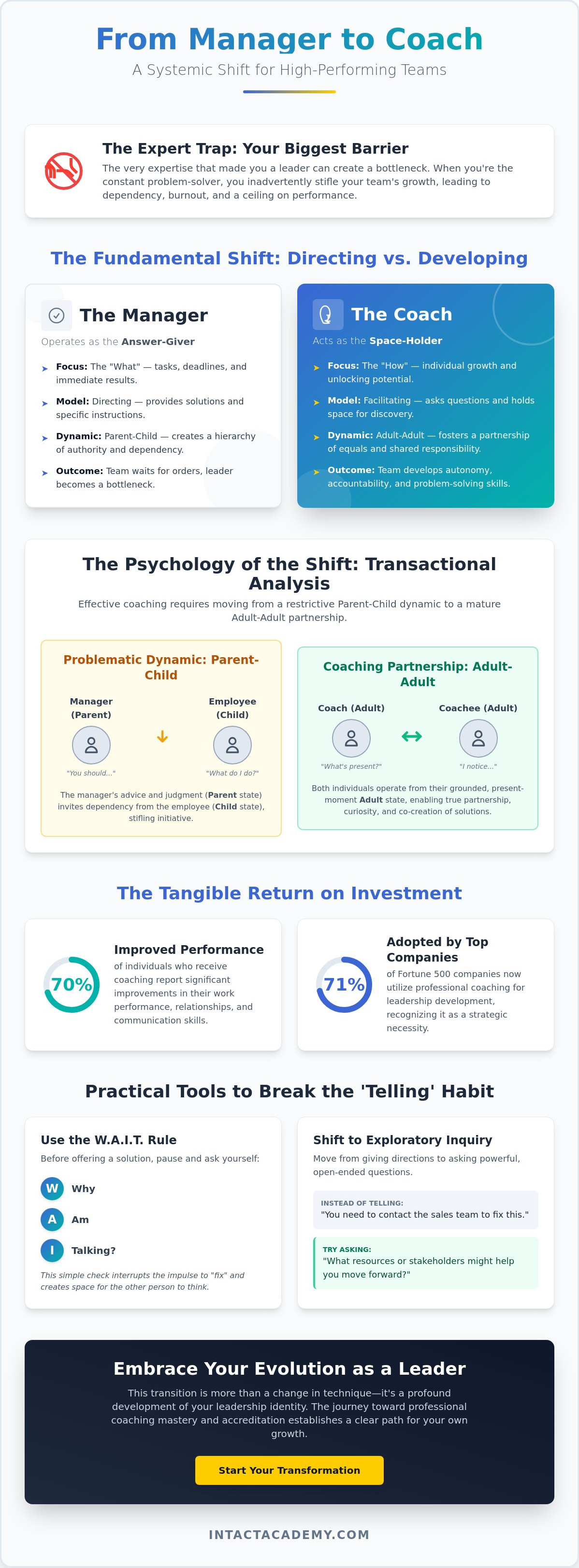
Many leaders believe they are coaching when they are actually providing a more polite form of direction. Learning how to transition from manager to coach involves a fundamental re-evaluation of where the "thinking" happens in a relationship. In a traditional managerial role, you are the primary engine of logic and problem-solving. When you shift toward coaching, you move from being the person with the answers to the person who holds the space for others to find them. This isn't a loss of power; it's a sophisticated redistribution of intellectual and creative responsibility.
The "Expert Trap" is often the greatest hurdle in this evolution. You were likely promoted because you were the most capable practitioner in the room. However, maintaining that status as the "smartest person" creates a systemic ceiling for your team. If you are always the one to solve the crisis, your team members never develop the cognitive muscles required to solve it themselves. This creates a cycle of dependency that leads to the exhaustion you feel today. By stepping back, you allow for a broader Coaching definition to take root, one where the focus is on unlocking a person’s potential to maximize their own performance.
The return on investment for this shift is documented and profound. Research indicates that 70% of individuals who receive coaching report improved work performance, and 71% of Fortune 500 companies now utilize professional coaching for senior leadership development. Moving from short-term task output to long-term human capacity isn't just a "soft" benefit; it's a strategic necessity for any high-performing organization.
The Managerial Directing Model
The directing model is characterized by a focus on the "what." It prioritizes tasks, deadlines, and immediate results. While this approach is necessary during a genuine crisis, using it as a default setting erodes psychological safety. When employees are constantly corrected or given specific instructions, they learn that their own judgment is secondary. Over time, this creates a culture of "waiting for orders," which leaves you as the sole bottleneck for every decision.
The Coaching Facilitation Model
In contrast, the facilitation model focuses on the "how" and the growth of the individual. It requires you to shift the burden of thinking from your shoulders to the employee's. As a coach, you act as a systemic mirror, reflecting back the coachee's patterns and assumptions. This creates a "Coaching Space," a psychological container where the employee feels safe enough to take developmental risks and explore new ways of working without the immediate fear of being "wrong."
The Psychology of Transition: Moving from Parent to Adult
To truly master how to transition from manager to coach, you must look beneath surface-level behaviors and examine the underlying psychological architecture of your professional relationships. This is where understanding what is transactional analysis becomes an indispensable tool. Transactional Analysis, or TA, posits that we operate from three distinct ego states: Parent, Adult, and Child. Traditional management is frequently trapped in a Parent-Child dynamic. In this cycle, the manager acts as the ultimate authority, and the employee adopts a position of dependency. Moving toward coaching requires a deliberate decontamination of the Adult state, allowing for a partnership of equals.
The 'Parent' ego state is often where managers feel most comfortable. It is the seat of advice, judgment, and "fixing." When you operate from this state, you unconsciously signal to your team that they lack the resources to solve their own problems. This invites the 'Child' ego state in your employees, leading them to wait for permission or instruction before acting. If you've ever wondered why your team lacks initiative, the answer often lies in this systemic dance. Breaking this habit is the core challenge of how to transition from manager to coach. It requires the courage to step out of the expert role and into a state of curious observation.
Implementing sophisticated leadership coaching strategies effectively means staying in the Adult state even when the pressure to deliver is high. The Adult state is the only place where true coaching occurs because it is grounded in the present moment, free from the "shoulds" of the Parent or the "can'ts" of the Child. Developing this psychological literacy is a journey of personal transformation. Many leaders find that joining a TA EMCC Senior Practitioner academy provides the structured environment needed to internalize these complex shifts.
Recognising Your Default Ego State
Most managers oscillate between the 'Nurturing Parent', who smothers growth by being too helpful, and the 'Controlling Parent', who stifles it through criticism. Both states invite dependency. To catch this in real-time, ask yourself: "Who am I being in this conversation?" If you feel the urge to rescue or reprimand, you've left your Adult state. Recognizing these triggers is the first step toward systemic change.
Decontaminating the Adult State
Decontaminating your Adult state involves stripping away the language of authority. Replace "you should" with "what are your options?" This shift requires developing an 'Observer' self that monitors your impulses. Perhaps the most powerful tool in this process is silence. By allowing for quiet moments, you create the necessary vacuum that pulls the coachee's Adult state to the surface, forcing them to own the thinking process.
Breaking the 'Telling' Habit: Practical Tools for the Shift
The impulse to provide immediate answers is deeply ingrained in the managerial psyche. It feels like efficiency; it is actually a form of systemic erosion. Learning how to transition from manager to coach requires a disciplined departure from the comfort of instruction. One of the most effective tools for this evolution is the W.A.I.T. rule: Why Am I Talking? This simple inquiry acts as a mental circuit breaker. It forces you to evaluate whether your contribution adds genuine value or merely relieves your own anxiety about the silence. When you stop talking, you stop directing, and you finally begin to observe the system as it truly is.
Language serves as the primary vehicle for this transformation. Moving away from "Why" questions is essential, as they often carry an undertone of judgment that triggers a defensive Child response in the employee. Instead, favor "What" and "How" questions. These exploratory queries invite the employee to analyze the situation from their Adult state. For instance, replace "Why is this project late?" with "What are the systemic hurdles currently impacting the timeline?" This shift moves the focus from personal blame to collaborative problem-solving.
When faced with the common "I don't know" response, the manager-coach must resist the urge to rescue. Jumping in with the answer reinforces dependency. Instead, hold the space. You might respond with, "If you did know, what would be the first possibility you'd explore?" or simply allow the silence to do the work. Silence is a developmental tool, not a void that needs filling. It is in these quiet moments that the coachee's own Adult logic often emerges, leading to more sustainable solutions than any directive you could provide.
Powerful Inquiry vs. Managerial Directives
A directive like "Focus on the client feedback first" shuts down the employee's prioritization process. A coaching inquiry such as "How does the client feedback align with our current priorities?" invites them to think systemically. Employing a "Three-Second Rule" can be transformative. By waiting three seconds after an employee finishes speaking, you ensure they have truly completed their thought and give yourself space to formulate an Adult inquiry rather than a Parent reaction.
The Coaching Contract
Transparency is the bedrock of psychological safety. You must clearly define the boundaries of your interaction: are you in a coaching session or a performance review? Establishing a formal coaching contracting process ensures that both parties understand the objectives and the "rules of engagement." This clarity prevents the confusion that occurs when a manager suddenly shifts from giving orders to asking deep questions without warning, which can otherwise feel manipulative rather than supportive.
The shift in your leadership style doesn't happen in a vacuum. It occurs within a complex organizational system that has grown accustomed to your previous patterns of behavior. As you learn how to transition from manager to coach, you might be surprised to find that your team initially resists the change. This isn't necessarily a sign of failure; it's a natural systemic response to the loss of a familiar Parent-Child dynamic. Employees who have relied on your directives may feel abandoned or frustrated when you stop providing the "right" answers. They might even plea for you to "just tell me what to do," seeking the safety of the old, dependent hierarchy.
This resistance is often a micro-level manifestation of the challenges found in leading organizational change. You aren't just changing your behavior; you're attempting to rewrite the unspoken contract of the department. Building psychological safety is the only way to navigate this friction. Your team must trust that this new space for inquiry is a safe container for their growth, not a trap designed to expose their lack of knowledge. Without this foundational trust, the coaching process will feel like an interrogation rather than an invitation to excellence.
Understanding the 'Discounting' Mechanism
In Transactional Analysis, "discounting" occurs when an individual ignores or minimizes some aspect of themselves, others, or the situation. When an employee says they don't know how to solve a problem, they're often discounting their own capacity for Adult logic. Your role is to catch these discounts and gently return the responsibility to them. You must also prepare for a temporary "performance dip." As the team learns to think for themselves, things might slow down. This is the price of long-term autonomy. If you can hold the space through this dip, the resulting high-performance culture is well worth the initial discomfort.
The Manager-Coach as a Systemic Change Agent
You act as a powerful systemic mirror for your organization. When you consistently model Adult-Adult interactions, you create a ripple effect that can shift the entire department's culture. This requires a delicate balance of your dual roles. There are still moments where you must act as the manager, setting firm boundaries or making final decisions. However, by clearly signaling when you're wearing your coach hat, you provide the clarity the system needs to evolve. This evolution doesn't just reduce your stress; it transforms the very nature of what's possible for your team.
If you're ready to master these systemic dynamics and lead your team toward genuine autonomy, consider how our TA EMCC Senior Team Coach Academy can provide the depth of training you need to succeed.
Achieving Mastery: The Journey to Senior Practitioner
The initial steps on how to transition from manager to coach often focus on acquiring a new set of conversational tools. However, true mastery requires moving beyond the application of techniques into a fundamental shift in identity. It is the difference between performing a role and embodying a state of being. While many tools-based courses provide a checklist of questions, a systemic approach grounded in Transactional Analysis allows you to understand the energetic currents beneath every interaction. This depth is what separates a proficient manager from a senior practitioner who can navigate the most complex organizational landscapes.
As the executive coaching and leadership development market is projected to reach $174.53 billion by 2031, the need for rigorous professional standards has become paramount. Pursuing accreditation through bodies like the EMCC or ICF isn't merely about adding letters to a title; it is about committing to a path of continuous reflection and ethical practice. A systemic Executive Coaching Certification ensures that your impact is sustainable, moving the needle on organizational culture while fostering individual wholeness. It provides the intellectual framework to understand why certain interventions work, allowing you to move from intuition to evidence-based mastery.
The TA EMCC Senior Practitioner Academy
This academy is designed for those who seek to move from "doing coaching" to "being a coach." It provides a stable container for your evolution, where Transactional Analysis and systemic theory become the lenses through which you view every professional encounter. You won't be learning in isolation. Instead, you'll join a global cohort of mature, reflective professionals, each committed to their own flourishing and the success of their organizations. It is a space where the intellectual rigor of psychology meets the practical demands of business, creating a unique environment for profound human transformation.
Next Steps for Your Professional Evolution
Integrating coaching into a C-suite identity requires a guide who understands both the boardroom and the psyche. Sari van Poelje brings decades of experience in mastering systemic change, acting as a bridge between high-level theory and executive reality. This journey toward mastery is an invitation to return to a state of genuineness, where your leadership becomes an expression of your most complete self. We invite you to discover our TA EMCC Senior Practitioner Academy and begin the next chapter of your professional transformation.
Embracing the Evolution of Your Leadership Identity
The journey toward a coaching leadership style is an invitation to reclaim your own strategic focus while fostering genuine team autonomy. By moving from the directive Parent ego state to a collaborative Adult partnership, you dismantle the expert trap that creates organizational bottlenecks. Understanding how to transition from manager to coach is not merely a skill acquisition; it's a systemic transformation that allows you to hold space for others to flourish. This shift requires the courage to replace immediate answers with powerful inquiry and to navigate the initial resistance of a changing system.
This evolution requires a stable container and expert guidance. Our EMCC and ICF accredited programs offer the psychological depth needed for this profound shift. Led by Sari van Poelje, a global expert in Transactional Analysis, our academy brings together a diverse cohort of professionals from over 14 countries. You'll move beyond surface-level techniques into the realm of true professional mastery. Explore the TA EMCC Senior Practitioner Academy at Intact Academy and begin your path toward systemic impact. True leadership is the courage to step back so that others may step forward. We're here to support you as you return to a state of completeness and genuine impact.
Frequently Asked Questions
What is the biggest difference between a manager and a coach?
The primary difference lies in the direction of the thinking process. A manager is typically responsible for the "what" and the "when," directing tasks to meet immediate organizational goals. A coach, however, facilitates the "how," focusing on the individual's growth and their ability to solve future problems independently. This shift requires a fundamental movement from a position of authority to one of partnership and inquiry.
How do I know if my team is ready for me to be their coach?
Readiness is often signaled when team members show signs of frustration with repetitive technical fixes or express a desire for more autonomy. If your team is capable of basic task execution but feels stuck in a cycle of dependency, they're ready for a coaching space. This transition invites them to move beyond their current limits and take ownership of their professional evolution within the organization.
Can I coach my direct reports if I'm also responsible for their performance reviews?
Yes, you can, provided there is clear psychological contracting. You must explicitly state which "hat" you're wearing in any given conversation. While performance reviews are evaluative and focused on past results, coaching is developmental and focused on future potential. Keeping these boundaries transparent ensures that the coaching space remains a safe container for risk-taking and honest self-reflection without the fear of immediate judgment.
How long does it take to transition from a managerial style to a coaching style?
Learning how to transition from manager to coach is a journey of identity, not just a skill upgrade. While you can start asking better questions tomorrow, internalizing the Adult-Adult mindset typically takes six to twelve months of deliberate practice. This timeline allows for the team to adjust to the new systemic expectations and for you to unlearn the reflexive impulse to provide immediate, directive answers.
What should I do if an employee refuses to engage in coaching and just wants answers?
Address the resistance as a valuable systemic data point rather than a personal failure. This "discounting" of their own capacity is often a sign of long-term dependency on authority. Gently name the pattern you're observing and explain the developmental benefit of them finding the solution. Holding the coaching space firmly but with empathy eventually encourages the employee to step into their own Adult logic.
Is coaching effective in high-pressure, fast-paced environments?
Coaching is essential in high-pressure environments to prevent leadership burnout and systemic bottlenecks. While it feels slower in the moment to ask a question rather than give an order, it builds the long-term cognitive capacity of the team. This allows them to handle future crises without your constant intervention, ultimately increasing the speed and agility of the entire department as autonomy grows.
Do I need a formal certification to be a 'manager-coach'?
You don't need a formal certification to begin using coaching techniques, but mastery often requires structured developmental support. High-level training, such as our TA EMCC Senior Practitioner academy, provides the psychological grounding necessary to handle complex systemic resistance. Certification ensures you have the ethical framework and professional rigor to sustain a coaching culture within a sophisticated and demanding corporate environment.
How can Transactional Analysis help me become a better coach?
Transactional Analysis offers a profound map of human behavior through ego states. It helps you identify when you're operating from a directive "Parent" state and how that inadvertently invites a dependent "Child" response from your team. By staying in the "Adult" state, you maintain the clarity and presence required for professional coaching, ensuring your interactions remain grounded, objective, and truly transformative for the system.


