

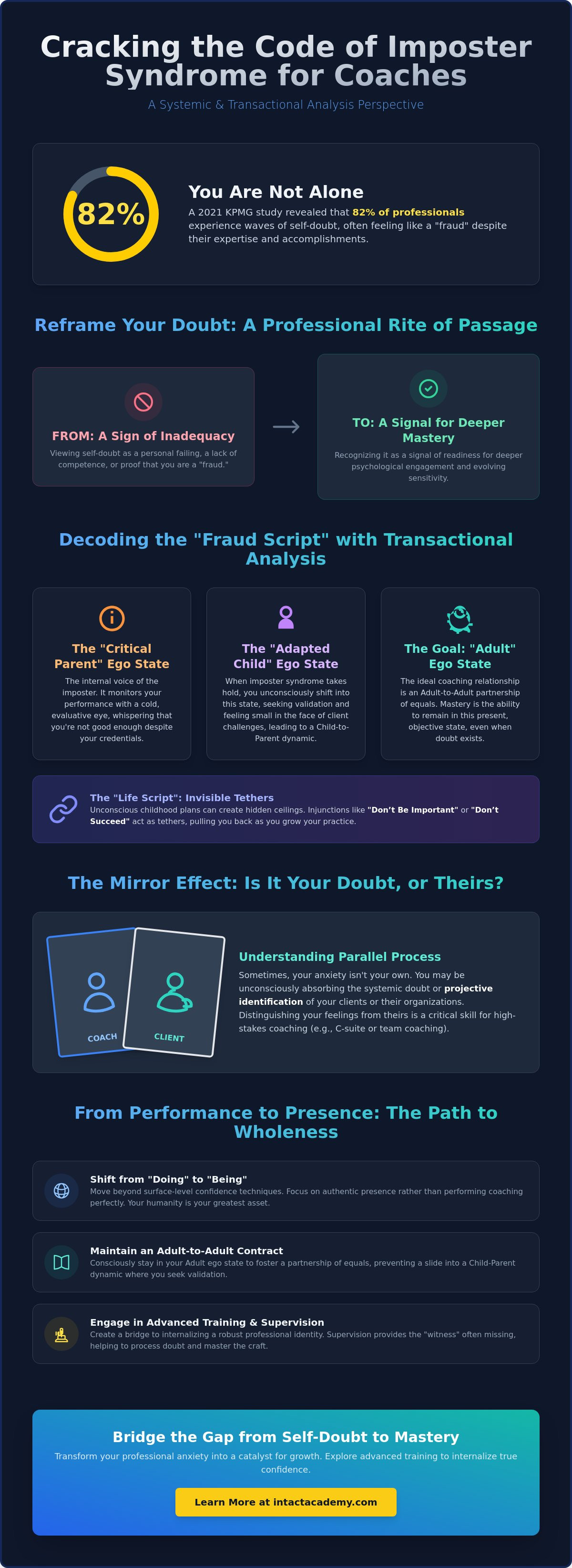
What if the persistent whisper that you're "faking it" isn't a sign of professional inadequacy, but a sophisticated signal from your internal system? Even for the most experienced practitioners, imposter syndrome for coaches often feels like a shadow that follows every successful session, suggesting that your achievements are mere luck. You might find yourself over-preparing for hours or hesitating to claim the premium rates your expertise deserves. You aren't alone in this experience; a 2021 KPMG study revealed that 82% of professionals navigate these same waves of self-doubt.
This article invites you to view these feelings through a different lens. We'll explore how Transactional Analysis and systemic perspectives can transform professional anxiety into a catalyst for coaching mastery. By understanding the "script signals" that tether your identity to old ego states, you'll learn to move toward a state of professional wholeness. We'll examine how to internalize true confidence, turning your self-doubt into a profound tool for psychological insight and deeper client transformation.
Key Takeaways
- Reframe imposter syndrome for coaches as a professional rite of passage that signals a readiness for deeper psychological engagement rather than a lack of competence.
- Identify the "Critical Parent" ego state and the underlying Life Scripts that limit your professional growth, allowing you to reclaim your authority.
- Learn to distinguish your personal anxiety from the "Parallel Process," where you may be unknowingly absorbing the systemic doubt or projective identification of your clients.
- Shift your focus from external performance to internal presence by maintaining an "Adult" ego state during high-stakes sessions.
- Explore how advanced training and supervision serve as a bridge to internalizing a robust professional identity grounded in completeness.
The Silent Struggle: Why Even Master Coaches Face Imposter Syndrome
The coaching room is often a place of profound silence; it is where the practitioner sits alone with the weight of another's transformation. This isolation creates a fertile ground for self-doubt. While we are trained to hold space for others, we often lack a witness for our own internal process. Impostor syndrome, characterized by the persistent fear of being exposed as a fraud, is an experience that transcends years of practice or the number of hours logged in a logbook. For many, imposter syndrome for coaches is not a pathology to be cured, but a professional rite of passage that signals a transition into deeper levels of work.
It is a common paradox that high-level accreditations from bodies like the EMCC or ICF often trigger these feelings rather than soothing them. As your credentials grow, the perceived height from which you might fall increases. You might feel that a Master Certified Coach shouldn't feel uncertain, yet this very uncertainty is often a sign of your evolving sensitivity. From a Transactional Analysis perspective, this internal friction often represents a "Child" ego state responding to "Adult" responsibilities. When the stakes of a session feel immense, the inner child seeks the safety of a script, feeling small in the face of the client's complex reality.
The High Stakes of Executive and Team Coaching
Coaching the C-suite amplifies the fear of being "found out" because these clients often occupy positions of significant systemic power. When you step into a boardroom or a high-stakes executive session, the pressure to provide immediate ROI can feel suffocating. In systemic team coaching, the complexity is even greater; you aren't just managing one individual, but an entire field of intersecting patterns and histories. The Coach’s Imposter Gap is the space between professional persona and internal felt-sense.
Moving Beyond "Fake It Till You Make It"
Surface-level confidence techniques fail in deep developmental work because they address the mask, not the wearer. Clients who are themselves high-achievers often have a keen intuition for incongruence; they can sense when a coach is performing rather than being. True growth requires a commitment to professional development for coaches that prioritizes psychological depth over mere performance. By shifting the focus from "doing" the coaching perfectly to "being" present with the client's reality, you allow your humanity to become your greatest asset. Mastery is not the absence of doubt, but the ability to remain in an Adult ego state while the doubt exists.
Decoding the "Fraud" Script: A Transactional Analysis Perspective
To understand the persistence of imposter syndrome for coaches, we must look beyond surface-level mindset shifts and into the architecture of the Life Script. In Transactional Analysis, a Life Script is an unconscious plan made in childhood, reinforced by parents, and justified by subsequent events. For the professional coach, this script often contains hidden ceilings. If your early environment suggested that visibility was dangerous or that success was reserved for others, you might carry injunctions like "Don’t Be Important" or "Don’t Succeed." These mandates act as invisible tethers, pulling you back just as your practice begins to scale.
The voice of the imposter typically resides in the Critical Parent ego state. This internal figure monitors your performance with a cold, evaluative eye, whispering that you're a fraud despite your credentials. To mask the resulting anxiety, many practitioners engage in Psychological Games such as "I’m Only Trying To Help." While it looks like altruism, this game often serves to keep the coach in a "one-up" position to avoid the vulnerability of being seen as an equal. Recognizing these patterns is a vital part of advanced practitioner training, where we move from performance to authentic presence.
Ego States and the Coaching Relationship
A professional coaching contract is ideally an Adult-to-Adult transaction. It's a partnership of equals. However, when imposter syndrome for coaches takes hold, the dynamic often shifts into a Child-to-Parent relationship. The coach enters their Adapted Child ego state, unconsciously seeking validation or "permission" to lead from the client. This shift compromises the coach's potency. For a deeper understanding of these dynamics, it's helpful to explore what is transactional analysis and how it informs professional boundaries.
Injunctions and Counter-Injunctions in Practice
Many coaches are driven by a "Please Others" counter-injunction, which leads to over-servicing and eventual burnout. When this is coupled with a "Be Perfect" driver, the coach becomes trapped in a cycle of excessive preparation and a relentless pursuit of more certifications. They believe that one more course will finally silence the doubt. Practitioners can benefit from reviewing 8 Key Strategies for Imposter Syndrome Coaching to begin dismantling these drivers. A Script Signal is a somatic or emotional alert that an old pattern is being triggered. By identifying these signals in real-time, you can consciously choose to return to your Adult ego state, reclaiming your professional wholeness.
The Mirror Effect: Distinguishing Your Doubt from Parallel Process
The coaching room is never a vacuum; it is a relational field where two systems meet and influence one another. Often, what we misidentify as personal imposter syndrome for coaches is actually a sophisticated form of data collection known as parallel process. This occurs when the dynamics of the client's system are unconsciously replicated within the coaching relationship. If you suddenly feel incompetent, small, or "found out" while sitting with a high-achieving client, you must ask a vital question: Is this doubt mine, or does it belong to the organization I am coaching?
Through projective identification, a client may unconsciously "deposit" their own disowned feelings of inadequacy into the coach. If the client cannot tolerate their own vulnerability, they may project it onto you, leaving you to carry the weight of their unacknowledged fraudulence. By using "Self-as-Instrument," you can begin to treat these sudden waves of self-doubt not as personal failures, but as diagnostic indicators of the client's internal or systemic reality. This shift moves you from being a victim of the feeling to an observer of the system.
Transactional Analysis and Systemic Mirroring
In Transactional Analysis, we understand this mirroring through the lenses of transference and counter-transference. A client might "recruit" you into their script, casting you in the role of a critical parent or a helpless child. When you are recruited, your own script injunctions may flare up in response. Staying clear and grounded is essential when leading organizational change, as it requires you to maintain a firm systemic boundary. Without this clarity, the coach becomes another entangled element of the very dysfunction they were hired to resolve.
Case Study: The "Fraudulent" Team Coach
Consider a hypothetical scenario where an experienced practitioner is coaching a senior leadership team during a merger. Despite their years of expertise, the coach begins to feel increasingly anxious, over-preparing for every session and fearing they have nothing of value to offer. By applying the systemic coaching insights pioneered by Sari van Poelje, the coach realizes the team is paralyzed by their own secret fear of being incompetent in the new corporate structure.
Once the coach identified this as a parallel process, they shared their felt-sense of "not being enough" with the team. This intervention broke the collective silence. The team acknowledged their shared anxiety, moving from defensive posturing to authentic collaboration. By transforming their own imposter syndrome for coaches into a systemic observation, the coach provided the exact breakthrough the team needed to move forward with integrity.
From Performance to Presence: Advanced Strategies for Professional Wholeness
Real mastery in the coaching room begins when we stop attempting to be the "perfect" practitioner and start allowing ourselves to be the "present" one. This shift requires us to redefine the internal coaching contract, moving beyond a promise of results to an agreement of "OK-ness." In this state, we accept our humanity alongside our expertise. Integrating the shadow parts of ourselves; those moments of doubt, uncertainty, or perceived failure; is what allows us to move from a performance-based identity to one of presence. When we embrace our complete selves, we stop performing for the client and start being with them.
In high-pressure corporate environments, the "Three-Way Contract" serves as a vital tool for systemic clarity. By explicitly defining the relationship between the coach, the individual client, and the sponsoring organization, we create a boundary that protects our professional identity. This clarity directly reduces the anxiety associated with imposter syndrome for coaches. It ensures that the coach isn't unconsciously carrying the organization's unstated expectations or the client's fear of failure. When the boundaries are clear, the "Adult" ego state can remain functional and observant rather than becoming overwhelmed by systemic pressure.
The Power of Professional Supervision
While mentoring focuses on the acquisition of skills, Systemic Supervision provides a safe container for the coach’s vulnerability. It is the essential antidote to the isolation of the coaching role. In supervision, we engage in the process of "de-contaminating" the Adult ego state. This involves identifying where our personal "Child" or "Parent" ego states have intruded upon our professional work. It allows us to process the parallel dynamics we've absorbed from our clients, ensuring that our internal system remains clear and available for the next session.
Actionable Tools for the Coaching Room
Maintaining an Adult ego state during a session is a practiced skill. One effective technique is the "30-Second Adult Check-In." Before responding to a challenging client moment, pause to ask: "Which ego state is driving this response?" If you feel a need to over-explain or "save" the client, you've likely slipped into a "Parent" or "Child" dynamic. Additionally, we must learn to reframe "I don’t know" as a potent, authentic intervention. Admitting uncertainty isn't a failure of expertise; it's an invitation for the client to step into their own resourcefulness. Professional Wholeness is the integration of expertise and vulnerability. By embodying this wholeness, we model the very authenticity we seek to cultivate in our clients.
Moving Toward Mastery: The Role of Supervision and Advanced Training
The journey toward professional mastery is less about the acquisition of new techniques and more about the internalization of a robust professional identity. For many, the persistent experience of imposter syndrome for coaches marks the boundary between being a practitioner who "does" coaching and one who "is" a coach. Advanced training provides the structured methodology needed to cross this threshold. It offers a space where the psychological underpinnings of your work are examined as rigorously as your tactical interventions. This transition from doing to being is the hallmark of the Senior Practitioner; it requires a willingness to let go of the safety of tools and trust in the potency of your own presence.
The TA EMCC Senior Practitioner academy is designed specifically for this evolution. By grounding your practice in Transactional Analysis and systemic theory, you build a foundation that can withstand the pressures of high-stakes executive environments. This isn't about adding another certification to your wall. Instead, it's about developing the internal stability to hold the complexity of your clients' systems without losing your own ground. When your professional identity is rooted in psychological depth, the "fraud" script loses its power to disrupt your work.
The Intact Academy Approach to Mastery
At Intact Academy, we believe that professional growth is inseparable from personal transformation. Our focus on Transactional Analysis allows you to map the ego states and script patterns that drive both your clients and yourself. When you join our global cohort, the "imposter" experience is quickly normalized through shared inquiry. You realize that your peers, many of whom are leading organizational change in major corporations, share these same internal dialogues. This collective awareness dissolves the isolation that often fuels self-doubt.
For those working with groups, the TA EMCC Senior Team Coach Academy addresses the specific anxieties inherent in group dynamics. It provides the systemic tools to navigate the complex fields of projective identification and collective resistance. By understanding the group as a single organism, you move from a place of individual performance to systemic facilitation. You learn to stay grounded even when the team system attempts to pull you into its own chaos.
Your Next Steps to Wholeness
The path to wholeness is not a destination but a continuous process of becoming. Ongoing systemic supervision is vital for maintaining this clarity. It ensures you have a dedicated space to process the emotional weight of your work and stay aligned with your Adult ego state. We invite you to join a community that values psychological depth over surface-level success, moving beyond the frantic energy of typical coaching markets.
Your feelings of self-doubt are not a sign that you've failed; they're a sign that you're standing at the threshold of your greatest impact. If you can view your doubt as a signal for deeper exploration, it becomes your most valuable teacher. As Sari van Poelje often reminds us, the most powerful tool you have in the coaching room is your own authenticity. Embrace the courage to be real, and you'll find that your perceived inadequacy is actually the doorway to your professional wholeness.
Embracing the Path to Professional Wholeness
The persistent feeling of being a fraud is rarely about a lack of skill; it's an invitation to deepen your psychological presence. By decoding your internal script and recognizing the parallel processes at play, you transform self-doubt into a diagnostic tool for systemic change. This journey from performance to presence allows you to inhabit your professional identity with a sense of completeness. Navigating imposter syndrome for coaches requires a shift from seeking external validation to cultivating internal stability.
When you're ready to move beyond surface-level fixes, we invite you to join a community of global practitioners. Deepen your mastery and overcome the "fraud" script at the TA EMCC Senior Practitioner academy. Led by global TA expert Sari van Poelje, our EMCC and ICF accredited programs bring together participants from over 14 countries to explore the intersection of human behavior and organizational success.
Frequently Asked Questions
Is imposter syndrome common among experienced coaches?
Yes, imposter syndrome for coaches is remarkably prevalent even among senior practitioners and those with master-level credentials. A 2021 KPMG study found that 82% of professionals navigate these feelings at some point in their careers. For many, the sense of being a "fraud" actually intensifies as they take on more complex systemic roles or work with high-level executive teams.
How does Transactional Analysis help with imposter syndrome?
Transactional Analysis provides a psychological map to understand the internal dialogue that creates self-doubt. By identifying whether your thoughts originate in the "Critical Parent" or the "Adapted Child" ego states, you can gain the distance needed to return to your "Adult" state. This framework helps you move from an unconscious Life Script of inadequacy to a position of professional wholeness.
What is the difference between imposter syndrome and actual incompetence?
The distinction lies in the relationship between your internal felt-sense and your external results. Incompetence is a genuine lack of the necessary skills or knowledge required to fulfill a coaching contract. Imposter syndrome is the psychological inability to internalize your successes, where you feel like a failure despite objective evidence of your competence and positive client outcomes.
Can supervision help me overcome the fear of being a fraud?
Professional supervision is the essential antidote to the isolation that breeds self-doubt. It provides a safe, reflective container where you can bring your vulnerabilities without judgment. Supervision helps you de-contaminate your Adult ego state, allowing you to separate your personal script patterns from the professional work you do with your clients.
How can I tell if my doubt is mine or my client’s (parallel process)?
You can distinguish these feelings by using "Self-as-Instrument" and noticing the timing of the doubt. If the feeling of incompetence is sudden, intense, and uncharacteristic of your usual professional state, it's likely a parallel process. In these moments, you're unconsciously mirroring the client’s or the organization’s own systemic anxiety and fear of failure.
Does getting more certifications cure imposter syndrome?
Certifications rarely provide a permanent cure and can sometimes act as a temporary "fix" for a deeper psychological driver. Many practitioners believe the next credential will finally make them feel "enough," but this often reinforces the "Be Perfect" driver. True professional confidence comes from internalizing your identity through deep developmental work rather than accumulating external badges.
What are the "drivers" in TA that lead to imposter syndrome?
Common drivers that fuel imposter syndrome for coaches include "Be Perfect," "Please Others," and "Try Hard." These are unconscious internal commands that set impossible standards for success. When you don't meet these perfectionistic ideals, the Critical Parent ego state intervenes with the "fraud" narrative, suggesting that your achievements are merely a result of luck.
How do I stay in my Adult ego state when I feel like an imposter?
Maintaining your Adult ego state requires a deliberate, somatic check-in during the session. When you feel the wave of doubt, pause for a few seconds to name the feeling internally. This simple act of observation creates a psychological gap between you and the emotion. It allows you to step out of the "Child" state and re-align with your professional expertise and the reality of the present moment.


