

What if the hidden obstacle to your team's progress isn't a lack of information, but the invisible psychological scripts running beneath every agenda item? You've likely experienced the exhaustion of circular boardroom debates where logic fails to bridge the gap between conflicting perspectives. It's a common struggle for high-stakes groups to face decision fatigue or the quiet sting of post-meeting sabotage, even when the strategic data seems clear. This guide offers a systemic perspective on improving decision making in leadership teams, moving beyond traditional frameworks to address the deep human complexities that drive executive behavior.
We'll explore how to break unconscious patterns of hesitation and cultivate a culture of genuine psychological safety. By shifting toward Adult-to-Adult communication, you can ensure that every choice is not just a tactical win, but a sustainable commitment fully supported by the collective. We will examine the psychological foundations that allow a team to move from a collection of individual experts to a truly cohesive and autonomous unit. Discover how to transform your decision-making process into a space of clarity, integrity, and shared purpose.
Key Takeaways
- Shift from purely logical frameworks to a systemic awareness of the underlying psychological scripts that often influence executive choices.
- Discover how improving decision making in leadership teams involves moving out of Parent or Child ego states and into a state of conscious Adult-to-Adult autonomy.
- Uncover the "Psychological Games" and Drama Triangle roles that create repetitive cycles of blame, rescue, and victimhood in high-stakes environments.
- Apply the three-level contracting framework—Administrative, Professional, and Psychological—to ensure every collective decision is backed by deep commitment.
- Learn how systemic team coaching provides the necessary mirror for teams to recognize their own patterns and evolve toward a state of completeness and shared purpose.
Beyond Logic: Why Traditional Decision-Making Models Fail
Decision-making is rarely the isolated, logical event we wish it to be. In high-stakes environments, it's a systemic act, a transaction that ripples through the entire organizational fabric. Many leaders rely on linear models, believing that if they follow a specific set of steps, the right outcome is guaranteed. However, improving decision making in leadership teams is less about refining the steps and more about understanding the systemic field in which those steps are taken. When we view a decision as a living part of a larger whole, we begin to see why even the most brilliant experts can find themselves stuck in a loop of indecision.
The "Data Paradox" often complicates this process. We're told that information is power, yet in many boardrooms, an abundance of data leads to a deficit of clarity. This happens because data is frequently used as a defense mechanism against the inherent risk of being wrong. If we have enough spreadsheets, we don't have to face the personal responsibility of the leap. This hesitation is often reinforced by an organizational culture that rewards "careful consideration" while subtly punishing the courage required for genuine transformation. In these moments, the decision is often made by the unconscious mind long before the rational mind constructs a justification for it.
The Limits of Rationality in High-Stakes Environments
When the pressure mounts, our biological systems often override our strategic training. Executive stress has a documented impact on the prefrontal cortex, the part of the brain responsible for complex planning and impulse control. As cortisol levels rise, the rational mind retreats, and we fall into the trap of analysis paralysis. We aren't just over-thinking; we're biologically seeking a level of safety that logic alone cannot provide. Moving toward professional mastery requires a shift from surface-level logic to systemic insight, acknowledging that a team's collective nervous system is just as important as its collective IQ.
The Invisible Boardroom: Who is Really Making the Decision?
Every boardroom is crowded with unvoiced participants: the personal histories, early life scripts, and unexamined anxieties of every leader present. These invisible influences often dictate the speed and direction of organizational change. When a team struggles to commit, it's rarely because the plan is flawed. It's more often because the plan triggers an unvoiced fear or conflicts with a deep-seated organizational script. By understanding groupthink and the subtle ways we seek consensus to avoid individual exposure, we can begin to address the psychological undercurrents that truly drive our choices. Improving decision making in leadership teams requires us to look at these patterns with compassion and precision, ensuring that our decisions are made by the Adult leaders of today, not the historical scripts of yesterday.
The Transactional Analysis of Decision-Making: Ego States at the Table
The boardroom is not just a place for strategy; it's a stage for the human psyche. To move beyond the limits of logic discussed previously, we must understand the specific internal states that leaders inhabit during high-stakes discussions. Transactional Analysis (TA) provides a profound framework for this by identifying three distinct ego states: Parent, Adult, and Child. When we look at the process of improving decision making in leadership teams, we often find that the most persistent roadblocks aren't technical. They're the result of leaders unknowingly communicating from ego states that aren't suited for the task at hand.
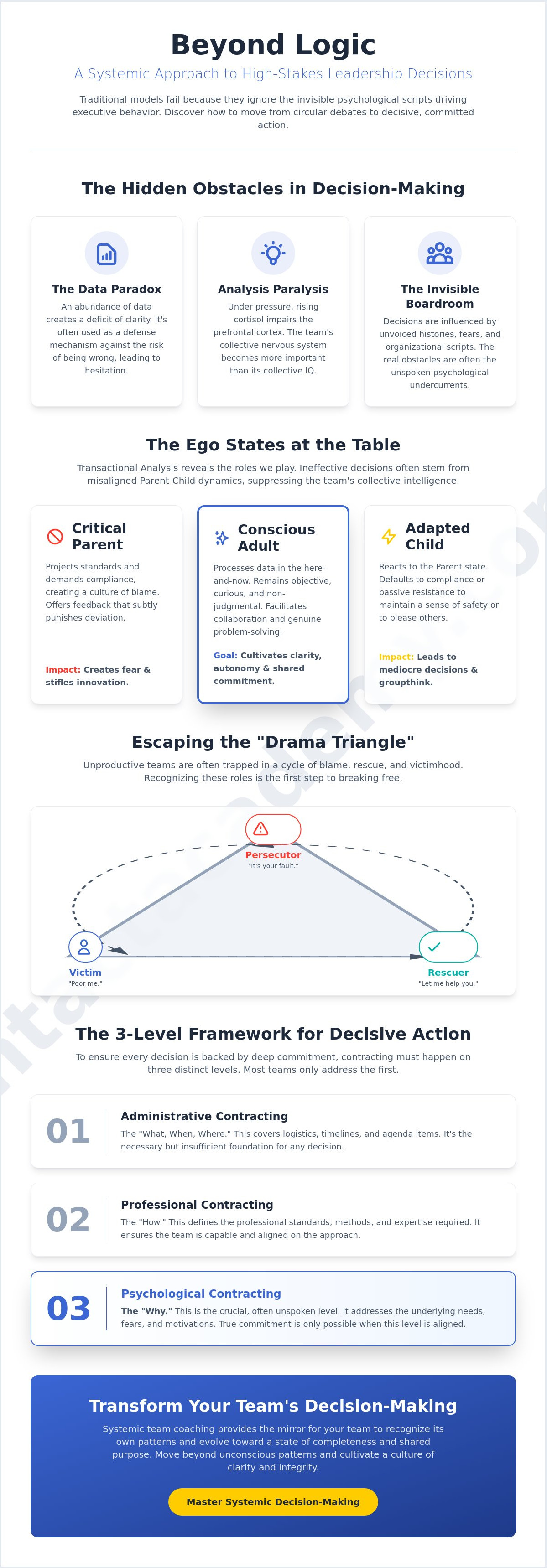
When a leader operates from a Critical Parent state, they don't just offer feedback. They project a standard that demands compliance and subtly punishes deviation. This creates a culture of blame where fear becomes the silent architect of every choice. In response, the rest of the team often retreats into an Adapted Child state. Instead of challenging a flawed assumption or offering a creative alternative, they default to compliance or passive resistance. This "Parent-Child" dynamic is a primary reason why intelligent teams make mediocre decisions; the collective intelligence is suppressed by a desire for safety or a need to please the dominant figure.
The goal is to cultivate a consistent Adult ego state across the entire team. The Adult is the part of us that processes data in the here and now, remaining objective, curious, and empathetic. By empowering better decisions through this state, leaders can separate their personal anxieties from the organizational needs. It's a state of presence that allows for a full assessment of reality without the distortion of past scripts or future fears. Improving decision making in leadership teams requires a deliberate shift into this Adult state, where information is used for clarity rather than as a shield.
Identifying Ego States in Team Interactions
Recognizing these states in real-time is a hallmark of professional mastery. You can hear the Critical Parent in phrases like "we should have known" or "that's just how it's done." Conversely, the Adapted Child often surfaces through hesitant tones or a "yes, but" approach to problem-solving. When you notice these transactions, the most effective strategy is to invite the Adult back into the room. This can be done through open, reflective inquiries that ground the team in current facts rather than historical grievances. Exploring these dynamics through Team Coaching allows a group to witness their own transactions in real-time, creating a stable container for change.
Developing Autonomy and Awareness in Leadership
Self-awareness is the engine of decision speed. When leaders understand their own dominant scripts, they stop being passengers to their unconscious reactions. Understanding what is transactional analysis serves as a diagnostic tool, helping you map your team's ego states during a crisis. Try this: in your next high-pressure meeting, observe who is judging (Parent), who is rebelling or complying (Child), and who is actually analyzing the situation (Adult). This simple act of observation begins the process of returning to a state of collective completeness and genuine autonomy.
Psychological Games and Groupthink: Identifying Invisible Saboteurs
Even the most sophisticated executive teams can fall prey to unconscious patterns that derail progress. These patterns, known in Transactional Analysis as "Psychological Games," are repetitive sequences of behavior that lead to a predictable, often unproductive outcome. When a team is caught in a game, they aren't truly solving a problem; they're playing out a script that satisfies an underlying psychological need. The cost to the bottom line is significant, as these games consume the energy and focus required for improving decision making in leadership teams.
At the heart of many dysfunctional team dynamics is the Drama Triangle. This model identifies three shifting roles: the Persecutor, who blames; the Rescuer, who over-functions; and the Victim, who feels powerless. In a leadership context, "Rescuing" is particularly insidious. When a leader steps in to "save" a struggling department or individual without being asked, they inadvertently strip that team of its agency. This prevents collective ownership and ensures that future decisions remain dependent on the leader's intervention. Over time, this dynamic fosters groupthink, a collective survival script where the team prioritizes harmony and conflict avoidance over critical analysis and truth.
Spotting the "Yes, But" Game in Strategy Meetings
One of the most common saboteurs in high-stakes meetings is the "Yes, But" game. It begins when a team member presents a problem and invites suggestions. When colleagues offer solutions, the initiator immediately rejects them with a "Yes, but" followed by a reason why it won't work. This cycle can continue indefinitely, leading to circular arguments and decision fatigue. To break this cycle, leaders must move toward authentic, direct communication. Instead of offering more solutions, ask the initiator: "What do you intend to do about this?" This shift places the responsibility back where it belongs.
Exiting the Drama Triangle
Moving beyond these patterns requires a conscious effort to shift roles. We must move from Rescuer to Coach, and from Victim to Creator. This transition is essential for leading organizational change through the lens of psychological safety. By calling out games with curiosity rather than judgment, you create a space where the team can see their own patterns. For example, a leader might say, "I notice we've spent twenty minutes rejecting ideas. What's happening in the room right now?" This reflective inquiry invites the team back into their Adult ego state, allowing them to resume the work of genuine transformation.
Contracting for Clarity: A Framework for Decisive Action
A decision in a boardroom is more than a momentary agreement or a show of hands. Within the framework of Transactional Analysis, we view this commitment as a "Contract," a bilateral agreement to perform a specific action for a specific outcome. Improving decision making in leadership teams requires moving beyond vague intentions into the territory of explicit, multi-layered commitments. Without a robust contract, even the most logical strategic plans often dissolve into the psychological games and circular arguments we explored earlier.
To ensure a decision holds weight, leaders must address three distinct levels of contracting. The Administrative level covers the logistics: who is responsible, what are the deadlines, and how will progress be measured? The Professional level defines the technical goal: what specific problem are we solving? However, the Psychological level is where most leadership decisions fail. This level involves the unvoiced expectations, the hidden fears of failure, and the unspoken "No-Go" zones that participants carry. If these psychological undercurrents aren't made explicit, they'll inevitably sabotage the implementation phase during the quiet hours after the meeting ends.
The 4-Step Contracting Process for Teams
Before a final vote is cast, a team should verify their agreement against four essential criteria to ensure stability and collective buy-in. This structure provides a stable container for the often-turbulent work of organizational change.
- Mutual Consent: Are all participants operating from their Adult ego state, or is someone complying out of fear? Genuine consent requires full presence and autonomy.
- Valid Consideration: What is being exchanged? Every decision has a cost, whether it's time, budget, or the abandonment of an alternative path. This exchange must be clear to all.
- Lawful Object: Does the decision align with the organization's core values and ethical standards? A decision that violates the systemic integrity of the company will eventually trigger resistance.
- Competency: Does the team actually have the authority and the specific skills required to execute this choice? Deciding on a path you can't walk is a setup for systemic failure.
Managing the Psychological Undercurrent
True professional mastery involves the ability to name the unvoiced. When a team feels stuck, it's often because the psychological contract has been breached or was never established. Leaders can use techniques found in an executive coaching certification to facilitate deeper alignment, asking questions that bring hidden anxieties into the light. If the external environment shifts during implementation, the team must be willing to engage in "re-contracting." This isn't a sign of failure; it's an Adult response to changing reality. Improving decision making in leadership teams requires this level of flexibility and honesty. To deepen your team's capacity for these high-level transactions, explore our TA EMCC Senior Team Coach Academy for a structured approach to systemic transformation.
Mastering Systemic Decision-Making with Intact Academy
The transition from transactional management to transformational leadership is a journey toward completeness and genuineness. It requires more than just a grasp of logical frameworks; it demands a deep understanding of the human systems we inhabit. Improving decision making in leadership teams isn't a one-time fix but a continuous process of evolution. By integrating Transactional Analysis into your professional practice, you gain a lens through which the invisible becomes visible, allowing for decisions that are both strategically sound and psychologically resonant. This shift moves the team from a state of mere cooperation to one of true collective autonomy.
Systemic team coaching plays a pivotal role in this evolution. It acts as a mirror, enabling teams to observe their own patterns of ego states and psychological games as they happen. This real-time awareness is what allows a group to move from reactive scripts to conscious Adult presence. To sustain this high level of performance over time, we must also recognize the role of systemic supervision. It provides the necessary space for leaders and coaches to reflect on their own impact. Supervision isn't merely an administrative check; it's a developmental necessity that ensures the decision-making process remains untainted by unexamined biases or historical baggage.
Deepening Your Impact as a Leader or Coach
In the complex business environment of 2026, surface-level skills no longer suffice. Leaders are expected to manage not just tasks, but the intricate emotional and systemic health of their organizations. Think about the last time a decision felt heavy or misaligned. Was it a lack of data, or a lack of systemic insight? An EMCC-accredited approach to coaching provides the intellectual rigor and ethical foundation required for this level of mastery. Sari van Poelje has pioneered the integration of agile TA into modern leadership, offering a methodology that honors both human depth and organizational agility. This approach ensures that the process of improving decision making in leadership teams becomes a catalyst for profound human transformation.
Join the Academy for Systemic Mastery
If you're ready to move beyond transactional training, our TA EMCC Senior Team Coach Academy offers a stable container for your growth. As an international training institute, we provide access to expert faculty who have seen the inner workings of countless global organizations. You'll learn to apply these psychological insights to your next board meeting, transforming the way your team communicates, contracts, and decides. We invite you to step into a space of quiet power and global citizenship, where your development as a leader mirrors the flourishing of the systems you lead. Explore our TA EMCC Senior Team Coach Academy to transform your leadership impact.
Toward a Culture of Collective Autonomy
True professional mastery lies in the shift from what we decide to how we behave during the process. By recognizing the ego states at play and the psychological games that often sabotage consensus, leaders can return to a state of genuine completeness and clarity. Improving decision making in leadership teams requires the courage to name the unvoiced and the discipline to contract for clarity at every systemic level. When you move beyond surface-level logic, you create a space where sustainable, fully supported outcomes become the natural result of Adult-to-Adult transactions.
For those ready to master these systemic nuances, Intact Academy offers a stable container for profound professional transformation. Led by global TA expert Sari van Poelje, our EMCC and ICF accredited programs have empowered participants from more than 14 countries to lead with greater depth and precision. We invite you to elevate your team dynamics at the TA EMCC Senior Team Coach Academy and discover the profound impact of systemic awareness. The path to transformational leadership isn't a destination; it's a steady process of becoming. Your next board meeting is the perfect place to begin.
Frequently Asked Questions
How does Transactional Analysis specifically help with team decision-making?
Transactional Analysis provides a diagnostic framework to identify the psychological ego states that drive or derail boardroom interactions. By decoding these transactions, teams can move from reactive scripts to conscious, here-and-now problem solving. This shift is essential for improving decision making in leadership teams, as it allows members to address the unvoiced tensions that often block consensus despite the availability of clear strategic data.
What is the "Adult" ego state and why is it critical for leaders?
The Adult ego state is a psychological position of presence where a leader processes information objectively in the here and now. Unlike the Parent or Child states, which are based on historical scripts, the Adult remains curious and analytical. It's critical for leaders because it facilitates calm, evidence-based dialogue. By staying in the Adult, you invite your team to move out of defensiveness and into collaborative problem solving.
How can we identify if our team is playing "Psychological Games"?
You can spot these games by looking for repetitive, unproductive patterns that leave everyone feeling confused or frustrated. If your team constantly asks for advice only to reject every suggestion with a "yes, but," they're likely caught in a game. These unconscious scripts serve to avoid genuine intimacy or risk. Identifying them allows the team to return to authentic, direct communication and real strategic work.
What is the difference between a logical decision and a systemic decision?
A logical decision relies on linear data and rational analysis to find the "best" answer. A systemic decision, however, views the choice as a transaction within a larger organizational field. It accounts for how the decision affects the whole system, including unvoiced psychological contracts and cultural scripts. This ensures the outcome is sustainable and has the deep commitment required for successful implementation.
Can these psychological models be applied to remote or hybrid leadership teams?
These models are perfectly suited for remote or hybrid environments where the lack of physical presence can heighten systemic anxieties. In a digital space, the psychological undercurrents are often harder to read, making explicit contracting even more necessary. Leaders can use these tools to bridge the distance, ensuring that every team member feels seen and that transactions remain clear and Adult-to-Adult.
How long does it take to see improvements in decision-making using these techniques?
Teams often experience a shift in clarity immediately after learning to identify ego states and games. However, embedding these changes into the organizational culture typically takes several months of deliberate practice. The process involves unlearning long-held scripts and building new habits of communication. This steady, methodical evolution is what creates a stable container for long-term professional mastery and more effective collective action.
Is TA training suitable for executives who are not professional coaches?
TA training is highly effective for executives because it offers a structured methodology for navigating the complexities of human behavior in business. You don't need to be a coach to apply these insights to strategic planning or conflict resolution. Understanding these psychological dynamics is a core component of improving decision making in leadership teams, allowing leaders to foster a culture of integrity, autonomy, and shared purpose.
What is the "Drama Triangle" and how does it affect team buy-in?
The Drama Triangle consists of three roles: Persecutor, Rescuer, and Victim. In a leadership context, these roles foster dependency rather than autonomy. When a leader rescues a team by stepping in too early, the team often retreats into a Victim state, feeling stripped of their agency. This dynamic destroys buy-in because the team no longer feels responsible for the decision's success or failure.


