

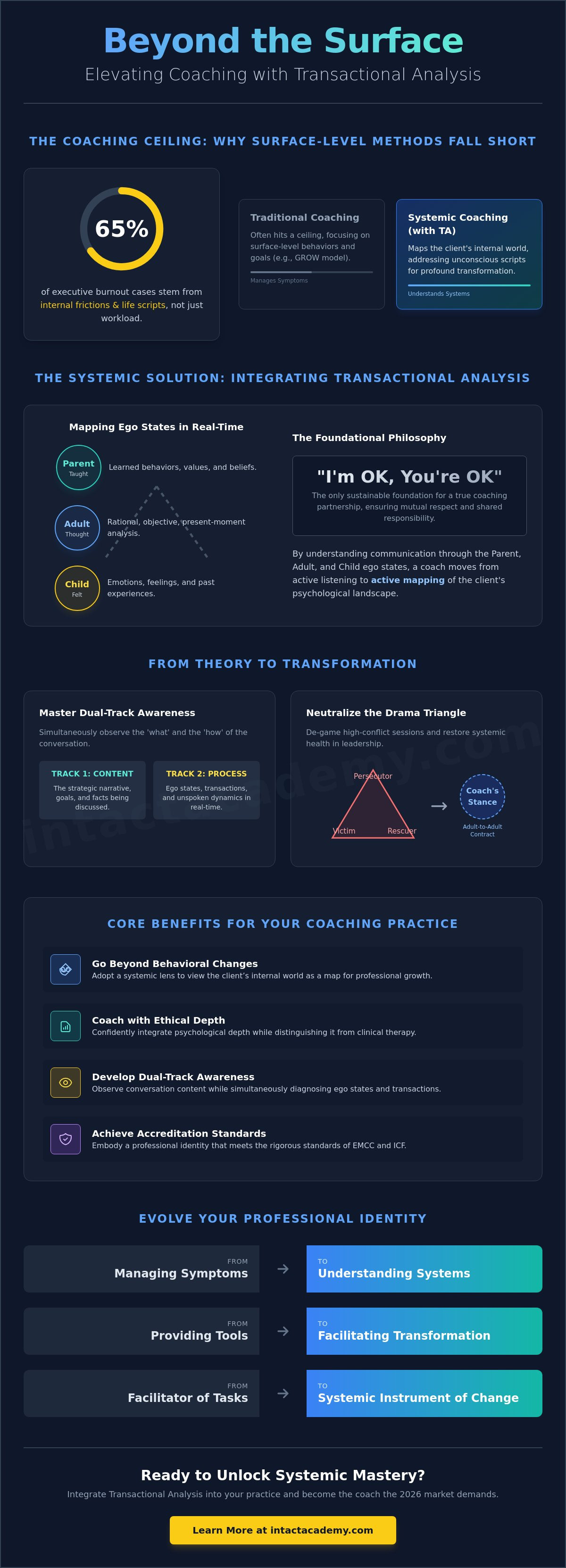
What if the "resistance" you encounter in your clients isn't a lack of motivation, but a deeply ingrained life script operating just beneath their awareness? You've likely felt that familiar tension when a talented executive repeats a self-sabotaging pattern, or a team collapses into psychological "games" despite your best interventions. It's exhausting to feel stuck at the surface, yet integrating TA into your coaching practice allows you to address these patterns without violating ethical boundaries. Research suggests that 65% of executive burnout cases stem from these internal frictions rather than workload, proving that surface-level coaching is no longer enough for the demands of 2026.
This integration moves you beyond transactional fixes toward a systemic understanding of human behavior. You'll discover how to navigate unconscious workplace dynamics with a clear, structured framework that ensures both safety and intellectual rigor. We will explore how this psychological depth transforms your client outcomes while aligning with the 2026 standards for EMCC and ICF accreditation. It is a shift from managing symptoms to understanding systems; a journey from providing tools to facilitating profound transformation. You'll learn to evolve your professional identity, moving from a facilitator of tasks to a systemic instrument of human change.
Key Takeaways
- Learn to move beyond surface-level behavioral changes by adopting a systemic lens that views the client’s internal world as a map for professional growth.
- Master the art of dual-track awareness, where you observe the content of the conversation while simultaneously diagnosing ego states and real-time transactions.
- Gain confidence in integrating TA into your coaching practice by understanding the vital distinction between facilitating professional potency and clinical healing.
- Identify and neutralize the Drama Triangle in leadership dynamics, allowing you to de-game high-conflict sessions and restore systemic health.
- Transition from merely applying theory to embodying a professional identity that meets the rigorous standards of EMCC Senior Practitioner and Senior Team Coach accreditation.
The Evolution of Professional Coaching: Why Transactional Analysis is the Key to Systemic Impact
The coaching landscape has reached a point where volume and depth must finally reconcile. With a 54% increase in coaching practitioners since 2019, the market in 2026 is no longer seeking more coaches; it is seeking more mastery. Integrating TA into your coaching practice represents a deliberate shift from managing behaviors to understanding the psychological architecture of the individual. This isn't merely about adding a new tool to your kit. It's about evolving your professional presence to see the systemic patterns that others miss. It's about moving from the transactional to the transformational, ensuring that every intervention resonates with the weight of psychological insight.
Moving Beyond Surface-Level Competencies
Traditional coaching frameworks like the GROW model often serve as excellent starting points, but they frequently hit a ceiling when faced with complex human dynamics. High-level executives don't fail because they lack a plan. They fail because of the unconscious scripts they carry into the boardroom. By understanding what is transactional analysis, you gain a map for the territory that behavioral models ignore. Research from 2023 indicates that 65% of executive burnout cases are rooted in these internal scripts rather than actual workload. TA allows you to decode these patterns, offering a systemic guide that makes the invisible visible. It provides a language for the subtle resistance that stops even the most driven leaders from reaching their potential.
The Philosophy of Genuineness in Professional Settings
The foundational principles of Transactional Analysis are built upon the "I'm OK, You're OK" philosophy. In a professional context, this position is the only sustainable foundation for a true partnership. It necessitates an Adult-to-Adult contract, ensuring that the coaching relationship remains a space of mutual respect and shared responsibility. As a coach, your own awareness of your Life Script is paramount. Without this insight, you risk falling into counter-transference, where your own unconscious needs begin to drive the session. This level of self-mastery ensures that you remain a clean instrument for the client's growth. The systemic encounter is a profound meeting of two human systems where the coach’s presence acts as a catalyst for the client’s return to a state of completeness and genuineness.
When you commit to integrating TA into your coaching practice, you're choosing to see the person, not just the problem. You're opting for a reflective and inviting style that honors the intelligence of your client while providing the structured methodology needed to navigate complex organizational systems. This approach doesn't rush the process. Instead, it builds a narrative of evolution, allowing for a return to wholeness that surface-level training providers simply cannot offer. It's a path toward professional potency that respects the depth of the human experience.
The Architecture of Integration: Mapping Ego States and Transactions in Real-Time
Mastery in the coaching room requires a dual-track awareness. While you listen to the strategic content of a client's narrative, you must simultaneously observe the psychological process unfolding in the present moment. Integrating TA into your coaching practice provides the diagnostic lenses needed to perform this split-screen analysis. By viewing communication through the Parent, Adult, and Child ego states, you move beyond active listening into active mapping. You begin to see not just what is being said, but from which part of the personality the message originates and where it is intended to land.
Identifying Ego State Dynamics in the Coaching Room
The coaching relationship is a living system where ego states constantly interact. A client may inadvertently "hook" your Child ego state by presenting as a helpless victim, or trigger your Parent by challenging your authority. Recognizing these shifts is essential for maintaining professional potency. When you feel a pull to rescue or criticize, you've likely stepped out of your Adult. Effective coaches use powerful inquiry to invite the client back into their own Adult ego state, restoring the objective, here-and-now focus required for growth. In team settings, consciously modeling the Nurturing Parent can provide the psychological safety necessary for members to take risks, yet the ultimate goal remains the strengthening of the collective Adult. For those seeking to master these nuances, our TA EMCC Senior Practitioner academy offers a structured environment for this developmental work.
Analyzing Transactions to Resolve Communication Blockages
Workplace friction often stems from "crossed transactions," where a message sent from one ego state receives an unexpected response from another. A leader asking a factual question (Adult) might receive a defensive, emotional rebuttal (Child), stalling the project instantly. By understanding the systemic path to TA integration, you can help clients map these exchanges in real-time. This involves distinguishing between the Social level (the words used) and the Psychological level (the underlying intent). Ulterior transactions, where the psychological message contradicts the social one, are the breeding ground for organizational "games."
A 2022 analysis demonstrated that leaders who utilize ego-state awareness reduced conflict-related delays by 30%. This data underscores the pragmatic value of integrating TA into your coaching practice. Beyond resolving conflict, you can use the concept of "Strokes"—units of human recognition—to shift organizational culture. By teaching leaders to provide authentic, positive recognition, you help them move away from a culture of scarcity toward one of abundance and motivation. This systemic shift doesn't just improve performance; it fosters a sense of wholeness and genuineness within the entire team structure.
Navigating the Boundary: Integrating Psychological Depth without Crossing into Therapy
The most frequent objection to integrating TA into your coaching practice is the fear of uncovering more than a coach is ethically equipped to handle. It's a natural hesitation. When we move beyond surface-level behavioral fixes, we inevitably touch the psychological structures that govern a person's life. However, the boundary between coaching and therapy is not a blurred line; it's a fundamental shift in intent. While therapy focuses on clinical healing and the resolution of historical trauma, coaching focuses on professional potency and the expansion of the client’s Adult ego state in their current role. By maintaining this distinction, you provide a space where profound change can occur safely within a professional context.
The Ethics of Depth: When Does Insight Become Intervention?
Ethical rigor is the cornerstone of any deep developmental work. Recognizing the "Red Flags" is vital for the safety of both the coach and the client. If a client exhibits chronic emotional dysregulation, an inability to function in their daily role, or persistent trauma narratives that prevent forward movement, a clinical referral is the only ethical path. This level of discernment is a key outcome of professional development for coaches who wish to work with psychological depth. During the initial chemistry session, it's helpful to explain your TA-informed approach as a method for mapping communication and leadership patterns, rather than a clinical intervention. Multi-party contracts that involve the sponsoring organization also serve as a protective boundary, ensuring that the focus remains on professional growth and systemic health.
Re-authoring Professional Scripts vs. Healing Trauma
In a coaching context, we work with what we call the "Working Script." This is the set of unconscious patterns that dictate how a leader manages conflict, delegates tasks, or handles failure. For example, a leader with a "Be Perfect" driver doesn't need to analyze childhood origins to recognize how this pattern currently causes bottlenecks in their team. Instead, we use TA to increase their Autonomy, which involves the development of awareness, spontaneity, and intimacy in their professional relationships. This allows the client to choose a different response in the moment, rather than acting out a pre-written script that no longer serves them. Coaching script work focuses on re-authoring the client’s current professional narrative for increased efficacy, whereas therapeutic re-parenting aims to resolve the foundational emotional wounds of the past.
When you focus on the "Working Script," the goal is always the client's return to a state of completeness and genuineness within their organizational system. You aren't looking to fix a broken past; you're looking to unlock a more potent future. This approach respects the maturity of the client, treating them as an equal partner in the process of change. It ensures that every insight gained translates directly into more effective leadership and healthier team dynamics. Integrating TA into your coaching practice, when done with this level of clarity, becomes a powerful catalyst for systemic evolution without ever losing its grounding in professional pragmatism.
Practical Applications: Using TA to Navigate Games and Organizational Scripts
Integrating TA into your coaching practice offers a profound advantage when navigating the murky waters of executive politics. Beyond individual ego states lies the territory of psychological "games": repetitive, unconscious patterns of interaction that inevitably end in a familiar, negative payoff. In leadership, these games often crystallize into the Drama Triangle, where individuals rotate between the roles of Persecutor, Rescuer, and Victim. A coach who isn't aware of these dynamics can easily be pulled into the triangle, becoming a "Rescuer" for a client who is playing the "Victim" of their board's expectations. This awareness allows you to maintain the distance needed to remain a clean instrument for change.
Organizational culture is often just a collection of these games played at scale, governed by what we call Organizational Scripts. These scripts are the unconscious rules of the company: "we don't challenge the founder" or "we prioritize speed over quality." When you are leading organizational change, ignoring these scripts is a primary cause of systemic resistance. TA provides the tools to help the system recognize these scripts. By bringing these hidden rules into the light of the Adult ego state, you create the psychological space required for genuine innovation and systemic health.
Spotting and Stopping Psychological Games in Executive Sessions
The most common workplace game is "Why Don't You—Yes But" (WDYYB), where a client asks for advice only to reject every suggestion offered. The "Switch" occurs when you realize you've been working harder than the client, and the "Cross" is the moment of mutual frustration. Another frequent pattern is "If It Weren't For You," where a leader blames their team for their own lack of progress. To "de-game" the session, you must refuse the Rescuer or Persecutor role. Instead of offering more solutions or joining the blame, use Adult confrontation: "I notice that for every suggestion I make, there is a reason why it won't work. What do you think is happening here?" This shifts the focus from the problem to the process, restoring the client's autonomy.
Systemic Contracting: The Foundation of Sustainable Change
Effective change requires more than a simple two-way agreement. The "Three-Cornered Contract" is a vital TA tool that aligns the coach, the client, and the organizational sponsor. This ensures that the individual's growth doesn't happen in a vacuum but supports the broader systemic needs. We often look to the work of Sari van Poelje, who pioneered the application of agile TA to help organizations move through these transitions with speed and psychological depth. This level of contracting prevents the coach from becoming an unwitting participant in a company's dysfunctional script.
For those ready to deepen their systemic impact, our TA EMCC Senior Team Coach Academy provides the rigorous training needed to facilitate these complex shifts. By mastering these practical applications, you move from being a consultant who suggests change to a systemic instrument who embodies it. You'll learn to hold the tension of the system while inviting each individual back to their state of completeness and genuineness.
The Journey Toward Systemic Mastery: Integrating TA into Your Professional Identity
The transition from applying a model to embodying a philosophy marks the true threshold of mastery. Integrating TA into your coaching practice is not a weekend endeavor or a simple addition to a toolkit; it's a process of professional evolution. As you internalize the principles of ego states, transactions, and scripts, they cease to be external diagnostic tools and become a part of your internal operating system. This embodiment allows you to show up with a quiet power and presence that clients sense immediately. You stop "doing" coaching and start being a systemic instrument of change, modeling the very autonomy and Adult presence you seek to facilitate in others.
For the sophisticated practitioner, this depth is the bridge to higher levels of professional accreditation. In 2026, the coaching market is increasingly discerning, moving away from generic certifications toward those that reflect psychological rigor. Mapping your TA journey to the EMCC Senior Practitioner and Senior Team Coach requirements ensures that your expertise is recognized by global standards. This path requires more than just hours logged; it demands a demonstrated ability to work with complexity and a commitment to Systemic Supervision. Supervision acts as the vital container where your TA-informed practice is refined, ensuring you remain "Intact" and ethically grounded while navigating the turbulent dynamics of executive leadership.
From Practitioner to Senior Practitioner
The EMCC criteria for Senior Practitioner status place a high premium on "psychological mindedness." Integrating TA into your coaching practice provides the specific evidence needed to satisfy these rigorous standards. By building a portfolio of case studies that demonstrate how you've used TA to resolve crossed transactions or de-game high-conflict teams, you provide concrete proof of your systemic impact. This isn't just about theory; it's about showing how psychological depth translates into organizational success. Joining a global community of practice, such as Intact Academy, provides the peer support and mentor coaching necessary to navigate this transition with confidence and integrity.
Wholeness as a Strategic Asset
The ultimate goal of this journey is to become an "Intact" coach. This means returning to a state of completeness and genuineness where your professional brand is an authentic reflection of your internal mastery. When you model autonomy—defined in TA as awareness, spontaneity, and intimacy—you provide a powerful template for your clients. This wholeness becomes your most significant strategic asset, distinguishing your value proposition from more transactional training providers. You're no longer just helping clients solve problems; you're helping them return to their own state of potency and systemic health.
This path toward mastery is both a personal and professional commitment. It's an invitation to look inward so that you can more effectively lead others outward. If you're ready to move beyond surface-level techniques and embrace a path of profound human transformation, we invite you to explore the TA EMCC Senior Practitioner academy. Here, you'll find the structured methodology, psychological depth, and global mentorship required to begin your journey toward systemic mastery in 2026.
Embodying the Future of Professional Coaching
The path to systemic mastery requires a shift from doing to being. You've explored how ego state awareness and game analysis move beyond surface-level fixes to create profound organizational change. You now understand the vital distinction between clinical healing and professional potency; this ensures you work with psychological depth while maintaining rigorous ethical boundaries. Integrating TA into your coaching practice is the definitive step toward this professional evolution, allowing you to show up as a stable container for your clients' transformation.
To deepen this journey, join a global community of practitioners spanning 14+ countries. Our programs are led by Sari van Poelje, a global TA expert, and carry both EMCC and ICF accreditation to ensure your mastery is recognized worldwide. It's time to move beyond the transactional and return to a state of completeness in your work. Apply for the TA EMCC Senior Practitioner Academy today to refine your systemic impact and claim your place as a leader in the field. Your commitment to depth is the catalyst for the flourishing of every individual and system you touch.
Frequently Asked Questions
Is Transactional Analysis only for therapists, or can coaches use it too?
Transactional Analysis is a versatile psychological framework with distinct applications in clinical, educational, and organizational fields. While therapists focus on healing historical trauma, coaches use TA as a communication map to increase professional potency and leadership efficacy. Integrating TA into your coaching practice allows you to address behavioral patterns and workplace dynamics without crossing into clinical territory. It provides a structured methodology for understanding human systems in high-performance environments.
How long does it take to effectively integrate TA into my coaching practice?
Mastery is a gradual process of embodiment rather than a quick skill acquisition. Initial concepts like ego states can be applied almost immediately to clarify communication and resolve conflict. However, integrating TA into your coaching practice at a level that meets EMCC Senior Practitioner standards typically requires one to three years of consistent study and supervision. This timeframe allows for the deep internalization of theory and the refinement of your professional presence.
What are the most common TA 'games' found in corporate environments?
The most prevalent games in executive settings are "Why Don't You, Yes But" and "If It Weren't For You." In the first, a leader solicits advice only to reject every suggestion offered, maintaining a position of intellectual superiority. In the second, individuals blame colleagues or organizational culture for their own lack of progress. Recognizing these patterns early prevents you from being pulled into the Drama Triangle as an unwitting rescuer or persecutor.
Can I get EMCC accreditation by specializing in Transactional Analysis?
Specializing in TA is an excellent path toward EMCC Senior Practitioner or Senior Team Coach accreditation. The EMCC values "psychological mindedness," a core competency that TA training directly addresses through its focus on ego states and systemic scripts. By documenting how you apply these concepts to facilitate client growth, you build a robust portfolio that meets the rigorous standards of global bodies. This specialization distinguishes your brand in a competitive market.
What is the difference between an ego state and a personality trait?
An ego state is a consistent pattern of feeling and experience directly linked to a corresponding pattern of behavior in the present moment. Unlike a personality trait, which is often viewed as a static characteristic, an ego state is dynamic and situational. You can consciously shift from a reactive Child ego state to an objective Adult state during a board meeting. This flexibility is what makes TA such a powerful tool for professional development.
How do I handle a client who refuses to move out of a 'Victim' role in the Drama Triangle?
Use Adult to Adult confrontation to invite the client back into their own potency and responsibility. When a client stays in the Victim role, they are looking for a Rescuer to do the work for them. Instead of offering solutions, ask reflective questions that highlight the repetitive nature of the pattern. You might say, "I notice that for every path we identify, you find a reason it is impossible. How is this serving you right now?"
Do I need to tell my clients I am using Transactional Analysis?
Transparency is a matter of professional preference and contracting, though many coaches find that introducing the framework builds trust. You don't need to teach a full theory lesson to be effective. Many coaches introduce TA as a "communication map" or a "leadership framework" during the chemistry session. This framing makes the psychological depth feel accessible and pragmatic rather than clinical, setting a clear expectation for the depth of the work.
What is the 'systemic' part of TA-informed coaching?
The systemic element involves looking beyond the individual to the unconscious rules and scripts governing the entire organization. TA-informed coaching recognizes that an executive's behavior is often a response to the "Three Cornered Contract" between the coach, the client, and the sponsoring system. By addressing these organizational scripts, you facilitate a return to wholeness for the entire system, ensuring that individual growth isn't stifled by a dysfunctional corporate culture.


