

What if the greatest obstacle to your team’s transformation isn't a lack of skill, but a lack of systemic distance? When leadership dynamics stall, many organizations reflexively choose between the familiar face of an insider or the fresh perspective of a consultant. Weighing the internal vs external team coach pros and cons is rarely about cost alone; it's a strategic calculation of psychological safety and cultural insight. You've likely felt the frustration of a coaching engagement that stays on the surface. Perhaps you've seen an internal coach lose their edge by becoming entangled in the very office politics they were meant to resolve.
We understand that choosing the right developmental partner is a high-stakes decision that impacts the collective health of your organization. It's a choice that requires both professional pragmatism and psychological depth. This article provides a clear framework to help you decide which path aligns with your specific systemic needs. We'll explore how the concept of distance influences coaching outcomes and how to ensure your choice meets EMCC or ICF standards for quality assurance. By the end, you'll have the clarity needed to foster deep, sustainable change rather than settling for temporary fixes.
Key Takeaways
- Evaluate the concept of systemic distance to determine if your organization needs the intimate cultural knowledge of an insider or the radical objectivity of a specialist.
- Utilize a strategic framework for weighing internal vs external team coach pros and cons, prioritizing psychological safety and long-term impact over simple budgetary metrics.
- Explore how the lens of Transactional Analysis illuminates hidden team dynamics and why external practitioners are often better positioned to navigate complex psychological contracts.
- Apply the Complexity Scale to discern when to deploy internal resources for organizational skill-building versus engaging external mastery for high-stakes C-suite transformations.
Defining the Systemic Distance: Internal vs External Team Coaching
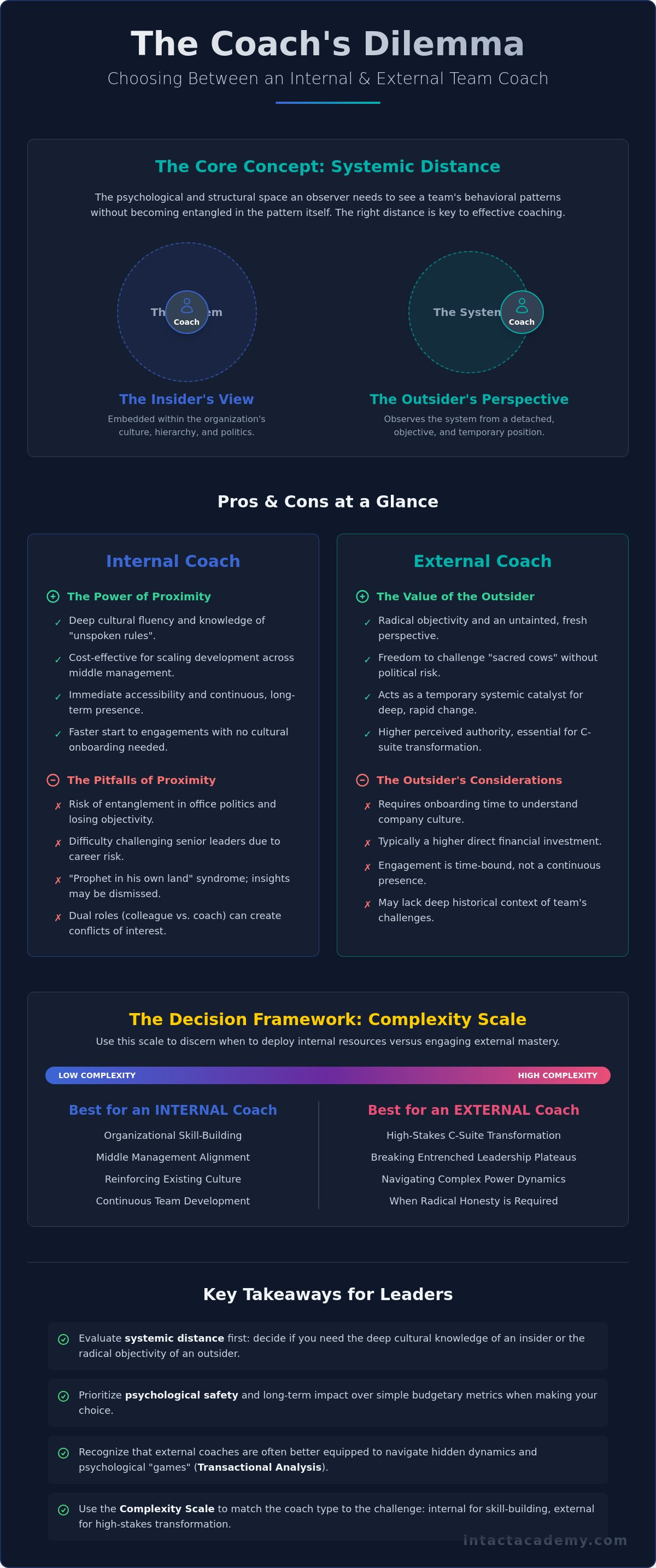
To truly understand the dynamics of a team, one must consider the vantage point of the observer. Within the discipline of professional Coaching, we often speak of "systemic distance." This is the psychological and structural space required to see the whole pattern of a team’s behavior without becoming part of the pattern itself. When leadership teams evaluate the internal vs external team coach pros and cons, they aren't just choosing a service provider; they are choosing where that observer stands in relation to the organizational soul. How far back must one step to see the forest rather than just the trees?
Internal team coaches are integrated members of the organization, typically housed within Human Resources or Learning and Development departments. They possess an intimate knowledge of the company’s history and unspoken rules. Conversely, external team coaches are independent practitioners brought in for specific, time-bound systemic interventions. They operate outside the hierarchy, providing a level of detachment that is often impossible for an employee to maintain. This distinction is vital because team coaching requires a more complex psychological contract than individual work. It involves managing the needs of the leader, the collective team, and the organization simultaneously, all while negotiating the invisible forces of the system.
The Role of the Internal Team Coach
The internal coach serves as a cultural steward and a continuous presence. Because they are already embedded in the system, they can offer immediate support and monitor progress over long periods. They understand the "shorthand" of the company, which allows for a faster start to any engagement. However, they face the significant challenge of wearing two hats. They must balance their role as a developmental partner with their status as a colleague or subordinate within the same hierarchy. This can create tension when the coach needs to challenge a senior leader who may have influence over their own career path. An internal team coach is a systemic insider with a shared destiny.
The Role of the External Team Coach
The external coach brings an untainted eye to high-stakes team dynamics. Unburdened by the need for long-term political survival within the company, they have the freedom to challenge "sacred cows" and name the "elephants in the room" that insiders might ignore. Their presence is a temporary systemic catalyst, designed to provoke a shift and then depart, leaving the system more capable than they found it. This objectivity is essential for C-suite teams where the internal vs external team coach pros and cons lean heavily toward the need for radical, unfiltered honesty to break through entrenched leadership plateaus. They don't just facilitate; they interrupt the status quo.
Internal Team Coaching: The Power and Pitfalls of Proximity
Proximity is a double-edged sword. When an organization chooses to develop its own talent, it gains a coach who breathes the same air as the teams they serve. This closeness allows for immediate accessibility; there's no need for lengthy onboarding or cultural translation. An internal coach already understands the organizational "scripts", those repetitive patterns of behavior and communication that define "how we do things around here." They see the subtle shifts in the office climate that an outsider might miss.
Evaluating the internal vs external team coach pros and cons requires looking past the surface level of the balance sheet. For many, the decision between an internal or external leadership coach comes down to scale. Internal coaching is remarkably cost-effective for middle management teams where the goal is often skill-building and alignment. However, this proximity carries a hidden tax. We call it the "Prophet in his own land" syndrome. It's the phenomenon where a coach’s insights are dismissed simply because they're seen as "just" another employee. Without the perceived authority of an outsider, their voice can struggle to rise above the daily noise of the business.
The Advantage of Cultural Fluency
Internal coaches are masters of the unwritten rules. They know which social norms are flexible and which are set in stone. By leveraging existing relationships, they can accelerate the coaching contract, moving past the "getting to know you" phase into deep work almost instantly. They aren't just fixing problems; they're drivers of a long-term professional development for coaches strategy that embeds growth into the company's DNA. This organic integration ensures that the transformation isn't an isolated event but a continuous evolution.
The Challenge of Confidentiality and Dual Roles
The psychological weight of an internal role is heavy. Knowing "too much" about a team member's history, their personal struggles, or their standing with HR can cloud a coach’s objectivity. This is where systemic blindness often sets in. The coach becomes part of the very system they're trying to transform, adopting the same blind spots as the team. Hierarchical reporting lines often trigger "Parent-Child" ego state reactions. A team might subconsciously view an internal coach as a parental figure to be pleased, or a sibling to compete with, rather than a neutral partner. Navigating the boundary between coaching and performance management requires immense maturity and a clear psychological contract. Without this, the coach risks becoming a "rescuer" in a drama triangle, further entrenching the team in their existing dynamics.
If you're looking to elevate your internal team's ability to hold these complex boundaries, exploring the training programs at Intact Academy can provide the rigorous framework needed for such mastery.
External Team Coaching: The Value of the Outsider Perspective
While the internal coach offers the gift of proximity, the external practitioner provides the luxury of distance. This distance is the foundation of radical objectivity. Because an external coach doesn't depend on the organization for their long-term career progression or social belonging, they possess the freedom to speak uncomfortable truths. They can observe the system without being captured by its gravity. When weighing the internal vs external team coach pros and cons, organizations often find that for high-stakes transformations, the outsider’s neutrality is their most potent asset.
This perspective comes with its own set of complexities. The financial investment is typically higher, reflecting the specialized expertise required to navigate deep-seated systemic issues. There's also the risk of "organ rejection." If a team’s culture is particularly rigid or defensive, they may view the external coach as an intruder rather than a partner. Unlike internal resources, external coaches have a limited long-term presence. Once the engagement ends, the responsibility for reinforcing new behaviors shifts back to the system itself, which can lead to a regression if the initial work wasn't sufficiently deep.
Breaking Systemic Stagnation
An external lens is often the only way to identify the "Psychological Games" that teams play. These are unconscious, repetitive patterns that serve to maintain the status quo while appearing to seek change. Insiders often become blind to these games because they're players in them. A coach with a rigorous executive coaching certification understands how to maintain professional boundaries while inviting the team to look at these hidden scripts. They act as a neutral container for the collective anxiety that inevitably arises during a major redesign, ensuring that the team stays with the process rather than retreating into old habits.
The Credibility of the Specialist
Senior leadership teams, particularly at the C-suite level, often require a coach they perceive as an intellectual and professional peer. The credibility of the specialist lies in their ability to match specific skills to complex team dysfunctions, such as a lack of accountability or eroded trust. In the context of internal vs external team coach pros and cons, the external expert is often seen as more authoritative when leading organizational change. They bring a breadth of experience from multiple industries, allowing them to cross-pollinate ideas and challenge parochial thinking that can stifle innovation. Their role is to be the catalyst that shifts the system into a new state of being.
The Transactional Analysis Lens: Navigating Power and "Games"
Power dynamics aren't just about who sits at the head of the table; they're about the subtle, often unconscious exchanges of energy and intent between team members. When evaluating the internal vs external team coach pros and cons, we must consider the psychological architecture of the team. We often utilize Transactional Analysis (TA) to decode these interactions. By understanding what is Transactional Analysis, a coach can see how power is distributed and how specific "games" are played to avoid genuine change. This lens allows us to move beyond surface behaviors and address the systemic roots of stagnation.
The "Contracting" phase is where the success of a systemic intervention is truly decided. External coaches typically have cleaner contracts because they operate entirely outside the company hierarchy. They aren't concerned with their next promotion or annual performance review, which allows them to address organizational "Scripts" with courage. These scripts are the repetitive patterns of failure that persist in a company regardless of who is in the room. Without a clear, psychological contract that allows for challenge, a coach becomes just another part of the scenery.
Teams frequently fall into the Drama Triangle, a cycle where members rotate through the roles of Victim, Rescuer, and Persecutor. It's a seductive trap. An internal coach, driven by a deep-seated desire to help their colleagues, is particularly prone to the "Rescuer" role. When a coach rescues, they inadvertently keep the team in a "Victim" state, preventing them from taking full responsibility for their own transformation. The external coach has the systemic distance required to stay out of the triangle, acting instead as a witness to the team’s own capacity for growth.
Ego States in the Coaching Relationship
In any coaching intervention, the goal is for the coach to remain in the "Adult" ego state. This state is characterized by objective, here-and-now processing. When the coach stays in "Adult," it invites the team to step out of their reactive "Child" or "Parent" states. Internal coaches are more susceptible to being pulled into these reactions because they share the same organizational history. For example, in a high-pressure board meeting, an internal coach might subconsciously revert to a "Child" state when confronted by an aggressive CEO, losing their ability to lead the transformation. Mastery requires the ability to hold the "Adult" space even when the system is in chaos.
Uncovering Unconscious Organizational Patterns
External coaches are often better at spotting the "games" teams play to maintain the status quo. These are unconscious strategies designed to avoid the vulnerability required for real change. Internal L&D professionals often fall into the "Rescuer" trap, taking on the team's emotional burden instead of holding them accountable. A coach’s primary tool is their own awareness of the system they have entered. By noticing their own internal reactions, they can mirror back to the team the very patterns that are holding them back.
If you're ready to master these systemic dynamics and elevate your practice, our TA EMCC Senior Team Coach Academy offers the psychological depth required for true organizational mastery.
Decision Framework: When to Choose Internal vs External
The choice between an internal and external resource is a strategic calculation of systemic readiness. It's not merely a budgetary line item but a reflection of where the organization stands in its process of becoming. Navigating the internal vs external team coach pros and cons requires a nuanced look at the Complexity Scale. For initiatives focused on skill acquisition or maintaining ongoing alignment, an internal coach is often the ideal choice. Their presence is steady; their knowledge of the company’s inner workings is unmatched. However, when the goal is a profound systemic shift, the "untainted eye" of an external practitioner becomes indispensable.
Stakeholder seniority also dictates the level of mastery required. C-suite teams operate within high-pressure environments where the stakes of failure are immense. These leaders almost always require the authority and psychological distance that only an external practitioner with "Senior Team Coach" mastery can provide. While the financial investment for an external expert is higher, the ROI is found in the long-term value of a transformed culture. A failed intervention by an insider who lacks the perceived authority to challenge the CEO can be far more costly than the fee of a specialist. For organizations seeking a middle path, hybrid models are emerging as a powerful solution. Here, external experts are brought in to supervise and mentor an internal coaching pool, ensuring quality and preventing the systemic blindness that often plagues insiders.
A Strategic Decision Matrix for HR Leaders
When you're faced with this decision, consider three primary criteria to guide your path. First, assess the level of conflict. High-conflict scenarios require a neutral container that only an outsider can provide. Second, evaluate the strategic importance. If the transformation is mission-critical to the company's future, the specialized expertise of an external coach is a necessary safeguard. Finally, consider scalability. If the goal is to embed a coaching culture across hundreds of middle management teams, building an internal capability is the most sustainable and cost-effective approach. Each tool has its place in the service of organizational wholeness.
Investing in Mastery: The Path to Senior Accreditation
For the internal coach, the journey doesn't end with a staff appointment. To bridge the authority gap and provide the same depth as an external peer, pursuing a rigorous team coaching course is essential. This level of professional development transforms a "helper" into a systemic catalyst. Our TA EMCC Senior Team Coach Academy is designed for both internal and external practitioners who seek to master the psychological complexities of team dynamics. By investing in this level of accreditation, you ensure that your coaching interventions are grounded in global standards. Wholeness in coaching comes from having the wisdom to choose the right tool for the systemic need, ensuring that every intervention moves the organization closer to its most genuine state.
Cultivating Systemic Wholeness in Your Organization
Choosing how to support your teams is a profound act of leadership. It requires a clear-eyed assessment of the internal vs external team coach pros and cons, moving beyond surface-level logistics into the realm of systemic impact. Whether you opt for the intimate cultural fluency of an internal practitioner or the radical objectivity of an external specialist, the goal remains the same: returning the system to a state of completeness and genuineness. By applying the Complexity Scale and the lens of Transactional Analysis, you ensure that your coaching interventions don't just solve immediate problems but address the underlying scripts that hinder growth.
If you're ready to deepen your impact and facilitate human transformation, we invite you to explore our TA EMCC Senior Team Coach Academy for Systemic Mastery. Led by international expert Sari van Poelje, our EMCC and ICF accredited programs have empowered participants from over 14 countries to lead profound organizational change. True transformation happens when the coach maintains the "Adult" ego state and respects the boundaries of the psychological contract. The courage to look inward is the first step toward outward flourishing. We're here to provide the stable container for that journey.
Frequently Asked Questions
Is internal coaching more effective than external coaching?
Effectiveness is not a matter of quality but of systemic fit. Internal coaching excels in long-term skill acquisition and maintaining cultural continuity across middle management. External coaching is typically more effective for high-stakes interventions where radical objectivity and systemic distance are required to break entrenched leadership patterns. The choice depends entirely on the complexity of the change you seek to facilitate.
What are the main ethical challenges for internal team coaches?
The primary hurdle is managing dual relationships and confidentiality within a single hierarchy. Internal coaches must navigate the tension between their role as a developmental partner and their status as a colleague or subordinate. They often face the psychological weight of knowing "too much" about team members, which can lead to systemic blindness or an unconscious pull into the "Rescuer" role within the Drama Triangle.
How do I measure the ROI of an external team coach?
Measure ROI through qualitative systemic shifts and quantitative business KPIs linked to collective performance. Look for reduced turnover, faster decision-making cycles, and improved alignment on strategic goals. While external fees represent a higher initial investment, the long-term value of a transformed leadership culture often outweighs the cost when you weigh the internal vs external team coach pros and cons against the price of stagnation.
Can an internal coach effectively challenge a CEO?
It's difficult for an internal coach to maintain the necessary psychological distance to challenge a CEO. The inherent power imbalance often triggers a "Parent-Child" ego state reaction, where the coach may feel silenced by their shared destiny with the company. External coaches provide the "Adult" presence required to hold senior leaders accountable without the fear of political repercussions or career fallout.
What qualifications should I look for in an external team coach?
Seek practitioners with senior-level accreditation from recognized global bodies like the EMCC or ICF. A qualified coach should demonstrate mastery in systemic frameworks and psychological models such as Transactional Analysis. Their ability to remain a neutral observer is vital. Look for a track record of facilitating deep transformation across multiple industries to ensure they bring a breadth of perspective to your unique culture.
When is a hybrid coaching model the best approach for an organization?
A hybrid model is ideal when an organization seeks to scale coaching while maintaining rigorous standards for complex interventions. In this scenario, external experts provide systemic supervision and mastery-level training for an internal coaching pool. This approach combines the cost-effectiveness of internal resources with the objective oversight of external specialists, ensuring the internal team doesn't become "sucked into" the very politics they intend to shift.
How does Transactional Analysis help in choosing a coach?
Transactional Analysis provides a map of the ego states and "games" present within a team’s interactions. Choosing a coach involves identifying who can best remain in the "Adult" state given the team’s current dynamics. If an organizational script is particularly rigid or defensive, an external coach is usually required to provide the systemic distance needed to interrupt the cycle and invite a more genuine way of being.
What is the difference between team building and systemic team coaching?
Team building is a transactional event focused on morale and social bonding; systemic team coaching is a developmental process focused on profound transformation. While team building might provide a temporary lift in spirits, systemic coaching addresses the deep-seated patterns and psychological contracts of the collective. It's a methodical journey that rewires how a team functions as a living organism within the larger organizational system.


