

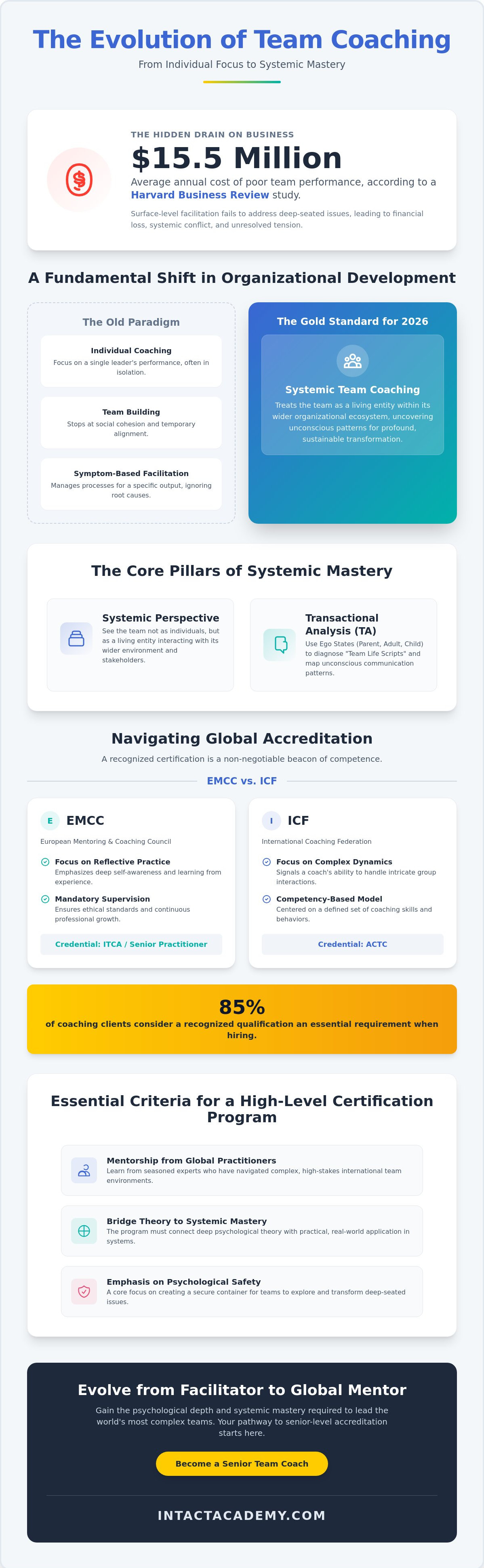
A Harvard Business Review study found that poor team performance costs businesses an average of $15.5 million annually. You likely recognize this cost not just in financial loss, but in the palpable tension of a boardroom where conflict has become systemic. It's exhausting to feel out of your depth when surface-level facilitation fails to address the underlying psychological scripts driving team behavior. You deserve an international team coaching certification that commands executive respect and provides a structured framework for profound human transformation.
We understand that true mastery requires moving beyond basic tools to understand the unconscious patterns that dictate organizational success. This guide offers a comprehensive roadmap to choosing a credential that merges psychological depth with systemic mastery. We'll examine the distinct pathways of the ICF and EMCC, the integration of Transactional Analysis in team dynamics, and the process of becoming a catalyst for sustainable change. By the end, you'll have the clarity needed to evolve from a facilitator into a wise global mentor for the world's most complex teams.
Key Takeaways
- Understand the fundamental shift from individual executive coaching to systemic team interventions as the gold standard for organizational health in 2026.
- Learn how to apply Transactional Analysis to identify "Team Life Scripts," uncovering the unconscious patterns that either drive or derail collective performance.
- Navigate the complexities of securing an international team coaching certification by comparing the specific requirements and philosophical approaches of the EMCC and ICF.
- Identify the essential criteria for high-level training programs, emphasizing the need for psychological safety and mentorship from seasoned global practitioners.
- Discover the pathway to achieving senior-level accreditation that bridges the gap between theoretical psychological depth and practical systemic mastery.
The Evolution of the International Team Coaching Certification
The landscape of organizational development has fundamentally transformed. We've moved beyond the era where coaching was a solitary pursuit aimed solely at the individual leader. In 2026, the complexity of global markets and hybrid work structures has made the team the primary unit of transformation. Obtaining an international team coaching certification is no longer a luxury for the elite coach; it's a professional necessity for those who wish to facilitate sustainable change. This certification represents a specialized mastery of group dynamics, requiring the coach to hold both the individual and the collective in a single, coherent gaze.
There's a critical distinction to be made between team building, facilitation, and systemic team coaching. Team building often stops at social cohesion. Facilitation focuses on managing a process to reach a specific output. Systemic team coaching, however, treats the team as a living entity with its own unconscious patterns and "life scripts." It's about helping the team recognize how they interact with their wider environment and the stakeholders they serve. This shift toward the systemic reflects a growing maturity in the market, where organizations seek more than just temporary alignment.
Why Surface-Level Facilitation Is No Longer Enough
Traditional workshops often provide a temporary reprieve from tension without addressing the root cause of the friction. These interventions treat symptoms rather than the underlying organizational culture. In high-stakes corporate environments, leaders now demand practitioners who can navigate the turbulent waters of systemic conflict. Systemic coaching creates a container where deep-seated issues can be surfaced and transformed. It moves the needle because it works with the reality of the system, not just the polite surface of professional interaction. Organizations are tired of "one-off" events that fail to produce lasting evolution. They seek a deeper, more rigorous engagement that honors the intelligence of the team.
Global Accreditation Bodies: EMCC and ICF
Two primary organizations define the standards for this work: the European Mentoring and Coaching Council (EMCC) and the International Coaching Federation (ICF). The EMCC has long been a proponent of reflective practice and mandatory supervision, offering the Individual Team Coaching Accreditation (ITCA). Meanwhile, the ICF has introduced the Advanced Certification in Team Coaching (ACTC) to signal a coach's ability to handle complex group dynamics. Both pathways require a significant commitment to education and documented practice.
Holding an international team coaching certification from these bodies provides a bridge across borders. It assures multinational organizations that a coach possesses the intellectual rigor and psychological depth required to work in diverse, executive settings. Research published in August 2025 indicates that 85% of coaching clients consider a recognized qualification an essential requirement when hiring. In a market saturated with surface-level training, these credentials serve as a beacon of systemic competence. They offer a stable foundation for the often-turbulent work of professional and personal change.
The Core Pillars of Systemic Team Coaching Mastery
The pursuit of an international team coaching certification is often driven by a desire for deeper impact. While many programs focus on surface-level diagnostics, true mastery requires an understanding of the invisible threads that bind a group together. We view the team not as a collection of individuals, but as a singular, living entity existing within a wider organizational ecosystem. This systemic perspective allows the coach to see beyond immediate friction to the underlying structures that dictate performance. Understanding The Power of Team Coaching involves recognizing that every team operates according to a set of unwritten rules and shared histories. Transformation begins when these hidden dynamics are brought into the light of conscious awareness.
Transactional Analysis as a Team Diagnostic Tool
Transactional Analysis (TA) offers a profound lens for mapping these unwritten rules. By observing "Ego States"—the Parent, Adult, and Child patterns within each member—we can visualize how a leadership team communicates under pressure. Does the team default to a critical Parent-Child dynamic during a crisis? Or can they maintain an Adult-Adult connection to solve complex, systemic problems? These patterns often manifest as "Workplace Games," repetitive sequences of interaction that stall innovation and create resentment. Transactional Analysis bridges the gap between individual psychology and group behavior by providing a shared language for observable interactions. Practitioners who study at the TA EMCC Senior Team Coach Academy learn to decode these games, allowing the team to return to a state of genuineness and collective flow.
Systemic Awareness and Organizational Impact
Beyond communication, systemic mastery involves mapping invisible boundaries and hierarchies that influence how work actually gets done. A team doesn't exist in a vacuum; it's constantly influenced by the "Team Life Script," which is an unconscious narrative about the team's identity, worth, and eventual destiny. A coach holding an international team coaching certification acts as a stable container for the turbulence that arises when these scripts are challenged. By facilitating systemic alignment, the coach ensures that transformation isn't just a fleeting moment of clarity but a sustainable organizational evolution. This process requires rigorous contracting from the outset, establishing a psychological and professional foundation that honors the complexity of the human systems involved. It's about moving from a state of reactive conflict to one of proactive, systemic equilibrium.
Comparing Certification Paths: EMCC Senior Team Coach vs. ICF ACTC
Selecting an international team coaching certification is a decision of both strategic and personal alignment. Do you find yourself drawn to the rigorous, competency-based assessment of the ICF, or does the EMCC's emphasis on the reflective practitioner resonate more deeply with your developmental journey? Both paths offer global recognition, yet they cultivate different qualities in the coach. The ICF ACTC serves as a specialized add-on to existing credentials. In contrast, the EMCC Individual Team Coaching Accreditation (ITCA) integrates into a broader framework of professional maturity and ongoing supervision.
Accreditation Requirements at a Glance
Educational hours are just the beginning. Proving your impact in the field requires a documented history of successful engagements. While both bodies demand high standards, their specific metrics for 2026 differ in focus:
- ICF ACTC: Requires 60+ hours of specialized team coaching education, 5 documented team coaching engagements, and 5 hours of coaching supervision.
- EMCC Senior Practitioner: Requires a minimum of 250 hours of coaching practice and a demonstrated commitment to reflective practice.
- Supervision: EMCC mandates at least one supervision session per quarter, or a ratio of one hour of supervision for every 35 hours of coaching.
This focus on supervision is the critical, often overlooked requirement for EMCC accreditation. It ensures the coach remains a stable container, unburdened by the systemic projections and "Team Life Scripts" of the groups they serve. It's a process of maintaining your own psychological hygiene so you can stay fully present for the team's transformation.
Choosing the Right Path for Your Career Goals
Choosing your path depends on the specific nature of your global practice. If your work takes you across North American and Asian markets, the ICF ACTC provides a widely recognized benchmark of performance that executive boards frequently look for. If you operate primarily in Europe or prioritize a relational, holistic approach to organizational change, the EMCC Senior Team Coach designation may offer a more congruent fit. For those seeking true systemic mastery, dual accreditation remains the gold standard. It signals a commitment to both technical excellence and deep psychological reflection. When selecting a team coaching course, consider which body’s philosophy aligns with your vision of human flourishing and professional integrity.
What to Look for in a High-Level Certification Program
Choosing an international team coaching certification requires looking far beyond the syllabus or the price point. You must assess the quality of the container in which you will grow. A high-level program provides more than just information; it offers a psychologically safe learning environment where you can explore your own dynamics before attempting to guide others. This safety is the bedrock of deep learning. It allows for the vulnerability needed to dismantle old professional habits and integrate a truly systemic perspective. Without this foundation, the training remains a purely intellectual exercise rather than a transformative journey.
Rigorous programs prioritize the integration of theory with immediate field application. Learning about systemic scripts is one thing; identifying them in real-time during a corporate crisis is another. Look for curricula that mandate field projects where you apply Transactional Analysis or other systemic frameworks to live team engagements. This hands-on approach ensures that the insights you gain are grounded in the messy reality of organizational life. It moves you from being a student of theory to becoming a practitioner of change.
The Importance of Systemic Supervision
Supervision is the most critical safeguard against coach burnout and ethical drift. It serves as a mirror, helping you navigate your own unconscious triggers and the systemic projections you inevitably absorb from teams. The EMCC places immense value on this, recommending a ratio of one hour of supervision for every 35 hours of coaching. This disciplined focus on reflective practice ensures you remain a clear, neutral instrument for your clients. Engaging in consistent professional development for coaches through supervision is what distinguishes a senior practitioner from a surface-level facilitator.
Expertise of the Lead Faculty
The background of your trainers dictates the depth of your mastery. Seek out programs led by seasoned practitioners who have spent decades in executive boardrooms, not just academics who study them. Learning from masters like Sari van Poelje in the field of Transactional Analysis provides a bridge between ancient psychological truths and modern business pragmatism. A global cohort further enriches this experience. Interacting with peers from diverse cultures and industries challenges your assumptions and broadens your systemic lens. This diversity is essential for anyone seeking a truly global international team coaching certification.
If you are ready to move beyond transactional tools and embrace the profound work of systemic transformation, we invite you to explore the TA EMCC Senior Team Coach Academy for your next stage of growth.
Becoming a Senior Team Coach with Intact Academy
The choice to pursue an international team coaching certification is ultimately a choice to return to a state of completeness. At Intact Academy, we believe that you cannot lead a team to a place of systemic health if you haven't first explored the depths of your own internal landscape. Our TA EMCC Senior Team Coach Academy is designed for the practitioner who is ready to move beyond the transactional and into the transformational. It's a space where professional pragmatism meets psychological depth, creating a stable container for your evolution as a leader of change. This program doesn't just meet global standards set by the EMCC and ICF; it exceeds them by fostering a state of wholeness in the coach.
A Curriculum Rooted in Depth and Pragmatism
Our curriculum is built on the belief that profound organizational impact requires a dual focus on individual psychology and systemic dynamics. You begin by grounding yourself in the TA Foundation, learning the language of Ego States and transactions. As you progress toward senior-level accreditation, the focus shifts toward large-scale Organizational Change. You'll learn to diagnose the "Life Script" of an entire department and facilitate interventions that honor the humanity of every stakeholder. This path often mirrors the journey taken in our executive coaching certification, where individual growth serves as the catalyst for broader systemic success. By the time you complete your international team coaching certification, you'll possess the tools to navigate even the most turbulent corporate environments with grace.
Your Journey Toward International Mastery
The journey is delivered through a rhythmic hybrid model, blending the reflective space of online learning with the visceral depth of in-person workshops. This structure allows ideas to resonate over time, mirroring the deliberate pace of deep learning itself. You'll join a global community of change-makers, sharing insights and challenges with peers who value integrity and depth as much as you do. The long-term impact on your practice is profound. You'll find yourself handling complex systemic conflicts with a sense of quiet power and clarity that commands executive respect. Your clients won't just see a coach; they'll experience a mentor who remains committed to their flourishing.
Are you ready to join a cohort of practitioners committed to human flourishing? Explore the TA EMCC Senior Team Coach Academy and take the first step toward systemic mastery.
Step Into Your Role as a Systemic Catalyst
Realizing systemic mastery is a journey of both professional rigor and personal evolution. You've explored how a deep understanding of Transactional Analysis and group dynamics can transform a dysfunctional team into a flourishing system. Choosing the right international team coaching certification ensures your expertise is recognized on a global stage while providing the psychological depth necessary for high-stakes executive work. This path requires a commitment to integrity, reflective practice, and the courage to address the underlying scripts that dictate organizational life.
At Intact Academy, our programs are led by Sari van Poelje and attract participants from over 14 countries, creating a rich and diverse learning community. Our EMCC and ICF accredited academies offer a stable foundation for those ready to move beyond surface-level interventions. If you feel called to lead profound human and organizational transformation, the time to act is now. Apply for the TA EMCC Senior Team Coach Academy and begin your path toward senior practitioner status. The world needs coaches who possess the wisdom to look beneath the surface. We're here to support your transition into mastery.
Frequently Asked Questions
Is an international team coaching certification worth the investment in 2026?
An international team coaching certification is essential in 2026 because 85% of coaching clients now consider recognized qualifications a mandatory requirement for hiring. Beyond marketability, this level of training allows you to address systemic friction that costs businesses an average of $15.5 million annually. It's an investment in your ability to handle high-stakes executive dynamics that surface-level practitioners simply cannot manage.
How long does it take to complete the EMCC Senior Team Coach certification?
Completing the EMCC Senior Team Coach accreditation typically takes between 12 and 18 months, depending on your existing experience and the pace of your practice. You must document a minimum of 250 hours of coaching practice to qualify at the Senior Practitioner level. This duration ensures you have sufficient time for the reflective practice and supervision necessary to embody the role of a wise global mentor.
Can I apply for ICF ACTC if my training was through an EMCC-accredited program?
You can apply for the ICF Advanced Certification in Team Coaching (ACTC) if your EMCC-accredited program meets the ICF's requirement of 60 hours of specialized team coaching education. Many high-level academies are dual-accredited to facilitate this global flexibility. You'll still need to hold a primary ICF credential, such as an ACC or PCC, and pass the ICF Team Coaching Certification Exam to secure the ACTC.
What is the difference between team coaching and group coaching in certification?
Team coaching focuses on the collective entity as a single system with a shared goal; group coaching involves individuals working on separate personal goals within a shared space. Certification for team coaching requires specific mastery in group dynamics and systemic interventions. It's the difference between coaching five individuals who happen to be together and coaching the "living entity" that is the team itself.
Do I need a prior individual coaching credential to start a team coaching certification?
You generally need a foundational individual coaching credential before pursuing specialized team accreditation. The ICF ACTC specifically requires an existing ACC, PCC, or MCC credential. While the EMCC pathway is more holistic, starting an international team coaching certification without foundational experience often leaves practitioners feeling out of their depth when individual psychological triggers disrupt the systemic work.
How does Transactional Analysis improve my effectiveness as a certified team coach?
Transactional Analysis provides a precise diagnostic map for identifying Ego States and "Workplace Games" that stall collective productivity. It allows you to see the unconscious patterns, or "Team Life Scripts," that dictate how members interact under pressure. By making these invisible scripts visible, you help the team move from reactive patterns to a state of Adult-Adult genuineness and sustainable alignment.
What are the supervision requirements for international team coaching accreditation?
International accreditation bodies now view supervision as a non-negotiable standard for ethical practice and professional maturity. The EMCC mandates at least one supervision session per quarter, or a ratio of one hour of supervision for every 35 hours of coaching. This disciplined focus on reflective practice protects both the coach and the client system from the unconscious projections often found in high-pressure organizational settings.
Can I complete my team coaching certification online?
You can complete your certification through hybrid or fully online models that utilize interactive, live workshops to build a global community. These digital containers are designed to maintain psychological safety while connecting you with peers from diverse cultures. While the delivery is virtual, the work remains deeply relational, requiring active participation in field projects to ground theoretical concepts in live organizational reality.


