

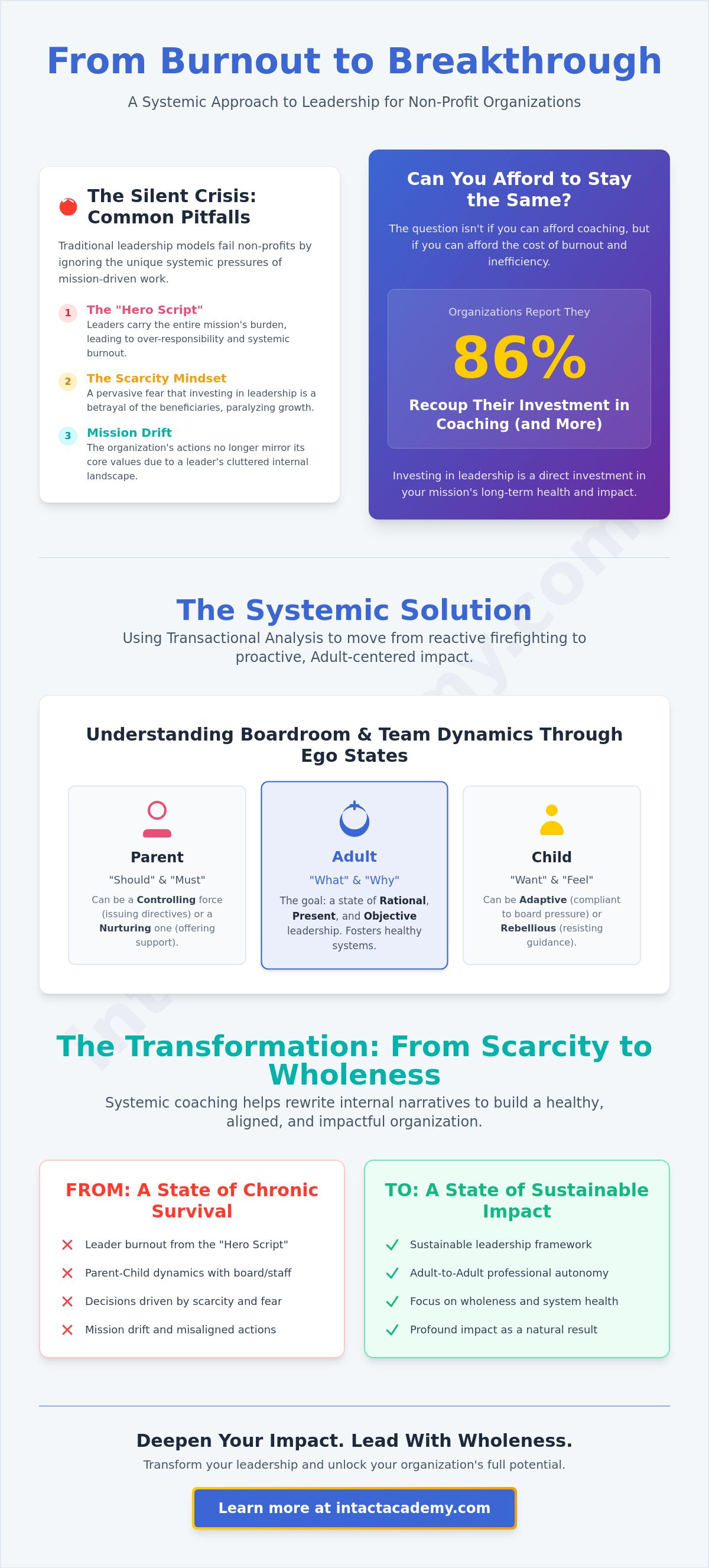
What if the relentless self-sacrifice often celebrated in the social sector is actually a systemic barrier to the very change you seek to create? You likely recognize the weight of the "hero" complex, that heavy mantle where a leader carries the entire burden of the mission while navigating the friction between boards, donors, and staff. It's common to feel that leadership coaching for non-profit organizations is a luxury your budget cannot justify, especially when the immediate pressure of the 2026 generosity crisis feels so much more urgent. Yet, when 86% of organizations report that they recoup their investment in coaching, the question shifts from whether you can afford to start, to whether you can afford to stay exactly as you are.
We understand that your work isn't just a career; it's a commitment to profound human transformation. This article explores how systemic coaching and Transactional Analysis can shift your leadership from a state of chronic survival to one of profound, sustainable impact. We'll examine the psychological frameworks that transform burnout into stable energy and provide a path to align your systemic goals with daily operations. By returning to a state of completeness, you can lead your organization toward a future where impact is a natural result of an aligned, healthy system.
Key Takeaways
- Learn to identify the "Hero Script" that drives chronic burnout and replace it with a sustainable framework for mission-driven leadership.
- Discover how Transactional Analysis ego states influence your board room interactions and organizational culture.
- Evaluate the true ROI of leadership coaching for non-profit organizations to justify the investment in senior-level systemic interventions.
- Shift your focus from scarcity to wholeness by addressing the underlying scripts that dictate how your organization functions.
- Gain a clearer understanding of how systemic supervision and psychological depth can transform your daily operations into profound social impact.
The Silent Crisis: Why Traditional Leadership Coaching Often Fails Non-Profit Organizations
The social sector operates on a frequency that is fundamentally different from the corporate world. When we discuss leadership coaching for non-profit organizations, we aren't simply talking about improving quarterly targets or refining a supply chain. We're addressing the delicate architecture of mission-driven systems where the primary currency is human flourishing. Traditional coaching models often treat an organization like a machine to be optimized. In contrast, a systemic approach recognizes that a non-profit is a living network of relationships, histories, and unconscious motivations. Without this depth, coaching remains a surface-level exercise that fails to touch the core of the leader's struggle.
Generic executive coaching often falls flat because it ignores the unique power dynamics inherent in the social impact space. To understand the evolution of these professional interventions, it helps to look at the broader history of what is coaching and how it has historically served the private sector. In a non-profit, the leader isn't just answering to a board; they're navigating the expectations of donors, staff, and the communities they serve. These external stakeholders introduce an emotional weight and a level of scrutiny that isn't present in a standard shareholder model. When a coach doesn't account for these systemic pressures, their advice can feel hollow or even counterproductive.
This misalignment often leads to "Mission Drift," which we view as both a psychological and systemic failure. It happens when the organization’s actions no longer mirror its values. This isn't usually caused by a lack of passion. Instead, it's a result of a leader’s internal landscape becoming cluttered with the noise of survival. When a leader loses their sense of wholeness, the organization follows suit, drifting away from its primary purpose to satisfy the immediate demands of the system.
The Psychology of the "Hero" and "Martyr" Scripts
Many founders and executives are driven by unconscious life scripts that demand total self-negation for the sake of the cause. They over-function to compensate for perceived gaps in the system, creating a Parent-Child dynamic where the board acts as a critical parent and the leader behaves like a compliant child. The Hero Script is an unconscious pattern of over-responsibility that leads to systemic burnout. Breaking this cycle requires more than better time management. It requires a deep rewrite of the leader’s internal narrative to move toward a state of genuine Adult autonomy.
Managing the Scarcity Mindset in Social Impact
There's a pervasive fear in the non-profit sector that investing in oneself is a betrayal of the beneficiaries. This scarcity mindset paralyzes growth and keeps leaders in a perpetual state of survival. It's vital to recognize the systemic link between leader health and beneficiary outcomes. When you move from a survivalist ego state to a professional adult state, you begin to see that your well-being is the primary infrastructure of the mission. Professional leadership coaching for non-profit organizations isn't a luxury. It's a commitment to the long-term health of the entire system.
A Systemic Lens: How Transactional Analysis Unlocks Non-Profit Potential
To lead a mission-driven organization is to exist at the center of a storm of human expectations. While traditional models might offer surface-level strategies, leadership coaching for non-profit organizations requires a more robust psychological map. Transactional Analysis (TA) provides this map. It allows us to move beyond the "what" of organizational behavior into the "why," revealing the invisible threads that bind a team together or pull them apart. By understanding the underlying transactions between individuals, we can transform a culture of reactive firefighting into one of proactive, Adult-centered impact.
At the heart of this approach is the recognition of ego states: Parent, Adult, and Child. In the high-pressure environment of a non-profit boardroom, these states often shift unconsciously. A board might slip into a Controlling Parent role, issuing directives that stifle innovation, while a leadership team might retreat into a Compliant Child state, executing tasks without questioning their systemic validity. Effective leadership coaching for non-profit organizations facilitates a return to the Adult state. In this state, leaders can process reality in the here-and-now, making decisions based on data and mission rather than historical baggage or emotional reactivity.
Ego States in Stakeholder Management
Navigating donor relationships requires a high degree of psychological literacy. It's common to see donors occupy a Nurturing Parent state, offering support that, while well-intentioned, can create a sense of dependency. Conversely, a donor in a Controlling Parent state may use funding as a tool for micromanagement. Recognizing these shifts is the first step toward maintaining an Adult-to-Adult dialogue. For those new to these concepts, understanding what is transactional analysis provides the foundational context needed to maintain professional equilibrium during financial crises or stakeholder friction.
Uncovering the Organizational Script
Every non-profit carries a script, a life plan created in its early years, often heavily influenced by the "founder’s myth." This script dictates how the organization handles conflict, success, and even failure. If the founding narrative was one of struggle and martyrdom, the organization may unconsciously sabotage its own growth to remain "true" to that origin. Breaking these repetitive cycles requires systemic awareness. It involves leading organizational change by addressing the psychological roots of these patterns rather than just the symptoms. When we clear these scripts, we create space for a new, healthier narrative to emerge.
This work is often undermined by "Psychological Games," structured series of transactions that feel familiar but lead to a predictable, negative payoff. Common games like "Yes, But" or "Look How Hard I'm Trying" drain emotional energy and stall progress. To prevent this, we utilize "Contracting for Change." This ensures that the coaching engagement is built on clear, explicit agreements about goals and boundaries, making the transformation both measurable and permanent. Those seeking to deepen their systemic impact often find that engaging in systemic leadership development provides the necessary container for this profound work.
Beyond Pro-Bono: Evaluating the True ROI of Senior-Level Coaching
There is a persistent, quiet tension in the social sector regarding the allocation of resources. Many boards feel a moral obligation to direct every possible cent toward frontline services, viewing executive growth as a secondary concern or a luxury. However, this perspective overlooks a fundamental systemic truth: the health of the organization is inseparable from the health of its leadership. When we discuss leadership coaching for non-profit organizations, we must move beyond the allure of "pro-bono" or "affordable" generalist support. These low-cost options often lack the systemic depth required to address the "wicked problems" that define the social impact space, such as chronic burnout, multi-generational trauma, and complex stakeholder friction.
Senior-level coaching is an investment in the organization's primary infrastructure. Research indicates that 86% of organizations report recouping their investment in coaching, with some seeing returns up to seven times the initial cost. In a non-profit context, this return isn't just financial; it's measured in the stability of the system. We see it in the speed of decision-making, the clarity of organizational culture, and the retention of key talent. Spending donor funds on executive development isn't a diversion from the mission. It is a safeguard for the mission's future.
Affordable vs. Senior Practitioner Coaching
The difference between a six-session "fix" and a systemic intervention is profound. A generalist coach might focus on surface-level productivity, but a senior practitioner looks at the underlying scripts that govern the entire system. This level of mastery requires rigorous professional development for coaches, ensuring they can hold the space for complex psychological shifts. To justify this to donors, we must present a framework for "Systemic ROI" that highlights how a more resilient leader creates a more efficient, less volatile organization.
The Cost of Non-Intervention
The financial impact of executive turnover is staggering, often costing an organization between 50% and 200% of the departing leader's annual salary. Beyond the immediate recruitment costs, there is the hidden drain of lost institutional knowledge and damaged donor relationships. When systemic conflict remains unresolved, it leads to missed grant opportunities and failed programs. The true cost of leadership failure far outweighs the investment in senior-level coaching. By choosing professional leadership coaching for non-profit organizations, you aren't just supporting a person; you're protecting the beneficiaries who rely on your organization's stability and longevity.
From Scarcity to Wholeness: Implementing a Systemic Leadership Framework
Moving from the "why" to the "how" requires a departure from linear, checklist-based models. In the context of leadership coaching for non-profit organizations, we implement a framework that honors the complexity of the mission. This isn't a surface-level correction. It's a fundamental shift from a scarcity mindset to one of systemic wholeness. By addressing the root causes of organizational friction, we allow the mission to breathe again, unburdened by the weight of unexamined habits.
The process begins with a systemic diagnosis. We look beyond the individual leader to the entire organizational field, asking what the system is trying to achieve through current behaviors. Once the field is mapped, we move to clearing the scripts. This involves addressing the unconscious "why" behind organizational patterns before attempting to change the "what." Without this depth, any change is merely cosmetic and will likely revert under pressure.
The third stage focuses on team alignment. By utilizing systemic team coaching, we bridge the often-painful gap between the board's strategic vision and the staff's operational reality. Finally, we establish a sustainable rhythm. This isn't about working harder. It's about building a culture of reflective practice that prevents the return of the survivalist ego state. The true value of leadership coaching for non-profit organizations lies in this ability to create a lasting, healthy pace for the entire system.
The Role of Systemic Supervision
Non-profit leaders carry an immense amount of emotional labor, yet they are often the least supported individuals in the system. Systemic supervision provides a stable container for this weight. Using the 7-eyed model, we examine the leader's work from multiple perspectives: the client, the interventions, the relationship, and the wider systemic context. This move from "doing more" to "being more effective" allows leaders to process their experiences without becoming overwhelmed by them, ensuring their energy remains focused on impact.
Building a Culture of Genuineness
True impact arises when an organization can return to its core mission without the distorting weight of the hero complex. When leaders operate from an Adult-Adult state, they foster transparency with donors and staff alike. This clarity is the hallmark of the Intact Academy philosophy, where wholeness is the primary metric of success. By implementing these systemic shifts, you create an environment where professional pragmatism meets psychological depth, allowing for a state of completeness that naturally attracts support and drives change.
To begin this transition in your own organization, explore our systemic leadership development programs.
Deepening Your Impact: The Intact Academy Approach to Non-Profit Mastery
The transition from a state of survival to one of sustainable impact requires more than just new skills; it demands a fundamental evolution in how a leader perceives their role within the system. At Intact Academy, we bridge the gap between psychological depth and professional pragmatism. We believe that leadership coaching for non-profit organizations should never be "corporate-lite." Instead, it must be a rigorous, systemic intervention that honors the complexity of the social sector while providing the structured methodology needed to drive real-world change. Our approach is rooted in the legacy of Sari van Poelje, whose work in applying Transactional Analysis to complex organizational systems has transformed how leaders navigate high-stakes environments across the globe.
For those who serve as advisors to the social sector, the path to mastery often involves a formal recognition of these deep systemic skills. Pursuing an executive coaching certification through a systemic lens allows consultants and internal leaders to move beyond surface-level problem solving. It provides the tools to identify the unconscious scripts and psychological games we explored in previous sections, ensuring that your interventions create lasting wholeness rather than temporary fixes. You aren't just learning to coach; you're learning to steward a living system toward its most genuine expression.
Our Senior Practitioner and Team Coach Academies
Our curriculum is designed for those who seek to move beyond transactional management. The TA EMCC Senior Practitioner academy focuses on the deep psychological work required to lead with presence and autonomy. Unlike standard training that emphasizes "doing more," our systemic approach focuses on "being more effective" by understanding the underlying transactions that define a culture. We invite you into a global community of practice where international perspectives shed light on local non-profit challenges. This diversity of thought helps leaders break free from the isolation of the "Hero" complex and find strength in shared insight and collective wisdom.
The Journey Toward Systemic Stewardship
The path toward sustainable transformation is rarely a straight line. It is a methodical process of clearing historical baggage, aligning team dynamics, and establishing a culture of reflective practice. When you engage with Intact Academy for consultancy or training, you're choosing a partner that provides a stable container for this turbulent work. We help you move from a survivalist ego state into a state of professional Adult stewardship, where donor relationships are transparent and staff energy is preserved. If you're ready to move beyond the cycle of burnout and sacrifice, we invite you to Explore our TA EMCC Senior Practitioner Academy and begin your journey toward systemic impact. Together, we can ensure that your organization doesn't just survive the current crisis, but flourishes as a beacon of social change.
Embracing the Future of Systemic Stewardship
The path from the exhaustive "hero script" to a state of systemic wholeness is both a professional necessity and a profound human evolution. By integrating Transactional Analysis, we move beyond surface-level fixes to address the underlying organizational scripts that dictate whether a system survives or flourishes. Investing in leadership coaching for non-profit organizations isn't merely an operational choice; it's a commitment to the long-term health of the communities you serve. When you lead from a place of Adult-Adult clarity, you create a stable container for your mission to thrive.
At Intact Academy, we provide the psychological depth and professional pragmatism required for this transformation. Our EMCC and ICF accredited programs, led by global expert Sari van Poelje, have empowered participants from over 14 countries to return to a state of completeness. You don't have to carry the weight of the mission alone. Master the art of systemic leadership at Intact Academy and transform your organizational culture into one of sustainable, profound impact. Your mission deserves a leader who is as whole as the change they seek to create.
Frequently Asked Questions
Is leadership coaching for non-profits different from corporate coaching?
Yes, it's different because it focuses on mission-driven systems and the unique emotional weight of the social sector rather than just profit-based performance. Non-profit coaching must address complex stakeholder dynamics, including the friction between boards, donors, and staff. It requires a coach who understands how to manage a "hero script" and the specific challenges of leading in a landscape of perceived scarcity.
How can our non-profit justify the cost of executive coaching to our donors?
You justify the cost by framing it as essential infrastructure that protects the organization from the high financial drain of executive turnover and mission drift. Professional leadership coaching for non-profit organizations ensures that leadership remains stable and decisions are made with systemic clarity. When donors see that a resilient leader manages resources more effectively, they recognize the investment as a safeguard for their own contribution's impact.
What is Transactional Analysis and why is it effective for NGOs?
Transactional Analysis is a psychological framework that maps human interactions through three ego states: Parent, Adult, and Child. It's effective for NGOs because it provides a clear language to decode the complex, often unconscious, power dynamics that stall mission-driven work. By identifying these states, leaders can move away from reactive patterns and return to a state of Adult-to-Adult transparency and genuine collaboration.
Can systemic coaching help with Board-Executive Director conflict?
Systemic coaching is specifically designed to resolve Board-Executive Director conflict by looking at the organization as a whole living system rather than focusing on individual faults. It identifies the Parent-Child dynamics that often trigger friction between oversight and operations. By realigning these roles through systemic awareness, the coach helps both parties return to a state of mutual respect and shared stewardship of the mission.
How long does a typical non-profit leadership coaching engagement last?
A typical engagement for senior-level coaching usually spans six to twelve months to ensure that systemic shifts are fully integrated. While short-term interventions can address immediate crises, lasting transformation requires a sustained rhythm of reflection and practice. This timeframe allows the leader to clear historical scripts and establish new, healthier patterns that can withstand the high-pressure environment of the social sector.
What should we look for when hiring a coach for our non-profit team?
Look for a coach who holds a senior-level certification and possesses a deep understanding of systemic methodologies like Transactional Analysis. It's crucial that they have experience with the specific psychological pressures of the non-profit world rather than just private-sector management. Verify their credentials through recognized bodies like the EMCC or ICF to ensure they have the maturity to handle complex organizational issues.
Does Intact Academy offer online training for international non-profit leaders?
Yes, Intact Academy provides online academies and training programs tailored for international leaders who seek to deepen their systemic impact. Our virtual programs offer a global community of practice, allowing you to learn alongside peers from diverse cultural and organizational backgrounds. This format ensures that high-level leadership coaching for non-profit organizations is accessible to those driving social change across the globe.
How does systemic team coaching improve non-profit efficiency?
Systemic team coaching improves efficiency by aligning every team member's efforts with the organization’s core mission and reducing internal friction. It identifies the repetitive "psychological games" that drain emotional energy and stall decision-making processes. When a team operates as a cohesive, Adult-centered system, they can navigate crises with greater agility and ensure that resources are directed toward the beneficiaries who need them most.


