

What if the greatest risk of your next C-suite appointment isn't a lack of strategy, but an invisible friction with the organizational soul you've just inherited? Most leaders approach a new role as a series of boxes to check, yet the reality is often a lonely struggle against established scripts and the quiet hum of imposter syndrome. You understand that true leadership isn't just about what you do, it's about who you're becoming within a complex system. This is where executive transition coaching evolves from a professional luxury into a systemic necessity.
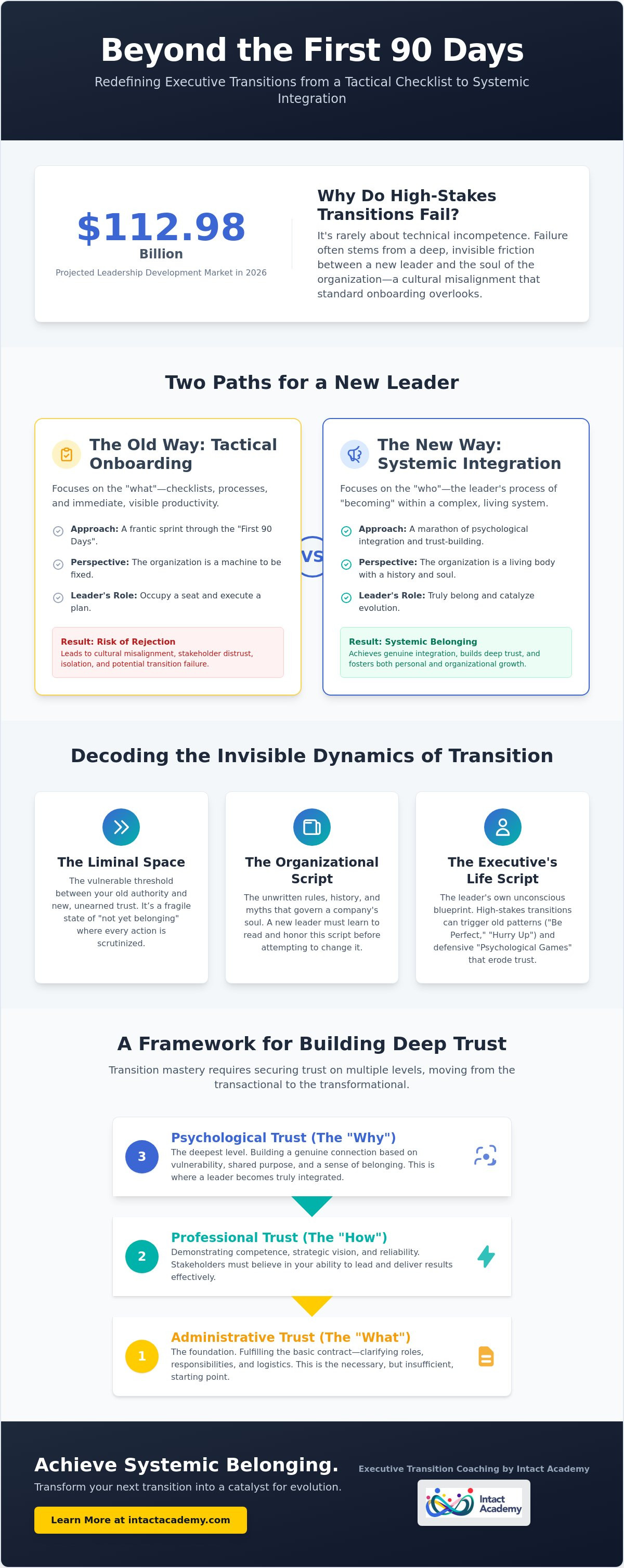
It's true that the stakes have never been higher, particularly as the leadership development market is projected to reach $112.98 billion in 2026. This article promises to show you how psychological depth and systemic frameworks transform high-pressure transitions into opportunities for genuine organizational evolution. We'll examine the methodology of aligning your personal life scripts with your new professional mandate, ensuring you don't just occupy a seat, but truly belong there. You'll discover how to build rapid stakeholder trust while remaining anchored in your own sense of wholeness.
Key Takeaways
- Shift your perspective from tactical onboarding to systemic integration to navigate the complex psychological thresholds of a new executive role.
- Discover how executive transition coaching utilizes Transactional Analysis to align your personal leadership script with the established culture and soul of the organization.
- Learn to interpret the "Organizational Script"—the hidden myths and history that dictate whether a system will embrace or reject a new leader.
- Apply a five-step framework centered on multi-level contracting to secure administrative, professional, and psychological trust with your stakeholders from the outset.
- Move beyond technical proficiency to achieve a state of systemic belonging, ensuring your transition becomes a catalyst for both personal and organizational evolution.
Beyond the First 90 Days: Redefining Executive Transition Coaching
Most leadership literature obsesses over the "First 90 Days," treating it as a frantic sprint toward visible productivity. However, executive transition coaching recognizes that a true shift in power is a marathon of psychological and systemic integration. It is the professional support for leaders navigating the threshold between identities. While business and executive coaching often focuses on immediate performance metrics, transition coaching focuses on the process of "becoming." Failed transitions rarely stem from a lack of technical skill. Instead, they're the result of cultural misalignment. When a system rejects a leader, it's often because that leader failed to read the invisible scripts governing the organization's soul.
This period of change exists in what we call the "liminal space." It's a state of being neither here nor there. You've left your previous authority behind, but you haven't yet earned the trust of the new system. It's a fragile, high-stakes gap where every action is scrutinized. Without a structured methodology, this space can feel like a vacuum of isolation. With the right guidance, it becomes a fertile ground for profound transformation.
The Threshold State in Executive Change
Entering the C-suite isn't just a promotion; it's a profound loss of the familiar. You leave behind a hard-won legacy and a network of certainties to face the vulnerability of being a newcomer. This shift carries a significant psychological weight that can trigger defensiveness or overcompensation. An expert coach provides a "stable container," a reflective space where you can process this vulnerability without the fear of appearing weak to your new board or team. It's about moving through the discomfort of not knowing, rather than rushing to provide answers that may not fit the new context.
Tactical Onboarding vs. Psychological Transition
Standard onboarding is tactical. It teaches you how to use the software, where the files are kept, and who reports to whom. It's necessary, but it's insufficient. A psychological transition involves learning the "unspoken rules" and the "unconscious contracts" that actually move the needle within a team. By understanding what is transactional analysis, leaders can map these unseen dynamics. Executive transition coaching ensures you don't just learn the business; you learn how to belong within it. You begin to see the organization not as a machine to be fixed, but as a living body with its own history, myths, and defense mechanisms that must be honored before they can be evolved.
The Psychological Script of Change: Why Technical Skill Isn’t Enough
Technical competence is the price of entry for the C-suite, yet it rarely determines the success of the tenure. A strategic checklist offers the illusion of control, but it cannot soothe the visceral friction of a leader’s internal world meeting a new organizational reality. Effective executive transition coaching moves beyond the visible surface of KPIs into the architecture of the human psyche. It addresses the "Life Script," a concept from Transactional Analysis that describes the unconscious blueprint we develop in early life to navigate the world. When you step into a high-stakes role, this script is often triggered by the sudden weight of new power dynamics, forcing old patterns to the surface.
Many leaders fall into "Psychological Games" during their first few months. The most common is the game of "Look How Hard I’m Working," where a leader attempts to prove their worth through sheer volume of activity rather than strategic presence. This isn't just a habit; it's a defense mechanism against the anxiety of the "newcomer" status. Without intervention, these games create a cycle of exhaustion and stakeholder distrust. The transformative power of executive transition coaching lies in identifying these patterns before they become ingrained in your new leadership identity.
Mapping the Executive Life Script
Past successes often mask underlying "drivers" like "Be Perfect" or "Hurry Up." In a previous role, these drivers might have fueled your rise, but in a new, complex system, they can lead to rapid burnout or alienation of your team. You may also carry "injunctions," such as "Don’t Belong" or "Don’t Be Close," which manifest as professional isolation just when you need connection most. A Life Script is the unconscious blueprint that dictates whether a leader views a crisis as an opportunity for growth or a threat to their survival. By mapping these scripts, you gain the agency to choose a new response that fits the current mandate.
Navigating Ego State Shifts in the C-Suite
When the spotlight intensifies, the Adult ego state often retreats, leaving the "Controlling Parent" to manage the anxiety. You might find yourself micromanaging or setting rigid expectations as a way to feel secure. This inevitably triggers a "Rebellious Child" response from your stakeholders, creating a culture of compliance rather than innovation. Maintaining an Adult-to-Adult contract requires a high degree of self-awareness and the courage to remain vulnerable. If you are interested in exploring these psychological foundations, you can learn to shift your ego states intentionally. For example, moving into a "Nurturing Parent" state can build rapid rapport with a board that feels unsettled by change, provided it's anchored in an Adult awareness of the organizational needs.
Systemic Belonging: Aligning the Leader with the Organizational Soul
Imagine an organization not as a machine with replaceable parts, but as a living body. When a new leader arrives, the system perceives them as a foreign graft. Without the right approach, the body’s immune response, its culture, its history, and its unspoken loyalties, may attempt to reject the newcomer. This is the core challenge addressed by executive transition coaching: ensuring that the leader doesn't just arrive, but actually belongs. True integration requires more than a tactical plan; it demands an alignment with the organizational soul.
Every system operates according to an "Organizational Script." These are the myths and narratives that define how things are done and what is valued. If a leader ignores these scripts, they risk creating systemic friction that no amount of technical brilliance can overcome. Success requires leading organizational change with a profound respect for what came before. It's not enough to have a better strategy; one must have a strategy that the system's soul can digest and support. Without this alignment, the leader remains an outsider, regardless of their title.
Honouring the Past to Build the Future
The systemic law of precedence dictates that those who came before must be acknowledged. If a new leader dismisses their predecessor’s work or legacy, they inadvertently alienate the people who were loyal to that era. Acknowledging "Organizational Ancestry" isn't about being stuck in the past. It's about giving the past a place so that the future has room to breathe. This creates a new, authentic contract between the leader and the system, built on respect rather than erasure.
Identifying Shadow Dynamics
Within any team, "Psychological Games" often run beneath the surface of professional interactions. A transition coach acts as a systemic observer, helping the leader see these shadow dynamics without becoming a player in them. To maintain this level of objectivity and depth, the coach often relies on systemic supervision. This ensures the coaching relationship remains a clean mirror, reflecting the system's truth rather than the coach's own biases. By spotting these dynamics early, you can navigate the transition with grace and maintain your professional integrity.
A Framework for Transition Mastery: From Onboarding to Integration
Transitioning into a senior role requires more than grit; it requires a structured methodology that honors the complexity of the human and the system. Effective executive transition coaching provides a roadmap through the liminal space, moving from initial entry to deep cultural integration. This five-step framework ensures that every layer of the transition is addressed, preventing the psychological friction that often leads to early burnout or systemic rejection.
- Multi-level Contracting: Establishing clear agreements at the administrative, professional, and psychological levels.
- Diagnostic of the Systemic Script: Identifying the hidden narratives and loyalties that govern the organization’s behavior.
- Identity Recalibration: Aligning your internal ego states with the external demands of the new role.
- Stakeholder Alchemy: Building authentic, Adult-to-Adult relationships through nuanced communication.
- Sustainable Integration: Shaping the culture while remaining anchored in your own sense of wholeness.
The Power of Multi-Level Contracting
Most failures begin with a lack of clarity in the contracting phase. While the administrative contract covers your salary and title, the psychological contract covers the unspoken expectations: what you'll give emotionally and what the system will provide in return. While an administrative contract defines the legal and logistical terms of employment, a psychological contract manages the implicit emotional and relational expectations between the leader and the organization. Setting these boundaries early protects your well-being. It prevents you from becoming a "savior" for problems you didn't create. If you're ready to master these dynamics, you can explore our Executive Coaching services to begin your own structured transition.
Stakeholder Alchemy: Moving Beyond Networking
Stakeholder management is often treated as a transactional networking exercise. In a systemic approach, we view it as alchemy. You must learn to map communication on two levels: the social level (what's being said) and the psychological level (what's actually happening). By understanding these layers, you can build "stroke economies" within your team. This means creating a culture of positive, authentic reinforcement that replaces the psychological games discussed earlier. Your presence shouldn't be a mask of authority. It should be a reflection of your genuine self, rooted in Adult awareness. This authenticity is what builds lasting trust with a board or a skeptical team, allowing you to lead with a quiet, stable power rather than a forced persona.
Deepening Impact: Executive Transition Coaching at Intact Academy
Intact Academy stands at the intersection of human behavior and organizational success. While many providers focus on surface-level skills, we invite you to go deeper. Mastering executive transition coaching requires a rare blend of psychological rigor and systemic insight. It's about more than managing a career move; it's about facilitating a profound human transformation. Under the guidance of Sari van Poelje, we've pioneered the application of Agile Transactional Analysis to complex organizational systems. This approach ensures that transitions aren't just about surviving the first 90 days, but about thriving within the organizational soul for years to come.
We understand that the transition process is often turbulent. Leaders frequently feel the weight of expectation and the isolation of a new role. Our methodology provides a stable container for this change, allowing you to return to a state of completeness and genuineness. By addressing the psychological scripts and systemic entanglements we've discussed, we help you lead with a quiet power that is both grounded and aspirational. It's a process of becoming who you need to be to meet the system's needs without losing your own center.
Training the Next Generation of Transition Masters
We believe that the quality of the transition depends entirely on the depth of the coach. Our TA EMCC Senior Practitioner academy is designed for those who wish to specialize in this high-value niche. By obtaining an executive coaching certification through our programs, you join a global community of practitioners committed to excellence. These programs blend international accreditation from the EMCC with the intellectual rigor of systemic TA. We don't offer quick-fix interventions. Instead, we focus on sustainable transformation that respects the complexity of the individual and the organization alike. It's a path for those who seek to move beyond transactional training and into the space of true mastery.
Bespoke Consultancy for the C-Suite
For leaders currently navigating a threshold, we offer direct Executive Coaching and Organizational Change services. These aren't standard consulting packages. They're bespoke journeys designed to help you recalibrate your identity and align with your new professional mandate. Whether you're a CEO entering a legacy firm or a founder scaling a global entity, our methodology ensures your transition remains grounded and authentic. We help you move beyond the ego and toward a state of systemic wholeness where your leadership becomes a catalyst for evolution. Join our Academy to Master Executive Transitions and discover the power of a truly systemic approach.
Mastering the Threshold of Leadership Evolution
Navigating a C-suite entry requires a profound shift from mere performance to systemic presence. We've explored how identifying unconscious life scripts and honoring organizational ancestry prevents the friction that leads to rejection. True belonging occurs when your Adult ego state leads the way, transforming a high-stakes transition into a catalyst for both personal and collective growth. This depth of insight is the hallmark of effective executive transition coaching.
If you're ready to move beyond transactional checklists and embrace a methodology rooted in psychological rigor, we invite you to partner with us. Led by international expert Sari van Poelje and serving professionals from 14+ countries, Intact Academy provides a stable container for your evolution. Our programs carry the prestige of being accredited by EMCC, ICF, and EATA, ensuring your development meets the highest global standards. Deepen your impact and master executive transitions with Intact Academy.
The threshold you stand upon isn't just a challenge to be survived; it's an invitation to return to your most genuine self. You have the courage to change. We have the framework to guide you.
Frequently Asked Questions
What is the difference between executive coaching and executive transition coaching?
Executive coaching focuses on ongoing performance and leadership development within a current role. In contrast, executive transition coaching is a specialized niche that supports leaders during the high-stakes threshold between roles. It specifically addresses the psychological friction and systemic alignment required when a leader’s identity and authority must recalibrate to fit a new organizational soul.
How long does a typical executive transition coaching engagement last?
Engagements typically span three to twelve months to ensure deep integration. While tactical onboarding might finish in weeks, the psychological re-scripting process requires more time. This duration allows the coach to provide a stable container as the leader moves through the liminal space of being neither "the old boss" nor yet fully integrated into the new system.
Why is Transactional Analysis (TA) effective for leaders in transition?
Transactional Analysis offers a precise framework for mapping the unconscious "Life Scripts" that are often triggered by new power dynamics. It allows leaders to identify their ego state shifts; moving from a reactive "Controlling Parent" to a grounded "Adult" state. This methodology makes invisible systemic pressures manageable, allowing for authentic relationship building with a new board or team.
Can transition coaching help with imposter syndrome in a new C-suite role?
Yes, it addresses the underlying drivers that cause a leader to feel like a fraud during significant change. By examining early "injunctions" such as "Don’t Belong," executive transition coaching helps leaders understand why their past successes feel distant. This process transforms the anxiety of the newcomer into a stable sense of systemic authority and wholeness.
What is systemic belonging in an organizational context?
Systemic belonging occurs when the organization’s culture and history no longer perceive the new leader as a foreign graft. It is a state of alignment where the leader honors the "Organizational Ancestry" while simultaneously evolving the system. When a leader achieves systemic belonging, they are no longer an outsider; they become a vital part of the organization’s living body.
How do I choose the right coach for an executive transition?
Prioritize coaches who possess deep psychological training and systemic expertise over those who only offer tactical business advice. Look for specialists with credentials from professional bodies like the EMCC or ICF. The right coach should act as a wise mentor, offering a reflective space that honors your maturity while challenging the unconscious scripts that might hinder your integration.
What are the risks of ignoring the "psychological contract" during onboarding?
Ignoring the psychological contract leads to cultural misalignment and eventual systemic rejection. While administrative contracts cover salary and logistics, the psychological contract manages the implicit emotional expectations of the team. If these unspoken agreements are left unaddressed, the leader often faces invisible resistance, stakeholder distrust, and a sense of isolation that technical skill cannot solve.
Is transition coaching only for external hires, or does it apply to internal promotions?
Internal promotions require transition coaching just as much as external hires do. Moving from peer to superior necessitates a profound identity recalibration and a re-contracting of all existing relationships. A systemic approach ensures that the "new" leader can navigate these shifting power dynamics without being pulled back into old, peer-level psychological games or scripts.


