

What if the "Agreement Trap", that polite, nodding consensus in your boardroom, is actually the greatest threat to your organization's 2026 strategy? You've likely experienced the exhaustion of a high-stakes meeting where every executive concurs, only to witness chronic silos and passive-aggressive resistance the moment the doors open. It's a common struggle where trust feels fragile and decisions stall despite a veneer of unity. When you invest in a leadership team alignment workshop, the goal isn't just to agree on a slide deck; it's to dismantle the systemic barriers that prevent your team from functioning as a single, cohesive organism.
We understand that true alignment is a psychological achievement as much as a strategic one. You'll discover how to move beyond superficial buy-in to a state of deep, systemic unity using Transactional Analysis and professional team coaching frameworks. This article previews a path toward sustained strategic clarity and measurable ROI, showing you how to navigate complex organizational conflict without breaking the human system. By looking inward at the psychological scripts running your boardroom, you can finally achieve the genuine intellectual and emotional commitment required for profound transformation.
Key Takeaways
- Distinguish between mere compliance and true systemic ownership to ensure your team moves beyond surface-level agreement into deep, shared accountability.
- Leverage Transactional Analysis to identify the unconscious "Ego States" that often stall high-stakes decision-making and create invisible barriers to progress.
- Discover why a leadership team alignment workshop must address psychological dynamics alongside strategic KPIs to create lasting, rather than temporary, unity.
- Implement a structured four-step process for facilitation that prioritizes psychological contracting and the establishment of safe boundaries for honest conflict.
- Evolve from periodic interventions to a state of coaching mastery, allowing your team to maintain systemic health through continuous, self-guided development.
Beyond Surface Consensus: What is a Leadership Team Alignment Workshop?
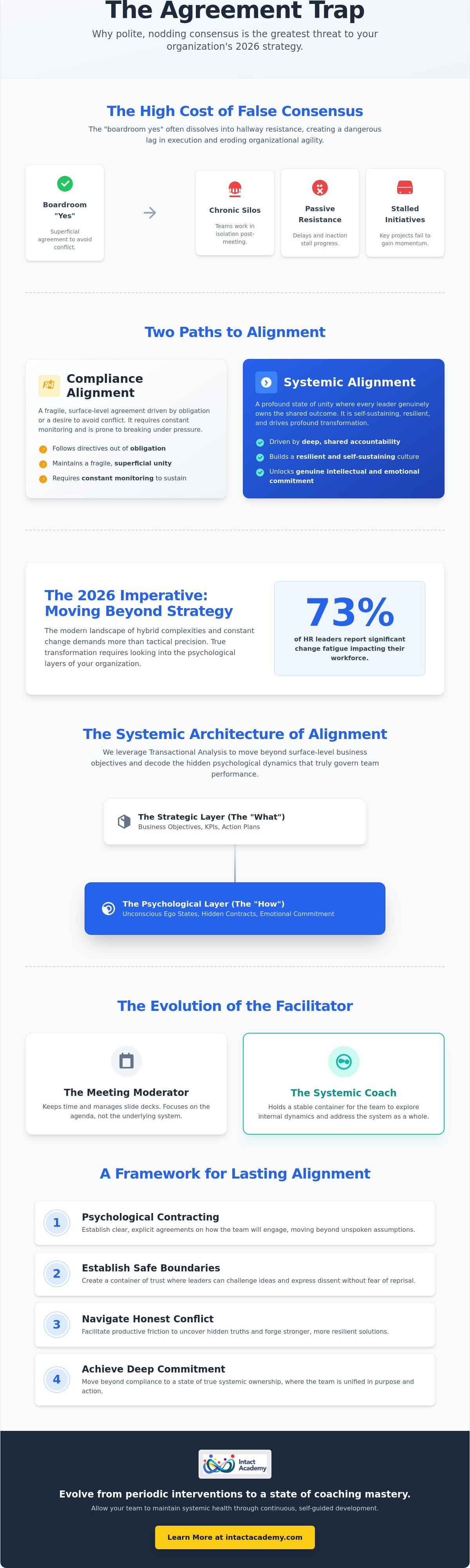
To lead effectively in 2026 is to recognize that a leadership team is not merely a collection of high-performing individuals, but a complex, living system. A leadership team alignment workshop serves as a profound systemic intervention designed to synchronize a team’s collective psychological state with its most ambitious strategic goals. In many executive suites, alignment is misunderstood as mere "Compliance Alignment," where members follow directives out of obligation or a desire to avoid conflict. We move beyond this surface-level agreement toward "Systemic Alignment," where every leader genuinely owns the shared outcome as their own. This distinction is critical; compliance is fragile and requires constant monitoring, while systemic alignment is self-sustaining and resilient.
The role of the facilitator in this environment has evolved significantly. We no longer need mere meeting moderators who keep time and manage slide decks. Instead, the modern workshop requires a systemic coach. This is a professional who understands the invisible threads connecting individual behavior to organizational performance. They don't just facilitate a conversation; they hold a stable container for the team to explore their internal dynamics. By addressing the system as a whole, the coach helps the team move toward a state of completeness and genuineness that traditional strategic planning often ignores.
The "Agreement Trap" in Senior Leadership
Consensus can be a mask. We often see the boardroom "yes" dissolve into a hallway "no" or a passive-aggressive delay the moment the meeting ends. This "Agreement Trap" creates a dangerous lag in execution and erodes organizational agility. Beneath the surface of formal agendas, "unspoken contracts" often dictate team behavior. These are the hidden psychological promises and fears that prevent real commitment. When a team avoids the friction of genuine debate to maintain a facade of unity, they trade short-term peace for long-term systemic failure. The cost of this false consensus is measurable in stalled initiatives and a lack of trust that trickles down through every department.
Why 2026 Requires Psychological Depth
The landscape of 2026 is defined by hybrid complexities and what research identifies as significant change fatigue, with 73% of HR leaders reporting its impact on their workforce. Surface-level strategic alignment is no longer enough to sustain an organization facing constant technological and regulatory evolution. While tactical precision is valuable, it's insufficient for true cultural transformation. Achieving deep unity requires looking into the psychological layers of the organization to understand how leaders truly relate to one another and their mission. This depth is essential for leading organizational change, ensuring that the system remains stable even as the world around it remains in flux.
The Systemic Architecture of Alignment: Leveraging Transactional Analysis
To understand why a leadership team alignment workshop succeeds where others fail, we must look beneath the surface of business objectives into the architecture of human interaction. We utilize Transactional Analysis (TA) as our foundational framework. This psychological model allows us to decode the complex dynamics that govern how executives relate, compete, and collaborate. Rather than viewing a team as a collection of separate personalities, we adopt a systemic lens. We treat the leadership group as a single living organism. When one part of the system is out of sync, the entire body suffers. Transactional Analysis provides a rigorous map for navigating the unconscious patterns and scripts that define a team's culture and dictate its performance.
In this systemic view, alignment is not a static agreement. It's a dynamic state of being. We observe that strategic failures are rarely the result of poor logic; they're almost always the result of psychological friction. An academic review on leadership alignment suggests that the integration of behavioral frameworks into strategic sessions significantly enhances the durability of the outcomes. By identifying the underlying transactions that occur during high-stakes debates, a team can move from reactive defensiveness to proactive co-creation. This shift is what transforms a group of talented individuals into a unified force capable of navigating the complexities of 2026.
Ego States in the Boardroom
At the heart of TA are Ego States: Parent, Adult, and Child. In the boardroom, alignment often breaks down when leaders slip into reactive states. A "Critical Parent" dynamic might manifest as a CEO who micromanages through blame, while an "Adapted Child" dynamic appears as executives who nod in agreement but harbor secret resentment. These transactions stall progress and kill innovation. True alignment requires "Adult-to-Adult" transactions, where leaders engage from a place of objective reality and mutual respect. This level of maturity requires deep self-awareness and the courage to step out of long-standing psychological scripts. If you're looking to deepen these interpersonal dynamics, our approach to Team Coaching offers a structured path toward this maturity.
Psychological Safety as a Systemic Requirement
We define psychological safety as the systemic capacity for productive conflict. It's not about being "nice"; it's about creating a container where the status quo can be challenged without fear of retribution. Using TA tools, we help teams build this container by establishing clear boundaries and shared language. When leaders understand what is transactional analysis, they gain the ability to spot "psychological games" before they derail a meeting. This clarity allows the team to focus their energy outward on market challenges rather than inward on internal politics. It's the difference between a system that consumes itself and one that evolves.
Strategic vs. Psychological Alignment: Mapping the Hidden Dynamics
A truly transformative leadership team alignment workshop recognizes that strategy is only as strong as the psychological soil it's planted in. We distinguish between "Hard Alignment," which focuses on strategy, KPIs, and roles, and "Soft Alignment," which addresses trust, intention, and culture. While most executive retreats obsess over the "Hard" elements, these achievements are often temporary. Without addressing the underlying psychological currents, the most brilliant strategic plan remains a fragile document. True unity occurs when the team’s collective unconscious is as committed to the goal as their conscious minds. This requires moving beyond the surface to identify "Invisible Silos." These aren't departmental boundaries; they're emotional barriers, such as old grudges or a fear of losing influence, that prevent genuine cross-functional collaboration.
Maintaining this level of depth requires more than a one-off session. It demands an ongoing commitment to the health of the system. This is where Systemic Supervision becomes vital. It acts as a reflective space for the team to examine their progress and identify where they might be slipping back into old, unhelpful patterns. By treating alignment as a continuous process of becoming rather than a static destination, leaders can ensure that their strategic goals remain supported by a robust psychological foundation. This systemic approach ensures that the energy of the team is directed toward growth rather than being consumed by internal friction.
The "What" vs. The "Who"
We often see teams struggle because they focus exclusively on task-based alignment (The "What") while ignoring relationship-based alignment (The "Who"). When you prioritize the "Who," resolving the "What" becomes significantly faster and more intuitive. A team that trusts its members can navigate complex strategic shifts with far less resistance. You might be experiencing psychological misalignment if you notice these indicators:
- Persistent gossip or "meetings after the meeting" to discuss boardroom decisions.
- Withholding critical data to protect departmental interests or personal status.
- Passive-aggressive agreement followed by a lack of execution.
- A visible lack of vulnerability when discussing failures or challenges.
Mapping the Team Script
In Transactional Analysis, we explore the concept of a "Team Script." This is a collective, unconscious life plan that a leadership group follows. Some teams are scripted for "Success," where they meet challenges with resilience and clarity. Others may be trapped in a "Failure" script, marked by constant crisis and blame. Most common is the "Near-Miss" script, where the team almost reaches its goals but sabotages itself at the last minute. Identifying your team's script is the first step toward re-scripting. During a leadership team alignment workshop, we help you recognize these patterns and consciously choose a new, high-impact narrative for your future. This re-scripting process transforms the team's identity, allowing them to step into a state of completeness and shared purpose.
Facilitating the Shift: A Framework for High-Stakes Alignment
A transformational leadership team alignment workshop is never a collection of generic icebreakers or surface-level goal-setting exercises. It's a deliberate, four-step systemic intervention designed to move a team from fragmented silos to a state of unified purpose. We begin with Contracting, where we establish the psychological boundaries necessary for radical honesty. This is followed by Diagnosis, where we use Transactional Analysis to uncover the hidden dynamics and "games" that typically stall progress. The third stage, Intervention, involves facilitating the difficult, Adult-to-Adult conversations that resolve long-standing friction. Finally, we reach Integration, where insights are distilled into a Systemic Action Plan with clear behavioral commitments.
This framework ensures that the workshop isn't a one-off event but a systemic shift. By following a structured methodology, the facilitator provides a stable container for the often-turbulent work of professional change. Each step builds upon the previous one, creating a narrative arc that moves the team from identifying a core human struggle to implementing a pragmatic solution. This process respects the intelligence of the leaders involved while challenging the unconscious patterns that hinder their collective success.
Contracting for Real Change
The contract is the cornerstone of any successful workshop. It represents a three-layered agreement that ensures everyone is working toward the same outcome. The Administrative contract handles the logistics of time and space. The Professional contract defines the strategic objectives. Most critically, the Psychological contract addresses the unspoken expectations and fears of the participants. Without this third layer, leaders won't feel safe enough to drop their masks. By setting clear boundaries for honesty and confidentiality, we create a space where the team can explore their deepest systemic issues without fear of retribution.
Identifying Psychological Games
In the high-pressure environment of the boardroom, leaders often fall into "Psychological Games." These are repetitive, unconscious patterns of behavior that result in negative outcomes for the system. You might recognize the "Yes, But" game, where a leader asks for advice only to reject every suggestion provided. Or perhaps "Look How Hard I’ve Tried," which is often used to justify a lack of results. A skilled facilitator identifies these games as they happen, calling them out gently to prevent the team from falling into the "Drama Triangle" of Victim, Rescuer, and Persecutor. Staying out of these roles allows the group to remain in their Adult ego states, focusing on reality rather than drama.
The Systemic Action Plan
Insights without action are merely intellectual exercises. To ensure the leadership team alignment workshop delivers a measurable ROI, we move from psychological breakthroughs to concrete commitments. What will change on Monday morning? We establish "Systemic KPIs" that measure the health of the team dynamic, such as the speed of decision-making or the reduction in siloed behavior. These steps are foundational for anyone looking to master the art of group dynamics, and they're core components of our team coaching course curriculum. For organizations ready to undergo this profound human transformation, our Team Coaching services provide the structure and support needed to sustain long-term change.
The Path to Mastery: Integrating Systemic Team Coaching into Your Leadership
A leadership team alignment workshop shouldn't be viewed as a final destination. It's a catalyst. It's the specific moment when the system begins to see itself clearly for the first time. For the transformation to take root, leaders must evolve beyond the session, moving toward a state of coaching mastery. This evolution allows the team to maintain its own alignment without the constant need for external intervention. At Intact Academy, our philosophy is rooted in the idea of professional mastery through wholeness. We believe that when a leader returns to a state of completeness and genuineness, they become a stabilizing force for the entire organization. When the leader is whole, the system follows.
This journey toward mastery is supported by rigorous standards. Facilitating these profound human shifts requires more than intuition; it requires a structured methodology backed by global accreditation. For those leading these transformations, EMCC-accredited training provides the intellectual and ethical framework necessary to hold complex systemic spaces. It ensures that the interventions you lead are grounded in proven psychological principles and professional integrity. In an era where 74% of leaders feel unequipped to lead change, according to Gartner research, this level of professional depth is no longer optional. It's a requirement for those who wish to lead with quiet power and global perspective.
From Manager to Systemic Leader
The transition from a traditional manager to a systemic leader is a shift from directing individuals to facilitating the system. You'll start to apply Transactional Analysis principles in every meeting and every interaction. Instead of merely managing tasks, you'll begin to manage the transactions between people. This shift requires a deep commitment to your own growth. We encourage you to view professional development for coaches as a core leadership strategy. By mastering the art of the Adult-to-Adult transaction, you create an environment where strategic clarity becomes the natural state rather than a forced outcome. You move from pushing for results to creating the conditions where results are inevitable.
Joining the TA EMCC Senior Team Coach Academy
For executive facilitators and senior leaders, the path to true impact often leads to formal accreditation. The TA EMCC Senior Team Coach Academy offers a space to deepen your understanding of systemic change. Here, you'll learn to master the interventions that turn a fragmented group into a high-performing system. This isn't just about learning new tools; it's about becoming a person who can hold the weight of organizational evolution with calm authority. We invite you to explore our Senior Team Coach Academy to master these interventions and lead your organization toward a future of genuine unity and sustained success. Step into your role as a wise mentor for your system.
Stepping into Systemic Unity
True transformation begins when a leadership team stops settling for the "Agreement Trap" and starts cultivating a state of genuine systemic ownership. We've explored how a leadership team alignment workshop serves as a vital container for this evolution. By utilizing Transactional Analysis to decode unconscious ego states and addressing the hidden psychological scripts within your boardroom, you can bridge the gap between strategic intent and sustainable execution. It's a journey from mere directing to profound facilitation of the human system.
If you're ready to lead your organization toward this state of completeness, we invite you to take the next step. You can master the art of systemic team alignment at the Intact Academy. Our EMCC and ICF accredited programs are led by global Transactional Analysis expert Sari van Poelje and have welcomed participants from over 14 countries. This is an invitation to join a global community of leaders committed to psychological depth and professional pragmatism. The path to a more aligned, resilient, and human organization is open to those with the courage to look inward. We look forward to supporting your evolution.
Frequently Asked Questions
What is a leadership team alignment workshop?
A leadership team alignment workshop is a systemic intervention that synchronizes a team's collective psychological state with its high-stakes strategic goals. It moves beyond simple task agreement to resolve the underlying interpersonal dynamics that often stall execution. By addressing the team as a single living organism, this workshop ensures that every member is intellectually and emotionally committed to a shared outcome.
How long does a typical team alignment workshop take?
A typical intensive workshop usually spans two full days, allowing enough time to move from initial contracting to deep psychological work. While the initial session is a powerful catalyst, true alignment is a process rather than an event. We recommend following the workshop with periodic systemic supervision to ensure that new behavioral commitments become permanent fixtures of the team’s culture.
How do you measure the success of an alignment workshop?
Success is measured through a combination of strategic lagging indicators and systemic leading indicators. You'll see a measurable increase in the speed of high-stakes decision-making and a significant reduction in passive-aggressive resistance or hallway dissent. Other indicators include improved cross-functional collaboration and a decrease in the "Agreement Trap" where consensus is merely a facade for compliance.
Can a team alignment workshop fix a toxic culture?
While a single workshop cannot instantly resolve years of dysfunction, it serves as a critical diagnostic and therapeutic intervention for the system. It creates a stable container where toxic patterns and unconscious "games" are brought to the surface and addressed through Adult-to-Adult transactions. Sustained healing requires a commitment to ongoing team coaching to replace old scripts with a culture of genuineness.
What is the difference between strategic alignment and team building?
Team building often prioritizes social bonding and interpersonal "niceness" through shared activities. In contrast, strategic alignment integrates the team’s psychological health directly with their business objectives and organizational purpose. It focuses on the "Who" to more effectively resolve the "What," ensuring that the team’s internal dynamics support, rather than hinder, their strategic clarity.
Who should facilitate a leadership alignment workshop?
These high-stakes sessions should be facilitated by a professional with deep expertise in both organizational systems and psychology. Ideally, look for a systemic coach with high-level accreditation who understands frameworks like Transactional Analysis. They must be able to remain objective and stay out of the team’s internal "drama triangle" while guiding them through difficult conversations.
How often should a leadership team run an alignment session?
We recommend a full-scale leadership team alignment workshop annually or whenever the organization faces a major strategic pivot. However, alignment is a fragile state that requires maintenance. Teams should integrate shorter systemic check-ins into their quarterly planning cycles to address emerging friction before it hardens into a chronic silo or a hidden conflict.
What are the most common "games" played in leadership teams?
Leadership teams frequently fall into repetitive patterns known as "psychological games" that deflect accountability. Common examples include "Yes, But," where advice is sought only to be rejected, and "Look How Hard I’ve Tried," which is used to justify a lack of results. Identifying these games allows the team to return to an Adult ego state and focus on objective reality rather than defensive posturing.


