
What if the true distance between your team members isn't measured in miles, but in the silent erosion of the psychological contract? While 53% of remote-capable workers now operate in hybrid models, those leading hybrid and remote teams often find that physical distance creates a subtle, persistent fragmentation of culture. You likely feel the weight of "invisible" dynamics, where proximity bias skews performance reviews and digital over-communication leads to a hollow sense of burnout. It's a common struggle to maintain a sense of collective energy when the systemic bonds of the office have been replaced by a flickering screen.
Mastering these challenges requires moving beyond surface-level management into the realm of human transformation. We'll provide you with a framework to understand the invisible dynamics of distributed leadership through the lens of Transactional Analysis and systemic coaching. This exploration covers how to rebuild psychological safety across time zones and manage the complex psychological contracts that define modern work. By looking inward at your own leadership presence, you can restore a sense of completeness and systemic impact to your entire organization.
Key Takeaways
- View your team as a single, interconnected organism to recognize how digital distance subtly reshapes the systemic field and influences inclusion.
- Identify the Parent, Adult, and Child Ego States in virtual interactions to move beyond repetitive psychological games and foster genuine connection.
- Shift your focus from monitoring task output to managing the psychological contract, a core competency for leading hybrid and remote teams with integrity.
- Establish check-in rituals and clear communication boundaries that honor the human element, ensuring psychological safety remains robust across time zones.
- Discover how advanced frameworks from the TA EMCC Senior Team Coach Academy can help you master the invisible dynamics of distributed leadership.
The Hybrid Paradox: Why Leading Hybrid and Remote Teams Requires a New Psychological Contract
Leading hybrid and remote teams is often mischaracterized as a logistical puzzle to be solved with better software or tighter schedules. In reality, it's a systemic challenge of maintaining human resonance without the physical containers of the past. When we lose the shared office, we lose the "holding environment" that naturally regulates team energy and social cohesion. This loss creates a paradox: the more we focus on digital proximity, the more emotional distance we often create.
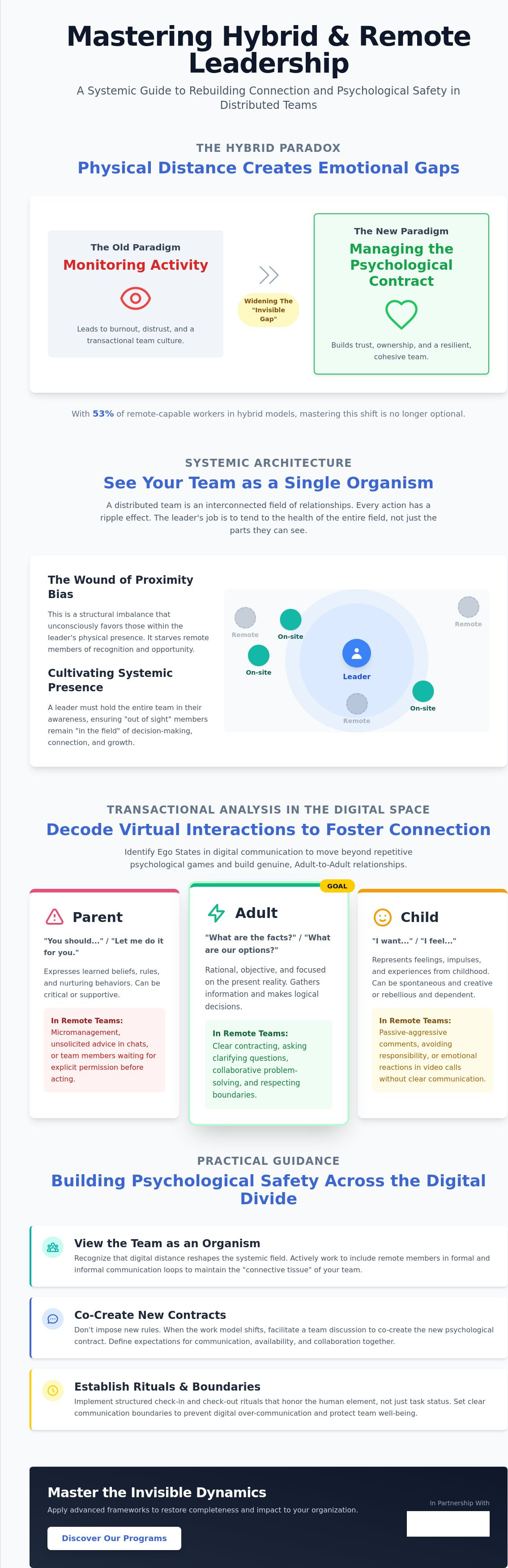
By 2026, the leadership paradigm has shifted fundamentally. The era of monitoring activity is over; it's been replaced by the necessity of managing the psychological contract. This shift acknowledges that high performance isn't a byproduct of surveillance, but of the unwritten agreements that bind an individual to a collective purpose. When leaders focus solely on task completion, they inadvertently widen the "Invisible Gap." This is the space where team culture withers, replaced by a purely transactional relationship that leaves employees feeling like cogs in a digital machine. Systemic health, the underlying vitality of the team as a single organism, must become your primary focus if you wish to sustain long term impact.
The Evolution of Leadership in a Distributed World
The role of the leader has evolved from being a central hub to becoming a systemic facilitator. You're no longer the sun around which the team rotates; you're the gardener tending to the environment where virtual team dynamics can flourish. This evolution requires "contracting for change" whenever the work model shifts. Traditional top-down initiatives fail in remote settings because they don't account for the subtle, private resistances that grow when people feel disconnected from the source of authority. You must co-create the new reality with your team rather than imposing it from above.
Identifying the Erosion of the Psychological Contract
Signs that your team's foundation is cracking are often quiet. You might notice a decline in spontaneous collaboration, or perhaps a rise in "Parent-Child" dynamics where team members wait for explicit permission before taking initiative. These are symptoms of a breaking contract. The psychological contract is the set of unwritten expectations between leader and employee. When these unstated needs for recognition and belonging aren't met, trust dissolves. Accountability shouldn't feel like a burden; it's a natural expression of a healthy, transparent digital culture where every member feels seen and valued for their whole self.
Systemic Architecture: Mapping the Hidden Dynamics of Remote Teams
To master the art of leading hybrid and remote teams, one must first recognize that a team is not merely a collection of individuals with separate tasks. It is a single, living organism. When team members are distributed, the "connective tissue" of the system becomes invisible, yet it remains the primary driver of performance. Systemic thinking allows us to see the team as a field of energy and relationships. In this field, every action or absence has a ripple effect. If you view your team through this lens, you begin to notice how the challenges of leading in a hybrid world are often rooted in the unconscious exclusion of those who aren't physically present.
Proximity bias is a systemic wound. It's not just a personal preference for the people we see in the hallway; it's a structural imbalance that favors those within the leader's immediate physical field. As Sari van Poelje highlights in her work on mastering systemic change, the leader’s vision must extend beyond the visible. You must cultivate a "Systemic Presence" that transcends the screen. This means holding the whole team in your awareness even when the cameras are off, ensuring that the "out of sight" members remain "in the field" of decision making and recognition.
The 5 Dysfunctions of a Remote Team: A Systemic View
Patrick Lencioni’s model takes on a different weight in a digital landscape. An absence of trust manifests differently in a Slack channel than it does in a meeting room. In virtual spaces, silence is often misinterpreted as agreement or, worse, as apathy. Trust in a distributed system requires intentional vulnerability. High stakes team facilitation now demands that you "hold the space" digitally, creating a container where conflict can be healthy and productive rather than passive aggressive. Those who wish to deepen these skills often find that our TA EMCC Senior Team Coach Academy provides the precise methodology needed to navigate these complex group energies.
Mapping the Unconscious Patterns in Digital Culture
Every team operates according to "scripts"—unconscious patterns of behavior that dictate how they respond to stress and change. In remote settings, "Parent-Child" dynamics frequently emerge. A manager might slip into a Controlling Parent ego state, micromanaging every digital timestamp, while the employee retreats into an Adapted Child state, doing only what is explicitly asked. These patterns hinder the autonomy required for remote success. Recognizing these scripts is a vital part of leading organizational change. By moving toward an "Adult-to-Adult" way of relating, you foster a culture of genuine accountability and mutual respect that survives any geographic distance.
Transactional Analysis in the Digital Space: Ego States and Social Strokes
Leading hybrid and remote teams requires an acute awareness of the silent language of "transactions" occurring through the screen. Every Slack message, every muted camera, and every delayed response carries psychological weight. In Transactional Analysis, we understand that people interact from three distinct ego states: Parent, Adult, and Child. In a digital environment, these states often become exaggerated. A leader might slip into a Controlling Parent state by demanding constant status updates, while an employee might retreat into an Adapted Child state, feeling helpless under the weight of "invisible" expectations. Recognizing these shifts is the first step toward restoring a healthy, functional system.
The digital space also gives rise to specific "Psychological Games" that can drain team energy. You might recognize the "Why Don’t You—Yes But" game playing out in your team chat. This occurs when a leader offers helpful suggestions to a struggling remote worker, only to have every solution shot down with a reason why it won't work. These games are often a subconscious cry for "strokes"—units of human recognition. Remote workers frequently feel starved for these strokes because the casual, spontaneous recognition of the office has vanished. Without intentional intervention, this "stroke hunger" leads to emotional withdrawal and decreased performance.
The Adult-to-Adult Connection: The Key to Remote Autonomy
Successful leadership in a distributed world relies on maintaining an Adult-to-Adult connection. This means interacting from a place of here-and-now reality, rather than from past patterns or future anxieties. When you operate from your Adult ego state, you foster a culture of "I’m OK—You’re OK," even across thousands of miles. This stance is essential for leading hybrid and remote teams with integrity. It allows you to move away from the "Controlling Parent" trap of micro-management and toward a model of systemic facilitation where employees feel empowered to own their outcomes. It’s about creating a space where autonomy is supported by clear, mutual contracting rather than surveillance.
Digital Stroking: Preventing Emotional Burnout
To prevent burnout, leaders must learn the art of digital stroking. A "like" on a project management board is a low-value, conditional stroke; it acknowledges the work, but not the person. A systemic stroke, however, recognizes the individual's unique contribution to the team's wholeness. You can use what is transactional analysis to re-energize a disconnected team by providing unconditional positive strokes—acknowledging a person's worth simply because they are part of the system. This practice builds a reservoir of psychological safety that sustains the team during high-pressure periods, ensuring that the human element remains at the heart of your digital culture.
Practical Guidance: Building Psychological Safety Across the Digital Divide
The first movement toward this safety is the implementation of "Check-in" rituals. These aren't mere icebreakers. They are systemic tools designed to honor the human being before the business task. By acknowledging the personal reality of each team member, you validate their presence in the field. This practice prevents the "stroke hunger" mentioned earlier and ensures that the emotional state of the team is visible to everyone. While data from 2026 shows that only 32% of companies invest in top-tier collaboration technology, the true differentiator for success isn't the software, but the quality of the psychological container you build.
Creating a "Safe Container" is essential for the high-stakes conversations that often get deferred in remote settings. Without a physical room to hold the tension, the leader must provide the psychological containment. This involves establishing clear "Rules of Engagement" that actively prevent digital exclusion, ensuring those off-camera aren't left out of the systemic field. To see where your own presence might be faltering, you may find that engaging in Systemic Supervision helps you identify the blind spots in your leadership style that digital distance tends to amplify.
The Anatomy of a High-Safety Virtual Meeting
Reading the room virtually requires a heightened sensitivity to micro-expressions and the weight of silence. You aren't just looking for visual cues; you're listening for the systemic resonance. As a systemic anchor, your role is to ensure that quiet voices aren't lost in the digital landscape. You must intentionally invite the "Child" ego state's creativity and the "Adult" ego state's logic into the space, especially when uncertainty is high. This prevents the Parent-Child dynamics that can stifle innovation in remote environments.
Contracting for Professional Mastery
Shifting from managing to coaching is the hallmark of a mature leader. In 2026, contracting stands as the most critical competency for hybrid leaders because it transforms vague expectations into solid psychological ground. This mastery allows you to navigate the complexities of leading hybrid and remote teams without slipping into micro-management. To deepen these skills, many professionals seek professional development for coaches. This journey moves you beyond tactical directives and into the realm of systemic facilitation, where you can lead with both authority and profound empathy.
Mastering Remote Leadership with Intact Academy
The transition from managing tasks to facilitating systemic health requires more than a change in policy; it demands a transformation of the leader’s own internal architecture. Leading hybrid and remote teams effectively is a journey toward profound human transformation. It’s about moving beyond surface-level coaching into a space where complex systemic issues become manageable through insight and structured methodology. Our TA EMCC Senior Team Coach Academy is designed for those who recognize that the future of leadership lies at the intersection of psychology and organizational systems. By integrating Transactional Analysis with the visceral realities of modern business, we provide the tools to master the invisible dynamics of distributed teams.
In an increasingly fragmented global market, the weight of international accreditation from bodies like EMCC and ICF serves as a marker of integrity and depth. These credentials signify that you possess the intellectual rigor and empathetic presence required to guide teams through the process of becoming whole. For the leader seeking to facilitate sustainable transformation, the next step is to deepen your systemic impact. This path doesn't just improve your team's output; it restores a sense of genuineness to your entire leadership practice, ensuring you remain a stable anchor in a world of digital flux.
From Practitioner to Master: The Intact Journey
The path to excellence begins with choosing the right team coaching course that aligns with your aspiration for systemic mastery. Our academy offers a stable container for deep learning, where you can move from a practitioner to a master of organizational change. Systemic supervision acts as a vital mirror in this process, allowing you to refine your remote leadership presence and identify the unconscious scripts that may hinder your team’s evolution. By joining our global community, you connect with practitioners who value wholeness and impact as much as profit, creating a network of support that spans the globe.
The ROI of Systemic Leadership Training
Investing in psychological depth yields measurable business outcomes that go far beyond traditional metrics. Data from April 2026 shows that hybrid work arrangements can reduce employee quit rates by approximately 33% compared to fully on-site roles. This retention is a direct result of the psychological safety and flexibility that a systemic leader provides. When you manage the psychological contract with integrity, you create a culture where innovation flourishes and burnout is minimized. To begin your own transformation, Join our next Masterclass on Systemic Team Coaching and discover how to lead with quiet power and a global perspective.
Embracing the Future of Systemic Leadership
The distance between us is never just geographical; it's a space that requires intentional psychological presence to bridge. By mastering the nuances of ego states and the systemic architecture of your organization, you transform the challenge of leading hybrid and remote teams into an opportunity for profound human connection. You've seen how re-contracting expectations and honoring social strokes can heal the fragmentation of digital culture. Now, the invitation is to move from insight into mastery.
If you're ready to deepen your impact and join a global movement of conscious leaders, we invite you to Explore our TA EMCC Senior Team Coach Academy. Our programs are EMCC and ICF accredited, led by international expert Sari van Poelje, and bring together participants from over 14 countries. This is your path to returning to a state of completeness and genuineness within your leadership. You have the courage to change; we provide the stable container for that evolution. Step forward into your next level of professional flourishing.
Frequently Asked Questions
What is the biggest challenge when leading hybrid and remote teams?
The primary obstacle is the loss of the "holding environment" that naturally regulates team energy and social cohesion. When leading hybrid and remote teams, you must replace physical proximity with a robust psychological contract. This shift requires moving from monitoring tasks to facilitating systemic health. It's about ensuring every member feels "in the field" of awareness, regardless of their geographic location or digital presence.
How does Transactional Analysis help in managing remote employees?
Transactional Analysis offers a precise map of human interaction through ego states and social strokes. By identifying whether a conversation is happening from an Adult, Parent, or Child state, you can steer interactions toward constructive, Adult-to-Adult autonomy. It also helps you recognize "Psychological Games" that often drain energy in digital chats. This awareness allows you to intervene with integrity and restore the team's collective focus.
How can I build trust in a team that never meets in person?
Building trust without physical presence requires deliberate vulnerability and rigorous "contracting for change." You must replace spontaneous office interactions with structured check-in rituals that honor the person before the professional task. Trust grows when team members feel seen and recognized through meaningful social strokes. This practice creates a reservoir of psychological safety that survives the lack of face-to-face contact.
What is proximity bias and how can systemic leadership prevent it?
Proximity bias is the unconscious tendency to favor team members who are physically closer to the leader. Systemic leadership prevents this by treating the team as a single organism and consciously including those who are out of sight. You must cultivate a "Systemic Presence" that holds the entire team in your awareness. This ensures that decision making and recognition are distributed equitably across the whole system.
Is a camera-on policy necessary for psychological safety in remote meetings?
A rigid camera-on policy is often counterproductive to psychological safety and can lead to digital exhaustion. Safety is built through mutual agreement and the quality of the "holding environment" rather than surveillance. It's more effective to contract with the team about when visual presence is essential for connection. This allows for better individual regulation of energy and respects the boundaries of the home environment.
How can I tell if my remote team is suffering from emotional burnout?
Burnout in remote settings often manifests as "stroke hunger" or a move toward passive-aggressive psychological games. You might notice team members retreating into an Adapted Child ego state, where they wait for explicit instructions and lose their creative spark. A decline in spontaneous collaboration and a shift toward purely transactional communication are also strong indicators that the team's systemic health is at risk.
What role does systemic supervision play for leaders of distributed teams?
Systemic supervision provides a vital reflective space for leaders to examine their own impact on the team's field. It helps you identify blind spots, such as proximity bias or a slip into a Controlling Parent management style. For those leading hybrid and remote teams, supervision acts as a regulatory mechanism. It ensures your leadership presence remains stable, empathetic, and grounded in the reality of the team's needs.
How do I choose the right team coaching certification for remote leadership?
Select a program that integrates psychological depth with professional pragmatism, such as the TA EMCC Senior Team Coach Academy. You should prioritize certifications that are EMCC or ICF accredited to ensure global recognition and high standards of practice. The right course will focus on systemic facilitation and Transactional Analysis. This moves you beyond surface-level management into the realm of profound organizational transformation.


